Shattered Politics #12: The Boss (dir by Byron Haskin)


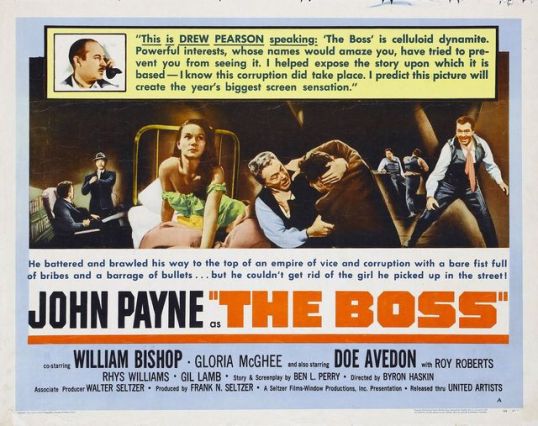
The Boss

After you’ve watched The Phenix City Story, why not go over to Netflix and watch another obscure but hard-hitting B-movie, The Boss?

First released in 1956, The Boss came out a year after The Phenix City Story but they both serve as good companion pieces to each other.  Whereas The Phenix City Story shows what it’s like to live in a city dominated by corruption and crime, The Boss shows how a city could get that way in the first place.

The Boss opens in 1919, in an unanmed midwestern city.  (A title card informs us that the city is a “middle class city.”)  World War I has ended and the returning soldiers are marching in a parade throughout the city.  Leading the march is Capt. Matt Brady (John Payne), a humorless war hero.  Marching behind him are a group of soldiers who all seem to hate his guts, even after Bob Herrick (William Bishop) attempts to defend him.  It appears that Matt was a strict officer during the war and Bob was the only one of his men who didn’t hate him.  Of course, a lot of that is because Bob was a childhood friend of Matt’s.  They both grew up in the city together.  To be exact, their home was in the third ward.  As Bob explains, the Brady family rules the third ward.

Matt’s older brother, Tim (Roy Roberts), is the 3rd ward’s alderman.  After the parade ends, Tim explains that he expects Matt to follow in the family business.  However, Matt doesn’t want anything to do with politics.  Instead, he just wants to marry Elsie (Doe Avedon) and live a normal life.  In fact, Matt says, he’s got a date with Elsie that night.

However, before Matt can go on that date, he ends up getting attacked and beaten up by some of the soldiers from the parade.  He’s late for his date and when Elsie refuses to forgive him, Matt ends up going out and getting drunk.  After getting into a few more fights, he meets an insecure woman named Lorry (Gloria McGhee) and announces that they’re getting married whether she wants to or not.

The next morning, Matt wakes up to discover that he now has a wife, Elsie never wants to see him again, and that Tim has dropped dead of a heart attack.  Bruised and hungover, Matt suddenly finds himself forced to take over the family business.

The film jumps forward a few years.  Matt is now the most powerful man in the city.  He decides who get elected to which office and, with the help of the Mafia, he’s made a lot of money for himself.  Bob, meanwhile, has married Elsie and is now Matt’s attorney and unofficial second-in-command.  Meanwhile, Lorry lives in a huge mansion that she never leaves.

It took me a while to get into The Boss.  In fact, I nearly stopped watching after the first twenty minutes because it didn’t ever seem like there would be a moment when Matt would be anything other than surly, drunk, and bruised.  But then, once Tim drops dead, the movie becomes a bit more interesting.  If you remember John Payne for anything, it’s probably for being the nice but kind of boring lawyer from the original Miracle on 34th Street.  So, it’s interesting to see him here, playing a crude and perpetually angry man who always seems to be on the verge of punching someone out.  He gives a good performance and occasionally you even feel a little sorry for Matt.  For everything he does wrong, he’s still essentially the same guy who wanted to marry a school teacher and live out in the suburbs.

Of course, I’m a history nerd so my favorite scenes in The Boss were the ones that dealt with real moments from history, like the scene where Matt panics when he hears about the 1929 Stock Market crash.  Even better, though, is a brief sequence that takes place at a political convention.  Though no names are uttered and the party is never specifically identified, it’s obvious that Matt is meant to be at the 1932 Democratic Convention and the candidate that is asking for Matt’s support is obviously meant to Franklin Roosevelt.  When Roosevelt is nominated without Matt’s support, Matt can only bitterly observe that he wishes he was from Chicago because then he could own a President.

Would a movie made today have the guts to say such a thing about FDR?  I doubt it.

The Boss is currently available on Netflix.  If you’re into politics and history (and maybe even political history), be sure to watch it before it goes away.

Shattered Politics #11: The Phenix City Story (dir by Phil Karlson)


PhenixCityPoster

If A Man Called Peter was the epitome of a stereotypical 1950s film, The Phenix City Story is the exact opposite.  Like A Man Called Peter, The Phenix City Story was released in 1955.  And like A Man Called Peter, The Phenix City Story is based on a true story.  However, beyond that, A Man Called Peter and The Phenix City Story might as well have been taking place on different planets.

And, in many ways, they were.  The Phenix City Story not only takes place in Phenix City, Alabama but it was filmed there as well and featured a few actual citizens in the cast.  Not only was The Phenix City Story telling a true story but the story was being told by some of the same people who actually lived through it.  That makes The Phenix City Story brutally realistic, with brutal being the key word.

And, just in case we have any doubt about the film’s authenticity, it actually opens with a 15 minute documentary in which Clete Roberts (who was an actual news reporter) interviews several citizens of the town.  All of them, speaking in thick Alabama accents and nervously eyeing the camera, assure us that what we are about to see is true.  Quite a few of them also tells us that they still live in fear of losing their lives as a result of everything that happened.

What’s amazing is that, once the actual film does get started, it manages to live up to all of that build up.  The Phenix City Story is a shocking film that remains powerful even 60 years after it was initially released.

As the film opens, we’re informed that Phenix City, Alabama is home to some of the most dangerous and violent criminals in the state.  From his club, crime boss Rhett Tanner (Edward Andrews) runs a shadowy organization that not only controls Phenix City but the entire state of Alabama as well.  The police ignore his crimes.  The majority of the town’s citizens are too scared to stand up to him.  When a returning veteran of the Korean War, John Patterson (Richard Kiley), tries to stand up to Tanner, the result is even more violence.  A young black girl is kidnapped and murdered, her body tossed on John’s front lawn as a warning.  John’s best friend is killed but Tanner uses his influence to have the death ruled accidental.

Finally, John and a group of other reformers convince John’s father — Albert Patterson (John McIntire) — to run for Attorney General.  Albert runs on a reform platform and exposes both the corruption of Phenix City and how Tanner’s power extends through the rest of the state as well.  When Albert wins the Democratic primary, he’s gunned down in the street and it’s up to John to avenge his death…

To say that The Phenix City Story is intense would be an understatement.  As directed by Phil Karlson, there’s not a single frame of The Phenix City Story that’s not full of menace and danger.  The stark black-and-white cinematography is full of shadows and the camera moves almost frantically from scene to scene, occasionally catching glimpses of dark figures committing acts of violence and cars speeding away from who knows what outage.  It’s a dark film but, ultimately, it’s also a hopeful one.  It suggests that evil will triumph when good men do nothing but that sometimes you can depend on good men — like Albert and John Patterson — to actually step up.

The Phenix City Story shows up on TCM occasionally and you should keep an eye out for it.  It’s one of the best B-movies ever made.

Shattered Politics #10: A Man Called Peter (dir by Henry Koster)


A_Man_Called_Peter

Occasionally, I’ll see a film like Crime of Passion or Bigger Than Life and I’ll say, “Wow, that’s really subversive for a movie that came out in the 1950s!”

And it’s true.  We tend to think of the 1950s as being a time when conformity ruled all.  It was a time of innocence and chastity, when cinema heroes all wanted to have a house in the suburbs and loving couples slept in separate beds and nobody ever questioned anything.  Of course, the truth of the matter is that there were a lot of films released in the 50s that challenge that perception.

And then again, there were also films like 1955’s A Man Called Peter.

A Man Called Peter is a biopic about Peter Marshall (played by Richard Todd), a Scottish immigrant who came to the United States, became a Presbyterian minister, and then eventually became the Chaplain of the United States Senate.  (That means that he would open each session of the Senate with a prayer and occasionally provide spiritual counsel to the senators.)  I recently watched it on Netflix, specifically because I thought it might be appropriate for this series of political reviews.

And it is, but just barely.

It actually takes the film a while to get to the part where Peter Marshall becomes the Senate Chaplain.  First, we watch him as a boy in Scotland, trying to stow away on a boat heading for America.  Then, several years later, he’s out walking on a foggy night.  He trips over a tree root and, as he lies on the ground, he announces that God has told him to 1) pursue a career as a minister and 2) to do so in America.  (I have to admit that I was raised Catholic so I have no idea whether he was having a typical Presbyterian spiritual experience or not.  But the film certainly takes it seriously.)

Peter ends up in America where he ministers to a church in Atlanta, marries Catherine (Jean Peters), and then eventually ends up at a church in Washington, D.C.  When he eventually is asked to serve as Chaplain of the Senate, both he and the film go out of their way to avoid taking any definite position on any issue.  Instead, Peter gives prayers that encourage the senators to put partisan bickering aside and work together to make the United States the best country in the world.

Having now watched all 120 minutes of A Man Called Peter, I can safely that this is a film that epitomizes everything that we always assume to be true about the 1950s.  From the film’s view of marriage to religion to politics, A Man Called Peter is perhaps one of the most stereotypically 1950s  movies ever made.  This is such a 1950s movie that it’s even filmed in CinemaScope!

(And speaking of CinemaScope, A Man Called Peter looks great but it’s perhaps one of the least intimate biopics that I’ve ever seen.  You can see every inch of the surrounding landscape but the human beings get lost.)

For me, the film’s most 1955 moment comes when Catherine first discovers that her husband has been reassigned to Washington, D.C.  She and Peter are on their honeymoon when they get a telegram telling them that their new home in Washington is ready.  Catherine is shocked.  Peter says that he didn’t want to interrupt their honeymoon by telling her that they’re not going home to Atlanta.  Instead, they’re going to an entirely new city and an entirely new life.  (In other words, Peter has decided to say goodbye to Catherine’s family and friends.)

“Aren’t you pleased?” Peter asks her.

Cheerfully, Catherine replies, “Well, who wouldn’t be?”

Ah, the 50s.

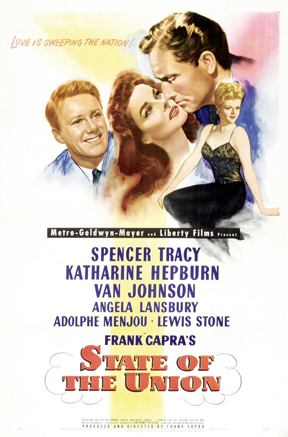
Shattered Politics #9: State of the Union (dir by Frank Capra)


Sotu1948

“Politicians have remained professionals only because the voters have remained amateurs!” — State of the Union (1948)

Does anyone remember the Americans Elect fiasco of 2012?

Americans Elect was an organization set up by a bunch of businesspeople, attorneys, and out-of-office politicians.  Their stated goal was to challenge the political establishment, shake up the two-party system, and elect a president.  The idea was that the party would hold a nationwide primary.  Any registered U.S. voter could go online and cast their vote on what they thought should be in the party’s platform and who they thought should be the Americans Elect presidential candidate.  Whoever won this nationwide primary would be required to 1) run on the platform and 2) pick a vice presidential candidate from the opposite party.

And all would be right with the world, right?

Right.

Anyway, I did register as an American Elect delegate, just because I was curious to see who was getting votes in the nationwide primary and who wasn’t.  (And yes, I did cast a vote.  I voted for Dallas County Commissioner Elba Garcia.)  Looking over the site, I saw that all of the usual suspects were getting votes — Ron Paul, Hillary Clinton, Michael Bloomberg, Donald Trump, and even Barack Obama.  None of the big vote getters were exactly nonpartisan or independent figures.  With the possible exception of Ron Paul, all of them were members of the very establishment that Americans Elect was claiming to challenge.

Anyway, Americans Elect ended up nominating no one for President and, as we all know, the 2012 election came down to choosing between two candidates who both received money from the same millionaires and, in the end, the status quo was upheld.

To be honest, everyone should have realized that Americans Elect was a sham as soon as the New York Times printed a column praising the effort.  Any truly independent political organization would never be praised by the New York Times.  Instead, like most so-called independent political organizations, Americans Elect was just a case of certain members of the establishment slumming.

So, the lesson of American Elect would seem to be that any attempt to run outside of the mainstream will, in the end, simply lead you back to the mainstream.  That was an expensive lesson for all of the volunteers who devoted their time to getting Americans Elect on the ballot in 28 states.  It was a lesson that they could have learned much more easily by watching the 1948 film, State of the Union.

In State of the Union, newspaper publisher Kay Thorndyke (Angela Lansbury) wants to make her lover, Grant Matthews (Spencer Tracy), President of the United States.  Grant is a no-nonsense, plain-spoken businessman who is quick to explain that he loves and cares about his country but that he hates partisan politics.  (In many ways, it’s impossible not to compare Grant to … well, to just about every single wealthy businessman who has ever run for public office while claiming to essentially be nonpolitical.  The big difference is that Grant actually means it.)  However, by subtly appealing to both his ego and his patriotism, Kay convinces Grant to run.  With the help of sleazy Jim Conover (Adolphe Menjou) and the sardonic Spike McManus (Van Johnson), Kay uses her money and her newspapers to turn Grant into a viable candidate.

The only problem is that Grant is separated from his wife Mary (Katharine Hepburn) and, since this movie was made in the 1940s, everyone knows that Grant has to be seen as being a family man if he’s going to be elected.  For the election, Mary and Grant pretend to be happily married.

As the primary season continues, Grant finds himself being more and more manipulated by Kay and Jim.  Eventually, Grant is forced to make a decision between his campaign and his integrity…

Following Mr. Smith Goes To Washington and Meet John Doe, State of the Union was the third part of director Frank Capra’s political trilogy.  Based on a play (which, itself, was supposedly inspired by the 1940 Republican presidential candidate, Wendell Willkie), State of the Union never quite escapes its stage-bound origins.  Add to that, the film was probably a bit more shocking when it was first released in 1948.  In 2015, we’re used to idea of politicians being controlled by money.  But, in 1948, audiences were perhaps a little bit more innocent.

But, that said, State of the Union is still an entertaining film.  Needless to say, Spencer Tracy and Katharine Hepburn have a wonderful chemistry together and Hepburn gets a great drunk scene.  (Hepburn had such an aristocratic presence that it’s always fun to watch her do comedy.)  Angela Lansbury also does well, playing a character who could very well grow up to be the role she played in The Manchurian Candidate.

67 years after it was first released, State of the Union remains an entertaining film that makes some good and still relevant points.  In 2016, when you’re tempted to get involved with the latest version of Americans Elect, watch State of the Union instead.

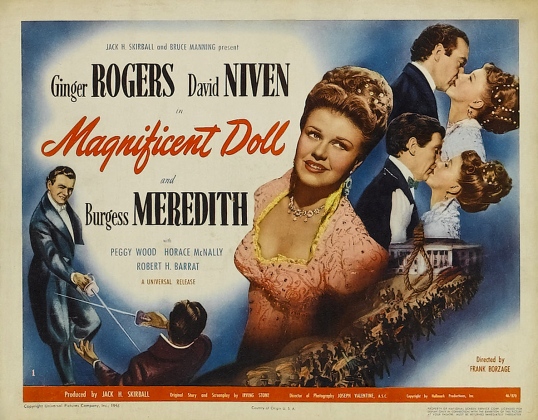
Shattered Politics #8: Magnificent Doll (dir by Frank Borzage)


Poster - Magnificent Doll_02

I’ve always been tempted to write one of those quizzes that you always see on Facebook, “Which American first lady should you be?”  That’s a question that I’ve often asked myself.  I know that I would not want to be any of our most recent first ladies.  (Sorry, Michelle.  Sorry, Laura.  Sorry, Hillary.)  Occasionally, I think that I would have liked to have been Jacqueline Kennedy, if not for what happened in Dallas.  Teddy Roosevelt’s daughter, Alice, is definitely a historical role model for me but it’s debatable whether she could truly be considered a first lady.  And, of course, there’s always Grover Cleveland’s wife Julia but ultimately, for me, there’s really only one choice.

If I could be any American first lady, I would be Dolley Madison.

Dolley, of course, was the wife of James Madison, who was not only our fourth President but also one of the smartest.  Madison was a skilled writer and scholar but he had absolutely no social skills.  Dolley, on the other hand, was vivacious and was, by the standards of the dentistry-free days of the 19th Century, one of the most beautiful women in America. Whereas James was uncomfortable meeting with people and struggled to express himself, Dolley was the world’s greatest hostess, bringing opposing forces together through the sheer force of her own charm and ability to throw a great party.  When the British invaded Washington D.C. during the War of 1812, Dolley was the one who saved the famous portrait of George Washington from being burned with the rest of the White House.

So, yes, I would definitely be Dolley Madison.

(Yes, I know that there’s some debate over whether her name should be spelled Dolly, Dolley, or Dollie.  I spell it Dolley and since I would have been her, I think my opinion counts for something.)

It’s a shame that there haven’t been many movies made about Dolley Madison.  Perhaps the best known is 1946’s Magnificent Doll, which is not a very good movie but which is amusing if you know something about history.

Magnificent Doll opens with young Dolley Payne (Ginger Rogers) being forced to marry John Todd (Horace McNally), a much older lawyer.  (John saved the life of Dolley’s father and, in gratitude, Dolley’s father gave him his daughter.)  Though John falls in love with her, Dolley refuses to show him any sign of affection and good for her!  (Seriously, arranged marriages suck.)  But then John dies of yellow fever and Dolley declares that she did love him all along.

But life goes on!

Soon, Dolley and her mother are running a boarding house in Philadelphia.  Fortunately, they happen to be running it at the same time that the Continental Congress is attempting to write the Constitution.  Several of the delegates are staying at the boarding house and two of them take a romantic interest in Dolley.

First there’s Aaron Burr (David Niven), a charming scoundrel who appeals to Dolley’s wild side.  Aaron does things like take her to a bar and kiss her underneath a staircase.  Aaron is vain.  Aaron is self-absorbed.  Aaron is an ambitious and charismatic brooder whose moods can be unpredictable.  Aaron is exiting!  Aaron is dangerous!  Aaron is a rebel!

And then you’ve got Aaron’s friend, James Madison (Burgess Meredith).  James is shy and gentle.  He’d rather read a book than go out.  He’s the type of smart kid who all the other kids make fun of but he’s also a good, decent man who has a great future ahead of him.  He just needs someone to bring him out of his shell.

In short, Aaron is the type of boy that you hope invites you to prom.  James is the type of boy that you marry.

And, when Dolley does marry James, it sends Aaron Burr into such a tail spin that he nearly prevents Thomas Jefferson from becoming President in 1800…

And, needless to say, this film is in no way historically accurate.  It is true that Aaron Burr was nearly elected President in 1800 and, had he been, Thomas Jefferson would never have been President.  However, most historians seem to agree that has more to do with Aaron Burr being ambitious and nothing to do with Dolley Madison.  In the end, Magnificent Doll may be amusing in its inaccuracies but bad history is still bad history.

That said, there’s still a part of me that enjoyed Magnificent Doll, despite the fact that it moves way too slowly and none of the actors (with the exception of David Niven) appear to be all that invested in their roles.  I think, ultimately, the reason I enjoyed Magnificent Doll was because it really is basically just a YA version of American history and, as a result, it does have some curiosity value.  One gets the feeling that if Magnificent Doll were released today, it would be split into two different films and that it would be promoted on social media with hashtags reading #TeamAaron and #TeamJames.

That said, if there’s any first lady who deserves a biopic (one that’s good as opposed to so-bad-its-interesting) it’s Dolley Madison.  (Personally, I would cast Amy Adams in the role.)  #TeamDolley all the way!

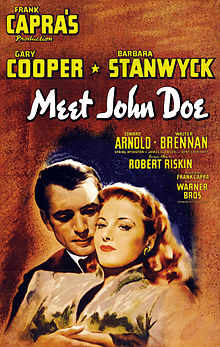
Shattered Politics #7: Meet John Doe (dir by Frank Capra)


Meet John Doe

I cannot stand the phrase “pay it forward.”

The idea is that somebody does something nice for you and then they say, “Pay it forward” and suddenly, you are magically required to go out and do something nice for someone else.  For one thing, I hate the obligation of it all.  I have this fear that as soon as I finally get finished paying it forward, some stranger is going to hand me a Coke and say, “Pay it forward,” and suddenly I’ll have to do it all over again!  And really, honestly, I shouldn’t have to pay it forward just because someone  gives me a Coke.  If you’re going to tell me to pay it forward, at least give me a car or a Victoria’s Secret gift card or something.

Ultimately, “pay it forward” is something that people say to make themselves feel good but it’s actually a pretty shallow concept.

The same thing can be said about John Doeism, the philosophy that rests at the center of the 1941 film Meet John Doe, our latest entry in Shattered Politics.  John Doeism is a grassroots political movement that is based around the slogan, “Be a Better Neighbor.”  Much like “Pay it forward,” “Be a better neighbor” sounds good and it’s easy to say but its main appeal is that it doesn’t require that much thought.  If anything, it sounds like the first step on the road to serfdom…

That said, I still like the film.

Meet John Doe opens with lay-offs at a major metropolitan newspaper.  (These lay-offs are signified by a handsome young man who points at people and then runs his finger across his throat.)  Among those laid off is columnist Ann Mitchell (Barbara Stanwyck).  However, before Ann is officially let go, she is told to write one final column.  Understandably angry over her treatment, Ann responds by making something up.  She writes and prints a fake letter from a man calling himself “John Doe.”  John Doe explains that he’s unemployed and that he will be committing suicide on Christmas Eve.

Well, quicker than you can say twitter death hoax, everyone in the entire country reads John Doe’s letter and demands to know who he is.  The newspaper’s editor, Henry Connell (James Gleason), rehires Ann and puts her in charge of finding the real John Doe.

When numerous unemployed and homeless men start to show up at the newspaper, claiming to be the real John Doe, little do they realize that they are, in fact, auditioning.  Ann finally decides that Joe Willoughby (Gary Cooper) has what it takes to be the public face of John Doe.  Not only does he have a compelling personal story (he’s a former baseball player whose career was ended by an arm injury) but he looks and sounds like Gary Cooper.

(And, as I typed that last sentence, it suddenly occurred to me that Meet John Doe managed to predict American Idol…)

Joe is soon a celebrity, reading speeches that have been written for him by Ann and encouraging people across the nation to be a better neighbor.  And Ann is falling in love with Joe.  However, Joe is not comfortable with his new role.  For one thing, he doesn’t like being a hero for telling a lie.  Secondly, he knows that rival newsmen are eager to expose him as being a fraud.  And finally, there’s a sinister publisher named D.B. Norton (played by Edward Arnold, who previously played corrupt Boss Taylor in Mr. Smith Goes To Washington) who is eager to be President of the United States.  He wants to turn John Doeism into a fascist political movement and, unless Joe endorses him, he’ll reveal that Joe’s a fraud…

Meet John Doe was Frank Capra’s follow-up to Mr. Smith Goes To Washington.  It features many of the same themes as Mr. Smith, with the main difference being that Meet John Doe is a lot more preachy.  Whereas Mr. Smith saved its big speech for the end, Meet John Doe has several big speeches spread throughout its running time.  (There’s also a scene where a guy named Bert tells the story of how he was inspired by John Doe and, I swear, it literally goes on forever.)

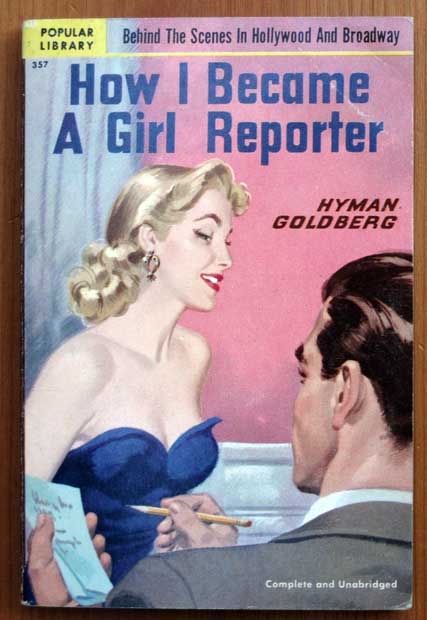
So, no, Meet John Doe is definitely no Mr. Smith Goes Go To Washington but I still liked it, mostly because of the chemistry between Gary Cooper and Barbara Stanwyck.  I wanted to be Barbara Stanwyck’s character.  Seriously, watching a film like Meet John Doe, leaves me convinced that I was born several decades too late.  If I had been born in 1918, I could have been a quick-witted, cynical, and secretly romantic intrepid girl reporter at a major metropolitan newspaper.

Girl Reporter

Even better, I would never have to worry about ever being told to “pay it forward.”

“American Sniper” Hits The Mark For Melodrama, But Misses Badly For Veracity


Ryan C. (fourcolorapocalypse)'s avatarTrash Film Guru

american-sniper-poster

What is it that makes a hero?

There are probably as many different answers to that question as there are people reading this (in other words, probably a few hundred if my daily wordpress stats are to be believed), but there are some character traits that I think we would all consider to be heroic : willingness to sacrifice oneself for the well-being of others, truthfulness, bravery in the face of overwhelming odds, staying firm in one’s ideals (assuming they’re decent ideals, of course) even when it’s dangerous to do so, etc.

By those standards, then, the “most lethal sniper in U.S. history,” Chris Kyle — who is credited by the Navy with over 160 kills in Iraq, while in his  memoir, American Sniper (upon which, needless to say, Clint Eastwood’s new film is based), he himelf puts the number northwards of 250 — probably meets most people’s definition of what…

View original post 2,040 more words

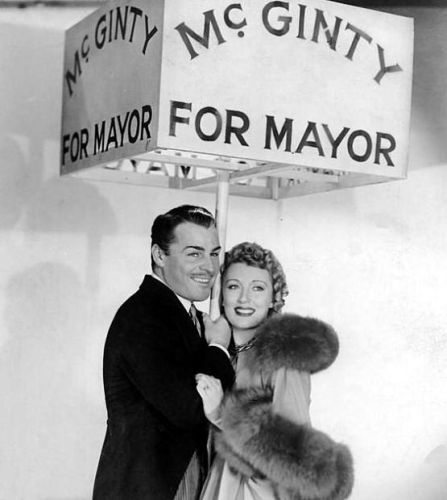
Shattered Politics #6: The Great McGinty (dir by Preston Sturges)


donlevy-angelus-mcginty_opt-1

 “This is the story of two men who met in a banana republic. One of them never did anything dishonest in his life except for one crazy minute. The other never did anything honest in his life except for one crazy minute. They both had to get out of the country.”

— The Great McGinty (1940)

For today’s final entry in Shattered Politics, we take a look at how elections are won north of the Mason-Dixon Line.

The Great McGinty begins in a bar located in an unnamed country in South America.  Tommy Thompson (Louis John Heydt) attempts to shoot himself but is stopped by philosophical bartender Dan McGinty (Brian Donlevy).  Tommy explains that he can never return to the United States because, in one moment of weakness, he stole some money.  McGinty replies that he can never return to the U.S. either.  Why?  “I was the Governor of a state, baby…” McGinty replies.

In flashback, McGinty explains how he came to power.  One day, while standing in a soup line, the homeless McGinty was approached by a local political operative (William Demarest) and offered $2.00 on the condition that he vote for a certain mayoral candidate.  McGinty agrees and then proceeds to vote 37 times.  When McGinty demands $74.00 for his efforts, he’s taken to the headquarters of the Boss (Akim Tamiroff, giving a wonderfully comedic performance).

The Boss is impressed with McGinty and, despite the fact that the two of them are constantly getting into fights with each other, he employs McGinty as a collector.  Eventually, he also arranges for McGinty to be elected alderman and then, running as a reform candidate, mayor.

Along the way, the Boss arranges for McGinty to get married.  McGinty’s wife (Muriel Angelus) originally has little respect for McGinty but, after they marry, she starts to realize that McGinty is not quite as bad as she originally assumed.  Eventually, she’s even impressed enough that she even stops seeing her boyfriend, George (Allyn Joslyn).

Meanwhile, the Boss arranges for McGinty to be elected governor.  However, once McGinty has won the election, he declares that he’s going to run an honest administration.  How does that turn out?  Well, it should be noted that the film opens with McGinty tending bar in South America…

The Great McGinty is a lot of fun and it’s interesting to think that this unapologetically sardonic look at American politics came out just a year after Mr. Smith Goes To Washington.  Imagine if Mr. Smith Goes To Washington had been told from the point of view of Edward Arnold’s Boss Taylor and you can guess what The Great McGinty is like.

If nothing else, The Great McGinty serves as a great reminder that political cynicism existed long before any of us cast our first vote.

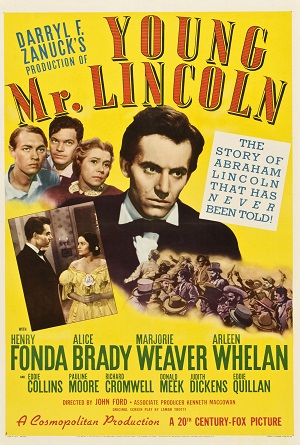
Shattered Politics #5: Young Mr. Lincoln (dir by John Ford)


YoungmrlincolnWay back in 1939, at the same time that Jimmy Stewart was conquering Washington in Frank Capra’s Mr. Smith Goes To Washington, the great director John Ford was making a film about another man who would eventually go to Washington.

In Young Mr. Lincoln, Henry Fonda plays the future 16th President.  Even though Fonda was probably far better looking than Abraham Lincoln ever was, he’s ideally cast in the role.  Along with being a very natural actor, Fonda personified a certain middle-of-the-country, stoic decency.  He played characters who were smart but never elitist and who were guided mostly by common decency.  In short, his screen persona was everything that people tend to think about when considering Abraham Lincoln.

As for the film itself, it begins with Lincoln as a simple storekeeper who accepts, as payment for groceries, a barrel of old books.  After reading the books and having a conversation with his doomed first love, Anne Rutledge (Pauline Moore), Lincoln decides to learn the law.

Years later, now a poor-but-honest lawyer, Abraham Lincoln arrives at Springfield, Illinois, sitting a top mule because he can’t afford a horse.  Lincoln opens a law office, awkwardly courts the rich and spoiled Mary Todd (Marjorie Weaver), and eventually defends two brothers who have been accused of murder.  While the case’s prosecutor (played by Donald Meek) may have a better education, he can’t compete with Lincoln’s common sense and ability to relate to the common people.

Obviously, the whole point behind Young Mr. Lincoln is that it’s about the early life of an American hero.  You watch the entire film with the knowledge that Lincoln is going to be the man who eventually leads the U.S. during the Civil War and who frees the slaves.  The viewer knows that Lincoln is going to be a great man, even if nobody else does and a good deal of the film’s effectiveness come from the moments when Fonda will strike an iconic pose or will casually deploy a familiar phase and you’re reminded of just who exactly it is he’s playing.

But, and this is why Young Mr. Lincoln remains a great film, the important thing is that the film is just effective when viewed as being a portrait of a dedicated lawyer trying to prove the innocence of his clients.  Fonda is compelling as both a future President and as an honest man trying to do the right thing.  Ultimately, the film would be just as compelling even if it was called Young Mr. Jones and didn’t open with soaring, patriotic music and end with a shot of the Lincoln Memorial.

It’s interesting to compare Young Mr. Lincoln to some of the other films made about Abraham Lincoln.  It’s a far more assured film than D.W. Griffith’s Abraham Lincoln and, needless to say, Henry Fonda makes for a better Lincoln than Walter Huston did.  At the same time, it’s far more naturalistic and less overly manipulative film than Steven Spielberg’s Lincoln.  In the end, it’s a good film and a great tribute to our 16th President.

And you can watch it below!

Shattered Politics #4: Mr. Smith Goes To Washington (dir by Frank Capra)


mr-smith-goes-to-washington

So, when you read that I was going to be reviewing 94 political films here at the Shattered Lens, you probably knew that one of them would have to be the 1939 best picture nominee, Mr. Smith Goes To Washington.

So, we all know that story right?  The senator from an unnamed state dies.  The weak-willed Governor (Guy Kibbee) has to appoint a new senator.  Political boss Jim Taylor (Edward Arnold) demands that the governor appoint one of his cronies.  The state’s reformers demand that the Governor appoint a never-seen crusader named Henry Hill (who, whenever I hear his name, makes me think of Ray Liotta snorting cocaine in Goodfellas).  The Governor’s children demand that he appoint Jefferson Smith (James Stewart, of course!), who is the head of something called the Boy Rangers.  The Governor flips a coin.  The coin lands on its edge but it also lands next to a newspaper story about Jeff Smith.

So, of course, Mr. Smith goes to Washington.

Now, as the movie quickly makes clear, Jeff Smith is immediately out-of-place in Washington.  For one thing, he’s actually excited to be there.  He’s convinced that he’s there to make America a better place.  When a bunch of drunken reporters (led by the great Thomas Mitchell) make Smith look foolish, Smith responds by running around Washington and punching them out.  (That whole sequence probably serves as wish fulfilment for a lot of politicians.)  When his cynical legislative aide Saunders (Jean Arthur) tells him that he’s too naive to survive in Washington, he wins her over with the purity of his idealism.  When his mentor, Senator Paine (Claude Rains), is revealed to be a part of Washington’s corrupt culture, Smith is stunned.  When Taylor tries to destroy his political career, Smith responds by giving the filibuster to end all filibusters.  He’s one man standing up against a culture of corruption and…

And there’s a reason why, 76 years later, aspiring political candidates still attempt to portray themselves as being a real-life, modern Jefferson Smith.

This is one of those films that everyone seems to agree is great and, of course, there’s many reasons to love Mr. Smith Goes To Washington.  There’s the lead performance of Jimmy Stewart, of course.  While this may not be his best performance (I prefer the more layered characterization that he brought to It’s A Wonderful Life and Anatomy of a Murder), it is Stewart at his most likable and, most importantly, he makes you feel Jeff Smith’s pain as he discovers that Washington is not the great place that he originally assumed it to be.  Claude Rains was always great when it came to playing good men gone wrong and he’s perfect as Sen. Paine.  Thomas Mitchell and Jean Arthur are perfectly cast and I always enjoy seeing the bemused smile on the face of Vice President Harry Carey as Smith conducts his filibuster.

But I think the best thing about Mr. Smith Goes To Washington is that it actually makes you believe that there are Jeff Smiths out there who actually could make a difference.  And, until Judd Apatow gets around to remaking the film with Adam Sandler, audiences will continue to believe.