Sailor Moon Crystal – Act 6 – Tuxedo Mask!


Tuxedo_Mask_crystal

Obviously, being back on a regular schedule of Sailor Moon has reinvigorated me. With a regular schedule returned to me, I find that each day is easier to suffer through, knowing that my long, Sailor Moon Crystal-less nightmare is closer to being over. Act 6, Tuxedo Mask! I think we can all guess on the subject matter here, though it seems frankly unlikely that this single act will resolve the standing mysteries about Tuxedo Mask. To find out, we’ll have to watch together.

Forget not, dear readers, that many peoples of the world still cannot enjoy this show – tremendous as it is! – legally within their own borders. You owe our friends in Canada and other countries at least one mild pang of guilt as you work your way through this fortnight’s offering from Sailor Moon Crystal. And if you are still well pleased at the end, your soul fulfilled and happy, chalk it up not to a lack of empathy, but rather to the fullness of the show.

In a very, very brief pre-credits scene, Luna introduces the Moon Stick. It’s sort of like a stick… with a big crescent moon on top of it. Obviously, all fans will recognize it right away.
Ballin’. Luna explains that it will help against enemies. Okay, that seems reasonable oh and we’re ready to go? Sailor Moon Crystal!

But first, let’s rock out.

A lot of Mamoru in this first segment. First, he wakes up in the middle of the night, full of doubts. Then he bumps into Usagi in the streets once again. Also, apparently he’s been giving press conferences… talking about how the various crimes he has committed were all in search of the Legendary Silver Crystal. Well, I suppose any number of B&E’s can be forgiven if it means keeping the Crystal away from Queen Beryl and the Dark Kingdom, and their mysterious Great Ruler.

Apparently Tuxedo Mask is the talk of the whole town. At school, on the radio, on TV, in the streets… he, and the Legendary Silver Crystal, are all anyone is talking about. Tuxedo Mask hopes that this will reveal a lead for him…

… But in the Dark Kingdom, the European Commander (whatever that means), Zoisite, petitions to replace Nephrite, who was both beaten and badly injured in the last act by Sailor Jupiter. Zoisite has a plan not only to seize the Legendary Silver Crystal, but also that whole general energy-grab thing that the Dark Kingdom is after. Great Ruler, etc., remember?

After closing time at the arcade, the Sailor Guardians discuss the situation. Luna has been doing a great deal of research, but apparently still doesn’t know who the enemy really are. She knows enough that they are trying to awaken some terrible evil from a deep sleep. Oh, and it will be bad if they succeed. In case that wasn’t clear. Their exact identities remain shrouded in mystery, though, and probably not for a hugely significant later reveal or anything like that. For the moment, the only important thing to know remains that the Legendary Silver Crystal is far too dangerous to be allowed to fall into enemy hands. In Luna’s opinion, it could destroy an entire planet if it fell into the hands of evil. I probably don’t need to spell out the ways in which that might be bad for you and me.

We learn a few key phrases here, too: The royal family of the Moon. The princess descended from the Moon. Awakened Sailor Guardians. Hmmm.

Meanwhile, much more importantly, ON TV…. a female anchor who looks suspiciously exactly like Zoisite except with hair pinned up differently… hypnotizes what appears to be every viewer in Tokyo into mindlessly searching everywhere they can think of, all in an effort to locate the Legendary Silver Crystal. Of course, all this pointlessly expendeded worry or whatever, is then absorbed by the Dark Kingdom.

Didn’t I see this commercial for Hanes tagless underwear like two years ago? Is this still some kind of big announcement? At least His Airness isn’t sporting that Hitler ‘stache in this one. Also, Wal-Mart seems to have stuffed a lot of commercials into Hulu’s repertoire. You shouldn’t shop there.

After the break, the Sailor Guardians head down into Luna’s secret base, which seems bizarrely large and also somewhat interdimensional, hanging out beneath a Sailor V machine. Using Luna’s computers, they’re easily able to track the energy being stolen from humans, and the mind control signal, to a TV station. The Sailor Guardians arrive right in time to observe Zoisite beginning to suck his victims dry of their energy. Weirdly, though Luna tells us she still isn’t sure at all about the enemy, she immediately identifies Zoisite by name. Was she there when the Four Kings (Kings!) introduced themselves at the Masquerade? I honestly can’t remember.

Sailor Moon’s own travels are interrupted when she runs into Tuxedo Mask again. He confirms in person that his goal is the Legendary Silver Crystal. But unlike the Sailor Guardians, he has no special powers (how does he keep finding Sailor Moon, then? Huh? HUH!?). Sailor Moon actually has similar concerns; she’s supposed to lead the Pretty Guardians, but she doesn’t have the firepower that her allies do (in perhaps the most stark reversal of the original anime yet, where the other Sailors frequently felt totally inessential), and she obviously feels inadequate to the task.

Speaking of which, on the rooftop of the TV station, Mars, Mercury and Jupiter are attempting to drop the hammer on Zoisite. A repeated assault from the Sailor Guardians seemingly has Zoisite on the ropes, before the shitennou (Kings!) manages to unleash a big counterattack. With the three Pretty Guardians trying to recover their strength on the helicopter pad, a peal of mad laughter besets them. Sailor Mars is awed by the evil energy she suddenly feels. Then, incredibly, Queen Beryl herself descends from the sky, introducing herself, and overwhelming the Sailor Guardians, who know instantly that they are outmatched. We need Sailor Moon!

Sailor Moon’s confidence is shot, but Tuxedo Mask talks her out of her funk. Maybe she doesn’t have the power to generate fire, ice, or lightning, but she is the leader, she has the power to make other people feel good about themselves. Sailor Moon transforms, and joins the fight! Awesome! In spite of her flaws, she is determined to help. She grips the Moon Stick (I wonder what it could fo…. whoa!) Moon Healing Escalation! Those words don’t really make sense in that order at any level! But she does release energy that gives even Queen Beryl a tiny bit of pause. When Sailor Moon attacks, Zoisite leaps in front of the blast and, to be generous, it seems to fuck him up bad. Beryl, to everyone’s amazement, takes her fallen shitennou (Kings!) and bounces.

With Sailor Moon’s energy exhausted, Tuxedo Mask carries her off to recuperate.

As predicted, we didn’t get many answers about Tuxedo Mask this week. But it looks like he rates his own 2-parter, because the next episode looks to be very much about him as well. So far we have only one episode that I would really describe as ‘filler’, because this one had a lot going for it, between Sailor Moon’s soul searching and a flesh-and-blood appearance by the mighty Queen Beryl. I’m still looking for confirmation on the fate of the luckless Jadeite, but maybe that will come in time.

Anyway, this was an action-packed week, and I hope you enjoyed the episode as much as I did. And yes, we’re all dying to see Sailor Venus introduced. I suspect we’ll be waiting a while though. I seem to remember her appearing only about two thirds of the way through the original anime. I don’t know when she first shows up in the manga, because frankly, I’m woefully unprepared for this week’s article. I’ll try to do better in a fortnight.

For now though, let us simply enjoy the warm embrace of Sailor Moon Crystal together, and glide off into the night.


Dance Scenes That I Love: The Perks of Being A Wallflower


I really probably shouldn’t share this scene until I actually post my review of The Perks of Being A Wallflower.  But I’ve still  got three other Back to School films to review before I get to Perks and I want to share this scene now!  In this dance scene that I love, Emma Watson and Ezra Miller take over the dance floor in spectacular fashion!

Back to School #70: Lymelife (dir by Derick Martini)


Lymelife_ver2

Lymelife is an odd but occasionally effective indie film from 2008.  Taking place in 1979, the film tells the story of two brothers living on Long Island.  The older brother, Jimmy Bartlett (Kieran Culkin) has recently graduated from high school and is preparing to enter the army.  (We hear that he’s going to be shipped off to fight in a war against Argentina, which is odd because, to the best of my knowledge, the U.S. has never been at war with Argentina.)  The younger brother is 15 year-old Scott (Rory Culkin), a gentle boy who loves Star Wars and who is doted on by his overprotective mother, Brenda (Jill Hennessy).  Scott’s relationship with his father, Mickey (Alec Baldwin), is far less positive with Mickey feeling that his youngest son is weak and Scott resenting the fact that Mickey is always cheating on Brenda.

As the film opens, a recent outbreak of Lyme Disease has got everyone in a panic.  Brenda, in particular, is terrified that Scott is going to get bitten by a tick and refuses to let him go outside unless every inch of his skin is covered and protected.  Causing Brenda even more panic is the fact that their neighbor, Charlie Bragg (Timothy Hutton), has contracted the disease and has lost his job as a result.  Now, he spends all of his time either outside trying to hunt deer or hiding down in his basement.  His wife (Cynthia Nixon) is forced to take a job from Mickey in order to support the family and soon, she and Mickey are having an affair.

In fact, the only person who doesn’t completely shun Charlie is Scott, though this is largely because Scott has, for years, had a crush on Charlie’s daughter, Adrianna (Emma Roberts).  Adrianna finally starts to return Scott’s affection but then Charlie discovers the truth about his wife’s job with Mickey and things … well, things do not end happily.

Lymelife is a strange film, one that at times almost plays like a parody of a typical indie film.  This is one of those films where a lot of things happen but you’re not always quite sure why they happened and ultimately, it’s hard not to feel like the film is essentially a collection of loosely related scenes, all looking for a stronger narrative.   But, with all that in mind, I still like Lymelife.  Director Derik Martini brings such an intense and humanistic touch to the film’s dangerously quirky storyline and it’s such an obviously personal film that it becomes fascinating in its own way.  Not surprisingly, both Alec Baldwin and Jill Hennessy overact in their roles (and considering that they have the most melodramatic lines, that’s not always a good thing) but, fortunately, Timothy Hutton, Emma Roberts, and the Culkin Brothers all give excellent performances.

Plus, the film’s ending is absolutely haunting, largely because of the wise use of the song Running Out Of Empty, which can be heard below.

http://www.youtube.com/watch?v=25FuH8uoi_s

Back to School #69: Superbad (dir by Greg Mottola)


Superbad

One of the great things about the 2007 comedy Superbad is that it has a title that allows for snarky but overworked reviewers like me to come up with an easy review.

For instance, if I disliked Superbad, I could just say, “Superbad more than lives up to its name!”  However, since I happen to like Superbad, I can say that Superbad is supergood, supercool, and superfun!

See how easily that works?

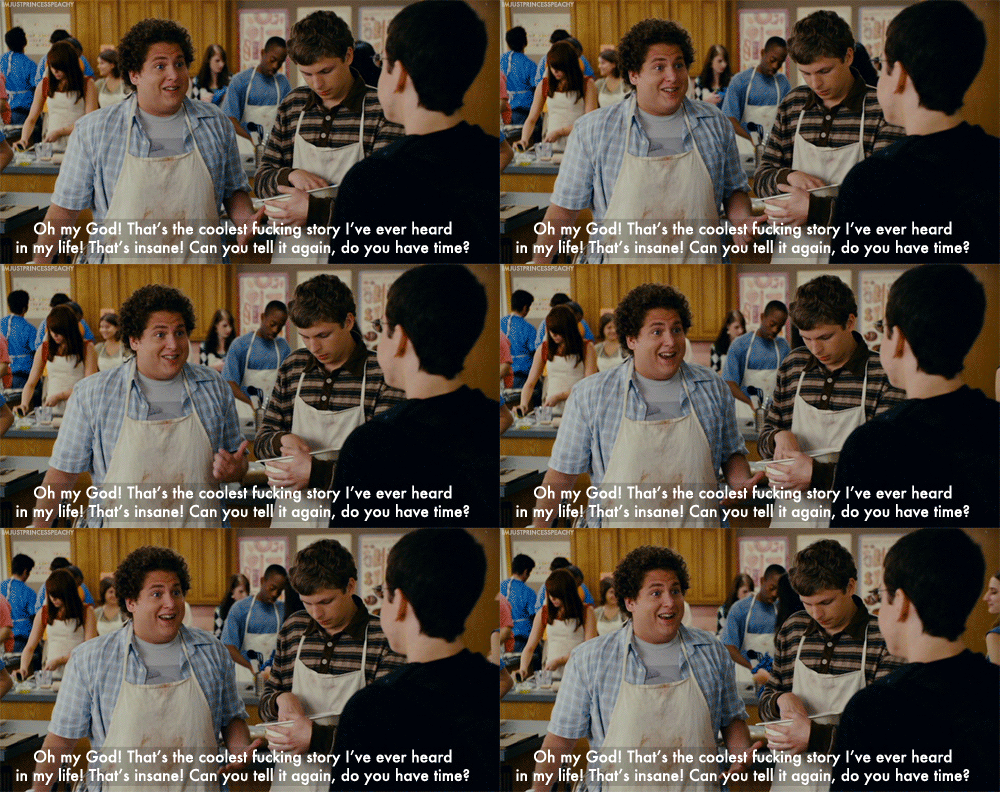
Plotwise, Superbad tells a story that will be familiar to anyone who has ever seen a teen comedy.  Three guys try to get laid.  Seth (Jonah Hill) is the rotund and boisterous one, the one who has a crush on Jules (Emma Stone), who is your basic good girl with a wild side.  Evan (Michael Cera) is the sweet and sensitive one.  And then there’s Fogell (Christopher Mintz-Plasse), the nerdy one with the thick glasses.  Fogell is the one who gets a hilariously bad fake ID, one that tells the world that his name is McLovin.

Superbad2

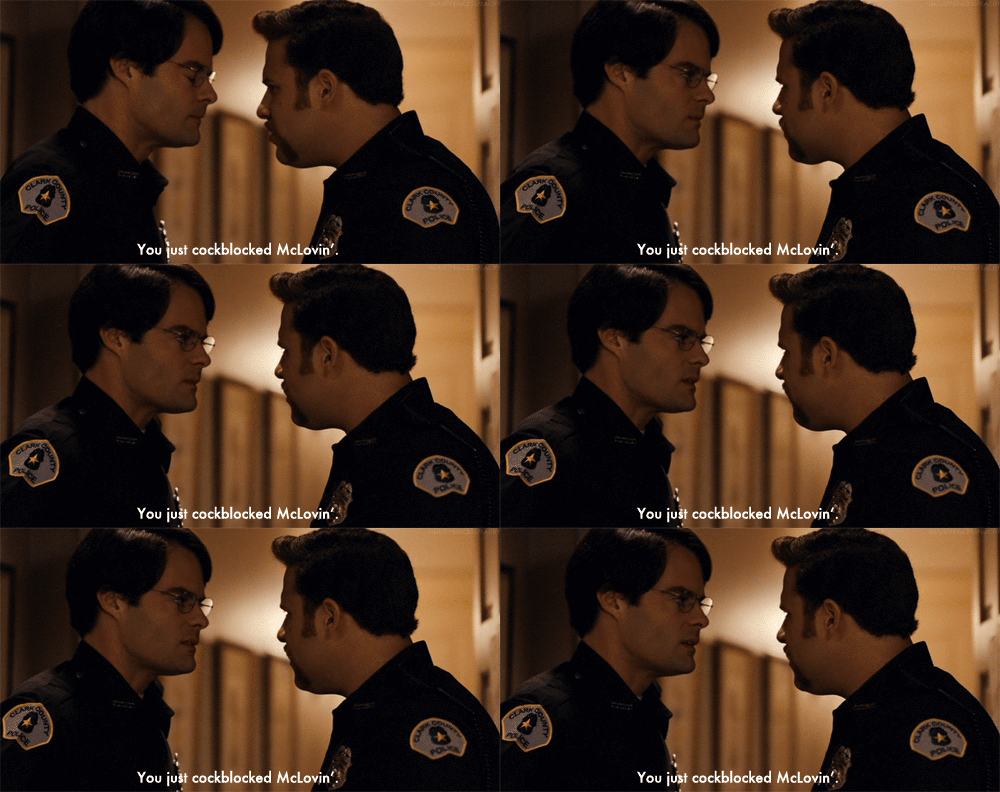
After Jules invites Seth to a party, he and Evan enlist Fogell to use his fake ID to buy them alcohol.  However, as often happens in the type of films, things get complicated.  While Fogell is buying the beer, the convenience store is held up.  The police arrive and Evan and Seth panic and run off.  Meanwhile, Fogell is befriended by the two cops (played by Seth Rogen and Bill Hader), both of whom are incredibly impressed that their new friend has as wonderful a name as McLovin.

(“You’re name’s McLovin?  That’s badass!”

Superbad23

And so, while McLovin bonds with his new cop friends, Seth and Evan continue to try to find beer and make their way to Jules’s party….

Superbad was produced by Judd Apatow and it features his usual combination of raunchy humor and sentimental bromance.  In fact, it’s such a male-centered film that I’m always a little bit surprised at how much I enjoy it.  However, Superbad is a seriously funny movie.  The script (which Seth Rogen and Evan Goldberg reportedly starting on when they were 13 years old) is full of great lines and Michael Cera and Jonah Hill make for an adorable comedy team.  And then there’s Christopher Mintz-Plasse who takes the character of Fogell to his most logical extreme and then just keeps going.  McLovin’s adventures may not be the most realistic or subtle part of the movie but they are still a lot of fun to watch.

Speaking of McLovin and his adventures with the cops, I love the performances of both Seth Rogen and Bill Hader.  If you don’t laugh at the way Seth Rogen says, “Oh no!  It’s the cops!,” then you need to be worried about your sense of humor.

Superbad is supergood, supercool, superfun, supersweet, and just plain super.

Superbad

Back to School #68: Juno (dir by Jason Reitman)


Junoposter2007

(SPOILERS BELOW)

Even though he’s a likable actor and has appeared in several films that I enjoyed, I am always a little bit uneasy whenever I see Jason Bateman on screen.  To me, he will always be Mark, the seemingly perfect husband from the 2007 best picture nominee Juno.  Mark and his wife Vanessa (Jennifer Garner) are unable to conceive so they agree to adopt the unborn child of pregnant teenager Juno (Ellen Page).

At first, Mark seems like the nicest guy on the planet.  Unlike his wife, Mark appears to be laid back and friendly.  Whereas Vanessa tries to maintain a polite distance between herself and Juno, Mark quickly befriends her.  It’s a familiar dynamic.  Vanessa is the one who keeps the household running.  Mark is the one who keeps the household fun.  Vanessa is the adult and Mark is the guy who is young at heart.  It’s not surprising that Juno finds herself feeling closer to Mark than to his wife.

Much like Juno, those of us in the audience are initially fooled into preferring Mark to his wife.  For me, the first indication that Mark was not quite the great guy he seemed to be came when he attempted to convince Juno that Herschell Gordon Lewis was a better director than Dario Argento.  But even that could be forgiven because, as Mark made his arguments, he revealed that he had a pretty good library of DVDs from Something Weird Video.

(Seriously, at that moment, I really hoped that the movie would just spend five minutes letting us see every title in Mark’s movie collection.)

But then there was that moment.  After telling Juno that he was planning on leaving his wife, he looked at her and asked, “How do you think of me?”  And I have to give Jason Bateman a lot of credit.  He delivered that line with just the right amount of needy selfishness.  It’s rare that you see an actor — especially one who has essentially built a career out of being likable — so fully commit to playing a reprehensible character.  When Mark reveals his true nature, it’s shocking because we were so ready to like Mark.  With that one line, we’re forced to re-examine the entire film and we realize that, much like Juno, we allowed ourselves to be fooled by Mark.

Juno is a film about growing up.  Vanessa is a grown up.  Mark refuses to grow up.  And, by the end of the film, Juno has grown up enough to know that she’s not ready to be a mother but Vanessa is.  Juno has grown up enough that she can allow herself to get close to the baby’s father, sweet-natured track star Paulie (played by Michael Cera).

For many people, Juno seems to be a love-it-or-hate-it type of movie.  There rarely seems to be a middle ground.  It seems that for every person who appreciates Ellen Page’s sardonic line readings, there’s another one who finds her character to be abrasive.  For every one who enjoys Diablo Cody’s script, there seems to be another one who finds it to be overwritten.  The same holds true for Jason Reitman’s direction.  Viewers either respond to his quirky vision or else they dismiss him as being far too showy for the film’s own good.

As for me, I’m firmly and unapologetically pro-Juno.  I think Juno is one of the best films of the past ten years and I think that, eventually, both the character of Juno and Ellen Page’s performance will be viewed as being iconic.  When future historians are watching movies for clues as to what it was like to be alive during the first decade of the 21st Century, Juno is one of the films that they will watch.

And when they do, hopefully, they will understand that Jason Bateman was just an actor giving a good performance as a bad person.

Back to School #67: Coach Carter (dir by Thomas Carter)


220px-Coach_Carter_poster

You all have got twitter to blame for this review.  I vaguely remember Coach Carter playing in theaters back in 2005 but I didn’t see it.  To be honest, the only thing that bores me more than high school football is high school basketball.  I have to admit that I really can’t stand to watch basketball, largely because I hate the way the player’s shoes are always squeaking on the court.  It just hurts my ears.

But, I’ve noticed that whenever Coach Carter shows up on television, everyone on my twitter timeline seems to get excited about it.  Coach Carter is one of those films that is obviously popular with a lot of people so, when I saw that it was going to be playing on Showtime last week, I figured why not?

And you know what?

Coach Carter is actually a pretty good movie.  If I don’t seem overly enthusiastic about it, that’s because I’m just not into sports.  But I do love movies and Coach Carter is an effective film.  That it’s predictable isn’t really that much of a surprise.  Predictability is actually probably one of the main appeals of the sports genre.  But Coach Carter is distinguished by a strong cast and it has a pretty good message to boot.

Plus, it’s based on a true story!  How true I don’t know but I’d like to think that the movie stuck pretty close to the facts if just because the story is so appealing.

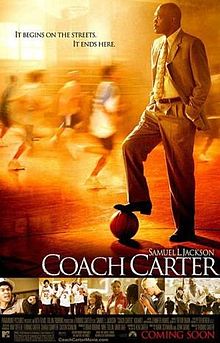
Anyway, the Coach Carter of the title is played by Samuel L. Jackson.  At the start of the film, Carter takes over as basketball coach at the same inner city high school that he graduated from.  When he first starts, his team is rude, disrespectful, and undisciplined.  The majority of them have little direction in their lives and have basically pinned whatever hope they have for the future on eventually playing professional basketball.

(I will admit right now that I was really excited to discover that Channing Tatum played one of the players.  The only thing that would have made me happier would have been for James Franco to suddenly show up.)

Carter informs his team that, in order to play for him, they have to be willing sign a contract that states that they will treat everyone respectfully, that they will wear a tie on game days, and that they will all maintain a C+ average.  Some of the players refuse to sign (and are promptly kicked off the team) but those who do quickly discover that Carter expects them to honor the terms of the contract.

And, under Carter’s leadership, the team goes on to have a great season.  They’ve got an undefeated record and appear to be heading for the play-offs when Carter discovers that several members of the team have failed to keep up their grades.  To the shock of both the faculty and the community, Carter benches his entire team and announces that none of them will play until all of them have at least a 2.3 GPA.

Needless to say, it all leads to one of those emotional school board meetings that always seems to show up in films like this.

As I stated above, it’s all fairly predictable but the movie itself is well-made.  And if anyone was born to play an outspoken basketball coach who isn’t going to let anyone tell him how to run his team, it’s Samuel L. Jackson.  Jackson is one of those actors who is so good and so powerful that I think we sometimes tend to take him for granted.  Perhaps the best thing about Coach Carter is that it gives Jackson a chance to show what he’s truly capable of doing as an actor.

Again, I really don’t know that much about basketball and I’m not a fan of the game.  But, with all that in mind, I was still entertained by Coach Carter.  If nothing else, it proved that a lot of the people on my twitter timeline aren’t crazy.

Back to School #66: Mean Creek (dir by Jacob Aaron Estes)


mean-creek1

2004’s Mean Creek is one of those films that makes me cry every time.

The story that it tells is, at first glance, a rather simple one.  It’s only as you start to dig beneath the surface that you discover just how complex the film really is.  Sam (Rory Culkin) is being picked on by the school bully, the overweight George (Josh Peck).  When Sam accidentally knocks over George’s video camera while George is filming himself playing basketball, George beats Sam up.

Sam’s older brother Rocky (Trevor Morgan) decided to get revenge and recruits two of his friends to help him out, Clyde (Ryan Kelly) and Marty (Scott Mechlowicz).  Their plan is to invite George to Sam’s birthday party and to take him on a rafting trip.  Eventually, they plan to challenge him to truth or dare, get him to strip naked, and then basically abandon him.

Needless to say, things don’t quite go as planned.

For one thing, it turns out that George is sincerely happy to have been invited to Sam’s party and he even shows up with a gift. George, it turns out, doesn’t consider himself to be a bully.  Instead, he’s just an overweight kid who is insecure about his dyslexia and who doesn’t have any social skills.  Once the boys and Sam’s girlfriend Millie (Carly Schroeder) are floating down the creek, they’re forced to reconsider their plans. Some want to forget about it and let George go.  Some want to still go through with the plan.

And, meanwhile, poor George continues to be his own worst enemy…

Mean Creek is a fascinating film because George is such an unexpectedly complex character.  When we first see him, it’s easy to dismiss him as just your standard middle school bully but, as the film progresses, it becomes apparent that there’s more to George than our first impressions may have suggested.  And yet, every time that we start to feel truly sorry for George, he says the wrong thing or he displays some sort of behavior that reminds us of why he was invited to the birthday party in the first place.  In the end, we’re as conflicted about him as everyone else on the boat.  He’s a bully but he’s not a bad kid.  Can we forgive him for being a bully or does he still need to be taught a lesson?

That’s the question at the heart of Mean Creek and the film’s final answer (or, perhaps I should say, lack of a final answer) makes me cry every time.  I don’t want to spoil the film for those who haven’t seen it (and everyone should see it), so I’m not going to give any more details about the film’s plot.  I’ll just say that Mean Creek is an important film and one that will leave you thinking about what you’ve just seen and how you feel about it.

Mean Creek

Back to School #65: Mean Girls (dir by Daniel Waters)


Mean Girls Poster

Mean Girls is a film that has a lot of nostalgic importance for me.  It came out when I was a senior in high school and it was the last film that I saw before I graduated.  So, for me, Mean Girls always brings back memories of the excitement of knowing that my “real” life was about begin.  When I watch it or think about it, I’m always transported back to that time when the future seemed limitless.  I knew I was going to go to college, I was going to meet the love of my life, and I was going to have a great time doing it.  Thoughts of Mean Girls transports me back to one of the most exciting times of my life and, for that reason, I like to think of it.

Add to that, Mean Girls happens to still be a pretty funny and perceptive movie.

One thing that I do always find interesting about films like Mean Girls and 10 Things I Hate About You is that, even though they may be critical of the traditions of high school, they all seem to be taking place in the type of idealized high school that we all wish that we could have attended.  These high schools are always huge with brightly colored walls and quick-witted students who never have a bad hair day.  The rich, popular kids are always so clever with the way that they express their disdain.  And even the outcasts are still pretty good-looking.  Even more importantly, the outcasts are always so sarcastic and political.  They don’t just accept their outcast status.  Instead, they spend all of their spare time plotting ways to overthrow the system.  Perhaps best of all, all of the various cliques have such clever nicknames.

From my experience, most public high schools aren’t actually like this.  Then again, I went to high school in Texas and most of these films were made in California so maybe it’s just a west coast thing.  The important thing about a film like Mean Girls is that, even though it takes place in a heightened reality, there’s still enough reality that anyone watching it can relate to the film’s story.

(It’s been my experience that even real life mean girls love Mean Girls, mostly because I think everyone assumes that in high school, they were one of the clever, sarcastic outcasts, regardless of whether they actually were.)

In Mean Girls, the popular clique is nicknamed the Plastics and they’re led by Regina George (Rachel McAdams).  New student Cady  (Lindsay Lohan) is the latest member of the clique but what the Plastics do not suspect is that Cady is actually an infiltrator who has been recruited by outcasts Janis (Lizzy Caplan) and Damien (Daniel Franzese) to take down the Plastics from the inside.  However, as Cady goes out of her way to destroy Regina’s reputation and turn the rest of the school against her, she soon discovers that she’s running the risk of becoming just as mean as Regina…

Mean Girls is a comedy but, at its center, there rests a very important message about the need for people to not … well, to not be mean.  That may seem like a simplistic message and I guess it is.  But it’s still a good message to get out.  The script by Tina Fey is both clever and funny, deftly mixing the message with the comedy.  Finally, the film has a great cast, with Lindsay Lohan and Rachel McAdams as stand-outs and great supporting turns from Amanda Seyfried, Lacey Chabert, and Tim Meadows.

Thanks for the memories, Mean Girls!

Mean Girls

Back to School #64: Friday Night Lights (dir by Peter Berg)


For the past three weeks, I’ve been looking at some of the best, worst, most memorable, and most forgettable high school and teen films ever made.  I’ve been posting the reviews in chronological order and, as I look back over the previous 63 Back to School reviews, one thing that I can’t escape is football.

It’s funny.  Despite being a Texas girl, I know very little about football and, whenever I have found myself watching a game, I’ve usually end up getting bored out of my mind.  I’m not a huge fan of sports films, either.  It’s just not my thing.  And yet, as a result of doing this series of reviews, I’ve watched more football films over the past month than I had probably seen in my entire life previously.  Some of the films that I’ve reviewed specifically were football films — The Pom Pom Girls, All The Right Moves, and Varsity Blues, for example.  However, even the film that weren’t specifically about the sport often featured scenes set on the football field.  Just think of Forest Whitaker in Fast Times At Ridgemont High or the socially conflicted jocks from Dazed and Confused.

For a lot of films, football and high school seem to go together.  And one of the most acclaimed high school football films is 2004’s Friday Night Lights.  Now, I have to admit that Friday Night Lights is not one of my favorite films.  It’s a football film, I’m not into football, and therefore, Friday Night Lights is a film that I respect more as a well-made film than like as a source of entertainment.  Perhaps the best thing that I can say about Friday Night Lights is that I understand why so many people who do love football also happen to love this film.

And I do have to say that I appreciate that Friday Night Lights is also a film about Texas that actually manages to realistically portray my home state without resorting to the predictable clichés that dominated Varsity Blues.

Taking place in Odessa, Texas, Friday Night Lights follows the 1988 season of the Permian Panthers.  As opposed to most sports films, Friday Night Lights does not focus on a team of lovable underdogs.  Instead, the Panthers are already known for being a championship team.  As the season begins, Coach Gary Gaines (Billy Bob Thornton) is under tremendous pressure to continue that winning tradition.  However, when the team’s star player is injured during the first game of the season, the Panthers suddenly find their pre-ordained winning season in doubt.  Gaines finds himself being alternatively celebrated and demonized depending on how the previous night’s game has gone and his players find themselves under tremendous pressure from everyone in town.  The film features a great performance from Billy Bob Thornton and a really good one from Derek Luke, playing a player who abruptly goes from being a future superstar to a present could-have-been.  In fact, the entire film is well-acted with even country singer Tim McGraw giving a surprisingly multi-faceted performance as a former player-turned-drunk.

In short, Friday Night Lights is a lot like Varsity Blues, except that it doesn’t suck.

(Incidentally, Friday Night Lights did inspire a TV series.  I never watched it.)

Friday_night_lights_ver2

Back to School #63: Thirteen (dir by Catherine Hardwicke)


Have you ever seen a film and thought to yourself, “Oh my God, that’s my life?”

That’s the way I always feel whenever I see the 2003 film Thirteen.  Thirteen is one of my favorite movies but I always get uncomfortable whenever I watch it because a lot of the film hits really close to home for me.  Thirteen tells the story of 13 year-old Tracy (played, in an amazing performance, by Evan Rachel Wood) who, after befriending Evie Zamora (Nikki Reed, who also co-wrote the script along with director Catherine Hardwicke), goes wild.  Soon, Tracy is shoplifting, self-harming, experimenting with drugs and sex, and striking out at her mother, Melanie (Oscar nominee Holly Hunter).

As played by Hunter, Melanie is probably one of the best moms to ever show up in a contemporary film.  I’m tempted to say that Hunter’s performance here is the American equivalent to Sophia Loren’s work in Vittorio De Sica’s Two Women.  Melanie is not portrayed as being perfect.  Instead, she’s a recovering alcoholic who is dating a former drug addict (played by Jeremy Sisto) and she doesn’t always say the right thing and sometimes she does wish that she could just be selfish and not have to deal with her rebellious daughter.  When Evie, claiming that she’s being abused at her own home, literally moves in with Tracy, Melanie instinctively knows that Evie is a bad influence but she can’t bring herself to turn her away.  And yet, for all the mistakes that she makes, Melanie is still a good mom.  She loves her daughter and finally proves that she’s willing to sacrifice her own happiness to try to save Tracy.  Off the top of my head, I can’t tell you who won the Oscar for Best Supporting Actress of 2003, but it should have gone to Holly Hunter.

Thirteen was the directorial debut of one of my favorite director, Catherine Hardwicke.  Hardwicke doesn’t get the critical respect that she deserves, largely because she directed the first Twilight.  (Twilight, however, is not a badly directed film.  The trouble is with the source material, not Hardwicke’s direction.)  With Thirteen, Hardwicke approaches the film with a matter-of-fact directness that keep the movie grounded and prevents it from going over-the-top with its nonstop parade of delinquent behavior.

Thirteen

It’s a difficult film for me to watch because, when I was thirteen, I basically was Tracy.  I was angry at my Dad for leaving us and a part of me blamed my mom but an even bigger part of me blamed myself.  Like Tracy, I felt as if I had been abandoned and I felt as if control of my life was out of my hands.  I resented the life that I imagined I would never get to live and so, I went out of my way to make sure that everyone knew that I didn’t need them but they certainly needed me.  I struck out in whatever way I could and, looking back at it now, I know that, basically from the ages of 13 to 17, I caused a lot of unneccessary pain to the people who loved me.

Thirteen captures all of that perfectly and, therefore, it’s not easy for me to watch.  But, at the same time, I’m always glad after I do watch it because I know that I turned out okay and that gives me hope that, despite the film’s ambiguous ending, Tracy will turn out okay as well.

Thirteen2003Poster