AMV of the Day: Evangelion 2.22 [Lights]


Evangelion-2-You-Can-Not-Advance-sub-español

The last three or four days and with many more to go, site co-founder Lisa Marie has been reviewing many films the depicts high school as seen by it’s many filmmakers down the years. While this particular major series of reviews is the creation of Lisa Marie and one she’s determined and enthusiastic in completing I thought I might drop by the proceedings and pop my head in quickly.

I don’t have a high school-themed review, but I do have the latest “AMV of the Day” that loosely follows the theme of high school. This time around the AMV is about a group of high school students in a futuristic Japan who also happens to be pilots of giant mechas (piloted robots) called Evangelions. Yes, I know it’s a very loose and barely there tie-in to Lisa Marie’s “Back to School” series, but who wouldn’t want to be a high school student and also be the pilot of giant Evangelions while wearing some fashionable plug suits. I mean the Evangelion anime is not just about mecha fighting monstrous angelic beings, but also has all the angst and growing pains of being a high school age teen.

The video’s creator, LuftPyrite, does a great job of marrying scenes from Evangelion: 2.0 You Can (Not) Advance with the Accent8 Remix of Ellie Goulding’s very popular and recognizable song “Lights”. While the video itself does end very abruptly it still doesn’t diminish just how good this video is from start to abrupt finish.

Anime: Evangelion: 2.0 You Can (Not) Advance

Song: Lights (Accentu8 Remix) by Ellie Goulding

Creator: LuftPyrite

Past AMVs of the Day

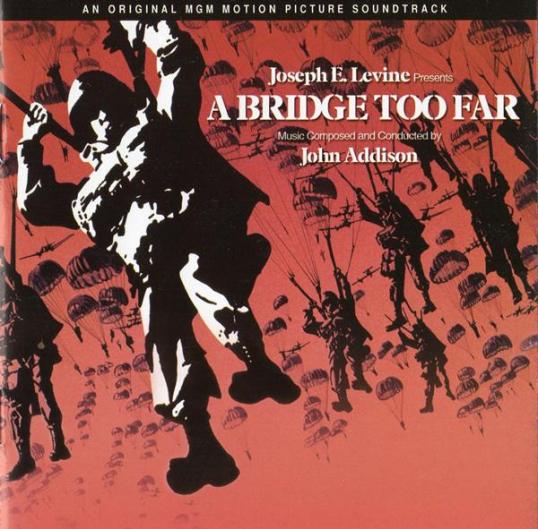
Song of the Day: A Bridge Too Far Overture (by John Addison)


ABridgeTooFar-Front_zps46c29dfd

John Addison’s film score for Sir Richard Attenborough’s military epic, A Bridge Too Far, has become as recognizable and as iconic as the film itself. One particular piece of music from the film that anyone who has watched in full and/or passing this great film is today’s “Song of the Day”.

The title track is “A Bridge Too Far Overture” and it’s ever present melody becomes the leitmotif for the entire film. It starts off quite celebratory in the beginning then gradually becomes melancholy and defeating as it helps set the tone and gives a sense of the tragedy to come from a very victorious beginning.

As someone who has enjoyed and studied films which depict important military events in history this song remains as one of my favorite and I can catch myself humming or whistling the tune whenever I hear it play as the film plays on the TV.

Review: A Bridge Too Far (dir. by Sir Richard Attenborough)


1977 a bridge too far

“Well, as you know, I always felt we tried to go a bridge too far” — Lt. Gen. Frederick Browning

With the recent passing of Sir Richard Attenborough I decided to bring up one of the films which first brought his name to my attention. I was quite the young lad when I first saw Attenborough’s epic war film A Bridge Too Far. I would say that it was one of my earlier memories of watching a film with my father who was a major fan of war films. One could say that I got my appreciation and love for the genre from him.

A Bridge Too Far was adapted from the Cornelius Ryan book of the same name which depicted from start to finish the disastrous World War II battle known as Operation Market Garden. The film states that the Allied landings at Normandy, France in the summer of 1944 had the German forces reeling and on the verge of collapse. With Eisenhower having to choose between competing plans to chase Hitler’s forces right into Berlin from his two best generals in George S. Patton and Bernard Montgomery, the film already lays down something that’s become synonymous with military disasters throughout history. Political expediency and pressure on Eisenhower led to an operation that was never attempted in military history and one which required every aspect of the operation to go according to plan for it to work. As the film would show this was not meant to be.

The film begins with the operation’s early days as Allied commanders rush to put Montgomery’s plan to drop 35,000 paratroopers behind German lines in occupied-Netherlands in order to capture and hold key bridges until Allied armored forces arrived to reinforce them. It’s a daring plan that the Attenborough films with a obvious confidence and enthusiasm, but also one that already showed some nagging doubts from field commanders who would be in the thick of the fighting if intelligence reports were inaccurate. One could almost say that Attenborough was making the film a sort of anti-war message which was a rarity when it came to Hollywood and and film industry depicting the events of World War II at the time.

While the film does explore that very anti-war theme throughout it’s really a by-product of how the battle itself unfolds and shown to the viewers that might give one such an idea. Yet, in the end A Bridge Too Far was a much more complicated film to just be labeled as an anti-war film. Yes, the battle itself was a disaster for the Allied forces of American, British and Polish soldiers involved, but despite the political bumbling and military arrogance of those who command from behind a desk, the film actually does a great job of showing that bond soldiers earn when confronted with the horrors of battle.

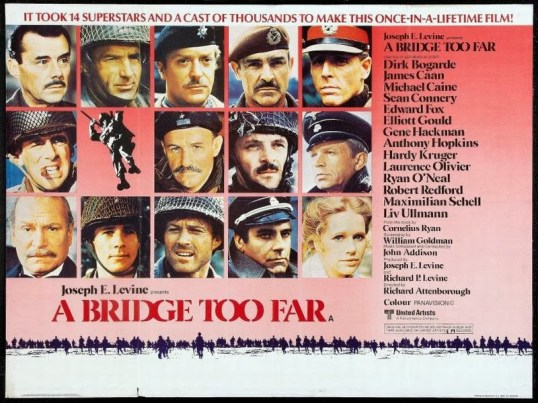
Attenborough and producer Joseph E. Levine pulls together an all-star cast for the film with names such as Sean Connery, Edward Fox, Robert Redford, Michael Caine and Laurence Olivier just to name a few. Films such as A Bridge Too Far rarely get made anymore in this day and age. The cast itself is part of the reason why the film still holds up to scrutiny decades after it’s release. While all-star casts such as this seemed to have been common place before the 1980’s it still looked like a daunting task for Attenborough to manage so many Hollywood stars and veteran British actors. Every character from Hopkin’s Col. Frost, Connery’s Gen. Urquhart and Redford’s Maj. Cook get to shine in their sections of the film as their individual stories about the battle all tie-in together to show just how complicated the events that they were filming truly turned out to be.

At times, one almost could feel overwhelmed by the amount of recognizable names and faces that come across the screen, yet Attenborough and producer Levine were able to juggle not just the logistics of the film’s screenplay, but the egos and reputation of the very stars who would become the backbone of the film.I think in a lesser filmmaker A Bridge Too Far could easily have turned into the very Operation Market Garden it was trying to depict.

It’s a film that never celebrates the concept of war itself, but actually shows that war remains a bloody and chaotic affair that relies not just on planning and execution but on the whims of lady luck. While Attenborough’s film never reached the sort of iconic status that another Cornelius Ryan adapted film has attained in The Longest Day, it does remain the more powerful of the two as it doesn’t just explore the historical event as a sort of academic exercise, but as an exploration of that old military adage of “No plan survives contact with the enemy”.

So, in the end I recommend that those looking to watch and experience the earlier directorial works of Sir Richard Attenborough should check out A Bridge Too Far. It remains to this day one of his more underappreciated films especially when compared to his later more acclaimed films like Gandhi, Chaplin and Shadowlands.

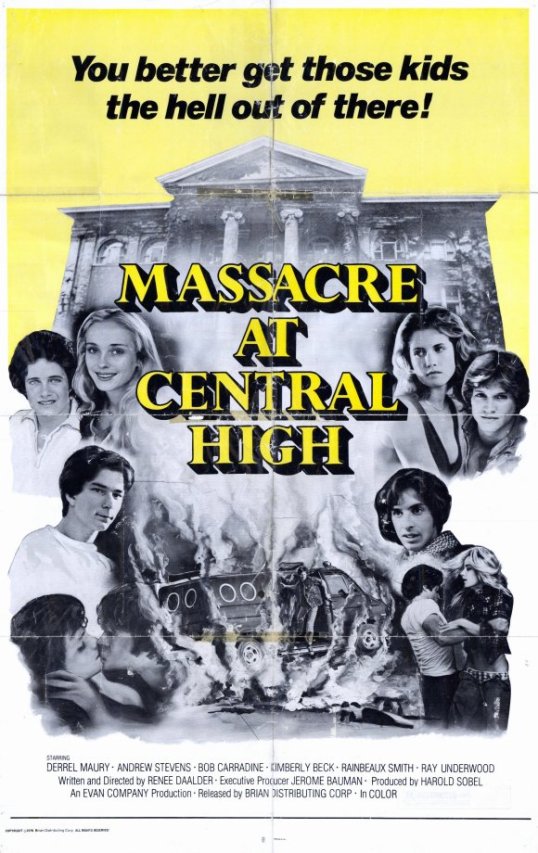
Back to School #18: Massacre At Central High (dir by Rene Daalder)


http://www.youtube.com/watch?v=YzX2RNGGM7U

With a title like Massacre at Central High, you probably think that this 1976 film is a low-budget slasher film.  However, you’re totally wrong.  Instead of being a low-budget slasher film, Massacre at Central High is a low-budget political allegory and it’s a pretty good one at that.  It’s also not exactly an easy film to see (I had to watch it off of a scratchy, old VHS tape), which is unfortunate because it’s probably one of the best exploitation films of the 1970s.

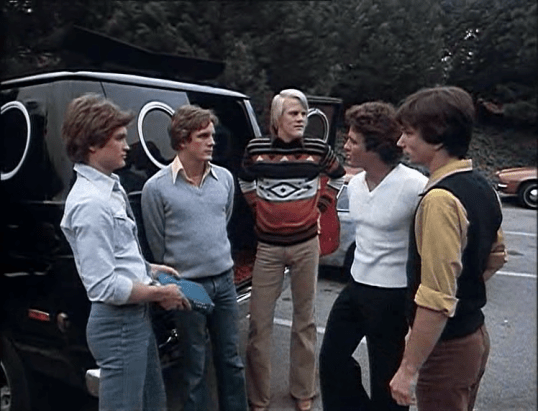
Massacre at Central High takes place at a high school in Southern California.  The first thing that you notice about Central High is that there aren’t any adults around.  The students don’t ever appear to go to class.  Instead, they spend their time roaming the halls.  The school is run by four wealthy jocks who enforce order, repress independent thought, and spend most of their time hanging out in an exclusive lounge.  Of the four ruling jocks, Mark (Andrew Stevens) is the most sensitive, an overall nice guy who doesn’t approve of the excesses of the others but, at the same time, isn’t willing to stand up to them either.

The Ruling Clique

The Ruling Clique

As for the other students, they spend their time being alternatively harassed and cared for by the jocks.  They’re told, of course, that everything is for their own good and that their survival depends on the survival of Central High.  Spoony (Robert Carradine) is caught and punished for spraying political graffiti on the lockers.  Oscar (Jeffrey Winner) is regularly bullied by the jocks on account of his weight.  School librarian Arthur (Dennis Kort) is attacked for being an intellectual.  When Rodney (Rex Steven Sikes) makes the mistake of parking his car in one of the jock’s space, they react by stealing and wrecking his car.

Things start to change when track star David (Derrel Maury) transfers to Central High.  David is an old friend of Mark’s and, at first, Mark attempts to get him to join the ruling clique.  However, David is disgusted by the other jocks and starts to stand up for the oppressed students.  The jocks (with the exception of Mark) respond by lowering a car down on David’s leg, crushing it.

No longer able to run track and now moving with a permanent limp, David refuses to tell anyone the truth about how he injured his leg.  Instead, he returns to school and gets his revenge, methodically murdering all of the jocks except for Mark.  Mark and his girlfriend Theresa (Kimberly Beck) now find themselves transformed into societal pariahs within the halls of Central High.  Meanwhile, the formerly oppressed students step up to fill the power vacuum and, to David’s disgust, they quickly turn out to be just as bad as their now deceased oppressors.

David Is Disappointed

David Is Disappointed

Now realizing that most revolutions are waged by the lower class against the upper class for the sole benefit of the middle class and that there’s absolutely no way to bring any real change to Central High, David instead makes plans to destroy the entire high school…

Surreal and dream-like, Massacre at Central High is a potent allegory that takes the concept of absolute power corrupting absolutely to its logical extreme.  It’s a film that celebrates revolution while, at the same time, asking, “What’s the point?”  It’s a film that looks at politics, society, and culture and actually has the courage to suggest that it might be better just to give up on all of it.  Featuring excellent performances from Maury, Beck, and Stevens and wonderfully off-center direction from Rene Daalder, Massacre at Central High is not an easy film to track down but it’s definitely one worth seeing.

Massacre At Central High

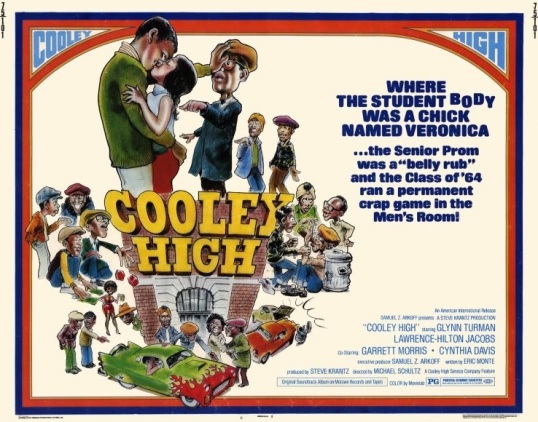
Back to School #17: Cooley High (dir by Michael Schultz)


http://www.youtube.com/watch?v=tmw1Llp92PU

For our next entry in Back to School, we take a look at a film that is often referred to as being a “black American Graffiti,” 1975’s Cooley High.

Cooley High follows the adventures of two lifelong friends who are both seniors at Edwin G. Cooley Vocational High School in Chicago, Illinois.  The charismatic Cochise (Lawrence Hilton-Jacobs) is a popular and friendly basketball star.  Meanwhile, Preach (Glynn Turman) is an aspiring writer who, despite his obvious intelligence, is also one of the worst students at the school.  Preach divides his time between skipping school, gambling, and writing poetry.  Alone among their friends, Cochise and Preach both seem to have a chance to escape from life in the projects.  At the start of the film, Cochise has just received a scholarship to play basketball in college.  As for Preach, he’s the eternal optimist.  He knows he’s going to make it, even if he doesn’t seem to be quite sure how he’s going to do it.

For the first half of the film, Cooley High is largely a plotless collection of vignettes featuring Cochise, Preach, and their friends skipping school, chasing girls, getting into minor trouble, and trying to avoid major trouble.  The emphasis is on comedy but, unlike a lot of high school comedies from the 70s and 80s, the humor grows organically from the characters.  Facing a future that’s likely to be dominated by prejudice, poverty, and limited opportunity, what can the students of Cooley High do other than laugh?  The second half of the film takes a far more dramatic turn, with Preach and Cochise accused of both stealing a car and snitching on the actual thieves in order to get out of jail.  The film’s downbeat conclusion may be predictable but it’s effective all the same.

One reason why I wanted to review Cooley High is because a few months ago, while I was trying to find something to watch on TV, I came across an episode of a show called Unsung Hollywood.  The title of the episode was “The Story of Cooley High” and it told the story of how and why this film was made.  It was actually pretty interesting to watch, as it featured interviews with screenwriter Eric Monte (who based the character of Preach on himself), director Michael Schultz (who directed a lot of memorable films in the 70s — including Sgt. Pepper’s Lonely Hearts Club Band — but has never quite gotten the recognition that he deserves), and the film’s two stars.  Even more interesting, however, were the interviews with the local Chicago residents who essentially played themselves during the filming of Cooley High.  Some of them had fond memories of appearing in the film while others were upset that the film’s box office success didn’t open up any new opportunities for them.  Most haunting of all was the fate of an amateur local named Norman Gibson.  After giving a genuinely good performance as a petty criminal who comes to a violent end in Cooley High, Gibson was murdered a year after the film was released.

As I mentioned before, Cooley High is often compared to American Graffiti and the two films do have some things in common, like the period setting and a great soundtrack.  Ultimately, though, Cooley High can stand on its own.

cooley

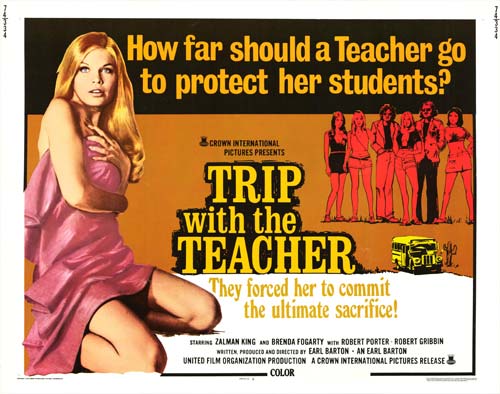
Back to School #16: Trip With The Teacher (dir by Earl Barton)


Trip With The Teacher

(MINOR SPOILERS)

First released in 1975 and subsequently included in a few hundred DVD box sets, Trip With The Teacher is yet another strange film from Crown International Pictures.

CIP_Logo

The film opens with a school bus driving through the California desert.  On board the bus is Miss Tenny (Brenda Fogarty) and four teenage girls.  One thing that I immediately noticed is that director Earl Barton — perhaps realizing that none of the girls had really been given any sort of individual personality — took the time to make sure each of the girls was color-coded so that the audience could keep them straight.  One is dressed in all blue, another in all green, and then another is wearing an unfortunate canary yellow.  Meanwhile, Julie (Cathy Worthington) is obviously meant to be the main girl because she’s allowed to wear not one but two colors — yellow and white.  When we first meet this group, we’re told that they’re on a field trip to see some Navajo ruins but, later on in the film, Julie says that they’re on a camping trip that has nothing to do with school beyond the presence of their teacher.  But the important thing is that they’re on a bus in the middle of the desert.  (The bus, by the way, is being driven by Marvin, who is played by an actor named Jack Driscoll and who might as well have “doomed” tattooed on his forehead.)

Also in the desert are two motorcycle-riding brothers — goofy Pete (Robert Porter), who has a big mustache and seems like a nice guy up until he starts trying to kill people, and Al (Zalman King), who is surly, wears weird sunglasses, and suffers from narcolepsy.  When Pete gets a flat tire out in the middle of the desert, he’s helped out by a passing motorcyclist named Jay (Robert Gribbin).  (Al sleeps through the entire encounter.)  Jay, who is oddly friendly and talkative, decides that he’ll ride along with these two strangers.

I’ve seen Trip With The Teacher a few times and I have to say that I have never really been able to figure out what’s supposed to be going on with Jay.  He’s the film’s nominal hero but Robert Gribbin plays him as being such a talkative and outwardly friendly character that my natural impulse is to distrust him.  Maybe I’ve seen too many films where the good Samaritan always turns out to be a psycho but Jay is simply too good to be true.

The Way Too Friendly Jay

The Way Too Friendly Jay

Briefly, this suspicion seems to be confirmed when Jay, Pete, and Al come riding up on the school bus and Jay sees Julie through a window.  Julie smiles and waves at Jay and I don’t blame her because I probably would have done the same thing, because Jay is cute, motorcycles are sexy, and you have to do something to pass the time while you’re being driven through the desert.  But then 30-something Jay smiles and starts to wave back at 16 year-old Julie and mouths something like, “Come over here!” before flashing a huge grin and the scene gets undeniably creepy.

(The creep factor is not lessened by Jay later telling Pete, “Gee, that Julie is a really cute girl.”)

Anyway, when the school bus eventually breaks down, the three motorcyclists stop to “help.”  In this case, helps means that Pete and Al use their motorcycles to tow the bus to a remote desert cabin.  After a fight that leaves Marvin dead, Pete and Al decide to take the teacher, the girls, and Jay hostage until they can figure out what to do….

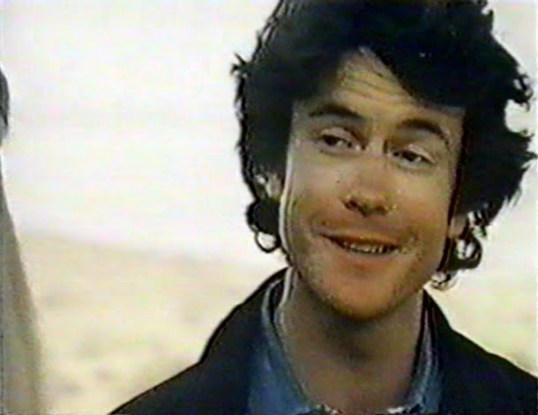
Now, I said earlier that Trip With The Teacher is weird and, believe it or not, it’s not just because of Jay.  In the role of Al, future director Zalman King gives one of the oddest cinematic performances that I have ever seen.  King alternates between underplaying and overacting, randomly going from mumbling to such an extent that you can barely understand him to literally yelling out every single line.  It’s a performance that is so strange that it transcends such mundane concepts as good or bad.  Single-handedly, Zalman King creates a reason for people to actually sit through Trip With The Teacher.

Zalman King in Trip With The Teacher

Zalman King in Trip With The Teacher

The other odd thing about Trip With The Teacher is that, despite all of the bad things that happen on screen, the film features some oddly cheerful music.  The film’s theme song is played over the end credits, which  juxtaposes the music with scenes from the movie.  It’s an odd experience, watching all of these tense scenes play out while listening to that cheerful music.

And you can watch those end credits below!  (This, needless to say, is where the spoiler warning comes into effect.)  In order to get the full effect, be sure to stick with the credits all the way until the music stops playing.

(A quick warning: Though Trip With The Teacher is actually pretty mild as far as 70s grindhouse and drive-in films are concerned, the end credits still feature a few images that some may find disturbing — especially if you haven’t actually seen the film.  Once you’ve actually sat through the film and can put everything in context, it’s pretty much impossible to take any of it seriously.)

Back to School #15: Horror High (dir by Larry N. Stouffer)


Horror High

So, you knew when I started this series of Back to School reviews that I would eventually end up reviewing a horror film or two.  Whether it’s because they were written and directed by people still bitter over being teenage outcasts or because they were produced by people who were smart enough to realize that a lot of horror fans are still students, several horror films have been set in the world in high school.

Take, for instance, the 1974 film, Horror High.

Horror High tells the story of Vernon Potts (Pat Cardi), who is the smartest student at his high school.  However, it’s debatable how much of an accomplishment that is because, in this low-budget film, it appears that there’s only 6 or 8 students at the school.  Regardless, Vernon’s combination of intelligence, acne, and social awkwardness have come together to make him the school outcast.  Not only do Vernon’s fellow classmates make fun of him but the janitor threatens to kill him, the football coach orders him to help the team cheat, and his English teacher destroys Vernon’s biology homework.  Vernon’s only friend is a guinea pig named Mr. Mumps.  Vernon eventually gives Mr. Mumps an experimental serum that turns Mr. Mumps into a murderous monster.  Unfortunately, the janitor subsequently kills the guinea pig but, in the process, he also forces Vernon to drink the serum, which leads to Vernon occasionally turning into a monster himself.  On the bright side, Vernon does eventually get to date the girl he has a crush on, largely because she’s single now that Monster Vernon has killed her boyfriend…

Horror High is one of those low-budget films that is so extremely odd that it can’t help but have an oddly dreamlike power to it.  This is one of those cases where the total lack of narrative logic actually works to the film’s advantage.  Pat Cardi makes for a believable outcast and everyone else in the cast is properly despicable.  As ludicrous as the plot may be, the film itself is full of a palpable atmosphere of dread and doom.  I’ve seen a lot of bad high schools in a lot of low-budget horror films but it’s hard for me to think of one that was quite as nightmarish as the one in Horror High.

Incidentally, Horror High was filmed in my home state of Texas, in the wonderful city of Irving!

And you can watch it below!

http://www.youtube.com/watch?v=zAjFFtZY3NE


Back to School #14: The Teacher (dir by Howard Avedis)


3df3d

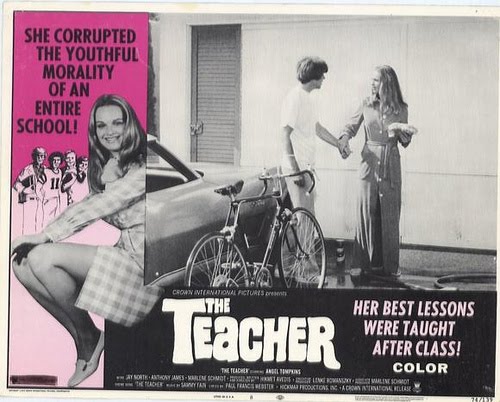
“She Corrupted The Youthful Morality of an Entire School!” the tagline for the 1974 film The Teacher screams out.

Uhmmm, no.

In fact, that’s probably one of the most deceptive taglines in the history of film advertising.  However, we shouldn’t be surprised that it was used.  Like The Young Graduates, The Teacher was produced by Crown International Pictures.  Crown International was all about getting people to buy tickets and they probably figured that more people would pay to see a movie about a teacher corrupting “an entire school” than they would for a film about a 28 year-old teacher having an affair with one (and only one) 18 year-old who has recently graduated high school.

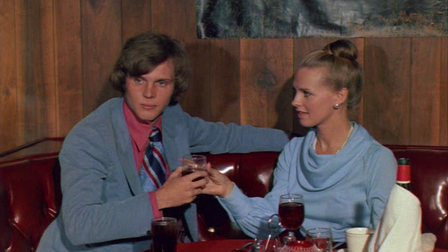
The relationship is between Diane (Angel Tompkins) and Sean (Jay North).  Diane lives next door to Sean’s family.  She’s married to a man who spends most of his time on the road, racing motorcycles and only occasionally calling his wife.  Diane is a teacher but we only briefly see her standing outside of the local high school.  While Sean admits that he has always had a crush on her and, at the start of the movie, even spies on her while she’s sunbathing, it’s never made clear whether or not Sean was ever actually in any of her classes.  In fact, the only thing controversial about their eventual relationship is that there’s a 10 year age difference between them.  But that really doesn’t seem to bother anyone, with the exception of two old women who happen to see Diane and Sean out on a date.

Teacher and Not A Student

Teacher and Not A Student

That, of course, doesn’t mean that Diane doesn’t have anything to teach Sean.  As the film’s theme song tells us, “Every boy needs a teacher, to help show him the way…”

But here’s the thing.  Considering how tawdry one would naturally expect a film like The Teacher to be, it’s actually treats Diane and Sean’s relationship with a lot of sensitivity.  Tompkins and North have a lot of chemistry together and both of them give natural and believable performances.  In many ways, this film is a sincere attempt to explore an unlikely relationship.  I’ve always felt that in almost every 70s exploitation film, there’s an art film waiting to break out.  That’s certainly the case with The Teacher.

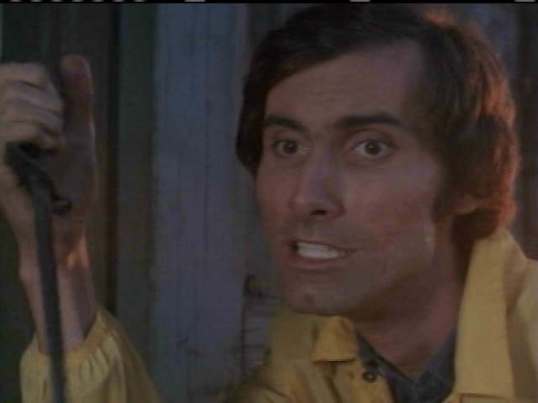
However, The Teacher isn’t just about Diane “teaching” Sean.  It’s also about a guy named Ralph, who also happens to be obsessed with Diane.  (When, at the start of the film, Sean is spying on Diane, little does he suspect that Ralph is spying on him.)  We know Ralph is a bit off because he’s always talking to himself, he drives a hearse, and he’s played by Anthony James.  You may not recognize his name but if you’re a fan of 70s and 80s exploitation cinema, you know who Anthony James is.  He’s one of those very intense, very creepy-looking character actors who would always show up playing psychos and evil henchmen.

Anthony James

Anthony James

Ralph is not only obsessed with Diane but he also blames Sean for the death of his younger brother.  It seems that Sean and Ralph’s brother were spying on Diane when, somehow, Ralph’s brother ended up falling to his death.  (If you get the feeling that literally every male in this film appears to spend the majority of his time watching Diane — well, you’re right.)  Ralph wants vengeance and, in his defense, Sean never really does seem to be that upset about the death of his best friend.

Because this film was made in the 70s, it all leads to surprisingly somber ending that will probably inspire you to reconsider any belief you may have in a benevolent God.

I have to admit that, out of all the Crown International films that I’ve recently watched, The Teacher was a favorite of mine.  Watching the film — with its constantly shifting tone and it’s mix of arthouse pretension and grindhouse melodrama — is an odd experience that epitomizes everything that I love about old exploitation films.

Thank you, Crown International, for always being you.

CIP_Logo