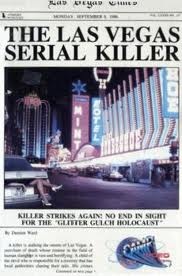
As we painstakingly established around these parts a few days back, The Hollywood Strangler Meets The Skid Row Slasher was not exactly Ray Dennis Steckler’s finer hour (okay, hour and ten minutes). It’s a definite head-scratcher of a movie, to be sure, but as mind-bogglingly weird as Steckler’s idea to shoot a silent slasher flick on a budget of $1,000 in 1979 was, that decision seems positively logical in comparison to his decision to actually make a sequel to said silent $1,000 slasher flick seven years later!
Still, in 1986, for reasons known only to the the pseudonymous “Cash Flagg” himself, that’s exactly what he did. Sort of. I think.
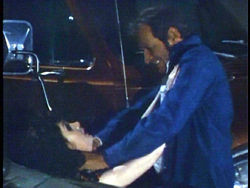
The setup here is, as you might expect, something of a puzzler in spite of its simplicity. Pierre Agostino is back as our strangler, but he’s called “Johnathan Glick” rather than “Johnathan Click,” and his stomping grounds have changed from Tinseltown to Sin City. He’s let out of the joynt on the flimsiest technicality you can possibly imagine — they never found any bodies, so his convictions for a series of murders are all overturned — and he hits the streets again and starts killing.
Now, that might seem to make sense apart from the inexplicable swapping of the C in the character’s last name for a G, but that’s really just the tip of the iceberg. What’s he doing in prison in Nevada when his kill-spree took place in California, for instance? And, oh yeah — what he even doing alive, since he was murdered by the Skid Row Slasher at the end of the last one?
You begin to see the problem here. But “problems” are a relative concept, I suppose, and the logical gaps in the story’s basic premise are absolutely nothing compared to the problems in this film’s pacing and execution.
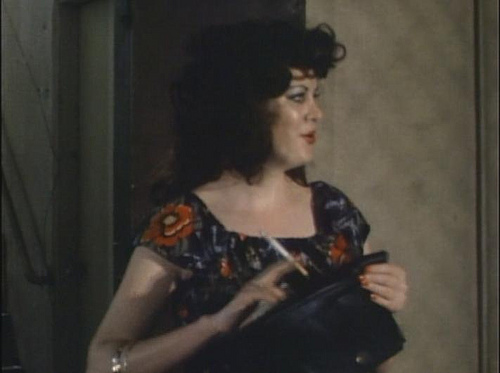
Steckler, here operating once again under his “Wolfgang Schmidt” nom de plume, has opted, no surprise at this point, to shoot the proceedings without sound — but instead of just telling the whole story via voice-over narration, he’s dubbed in actual, honest-to-goodness dialgoue in this one, and it’s never synched up even close to properly. Not that it really matters, because no one’s saying anything interesting — and nothing interesting is happening, either, with Click/Glick/whatever cruising downtown Vegas, the Strip, and neighborhood streets for ladies to choke with his bare hands. It’s, as you’ve no doubt come to expect, a pretty drawn out and tedious affair, and the killings themselves, when they do finally happen after interminable set-up periods, are all uniformly blase and aggressively nondescript.
Then we’ve got the subplot about two low-rent hoodlums who stand around making cat-calls at women, snatching their purses, and taking long lunch breaks. They always seem to show up in roughly the same locales as G(C)lick, and at roughly the same times, but their importance — and I use that term very loosely, trust me — to the goings-on isn’t fully explained until very nearly the end, at which point you’ll have long since stopped giving a shit, and this little “revelatory twist” is so underwhelming that it would almost be insulting if you weren’t so begrudingly impressed at Steckler’s bravado for thinking he could get away with an “explanation” so lame.
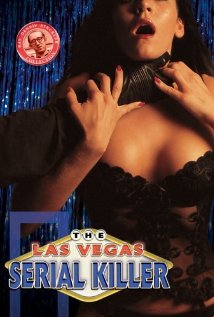
Unleashed on a by-and-large uncaring populace via the straight-to-VHS route, The Las Vegas Serial Killer is, naturally, available on DVD these days (it’s presented full-frame with mono sound, both of which are, I guess, adequate enough all things considered), and while Media Blasters, under their Guilty Pleasures sublabel, have given us a nice (-r than this flick deserves) set of extras, including an on-camera interview with the director and a full-length commentary track where he opines at length on the making of the production, at the end of the day it still makes no sense, simply because all the explanation in the world couldn’t begin to shine any light on why this was made and who Steckler thought his audience was.
Shit, I’ve seen this thing a few times now, and I’m still none the wiser. Is it a sequel to The Hollywood Strangler Meets The Skid Row Slasher? Is Agostino playing the exact same guy? How did he manage to survive when it sure as shit looked like he was dead? Why was he doing his time in a state other than that in which his (first) crimes were committed?
Fortunately, all of these questions have the exact same, simple answer — it doesn’t matter.
 Finally, we have the first official full trailer for the sequel to 2010’s surprise animated hit Despicable Me. The first two trailers were more teasers and sort of more like Minion-centric showcases.
 Through the Shattered Lens