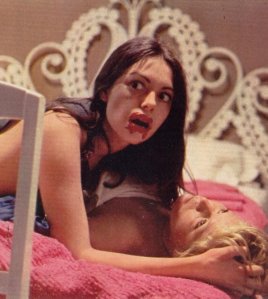
The Daily Grindhouse (Horror Edition): Female Vampire (dir. by Jess Franco)


My wonderful and loyal readers, I fear that I have failed you.  How is it, with my love of both grindhouse and Eurosleaze cinema, that I have yet to review a Jess Franco film on the site?  Halloween seems to be the perfect time to correct that oversight by taking a look at Franco’s infamous 1973 horror film, Female Vampire.

To truly “appreciate” a film like Female Vampire, it helps to know a little something about Jess Franco.  Working under a variety of pseudonyms, Spanish-born Jesus Franco Manera has been making films for over 60 years.   Among critics, Franco is usually either dismissed as a total hack (and/or pervert) or embraced as the living embodiment of the auteur theory.  Though no one’s quite sure how many films Franco has directed, Franco himself has estimated that he’s directed more than 200 films and, for the most part, he has financed and distributed them all on his own.  Franco has worked in every genre from thriller to comedy to hardcore pornography, but he is probably best known for directing low-budget, occasionally atmospheric erotic horror films like Female Vampire.

The opening of Female Vampire pretty much epitomizes everything that people love and hate about Jess Franco as a director.  The film begins with a series of ominous shots of a misty forrest.  The forest feels both beautiful and desolate at the same time and Franco’s camera lingers over the fog, building up an atmosphere of both mystery and melancholy.  Suddenly, we see one lone figure walking through the forest.  Irina (played by frequent Franco star Lina Romay) emerges from the fog, naked except for a cape and a belt.  The camera follows Irina as she walks through the mist.  When Irina stops and faces the audience, the camera zooms in to a close-up of her face and her body.  While Franco’s aim here is obviously to cater t0 the sexual fantasies of his predominately male audience, it’s still a remarkably strong scene because Romay faces the camera with such confidence that her nudity feels less like exploitation and more like empowerment.  (Romay was, like me, a self-described exhibitionist.)  Once Franco’s camera zooms away from Irina, she then starts to confidently approach the camera (and the audience as well).  She gets closer and closer to the camera until finally … she accidentally bumps her head on the lens.

That, for lack of a better example, totally sums the aesthetic of Jess Franco.  When you watch a Franco film, you’re left with the impression that Franco simply turned on the camera and recorded whatever happened to happen in front of it.  Occasionally, he managed to capture something unique and dramatic and just as often, he filmed someone bumping into the equipment or staring straight at the camera.  Whether he liked the spontaneity that came from an unexpected mistake or he just didn’t have enough money in his budget to do a second take, Franco would more often than not include these mistakes in his final film.

As for the rest of Female Vampire, it’s eventually established that. along with being a vampire, Irina is a countess and also a mute.  (At one point, we do hear her inner thoughts, a monologue in which she tells us, “I earnestly wish an end would come to this bloody race I am forced to run.”)  Several different cuts of Female Vampire have been released over the years and depending on which version you see, Irina either has to either regularly drink blood or drink semen in order to survive.  (“It was as if his potency was sucked out of him,” as the coroner puts it.)

While Irina spends all of her time wandering around a depressing resort town and seducing various victims, a poet (Jack Taylor) searches for her.  This poet — who spends a lot of time staring off into the distance and delivering inner monologues about walking down this road we call life — is determined that he and Irina are meant to be together.

There are many different version of Female Vampire currently in circulation.  For instance, a heavily-edited version was released in the U.S. as The Bare-Breasted Countess.   While Franco’s director’s cut lasts close to two hours, there are other versions that barely clock in at 70 minutes.  There’s a hard-core version, a soft-core version, and even a version that features close to no sex at all.  The version I saw was the DVD released by Image Entertainment.  That version is reportedly close to Franco’s original.

As is typical for a Franco film, not much happens in Female Vampire and what does happen doesn’t make much sense.  But, oddly enough, that actually worked in the film’s favor.  By ignoring things like plot and logic and by focusing on the film’s visuals, Franco made a film that literally feels like a dream.  Every scene is filled with an atmosphere of pure ennui and, when coupled with charisma of Lina Romay and Jack Taylor,  the end result is a film that’s strangely compelling.

James Bond Film Review: The Man With The Golden Gun (dir. by Guy Hamilton)


Hi there!  The name’s Bowman.  Lisa Marie Bowman.  Yes, I’ve made that joke a few times over the past two weeks but so what?  Let me have my fun!  And speaking of fun, we’ve been reviewing the entire James Bond franchise here at the Shattered Lens.  Today, we’re going to take a look at 1974’s The Man With The Golden Gun, the 9th “official” James Bond film and the second Bond film to feature Roger Moore in the lead role.

The Man With The Golden Gun is Francisco Scaramanga (Christopher Lee), the world’s most feared assassin.  Living on his own private island, Scaramanga is waited on hand-and-foot by a murderous dwarf named Nick Nack (Herve Villechaize) and his mistress Andrea Anders (played by Maud Adams, who, like me, is a member of the red-headed 2%).  Every few days or so, Nick Nack arranges for a different gangster or spy to come to the island and fight a duel with Scaramanga.  Much to Nick Nack’s disappointment, Scaramanga always manages to win each duel.  However, Scaramanga remains a frustrated assassin because he’s never had the chance to take on (and kill) his hero, James Bond.

Just how obsessed is Scaramanga with Bond?  Scaramanga has his own private funhouse set up on the island and the star exhibit at that funhouse is a wax figure of Bond that Scaramanga enjoys firing golden bullets at.

Meanwhile, in London, MI6 receives one of those golden bullets with “007” etched into the surface.  M (Bernard Lee), not wishing to see his best agent killed, immediately relieves Bond from his current mission.  Bond, along with a painfully dizzy British agent named Mary Goodnight (played by Britt Ekland), responds by setting off to track down Scaramanga on his own.

Bond eventually tracks Scaramanga down to Bangkok where Scaramanga is busy scheming to steal something called a Solex agitator which, depending on who is using it, can either be the key to solving the energy crisis or it can be a deadly, solar-powered weapon.  Bond also discovers that the bullet wasn’t sent by Scaramanga but was instead sent by Andrea who wants Scaramanga dead.

Not surprisingly, this all leads to what you would expect — an elaborate car chase, a Bond girl in a bikini, and a final duel between Bond and Scaramanga.

When The Man With The Golden Gun was first released way back in 1974, the film received some of the worst reviews in the Bond franchise’s history.  A typical review came from Time Magazine’s Jay Cocks who complained that Moore “lacks all Connery’s strengths and has several deep deficiencies”, whilst Lee was “an unusually unimpressive villain.”  In a complaint that would be made about the majority of the post-Connery, pre-Craig Bond films, Cocks also criticized the film’s plot for being too dependent on both Bond and Scaramanga using implausible gadgets.

While most of the Bond films were treated dismissively by critics when they were first released, the majority of them have also come to be seen in a more positive light  as the years have passed.  The Man With The Golden Gun, however, is an exception to that rule.  Nearly four decades after first being released, The Man With The Golden Gun still has a reputation for being a disappointment.  While Christopher Lee has rightly come to be recognized as one of the best Bond villains, the film itself is still regularly dismissed as one of the worst of the Bond films.

The Man With The Golden Gun‘s flaws are pretty obvious.

As played by Britt Ekland, Mary Goodnight is perhaps one of the most useless Bond girls ever and pretty much confirms every accusation of sexism that’s ever been made against the Bond films.  It’s hard not to wish that the role of Goodnight had been played by Maud Adams who, as Andrea Anders, proves to be one of the best of the Bond femme fatales.

Redneck Sheriff J. W. Pepper (Clifton James) was an acquired taste when he first showed up in Live and Let Die and those who were annoyed by his character the first time will probably not be happy when he implausibly pops up in this film, vacationing in Bangkok and somehow getting involved in yet another car chase.

Finally, while Roger Moore’s performance as James Bond has always been rather underrated, it’s hard to deny that he looks a bit ill-at-ease in this film.  As opposed to Live and Let Die (which was clearly written to match Moore’s interpretation of the role), The Man With The Golden Gun feels like it was written for Sean Connery’s more ruthless interpretation of the role.  There’s a rather ugly scene where Bond roughly slaps Andrea to get her to tell him about Scaramanga.  It’s the type of thing that you could imagine Connery doing without a second thought but Moore seems uncomfortable with it.  His Bond simply doesn’t have the sadistic streak that hid underneath the surface of Connery’s interpretation.

That said, The Man With The Golden Gun is something of a guilty pleasure of mine.  The Man With The Golden Gun is one of the Bond films that I always make a point to catch whenever it shows up on television and I certainly had a better time rewatching it than I did when I rewatched You Only Live Twice.  The film moves along quickly enough, the car chases are a lot of fun, and Scaramanga’s funhouse is one of the best of the Bond sets.  

For all of its flaws, The Man With The Golden Gun is saved by its trio of villains. Maud Adams, Herve Villechaize, and especially Christopher Lee give three of the most memorably eccentric performances in the history of the Bond franchise.  They’re so much fun to watch that, if spending time with them also means spending time with Mary Goodnight and Sheriff Pepper, it’s a sacrifice that I’m willing to make.

The strength of Christopher Lee’s performance as Scaramanga cannot be understated.  There’s something oddly touching in the contrast between Scaramanga the steely assassin with the golden gun and Scaramanga, the insecure killer who is apparently always comparing his accomplishments to the accomplishments of James Bond.  Lee’s Scaramanga is such a compelling character that you almost regret that he can’t, in some way, be allowed to achieve some sort of victory at the end of the film.

But, of course, if that happened then it would no longer be a James Bond film.

As always, regardless of what the critics may have wished, James Bond would return.  Ironically, Moore would follow-up a what many considered to be the worst James Bond adventure with a film that many consider to be one of the best.  We’ll be taking a look at The Spy Who Loved Me tomorrow.

Until then, let’s enjoy one of the most underrated theme songs in the history of the Bond franchise.

Anime You Should Be Watching Horror Edition: Hellsing Ultimate


Two posts in one month?  What sort of madness is this?  Well, I’ve been drinking a lot, so makes sense that I should attempt to ramble here where I have free reign to do so.  But never mind that, what’s important here is that in addition to my aforementioned Another, if you’re going to watch another horror anime this month, you should give serious consideration to Hellsing Ultimate.

Now, let’s be clear on one important fact.  I’m talking about the OAV series, as opposed to the TV series which came out 3 years prior to the much better OAV series.  The main problem with the TV series was that it came out when the manga was proving to be popular, however, Kouta Hirano was a very slow writer.  In fact, the manga was only a 10 volume series, yet it ran from 1997 until 2008.  For the math challenged among us, that’s 11 years to release 10 volumes of manga.  To give you all a very relevant comparison, another series that I’ve wrote about, One Piece, also started in 1997.  To date, One Piece has produced 67 volumes.  Even if we say that Eiichiro Oda is a freak of nature, most normal mangaka would produce three times what Kouta Hirano did in the same amount of time.  The point being that the original TV series came out early on in the run of the manga, so the ending has absolutely nothing like the manga.  Now, the OAV series was able to take its time and wait on the source material.  Hence, why I’m insisting that if you watch any Hellsing show, you should make it the OAV series.  It’s much more faithful to the manga, and while that doesn’t mean the TV series is bad, when compared against the original it just doesn’t hold up.

So, the long and short of Hellsing is that vampires are real.  Very real.  So what is your average person to do against such a threat?  Don’t expect your average army to save you.  Oh no, what you need is what the British government has.  You need the Hellsing Organization.  What makes the Hellsing Organization able to handle these freaks of nature better than your average army?  Well, they have themselves a trump card known as Alucard.  Anyone that has ever played a Castlevania game should know that name, but if you don’t, well then beware because I”m about to drop a very obvious spoiler on you.  See, Alucard is actually Dracula backwards.  GASP!  So, now do we understand why the Hellsing Organization is badass?  But Alucard is not the sort who cares to do all the work himself.  Not that he can’t, just he’s not above recruiting those in whom he sees potential.  And doesn’t every master want a pupil?  That’s largely why he “recruits” Seras Victoria as his student by turning her into a vampire as well.  In the TV series, Seras is shown almost as the main protagonist, while in the OAV series she shares the spotlight with Alucard and their boss, Integra Hellsing.

But it’s no fun if the protagonist is unbeatable and has no rival.  Well, enter Father Anderson.  Not only is he opposed to Alucard, but his group is entirely opposed to the whole Hellsing Organization.  See, the Hellsing Organization basically represent the Anglican Church, while Father Anderson represents the Catholic Church.  But this isn’t some regular human that miraculously is able to hang with a vampire.  Oh no, Father Anderson has a few tricks up his sleeve.  I could go on, but I’d say this video best sums up what kind of man he is.

But all that is just a taste of what’s to come.  A huge part of the divergence between the TV series and the OAV is that the overall villain is not really described in the TV series.  In the OAV, we find out that who the Hellsing Organization is ultimately fighting is not the Catholic Church as was hinted at this that video, but rather remnants from the Nazi party.  Yes, if the Nazis had access to this kind of army, World War II might have turned out vastly different.  Make no mistake though, this in no way tries to make the Nazi party out to be cool.  Every person involved with the Nazis are batshit insane.  It’s hard to say that there’s a “good guy” here, but certainly the Nazis are not them.  But isn’t that the worst kind of villain?  The ones who are fully aware that what they’re doing is pure evil and they just plain don’t care?  That’s exactly how the Nazis here are portrayed.  They’re not supposed to be misguided idealists, or innocents brainwashed against their will.  No, they know what they’re doing, what they represent, yet they don’t care.  They love it and embrace it, and they are shown to be completely nuts.  And frankly, that’s the only way this could work, because Alucard and the Hellsing Organization themselves are not, nor are they trying to be, paragons of virtue.  I mean, they rely on the power of vampires, and while Seras occasionally has some qualms about what she does, Alucard never cares if so called innocents are killed in the pursuit of his enemies.  The entire lack of caring for human life makes it very difficult to label any one group as good or evil.
So, I’ll readily admit that as far as “Oh hell, I just wet myself” type of horror goes, this doesn’t really fit the bill.  But really, do most people consider Dracula to be a horror movie?  Most would.  This is in the same vein as that.  It’s horror in that “Look at all these people being slaughtered, isn’t that horrible?” sort of way, and not in the freak you out sort.  The fact remains that this is a very well written anime.  Also, a fun fact is that this shares a link with another manga/anime, High School of the Dead.  It may not be readily apparent, but look at the character names in HSotD and then look at the name of the author of Hellsing.  See if there are any similarities.

All in all, Hellsing is a very entertaining show, and it could at times be considered gore porn more than a horror anime.  But, there’s little doubt that either way it’s definitely an anime worth watching.

Horror Film Review: Sinister (dir. by Scott Derrickson)


Sinister is the scariest film of 2012.

That’s not the way that I wanted to start this review because calling any film the best or the worst or the scariest reeks of hyperbole.  But, in the two weeks that since I first saw Sinister, I have not been able to get the film out of my head.  Sinister is not only a horror film.  It’s also a deeply disturbing experience that inspires you to keep an eye out for mysterious shadows while you’re leaving the theater.  As opposed to the similar Paranormal Activity films, Sinister remains scary even after the film itself has ended.  Sinister is like Insidious without that terrible ending.

In short, Sinister is the scariest film of 2012.

Sinister opens with a genuinely disturbing sequence, in which we see a family of four, standing next to a tree.  All of them are wearing bags over their heads, all of them are bound by tape, and all of them have a noose around their neck.  One of the tree’s limbs is sawed off by an unseen person, causing all four of our victims to be lifted up in the air and slowly strangled to death.  The grainy footage has the look of an old home movie and the whole scene has a sickeningly authentic feel to it.

Months later, Ellison Oswalt (Ethan Hawke) and his family move into the house where the murders previously occurred.  Ellison is a formerly succesful true crime writer who is desperately trying to come up with the bestseller that can revive his career.  He plans to write about the murders that occurred in the backyard of his new home but he neglects to tell his new family that they’re living in a murder house.

While exploring his new home, Ellison discovers a mysterious box in the attic.  The box contains a film projector and several reels of film.  Late at night, Ellison locks himself in his office and watches the films.  He discovers that each reel of film contains two scenes.  In the first scene, we see a happy family spending time together.  In the 2nd scene, we see that same family being brutally murdered in a way that provides a macabre comment on what they were previously seen doing.  For instance, a film entitled “Pool Party ’66,” starts with a family happily playing in a pool and ends with them being drowned.  “BBQ ’79” opens with a family barbecue and ends with that same family being burned alive in their car.

As Ellison investigates, he finds himself becoming more and more obsessed with the macabre home movies and it starts to become obvious that Ellison is a bit unstable himself.  Meanwhile, his son is having night terrors, his daughter is painting pictures of people hanging from a tree, and the local sheriff (played by Fred Thompson, the former presidential candidate) is encouraging Ellison to abandon his book and just leave town.

Oh, and little pasty-faced children are showing up in the house, standing in darkened corners and scowling at Ellison and his family…

There’s only so much that I can say about Sinister without giving away too much of the film’s plot.  Sinister may start out feeling like the 100th rip-off of Paranormal Activity but, much like last year’s Insidious, it eventually takes off in a direction of its own.  Hawke gives a memorably unhinged performance and, unlike so many other horror films, Sinister actually follows through on all of its dark potential.  Sinister ends with a twist that’s so disturbing and unnerving that I have yet to get out of my head.

If you’re looking for the scariest movie playing in theaters this Halloween, Sinister is it.

James Bond Review: Live and Let Die (dir. by Guy Hamilton)


One year and one day ago the very first James Bond film to star Sir Roger Moore, Live and Let Die, in the title role was reviewed by Lisa Marie, and now it’s time to revisit the eight official film in the series.

With the previous Bond entry, Diamonds Are Forever, we finally see Sean Connery run out of gas when it came to playing the title role of James Bond. Yet, despite the obvious boredom Connery was having in the film the producers of the series were still wanting him to come back for another Bond film. Maybe it was his experience during the production of Diamonds Are Forever or Connery finally decided it was truly time to go the series’ producers didn’t get their wish and were in a rush to find someone new to wear the mantle o Agent 007.

They finally found their new James Bond in the form of English-actor Roger Moore and production on Live and Let Die began soon after.

Roger Moore, for me, has always been the start of the less serious, but much more fun era of the James Bond franchise. His films still had the intrigue and action of the Connery-era, but the writers and producers of the series put in more one-liners and humor in the story. We begin to see the start of this in the previous Bond film (not handled as well and came off as awkward at times), but it was in Live and Let Die and in Roger Moore that this change in the series’ tone finally hit it’s stride.

The film dials back the global domination attempts by the series of villians both SPECTRE and not. This time around Bond must investigate the deaths of three MI6 agents who had been investigating one Dr. Kananga, the despot of the fictitious Caribbean island of San Monique. Kananga (played by Yaphet Kotto) also has an alter-ego in the form of Mr. Big who runs a series of soul food restaurants as a front for his drug business. Every Bond film always tries to out-elaborate the previous one with it’s villains plans. There’s no attempts by Kananga/Big to dominate the world. His plans are pretty capitalistic in a ruthless sort of way. He wants to corner the drug market in the US by flooding the illegal drug market with his own heroin which he plans to give away for free thus bankrupting the other crime lords and drug dealers.

This plan by Kananga actually looks to be very sound and it helps that he has the beautiful seer Solitaire (played by a young and beautiful Jane Seymour) to help him outwit ad stay ahead of his competitors and the law. His plan would’ve succeeded if not for the meddling of one British super-spy named James Bond.

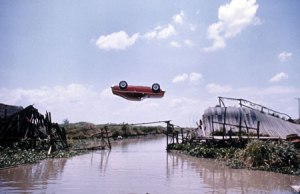
Live and Let Die might not have been as serious about it’s story as the early Connery films, but it definitely had a much more faster pace with more action to distinguish Moore from Connery. One particular famous action sequence involves Bond escaping from Kananga’s drug farm in the Louisiana Bayou country being chased not just by Kananga’s henchmen but by the local police in the form of Sheriff J.W. Pepper who plays the role of fool and comedy relief in the film. Even the smaller action scenes in the film had more life and fun to them like Bond escaping a gator pit by timing a run across the backs of a line of gators to safety.

Where the previous bond film’s attempt at injecting humor and more action into the story were more failures than successes in this film Roger Moore Bond film they worked in due part to Moore’s playful delivery of the one-liners and bon mots the role has become known for of late. Any trepidation that audiences and producers might have had about  Moore taking on the role that had been made famous by Connery  soon went away as this film played out.

Live and Let Die still remains my favorite of all the Roger Moore Bond films and saw it as the highlight of his time playing the character. While the follow-up films were good in their own right it was this initial Moore entry in the series where the writers, Moore and veteran Bond filmmaker Guy Hamilton were able to find the perfect balance of thrilling action and humor that the rest of the Moore-era films couldn’t replicate.

Next up for James Bond…The Man with the Golden Gun.

What Lisa Marie Watched Last Night #55 (Horror Edition): South Park S16E12 — A Nightmare On Face Time


Last night, like all good people, I turned over to Comedy and I caught the annual South Park Halloween episode.

Why Was I Watching It?

Because it was South Park, of course!

What Was It About?

It’s Halloween in South Park and Randy Marsh has just spent $10,000 to buy the deserted Blockbuster Video Store.  Randy drags his family down to their new store and puts them to work, sorting films left over from the late 90s and the early 21st Century.  Despite getting absolutely no costumers (and the fact that the theme from Kubrick’s The Shining keeps playing in the background), Randy remains convinced that DVD rental remains the way of the future.  Even though his family doubts him, Randy finds some comfort with the ghosts who live in the Blockbuster and who encourage him to go on a Jack Nicholsonesque rampage.

Meanwhile, Stan, Kyle, Kenny, and Cartman have come up with the perfect plan for Halloween.  Each one of them is going to dress up like a member of the Avengers and, as a group, win the town’s costume contest.  However, when Stan is forbidden to leave the Blockbuster by an increasingly insane Randy, Kyle is forced to use Face Time on his and Stan’s Ipads so that Stan can literally be in two places at once.   Cartman, meanwhile, has to deal with the fact that everyone in town thinks that he’s wearing a green Honey Boo Boo costume.

While out trick or treating, the boys come across a group of criminals who are robbing Redbox kiosks.  The criminals, already frustrated by the fact that nobody uses Redbox anymore, end up kidnapping Kyle’s Ipad and make plans to capture the rest of the kids at the South Park Monster Mash (which we are assured is a “graveyard smash.”)

What Worked?

Was this the best Halloween episode of South Park ever?  Well, I don’t know if I’d go that far but it was definitely one of the best.  From the minute that the familiar and ominous music from The Shining started up, I knew that I was going to love this episode.

Among my many favorite moments of this episode:

Randy watching Ted.

The cops talking about how the monster mash is a graveyard smash.

“I’m not Bruce Vilanch!”

“Kids, come look at the green Honey Boo Boo…”

What Did Not Work:

The episode itself was about as close to perfect as one could hope for.  Despite this, the hispster Toadsuckers at the A.V. Club still gave it a mixed review.  Perhaps if the episode had featured a reference or two to Arrested Development, the A.V. Club folks would have been kinder to it.

“OH MY GOD!  Just like me!” Moments

Unfortunately, nobody dressed up as The Black Widow for Halloween, which essentially prevented the entire episode from being a “OH MY GOD!  Just like me!” moment.

I was 12 years old when my family first moved back to Dallas and there was a Blockbuster Video located just a few blocks from our apartment.  A few months later, we moved to a house in the suburbs and, while it was quite different from living in an apartment in the ghetto, one thing remained the same — we still lived near a Blockbuster.  Seriously, it was so much fun going down there and looking at all the movies that were available and I can still remember how heated the discussions used to get between me and my sister Erin as we debated which R-rated movie we should try to talk our mom into renting for us.

(“Oh, mom,” I’d say, “they rate everything R nowadays, it doesn’t mean anything…”)

Perhaps that’s why, even in this time of Netflix and Hulu and streaming movies online and all the rest, I still love the idea of owning actual DVDs, Blu-rays, and even the occasional VHS tape.

I recently had a chance to drive by one of those old Blockbuster stores.  It’s a dollar store now and, while it sells a lot of stuff, there’s not a movie to be found. Boo hoo.

(Seriously, it was kinda depressing.)

Lessons Learned:

Things change.

October Music Series: Odroerir – Präludium


http://www.youtube.com/watch?v=9-aEi6Js6_o

I said I’d make it weird for the last week leading up to Halloween. Here’s some true kvlt kazoo metal to kick things off.

I have no idea if that’s actually what Odroerir are playing (I mean, Finntroll did it) or if it’s some medieval woodwind similar to what Stary Olsa use in the Drygula song I recently featured, but either way the “wtf” factor was probably not lost on them. Odroerir are a folk metal band with medieval tendencies hailing from the Thuringia region of Germany. They formed in 1998, and Präludium is the opener to their 2001 debut full-length Laßt Euch Sagen Aus Alten Tagen. The band’s name is a German variant of Icelandic Óðrerir, the name of the chalice of mead imbued with the knowledge of wisdom and poetry in Norse mythology. I don’t know that much wisdom went into crafting this song, but you can bet plenty of mead was involved.

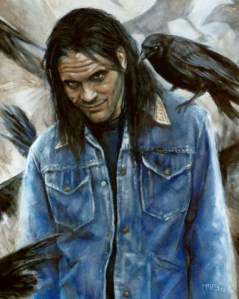
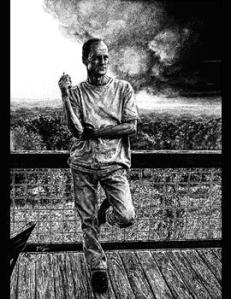
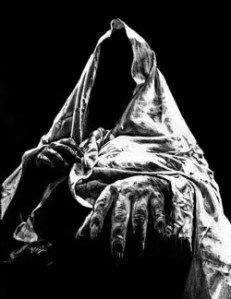
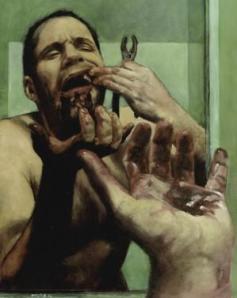
Artist Profile: Alex McVey


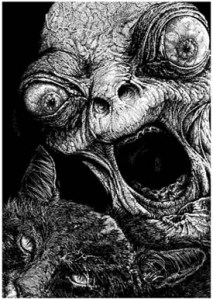
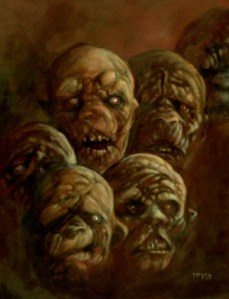
Considered by many to be the best artist currently working in the horror field, Texas-born Alex McVey is an award-winning illustrator whose work has ranged from album art to graphic design to book illustration.  He has illustrated the works of several horror writers, including Stephen King.


2000 and Beyond!


I wake up to a cold Thursday morning and what do I see but a classic Prince song staring up at me when I check the place. In order to segue from this Prince song into the new millennium of activity I thought it best to just say congratulations to everyone involved at this site for making it succeed beyond what I thought it would do when I first started it almost three years ago one bored December morning.

It doesn’t matter whether someone has posted just one thing or has been active since the start of their writing for me in the end they’ve been a major reason why I’m proud to say this site continues to be a unique place for people to visit. I’ve seen some criticize it for it’s chaotic nature. The site not having a clear and concise focus on just one subject matter. This place has always been a haven for those who want to write what they want and how they want without any sort of interference from me about content or style. I’m not the best writer in the world, but I know that I’ve grown in how I appreciate other people’s writing and passion for what they’ve been writing and posting at the site. I think this is what the place has become and that’s a place to exercise one’s passion for writing and discussion  about all things entertainment from high art to low brow entertainment. It’s a place to discuss, debate and disagree with a semblance of civility I find lacking in most places.

As my co-founder Lisa Marie would say this place is like a box of sleepy kittens and that is always a good thing.

So, time to celebrate the number that is the Prince song and move beyond the 2000th posting to the next 2000 and more.


Horror Scenes I Love: A Man Chooses… A Slave Obeys


Video games have scenes to love, too! And I’ll be your guide through some of the finest in this space.

If you have never played BioShock, stop right now, go buy the game, and play it. Wait, it came out six years ago and you can’t be bothered? Oh well. If you’re even considering playing Bioshock, you may not want to spoil this clip for yourself. On the other hand, it might inspire you to actually play the game – something I readily encourage. In either case, would you kindly join me in enjoying what earnestly could be the greatest scene in any video game ever made?

Would you kindly. A powerful phrase.