When I went to The Hunger Games on Friday, the last trailer shown before the film started was a 50-second teaser for The Twilight Saga: Breaking Dawn Part 2, which, by the way, is like one of the most awkward-sounded movie titles ever. Not that it matters since everyone’s just going to call it Twilight anyway…
Anyway, with this trailer, the Twilight series continues to equate losing one’s virginity to being turned into a supernatural creature. Despite the fact that the Hunger Games and Twilight are petty much designed to appeal to the same audiences, this trailer actually inspired some pretty derisive laughter from my audience. Most of that laughter was directed at poor Kristen Stewart hunting that deer but Edward’s comment regarding both he and Bella being the same temperature also got a reaction.
But you know what? Everyone laughs at Twilight and then they sneak off and wait in line for 24 hours to see the next movie*. As for me, I love my freaky, mismatched eyes but I still think it would be fun to have at least one red vampire eye…
————-
* That’s right. I said “wait in line…to see the next movie.” Deal with it, yankee.
With The Hunger Games currently dominating the box office and the Twilight saga coming to an end later this year, The Host (scheduled to be released in 2013) appears to be Hollywood’s next great attempt to capture the money of tweens and people who wish they were tweens. Much like Twilight, The Host is based on a book written by Stephanie Meyer and it’ll probably make a lot of money while getting slammed by critics. One positive note is that the film stars Saoirse Ronan, who deserved an Oscar nomination for Hanna. On the negative side, The Host is directed by Andrew Niccol, who is just a bad enough director to have a whole lot of rabid fans online.
The Hunger Games is something of an event film, which means that this may not be the only review for the movie. Especially since I haven’t seen Battle Royale, which many say The Hunger Games is very similar to, there’ll probably be a number of viewpoints to this movie.
I consider myself fortunate that I knew next to nothing about the movie adaptation to Suzanne Collins “The Hunger Games” or the novel itself. When I purchased my ticket for a midnight showing, there were only about 10 people around, many of them wearing T-Shirts with the logo. However, when the movie house started asking for the tickets, that 10 turned into 30. By the time the movie started, the 30 became about 50 or so. Not exactly a packed spectacle for where I reside, but I know the ones in Manhattan were.
If any comparisons can be made, I guess it could be to 1987’s The Running Man, with maybe a dash of The Truman Show, but The Hunger Games stands on it’s own because it’s protagonist, Katniss Everdeen, comes across as being in danger every step of the way. That’s enough to keep the audience enthralled. Arnold, not so much.
So, what are the Hunger Games? It’s overall a really great film with a strong female lead in Jennifer Lawrence.
In the future, the nation goes through a number of changes. Wars, famine and poverty ravage the land and eventually, a sense of peace is found. Panem, as the country is called, is divided into 12 Districts. Much like Joss Whedon’s Firefly, the land is broken between the rich who live in the Capitol and the Districts, which live off of a bartering system and are extremely poor. At one time, a 13th Division challenged the rule of the Capitol and had to be taken down. As punishment and to remind the other districts of how great the Capitol is, each District picks one boy and girl between the ages of 12 and 18 to participate in a last one to the death event known as the Hunger Games.
Lawrence (X-Men First Class, Winter’s Bone) easily carries the film as Katniss Everdeen, a resident of District 12, who is great at Archery and uses her skills to hunt for food for her family. When her sister, Prim (Willow Shields) is chosen as a Hunger Games Tribute, she volunteers to take her place. Leaving behind her mother, sister and best friend (Liam Helmsworth), Katniss is taken to the Capitol to participate. Joining her is another member of her District, Peeta (Josh Hutcherson).
Katniss and Peeta are then introduced to their team, lead by Haymitch Abernathy (Woody Harrelson), Effie Trinket (a nearly unrecognizable Elizabeth Banks), and Cinna (Lenny Kravitz). Harrelson pretty much nails every scene he’s in, something I’ve noticed lately with a lot of his roles. I found it interesting as well to see Lawrence play opposite Lenny, considering she only recently acted alongside his daughter Zoe in X-Men: First Class last year. He actually does well with the time he has on-screen.
That there is the core of the film. Can Katniss survive The Hunger Games? There’s much more to that, but in originally writing this, I ended up explaining most of the film.
The movie does get bloody. It doesn’t try to make light of any of the situations the characters are in, but being a PG-13 film, it doesn’t turn into anything on the lines of a Saw film (which makes me wonder how that would have turned out).
Can I take the kids to this one?
You can, yes, but note that even though this based on a story written for young audiences, it does have its share of blood and violence. Then again, considering that you can get the same kind of violence from video games these days, I’d say only the really young may be bothered. If there’s any problem regarding kids, it could be a patience factor. Kids expecting non stop action may get a little bored, but if they already read the book, they probably won’t have any problems with it at all and know what to expect. In terms of sexual situations, there aren’t any.
How long is the film? Am I going to yawn?
The Hunger Games clocks in at about 142 minutes (2 hours and 22 minutes). The first half of the film needs to set up for the second half (The Games themselves), and while it doesn’t move slow, it takes it’s time in letting the audience know what the stakes are for them and to show the contrasts between the districts and the Capitol. Think of it like Batman Begins. Before we get to see Batman, we had to be able to see Bruce Wayne go through his training. There’s not action all the way through the movie, which actually works in it’s favor. The same kind of applies for The Hunger Games. If that made you yawn, then that first half of this film may have the same effect. I loved it, myself, because a lot of that information felt necessary to me, but what works for me may not work for everyone else.
Overall, The Hunger Games was definitely worth it, at least for an initial viewing. I hope that if they go with a sequel (given the success of this one, that’s pretty much guaranteed), they expand more on Panem and some of the events that brought things to where they are now.
Hi there and welcome to another edition of Lisa Marie’s Favorite Grindhouse and Exploitation trailers! Today, we bring you 6 trailers specifically made to appeal to audiences made up of hard men and the women who have to put up with them.
1) Phantom Soldiers (1988)
Let’s start things off with this trailer from the Philippines. I never thought I’d see a trailer as violent as the trailer for Massacre Mafia Style but then I came across this one for Phantom Soldiers. “You’re a hard man…but the answer is no.”
2) Megaforce (1982)
This appears to be the family friendly version of Phantom Soldiers. I always love how these trailers for obviously terrible movies always claim to be bringing “the greatest spectacle ever” to audiences. Myself, I want to find and slap whoever thought it was a good idea for the bearded guy to wear a powder blue headband while talking about how the good guys always win “…even in the 80s!”
3) The Junkman (1982)
I guess if families weren’t watching the bearded man in the skin-tight outfit and the blindingly blue headband, they were witnessing the “chase thriller for the 80s…JUNKMAN!”
4) Terror in the Midnight Sun (1959)
I’ve never seen this film nor had I ever heard of it until I came across this trailer on YouTube. But I think that our readers who happen to be creature movie fans will enjoy this one.
5) The One-Armed Executioner (1983)
All this exposure to grindhouse and exploitation films must be getting to me because I kept expecting someone to go, “That’s not my arm, baby,” as I watched this trailer. Agck!
6) She-Devils On Wheels (1968)
After all that, it’s time for some girl power, don’t you think? From director Herschell Gordon Lewis, who also directed the Gruesome Twosome. “This picture is not for children…”
One of my favorite video game titles from 2010 was also one of it’s earliest releases with THQ and Vigil Games’ post-apocalyptic action-adventure, hack and slash Darksiders. It was the game which allowed the player to play as War of the Four Horsemen of the Apocalypse. It was a game that was received positively by both critics and the general public though the title was not without it’s flaws.
Darksiderssold quite enough units for both the Xbox 360 and the PS3 that THQ was quick to greenlit a sequel to the title. This was good news since the first game ended in what one could only assume was a cliffhanger. I mean this was a game that was epic in its art design, epic in it’s story (it is set after the world ends in the game’s prologue) and finally it just sounded epic. The ending itself wasn’t just a cliffhanger but gave a clue as to how the game would continue on as a franchise. War a player was already able to play in the first game and the game end’s with three other flaming meteor’s streaking down to Earth. Hmmm, I wonder just who or what exactly are those three mysterious meteors.
[spoilers in video below for those who haven’t played the first game]
With the sequel only months away from release we get the first CG cinematic trailer for it released and show’s the Death as the newest Horseman of the Apocalypse the player gets to play this time around. Yes, you heard that correctly. You as a player gets to play as Death itself. From the look of how Death move and fights in the trailer he’s more lithe and agile than the more brutish and “crush rocks with each step” brother War.
With both Skyrimand Mass Effect 3now out and played this title now goes up my list for 2012 as one of my most-anticipated titles to get a hold of a play. Also, one thing which should make playing Death epic: Michael Wincott will voice the character.
Darksidersis set for a June 26, 2012 release date for the Xbox 360, PS3, Wii U and Windows PC.
It’s hard to believe it but the little entertainment site that begun one quiet morning the day before Christmas 2009 has reached another milestone.
1500 articles posted is no small feat considering that this was originally a site dedicated to just it’s creator’s random thoughts on entertainment with little or no focus. As the months went by more people joined wanting to contribute and each and every one contributed in their own way. Many have begun to follow the thoughts, opinions and ramblings of the crew that made up the this chaotic ship called Through the Shattered Lens.
Once again I say thanks to those who have become my blog nakama and who continue to stay on board this ship to destinations unknown. My biggest thanks has to go to the one I consider this site’s heart and soul and one who continues to make running this little piece of the entertainment blogosphere quite an adventurous and unpredictable experience: Lisa Marie Bowman.
Fair winds and following seas to the crew of Through the Shattered Lens both new and old!
Ask most people what their favorite Herschell Gordon Lewis flick is, and the common answers you’re likely to hear will be either Blood Feast, 2,000 Maniacs, or The Gore-Gore Girls, with the occasional vote for The Wizard Of Gore simply because it was mentioned in Juno, they saw it due to the fact that Diablo Cody gave it her “certified cool” stamp of approval, and they then proceeded to go no further in the “Godfather of Gore”‘s cinematic ouevre than that.
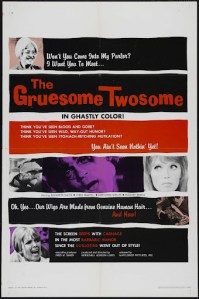
Fair enough. But for this armchair critic’s money, Lewis’ most fun — and most deranged (they usually go hand-in-hand with HGL) — work is 1967’s The Gruesome Twosome. The premise is pure genius, the humor is right up there at the forefront, and it’s as subtle as a hammer-blow to the forehead. What more could you possibly ask for?
Old Mrs. Pringle (Elizabeth Davis) is an eccentric yet hopelessly entrepreneurial senior citizen who runs not one, but two home-based businesses — a wig shop downstairs primarily catering to co-eds from the local college (yes, there was once a day when wigs were considered very hip fashion accessories by the under-65-and-without-cancer set), and a boarding house upstairs that pretty much rents rooms solely to — those same co-eds from the local college. It doesn’t take a seasoned exploitation viewer like myself or unobtainium13 vet Lisa Marie Bowman (who you can either thank, or blame, for getting me to start contributing to this site) to figure out at this point why Mrs. Pringle’s wigs have such fine-quality, completely-realistic-feeling hair, does it?
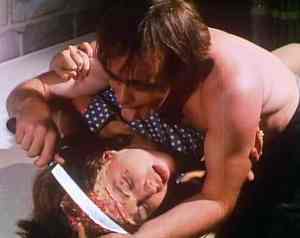
Well, okay, in case you’re slow on the uptake,the not-so-good Mrs. P.’s demented full-grown son, Rodney (Chris Martell), is taking the girls into the back room of the shop, scalping them, and then killing them — thus ensuring that their “room for rent” sign never has to come down, and that they never run out of wigs. And this is almost always shown in loving, close-up, excruciating, far-less-than-realistic detail. Truth be told, although Lewis had taken something of an extended hiatus from the gore genre he basically started single-handedly before returning to it with this film, he hadn’t been away so long that he forgot we wouldn’t have it any other way and he knew that his job was simply to deliver the goods. Sure, there’s a “plot” here of sorts — college student Kathy Baker (Gretchen Wells), a self-appointed “female James Bond,” starts doing the cops’ job for them and investigating the disappearances of all her classmates when one of her fellow residents of the all-girls’ dormitory doesn’t come home one night, much to the chagrin of her boyfriend, but as with any Lewis film, the payoff here comes primarily in the form of the ingenious set-up and the resultant heavy doses of viscera said set-up inevitably gives rise to — the rest is all filler.
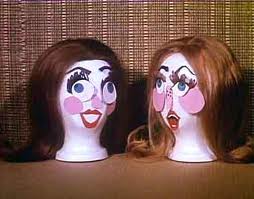
And it’s the quality of that filler that sets The Gruesome Twosome apart. Whether it’s the truly hysterical conversation between two styrofoam wig-form heads at the beginning of the film (a scenario Lewis had to improvise quickly on the fly to pad out the runtime to 70 minutes when the original opening scene was inadvertently destroyed, thus making it a genuine example of necessity being the accidental mother to genius), or the extended slapstick-style sequence where Kathy sics the cops on the poor German- immigrant gardener/handyman who works at the school who just likes to bury bones for his dog in his back yard, or Mrs. Pringle’s constant back-and-forth (in her mind, at any rate) dialogue with her stuffed bobcat, Napoleon, the downright clever nature of the padding in this film marks it as a cut above (pun only somewhat intended) its contemporaries.
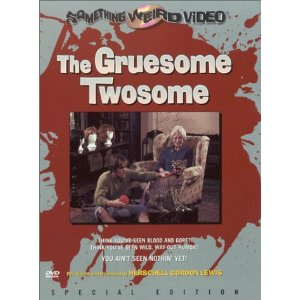
As is the case with pretty much every Herschell Gordon Lewis flick, The Gruesome Twosome is available on DVD from Something Weird Video in a “special edition” that features a remastered (and quite nice-looking) full-frame transfer, remastered mono sound, a full-length, and very entertaining, commentary track from Lewis himself, and the ubiquituous-on-these-things “Gallery of Herschell Gordon Lewis exploitation artwork.” Definitely an essential purchase either on its own or as part of the HGL box set that also contains A Taste Of Blood, She-Devils On Wheels, Something Weird, The Wizard Of Gore and The Gore-Gore Girls. If you haven’t got it, get it — and if you’ve got it already, there’s no such thing as a bad time to watch it again. Have fun — and don’t touch my hair.
(Warning: This review contains spoilers. A lot of them.)
Last week, I posted a poll and I asked you, the Shattered Lens readers, which film I should watch on March 20th and then subsequently review. You voted and the winner was the classic 1967 trashfest, Valley of the Dolls.
Based on a best-selling (and trend-setting) novel by Jacqueline Susann, Valley of the Dolls starts out with a disclaimer that informs us that the story we’re about to see is totally fictional and purely imaginative. That disclaimer is probably the funniest part of the entire film as Valley of the Dolls is notorious for being one of the first films dedicated to showing middle America just how miserable and screwed up those famous show business types truly are. As such, the main reason for watching a movie like this is so you can sit there and compare the cinematic troubles of a character like Neely O’Hara to the true-life troubles of an actress like Lindsay Lohan. Valley of the Dolls tells the story of three aspiring stars who, as they find fame, also find themselves dealing with heartbreak, insanity, and dolls. No, not the type of dolls that my mom used to collect. These “dolls” are a bunch of red pills that do everything from keeping you thin to keeping you awake and focused. (Though the pills are never actually called anything other than “dolls,” they appear to be the same pills that I take for my ADD.)
The least interesting of our three heroines is Anne Welles (Barbara Parkins). Unfortunately, Anne is also pretty much the center of the rather draggy first hour of the film. Anne is a walking cliché, a naive girl from a small town in New England who moves to New York, gets a room at the Martha Washington Hotel for Women, and a job at a local theatrical agency. “I want to have a marriage like mom and dad…but not yet!” Anne breathlessly tells us. Anne eventually ends up as the mistress of Lyon Burke (played by Paul Burke), a writer-turned-theatrical-agent who you know has to be a cad because his name is Lyon Burke and he takes Anne’s virginity but then refuses to marry her afterward. Anne eventually becomes a model and finds fame as the face of Gilligan Hairspray but she soon finds herself forced to watch as her two best friends travel down a path of self-destruction.
Anne is the film’s token “good girl” and, as such, she’s rather bland and boring. However, her character is interesting when considered as a symbol for the confused sexual politics of the time. Valley of the Dolls was made in 1967, at a time when Hollywood was still trying to figure out how to deal with the emerging counter-culture. The end result? A lot of rather old-fashioned films that were full of jarringly out-of-place counter-culture moments. By the time Valley of the Dolls came out, it was allowable to acknowledge that a single girl might actually have sex but she still had to, at the very least, feel an unbelievable amount of angst about it. That certainly is the case with Anne. Watching the film today, it’s hard to understand just what exactly Anne’s feeling guilty about. Lyon isn’t married. Anne finds success even as she pursues her relationship with him. Up until the final half of the film (at which point the morality of the time demands that both Anne and Lyon suddenly start acting totally out-of-character), Lyon treats her with about as much respect as you could probably expect to get from a man in the 1960s. And yet, Anne can’t feel complete simply because Lyon is hesitant about marrying her. When she and Lyon finally do make love, they do it with the lights off so the only thing the viewer sees are two shadowy figures holding each other. Following the film’s logic, if the lights had been left on, the character of Anne would have had to have been punished later in the film for allowing the audience to see too much of her.
When Anne first comes to New York, she befriends two actresses. The more tragic of the two is Jennifer North (played by Sharon Tate, who would be tragically murdered two years after this film came out), an insecure blonde who is valued more for her body than her talent. Jennifer spends her spare time doing bust exercises (“To hell with them!” she declares at one point as she glares down at her chest, “Let ’em droop!”) and dealing with phone calls from her mother, demanding that Jennifer send her money. Jennifer eventually ends up marrying a singer named Tony (played by Tony Scotti). Tony is a well-meaning if simple-minded guy who is married to a creepily overprotective sister (played by Lee Grant). Eventually, it turns out that Tony has a neurological disease and he’s eventually checked into a sanitorium. Penniless, Jennifer goes France and makes “art films.” (In one of Valley of the Dolls’ better moments, we’re shown a clip of this “art film” and it turns out to be a pitch perfect satire of every single pretentious soft-core film to ever come out of Europe.) Upon returning to America, Jennifer discovers that she has breast cancer and, declaring “All I’ve got is my body,” she commits suicide.
Though Sharon Tate gets considerably less screen time than her co-stars, she probably gives the strongest performance in this film. Certainly, her story is the most emotionally effective (even if it’s hard not to feel that, as is typical of the films of both the 60s and today, Jennifer is being punished for taking off her clothes on camera). Tate perfectly captures the insecurity that comes from being continually told that you have nothing more to offer beyond how you look. In her first appearance, she’s wearing an outrageously large headdress. “I feel a little top-heavy,” she says. “You are a little top-heavy,” some guy replies while leering at her breasts. If you doubt that Sharon Tate was a good actress, just watch her reaction. She perfectly captures a pain that I personally know far too well. Her subsequent suicide scene, which has the potential to be the most tasteless part of this film, is actually the most powerful and again, it’s because Tate plays the role perfectly.
(It’s been nearly four years since I lost my mom to breast cancer and I have to admit, I had a hard time watching the scenes where Jennifer discusses her diagnosis. Tate gave a great performance here and it’s a shame that she’s been permanently linked in the public imagination with Charles Manson and the later accusations against her husband, Roman Polanski. She had real talent.)
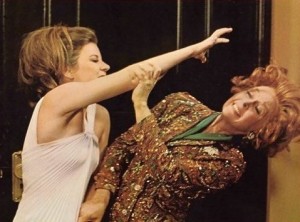
As poignant of Sharon Tate was in her role, the film’s fame (and infamy) ultimately rests with our third heroine, Neely O’Hara (played by Patty Duke in a performance that suggests that she was literally possessed during the filming). Neely is a scrappy, aspiring singer who is fired from a broadway show when her singing threatens to upstage aging star Helen Lawson (played by Susan Hayward, who was brought in to replace Judy Garland). Neely, however, refuses to let anything keep her down and soon, she’s singing at a Cystic Fibrosis telethon and becoming a big star. She marries her boyfriend Mel (played by Martin Milner, who grits his teeth and spits out every line) and moves to California where she soon becomes a big star and then finds herself hooked on “booze and dolls.” (“I need a doll!” she insists on several occasions.)
One reason the film’s 2nd hour is so much more fun than the first is because the film’s focus shifts from boring Anne to out-of-control Neely. Increasingly temperamental and unstable, Neely soon starts to spend all of her time with dress designer Ted Casablanca (a great name, if nothing else.) “You’re spending more time than necessary with that fag Ted Casablanca,” Mel tells her to which Neely replies, “Ted Casablanca’s no fag and I’m the dame who can prove it.” This, of course, leads to a divorce and soon Neely is living with Mr. Casablanca who informs her, after he gets caught cheating, “You made me feel as if I was queer…that little whore makes me feel 9 feet tall.”
When Lyon and Anne attempt to force Neely to enter a sanitorium, she responds to running off to San Francisco where she enters a bar and shouts, “I’M NEELY O’HARA!” before then wandering down a sleazy street and ranting, “Boobies, boobies! Nothing but boobies! Who needs them!?” Needless to say, this leads to her eventually overdosing and ending up in that sanitorium where she has a huge freak-out before singing a duet with Tony and resolving to get her life back in order. This, naturally, leads to her getting released, having an affair with Lyon, and then returning to Broadway where, in the film’s most deliriously odd moment, she steals Helen Lawson’s wig and flushes it down a toilet.
Valley of the Dolls is, admittedly, a terrible film but it’s also a lot of fun and that’s largely because of Patty Duke’s berserk performance as Neely O’Hara. Earlier, I said that Duke’s performance appears to suggest that she may have been possessed but, honestly, that barely begins to describe it. Whereas Tate managed to find some truth in the film’s melodrama and Parkins gives a performance that suggests that the script put her in a coma, Duke attacks every inch of melodramatic dialogue, barking out her dialogue with all the ferocity of a yapping little chiuaua. Duke gives a performance that is so completely and totally over-the-top that it’s hard not to respect her commitment to capturing every overheated, melodramatic moment.
I have to admit that one reason why I love this film is because I’m hoping that someday some enterprising director will remake it and cast me as Neely O’Hara. Everytime I watch this film, I find myself thinking about how much it would be to respond to every petty annoyance by screeching out, “I’m NEELY O’HARA!” Seriously, just think about it. As a character, Neely is a talented, ambitious, emotional, unstable, immature, demanding, bratty, spoiled, and determined. Sound like anyone whose film reviews you might have been reading recently? From my previous experience as a community theater ingenue, I can assure you that I can deliver melodramatic dialogue with the best of them and, unlike Patty Duke in this film, I can actually dance. Unfortunately, I can’t carry a tune to save my life but I’m thinking maybe they could bring in Kelly Clarkson to serve as my singing voice. (Or maybe Jessica Simpson. Did I ever mention that we both went to the same high school? Though not at the same time, of course.) After all, if Patty Duke could be obviously dubbed, why not me? I can just see myself now, wandering down some sleazy city street, singing to myself and declaring at the top of my lungs, “Ted Casablanca’s no fag and I’m the dame who can prove it!” I know that Lindsay Lohan will probably insist that this is the role she was born to play, but seriously, who needs Linsday when you’ve got a Lisa?
Beyond the so-bad-that-its-good appeal of the film, Valley of the Dolls is a fascinating cultural artifact for the reasons that I previously hinted at while talking about the character of Anne Welles. Valley of the Dolls was made in 1967 and, as such, it’s a perfect exhibit of an unstable time when Hollywood was unsure about whether it should embrace the “new morality” or if it should continue to recycle the same sort of old-fashioned filmmaking that had nearly bankrupted the big studios. The result was several films that felt oddly schizophrenic in their approach and that is certainly the case with Mark Robson’s direction of Valley of the Dolls. Whether it’s the way the film continually hints at nudity and sex while carefully not revealing too much or the way that random psychedelic sequences seem to suddenly appear on-screen, this is a movie that perfectly captures an uncertain film industry trying to figure out where it stands in a scary new world.
As always, I enjoyed watching this undeniably bad but just as undeniably compelling film. Our readers chose well! Thank you to everyone who voted and I hope you’ve enjoyed reading this review almost as much I enjoyed writing it.
So I have not posted in a while. Mainly because I was without a laptop for about two months, but also because I have not watched anything recently worth reviewing or discussing. That was until last week when I decided to subscribe to Hulu Plus to access their large selection of Criterion films. For those that might not have heard of the Criterion Collection, it is a DVD/Blu-Ray distribution company that acquires, restores and beautifully packages “classic”, “important”, foreign and American films with a focus on art-house and hard to find releases. I’ve been a fan for quite some time and recently had an urge to explore their collection more deeply, which has led to this post and hopefully more to come.
————————————————
“The Cranes Are Flying” is a visually dazzling, humane and emotional war drama about a girl struggling to survive during WWII as her boyfriend is on the front lines and communication with him is lost. This might sound like a story ripe for melodrama and clichés but instead it is very delicate and sincere. The development of the relationship between the young lady, Veronika, and her boyfriend, Boris, is handled so well and their chemistry so deep that when they are apart and when thing take a turn for the worst the pain and heartbreak feels all too real.
What truly made me fall in love with this film, beyond that touching and humane story, was just how exceptionally well crafted the film itself is. The visuals are at times stunning and the camera work, cinematography and crane movements are superb. It is one of those films that is the total package, delivering on an emotional, technical and storytelling level unlike most films made today. A definite must see.
“El Sur” is a lyrical and often haunting portrait of alienation, dislocation and the often un-remarkability of being human. Its story is seen through the eyes of a young girl named Estrella who is living with her family in northern Spain after the Spanish Civil War. We watch, in an almost mystical but utterly mesmerizing fashion as she begins to mature and realize truths about the world around her. The most shocking, and the one that plays the biggest role in her development has to do with her father who we learn comes from a deeply troubled past and is filled with pain. Like Victor Erice’s other film, “The Spirit of the Beehive” (one of my top fifteen favorite films of all time), it all plays out in a rather delicate manner and because the world we see is one through the eyes of a child it is often surreal and enigmatic. This is all handled with fantastic direction by Erice whose brilliant use of natural light and granulation adds a special touch to the visuals and tone. It definitely is a wonderful film and perhaps a new favorite.
*An interesting, albeit sad, fact about “El Sur” is that Erice had planned an additional 90 minutes to be added to the end of the story but the producers wouldn’t allow it. Luckily the final result was still near perfect and ends on a very fine note. The film is also apparently very hard to find, even Criterion has not released it but luckily was able to offer it for streaming. I do hope it gets a restored release sometime soon.
“Knife in the Water”, Roman Polanski’s first feature film, is a competently directed chamber piece about a couple who pick up a young hitch hiker and take him along as they go sailing out on a lake. Polanski seemed to have had some social themes he wished to address but personally I felt none of them really came through, and since their isn’t much in the way of thrills or humor the result was a rather boring affair that ended with no new insight or entertainment to be had. I guess I’d recommend it to those interested in seeing the first film of Polanski’s career, but other than that I doubt I’ll ever find myself considering watching it again.
“Umberto D.”, Vittorio De Sica’s neorealist tale of a pensioner struggling to get by, is an emotional depiction of the human condition, solitude and dignity. It stars Carlos Battisti, non-professional actor and university professor at the time, as Umberto Domenico Ferrari who after decades of civil service is left struggling to get by off of the small pension he receives. He has no family, and lives under the roof of a cruel landlady who wants him out. His only friend is his dog Flike, though he does have a good relationship with the landlady’s young maid.
The story begins as Umberto’s time in his apartment is nearing its end and unless he can pay his rent he will be evicted and left with no place to go. With a pension too small to make up for this debt he must sell his possessions for money and refuses to beg on the streets. When things do not seem to be going his way Umberto considers more drastic measures to escape his unhappiness and plight. It all builds up to a very sad, but also inspiring ending that nearly left me in tears.
Like De Sica’s other and perhaps more well known film “Bicycle Thieves”, the story appears rather simple on the surface but its examination of such universal and emotional themes is what makes it so profound. “Umberto D.” avoids melodrama and sentimentality in its portrayal of its protagonists struggle and instead handles it with a quiet sadness. I couldn’t recommend it more.
“Vivre Sa Vie” or ‘My Life to Live (It’s My Life)’ is the episodic telling of a period in time in the life of Nana, a mother and wife turned aspiring actress who turns to prostitution in search or happiness and money. In telling her story director Jean Luc Godard uses the camera as if it were the human eye, seeing at times the perspective of Nana viewing her surroundings; but is at its most interesting when it acts as an onlooker, mesmerized by her beauty and sadness, fixated on her flawless face. Often, like with “Breathless”, Godard’s overindulgence leads to excruciating viewing experiences, but because the camera and editing her serve some purpose it is not only bearable but escalates what on the surface appears to be a simple story. I found the whole thing to be rather fascinating and its ending stuck with my longer than I thought it would. Another high recommendation.
“Tokyo Drifter” and “Branded to Kill” by Japanese ‘B-movie’ director Seijun Suzuki can both best be describe, as one critic put it, like this “…Suzuki doesn’t do establishing shots and when he does, they don’t establish shit.” As true as that statement is, and the editing and fractured pacing (even more prevalent in ‘Tokyo Drifter’) are unusual and at times distracting, both still contain a level of uniqueness and visual splendor to make for satisfying and often amusing viewing experiences.
The first I watched was “Tokyo Drifter”, about a gangster trying to go legit though the world around him is trying to pull him back in or bump him off. It is definitely the most visually stunning of the two but contains a very fractured plot with at times hectic editing. Scenes often skip from one moment to the next which is at first hard to follow, especially considering how much story and how many characters are crammed into the short running time. And yet, its pop-art look, visuals and fresh and cool main character make it such a treat to watch that I just have to recommend it.
Next up was “Branded to Kill”, the more ‘conventional’ of the two, which had a much more fluid story and editing that wasn’t as chaotic. The story follows a hit man who after messing up a job struggles to survive as the organization that hired him tries to kill him. It honestly isn’t the most original or thrilling story. The most exciting parts come during a few surreal sequences when the main character seems to be losing his mind. Overall I wasn’t too impressed, though it still holds a visual uniqueness that makes it worth watching for those interested, and is perfect for a double feature alongside “Tokyo Drifter”.
“Summer Interlude” could be described as lesser Bergman, which isn’t surprising being that it is one of his earlier films, coming out before 1957 when he released “Wild Strawberries” and “The Seventh Seal” and his popularity and the quality of his films increased greatly. Still, it is a very good story about an unhappy ballet dancer who, when visiting a summer home, remembers her tragic past through flashbacks. The plot very much reminded me of “Wild Strawberries” (flashbacks/reevaluation of ones life) meets “Summer With Monika” (a summer fling on a beautiful island), which was a pleasant surprise considering this came out before both.
There honestly isn’t much more to say other than that the themes Bergman tackles here will be very familiar to those who enjoy his work. Its only fault in my opinion would be an end revelation that comes a bit too abruptly. Overall it is a must watch for any Bergman fan, but an ultimately unremarkable motion picture.
*This is the 16th film I’ve seen from Ingmar Bergman (my favorite director by a large margin) and the first of many of Bergman’s early films that Criterion and Hulu Plus have available.
“Eyes Without a Face”, Georges Franju’s gothic horror tale of guilt, obsession and beauty, is an atmospheric, finely shot and haunting film. The story follows Dr. Genessier whose daughter Christiane, after a serious car accident, is left with a face scared and practically missing. Feeling the guilt of having caused the accident, and wanting badly to give his daughter back her beauty while also furthering advances in the field of transplantation, Dr. Genessier hatches out a gruesome plan. He and his assistant track down and kidnap women bearing a resemblance to Genessier’s daughter so that they can remove their faces and try to successfully transplant them onto Christiane.
What makes the story and film so effective is the atmosphere and imagery. The buildup to the first surgery is a slow one, but as the fate of the woman chosen for the graphic procedure becomes clear there is a level of dread that fills the story that would make anyone uncomfortable. Add onto that graphic imagery like the facial surgery, shown in full, and the mask Christiane wears to hide her scars (which is arguably one of the creepiest I have ever seen) and it becomes a chill inducing experience.
The film isn’t without its flaws. The biggest being the way in which it often jumps from one scene to another, in which the audience can easily assume what happened but still periods of times seem missing. Luckily that is never really an issue and the end result is something I’d recommend to anyone, especially those with a preference for horror.
————————————————–
At the moment I still have 47 Criterion films in my queue to watch on Hulu Plus, and that is just those that I have a strong interest in. The size of the full collection to stream is around 130. I doubt I’ll make it through them all, but I hope to post another group of reviews like this every week.
I hope you enjoyed the reviews, and leave any comments (good or bad) below.
So, last week at this time, I asked you which movie I should watch on March 20th. I gave you twelve possible movies and I asked you to vote. 678 votes were cast and, despite strong showings by An Education, Crazy/Beautiful, and Nightmare City, the winner is Valley of the Dolls!
And for that, I thank you. As some of you may know, my dream is to someday play Neely O’Hara in a remake directed by our own Arleigh Sandoc.
I will be watching Valley of the Dolls tonight. Look for my review of it either on Wednesday or Thursday.





 Through the Shattered Lens