[Some Spoilers Within]
Ok, the second episode of The Walking Dead was seen by some as being too much like every past zombie films and stories that’s ever been told. It was too much about the typical zombie siege of a group of survivors inside a building with little to no way out of the predicament. Now add in the elements of infighting within the group not to mention a dangerous wild card of a character and some viewers were turned off by it. The fact that the episode was one of the goriest episodes of any show ever put on non-premium cable never got much press.
One character introduced in episode 2 which really polarized viewers was the one played by veteran genre actor Michael Rooker. The character was one Merle Dixon and he instantly appeared in the show as an uncouth, loud, abrasive redneck racist that for some the only thing missing was the song “Dixie” playing in the background. I must admit that the character of Merle Dixon was written and introduced rather awkwardly, but to say that the zombie apocalypse wouldn’t include such blatant racists individuals have way too an optimistic view of humanity.
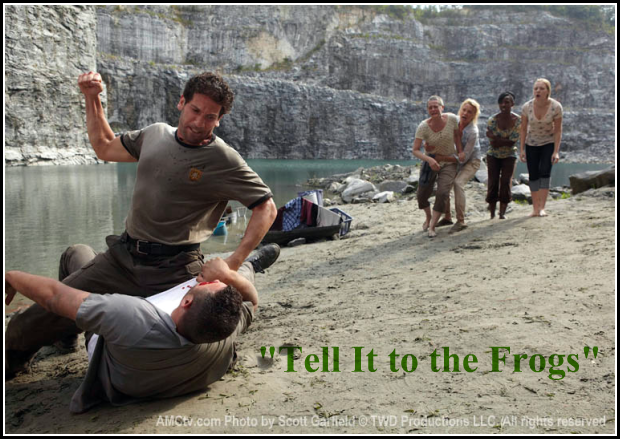
It is how we start the third episode, titled “Tell It to the Frogs”, that has redeemed the character of Merle Dixon to some skeptics. I wouldn’t say redeemed as in they accepted the racist but that he might still have a part to play in this 6-episode first season of the show. In the second episode Merle was left behind by Rick and the group handcuffed on the roof of the very building which was now overrun by “walkers”. Fortunately for Merle, T-Dog (who had happened to drop the cuff keys down the drain in his attempt to free Merle) had chained and padlocked the door to the roof to keep Merle from becoming the next sun-burned meal for the walkers. Unfortunately for Merle the chain and padlock had some slack to it that the door could be opened with enough of a gap for a walker to stick its head through.
Merle opens the third episode talking to himself as he reminisces about punching some Army officer in the past. Right from the get-go we see Merle might have lost his mind somewhat. But as soon as his trip down racist memory lane ends he finally snaps back to reality and realizes he’s cuffed to the roof, no key to the cuffs and the zombies as working their damndest to push the chained roof door wide enough to get through. Before the scene moves to the intro credits me last see Merle trying to use his belt to pull the steel hacksaw to him while praying and condemning Jesus in equal amounts.
That was some fine acting from Michael Rooker and was one of the highlights of the episode. While it still doesn’t answer the question of how such a racist was even with the group in the building, it does confirm that Merle might not be all there mentally. The appearance of his brother Daryl halfway through the episode and showing the younger Dixon to be as racist but not as unhinged reminds me of the two characters from Of Mice and Men except these two are of the racist variety. George being the younger Dixon and the Lennie role taken on by Merle. It’ll be interesting how these two new characters to the series will unfold as the first season rushes towards its conclusion. The scene in the end with Daryl finding the aftermath of Merle’s attempts to escape his cuffs was another fine moment in an episode that was more about character interaction and drama than about violence and gore (thought there’s some of that in the episode).
While the episode begins and ends with the fate of Merle Dixon the bulk of the episode was the reunion of the Grimes family and how Rick’s miraculous arrival has changed the camp’s group dynamics with Shane Walsh (Jon Bernthal in a performance which turned his character of Shane from hated “black hat” of the show to one that was a complex character who may or may not still be a simple “black hat”) and his wife Lori.
The scene where Rick slowly makes himself seen by the camp was very touching and showed hints of the love triangle the show will be exploring between Rick, Lori and Shane. The fact that Shane’s the first to see Rick and his expression turns from curiosity about who this new survivor was to one of shocked disbelief that the man he had spoken of as being dead has come back to his life. A life he seemed to be remaking with Lori as his partner and him a surrogate father to Rick’s son Carl. The reaction by Lori to suddenly seeing her husband back in her life healthy and alive ran the spectrum of surprise, shock and guilt.
Even the complex reactions from Shane and Lori didn’t diminish the heartwarming reunion between father and son as Rick literally fell to his knees in tears to hug his son Carl. That scene definitely was a tearjerker for many and Lincoln’s performance was very believable. One could almost see the burden and tension drain away from Lincoln’s Rick. The goal he had set for himself since episode 1 was now complete and nothing else mattered at that moment.
The show did have some moments which showed Darabont and the writers still feeling their way around Kirkman’s source material. One of it being the introduction of an abusive husband for one of the book’s regular faces in Carol. In the book the husband was only mentioned as not having survived the trip to Atlanta but no mention of him ever being abusive. Like the introduction of Merle in the previous episode, the appearance of Ed as the caveman husband was done too haphazardly. Almost like someone out of stereotype casting call, Ed bullied his way around the women in the camp until Shane had to step in and put on an epic beating that added some depth to the character of Shane but also made one wonder if the addition of Ed was just as a way to give Shane an outlet for the anger and frustration he was feeling from the return of Rick and the subsequent frosty attitude by Lori towards him.
In the end, “Tell It to the Frogs” was a much stronger return for the show after a second episode that some thought was being too stereotypical of a zombie story. I enjoyed the second episode but understand why some reacted to negatively to it after such a powerful initial pilot episode. The crew of Darabont, Kirkman and the other writers definitely have a balance to do between dramatic storytelling and zombie mayhem as the show continues through this first season and into the next. While some of the characters, both new and old, do seem too one-dimensional and more like plot devices for the main characters the show is only in its third episode and to judge the whole thing on such a small sampling is not fair to the show and the people behind it. I think the show has hit a nice balance of drama and mayhem. Time will tell if the show will live or die by balancing the two or finally landing on one side or the other.
PS: Oh yeah, anyone who happens to be fans of Bambi and her mom will have a hard time watching this episode.
 Through the Shattered Lens
I liked this episode pretty well. The scenes with Merle were more interesting than those from the previous episode, because of the situation he was in. But between the Brothers Dixon and now Ed, I have reached “What’d u say to me? I’ll tell u wut” overload. This show certainly doesn’t depict Georgians in a particularly positive light. I hope the focus shifts to more interesting and less annoying characters and things.
I have been struck in all three episodes at how careless the folks in the camp are. Shouldn’t they have better safety protocols – no one goes anywhere alone or unarmed (especially children), for example?
The deer scene reinforces my feeling that the zombies would be scarier if they ate only humans. This scene looked a bit like a homeless guy raiding a dumpster. If animals are just as tempting as people, than the zombies could be redirected to a pasture full of cows or other barnyard animals, while the people flee. The show would be kind of lame if all people had to do to escape was to put animals between themselves and the zombies. (I think a scene depicting such an attempt would be more frightening if the zombies ignored the animals, and relentlessly headed directly for the people.) I can’t really explain it any better than that, but I hope the animal alternative concept is deemphasized in future episodes.
Having said that, I did like the scene where the campers were beating down the zombie. He didn’t go down all that easily – it took quite a bit of force. And, of course, he took a licking and kept on biting, until, of course, he took a head shot.
I’m happy with the show. I do hope it gets truly scary. It hasn’t really been so very often, thus far, with some brief exceptions in the first episode. But lit;s kept me coming back each week, and anticipating the next one.
LikeLike
To be honest the comic book never truly got scary. It’s always been a series about drama and how people coped with the changed in the world. The zombies really get de-emphasized in some story arc and other people become the danger. The zombies never truly go away and are always the ever-present threat but they’re almost treated like a new force of nature that could be avoided if one followed the new rules of the world.
As for the zombies eating animals Kirkman is actually following something Romero hinted at in the very first zombie film he made when a zombie picked up bugs and in the remake of that film a zombie picked up and ate a mouse. Kirkman’s zombies are just walking bags of rotting flesh which are constantly in a state of hunger. Fresh flesh is all they want and since thats how they track their prey dead flesh does nothing for them. I understand what you’re saying about the large numbers of animals that are probably on the loose now and I think that explains why the camp hasn’t been hit until now.
The zombies must outnumber survivors hundreds of thousands to one so it’s logical to assume that they’ve now begun to filter out of the cities and into the countryside where there is more food. From what I could always gather in the comic books the zombies the group encounters never number in the thousands, but hundreds at best. Those always end up congregating near area where there used to be large populations of people. They’ve just sort of roamed and lurked in the area instead of venturing out. This is where, in the book, the terms lurkers and roamers came about. The huge herd that number in city-sized numbers only appear in later issues when large amount of loud noises begin to attract then from all directions.
I think someone made a good point in that this show is almost like Lost in that it will probably not be about zombies in the long run like how that show ended up never truly being about getting off the island and finding out what the whole island was about. There will be scary moments in The Walking Dead but the show will never be slasher, serial killer or supernatural scary. Like Romero’s original trilogy the show will have bursts of extreme terror but always with a slow, gradual growing dread leading up to it.
LikeLike