Lisa Marie’s 10 Favorite Episodes of South Park


I love South Park and, when I decided to list my ten personal favorite episodes, I thought this would be an easy article to write.  How wrong I was.  It’s hard to narrow 203 episodes down to 10 when you happen to love 193 of them.  As I struggled to settle on my ten, I did a google search to see what other South Park fans had listed as their top ten episodes.  What I discovered was that a lot of people had a top ten list and no one seemed to be in agreement.  I guess that’s why I love South Park.  It’s a show that people either love or hate, often for the exact same reasons.

I first truly discovered South Park when I was 18 and the show, itself, was either 7 or 8.  Don’t get me wrong.  I knew about the show and I’d seen the occasional episode (though my mom would always promptly change the channel if she walked into the room and saw it on the TV).  But, as far as becoming a true “fan” of the show, I arrived late.  Perhaps as a result, my list of favorite episodes is pretty much dominated by the latter seasons of the show (though I did come very close to putting Gnomes on the list). 

10) The List (Original Airdate: November 14th, 2007) — Okay, technically The List isn’t really one of the best episodes of South Park but it’s always made me laugh, largely because me and my girlfriends used to obsessively make lists like the one in this episode.  We also always took it way too seriously, even though the police were never called and I don’t think anyone ever ended up pulling a gun on anyone else.

9) You Got F’d In The A (Original Airdate: April 7th, 2004) — Not only is this episode of perfect parody of You Got Served, it’s also full of priceless WTF moments like the duck dancing to a song about Ketamine, Randy Marsh dancing to Achy Breaky Heart, and Butters killing even more people than usual as a result of his dancing.  It also features the Goth kids at their negative best.  Speaking as someone who used to have an exclusively black wardrobe even while she was fantasizing about becoming a world-famous prima ballerina, this episode gives me the best of both worlds.  It was also one of the 1st episodes of the show that I ever sat down and truly watched.

8 ) Ginger Kids (Original airdate: November 9th, 2005) — Cartman reveals that along with being a racist and an anti-Semite, he’s prejudiced against redheads as well.  Then he’s tricked into believing that he is a redhead and promptly organizes all the “gingers” in town into a cult.  Admittedly, one reason I like this episode is because I’m a ginger kid myself and, oddly enough, this episode was first broadcast on my 20th birthday. 

7) Miss Teacher Bangs A Boy (Original Airdate: October 18th, 2006) — Cartman as Dog, the Bounty Hunter.  What else needs to be said?  (Well, let’s not forget Ike’s facial expressions as Kyle tries to warn his parents about Miss Teacher.)

6) Night of the Living Homeless (Original Airdate: April 18th, 2007) — The homeless invade South Park and the end result is a brilliant parody of both zombie movies and liberal good intentions.

5) Whale Whores (Original Airdate: October 28th, 2009) — I like this episode for a lot of reasons.  First off, the TV show Whale Wars is one of those smugly, self-satisfied shows that just deserves to be ridiculed on general principle.  Secondly, it brought attention to just how barbaric Japanese whaling really is and it did so in a far more entertaining way than the Cove.  But, ultimately, it all comes down to Cartman’s performance of Poker Face.

4) You Have 0 Friends (Original Airdate: April 7th, 2010) — This is the episode that made me proud to have deleted my Facebook account years ago.

3) Pandemic and Pandemic 2: The Startling (Original Airdates: October 22nd and 28th, 2009) — Yes, a lot of South Park fans disliked the two Pandemic episodes but I loved them.  Along with ridiculing the current “home video horror” craze (which would later be epitomized by the ludicrous Paranormal Activity), the show also worked as a wonderful commentary on the whole series itself.  From the minute Craig said, “You know, this is why no one else wants to hang out with you guys…,” Pandemic had me.  Of course, needless to say, there’s also nothing cuter than a guinea pig in a pirate costume.

2) Go God Go and Go God Go Part XII (Original Airdate: November 1st, 2006 and November 8th, 2006) — There’s a lot of reasons why I like these episodes but the main reason is that, speaking as a nonbeliever, I’ve always felt that a lot of comedies satirize organized religion (excluding, of course, Islam) because it’s an easy target as opposed to actually having anything interesting to say about it one way or the other.  (Hello, Family Guy.)  It takes more guts to satirize something like atheism, especially the Richard Dawkins brand of disbelief.  Plus, the Sea Otters.  You have to love the Sea Otters.

1) The Imaginationland Trilogy (Original Airdates: October 17th, 24th, and 31st, 2007) — I don’t know that there’s anything left to be said about Imaginationland so I will just say that the relevance of this trilogy — in which humanity’s imagination is threatened by a bunch of thugs and bullies — became all the more obvious after Comedy Central decided to censor South Park’s 201st episode to avoid hurting the feelings of terrorists.

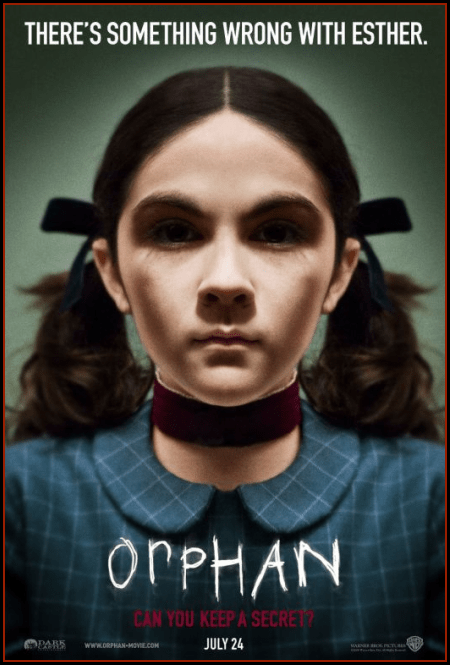
Review: Orphan (dir. by Jaume Collet-Serra)


There has been a complaint which has been getting louder and louder for the past several years from both horror and mainstream film fans. The complaint is that horror films of late have either been remakes or another sequel. While this complaint is not exclusive to the horror genre (non-horror genres have had the same problem) it is more prevalent and happens more often. Once in awhile a film will come out that tries to be different and put out an original story. Spanish director Jaume Collet-Serra has done just that with his second foray into feature filmmaking with Orphan. While the film won’t win many awards and become the critical darling the way Let the Right One In did Collet-Serra’s Orphan does bring a fresh new take on the evil child subgenre. Despite some of the flaws and script problems the film does entertain throughout most of its running time until it loses steam in the final 15 minutes.

Jaume Collet-Serra first got his start directing the 2005 remake of House of Wax. A film more famous (infamous in some people’s eye) for being the first major film of socialite Paris Hilton. A film that deservedly got panned by critics, but still did well enough in the box-office to put horror fans on notice that Collet-Serra might be a filmmaker to keep an eye on. Orphan marks his second full-lenght feature and using the screenplay by David Leslie Johnson, Collet-Serra tries a hand in the evil child subgenre which has more than it’s share of classic titles like The Omen, The Bad Seed and The Good Son. While this subgenre of horror usually means some sort of demonic-possession or some sort of mental or genetic abnormality causing for their psychotic or sociopathic behavior, in Orphan an interesting reason was given to the nature of it’s titual character.

The film begins with a harrowing and quite disturbing scene of the Vera Farmiga’s character pregnant and in labor, but also starting to miscarriage her child. The graphic nature of the scene quickly lays down the hammer that Orphan will not hold things back just because childen will be involved throughout most of it’s running time. We then see Farmiga’s Kate and her husband John (played by Peter Sarsgaard) at the local orphanage as they attempt to fix their family and ease Kate’s emotional turmoil over the miscarriage by adopting a child. They meet Esther a 9-year-old Russian orphan girl who seem to be the perfect child at first glance. Esther’s well-spoken and well-mannered at such a young age. Esther soon becomes part of John and Kate’s young family which consists of a younger deaf daughter named Max and a son named Daniel. While Max accepts Esther as a new older sister Daniel senses something just off-putting about Esther and reacts much more coldly towards his new dopted sister.

The majority of Orphan‘s second and first half of the third and final reel shows Esther’s true nature peek through the facade of Old World genteel and proper behavior. 12-year-old Isabelle Fuhrmann does an excellent job portraying the sociopathic and manipulative Esther. It is difficult to believe that a child actor of her age able to tackle such a dark role and actually pull it off without making the character too over-the-top or campy. In fact, no matter how one thinks of the performances of the rest of the film’s cast (Farmiga does a good job in the Cassandra-role with Sarsgaard an average performance as the hapless and clueless husband) this film is totally Fuhrmann’s and she sticks the landing.

While the film tries to make something original (and most of it is to a point) out of a tried-and-true model of the evil child storyline the script doesn’t hold up through the length of the film. The story itself is quite interesting when one really steps back to look at it, but there’s several leaps in logic the Kate character makes which will illicit more than a few confused reactions (running away from incoming help and into the dark, unknown being a major one). The dialogue itself is serviceable with none of it wince-inducing. There’s just a sense that the film’s reveal in the end of the film as to Esther’s true nature was just handled in a very clumsy manner. The twist is very original but the execution of that reveal after the tense and very brutal 40-50 minutes before it comes off quite flat. Orphan definitely looked like a script which was in need of several more rewrites to reconcile the first 3/4’s of the film with the final part. Yet, despite the ridiculous manner in which the final 10-15 minutes unfolds Collet-Serra manages to keep the film from dragging along through two hours. It actually plays much faster for a film with such a long running time.

In the end, Orphan marks a decidedly better effort from Jaume Collet-Serra, but one which still shows that he has some polishing to do to join the ranks of better horror directors of his generation. The film is enjoyable enough if given a chance. Most horror fans will enjoy the film and some may even embrace it because of the silly ending. Mainstream audiences looking for a change of pace from the strum und drang of the summer blockbuster season could do no worse than Orphan. It is not a perfect film and not even an above-average one, but it is a good horror film that tried to add something new to the genre, but hampered by a storyline that cannot sustain the tension it built-up and the brutality it showcased. In the hands of a much more seasoned filmmaker with a better hashed out screenplay Orphan could’ve become an instant classic.

Review: Sole Survivor (Dir. by Thom Eberhardt)


In my “which movie should I review poll” 1983’s Sole Survivor came in dead last, receiving a total of 3 votes out of the 234 cast.  I really wasn’t surprised to see that because Sole Survivor, along with having a dreadfully generic title, isn’t really that well-known.  I found the DVD at Half-Price Books where it was being sold for a dollar in the clearance section.  If not for the fact that I can’t resist a bargain, I would never have heard of this movie either.  Which is a shame because, taken on its own low-budget terms, Sole Survivor is actually a pretty effective horror film.

Written and directed by Thom Eberhardt, Sole Survivor has a plot that should be familiar with anyone who has ever seen any of the Final Destination films.  Denise (played by an actress named Anita Skinner) is a neurotic commercial producer who, as the film opens, is the sole survivor of a horrendous airplane crash.  (When we first see Denise, she’s still sitting in her seat, surrounded by the remains of her fellow passengers.)  Against the advice of just about everyone, Denise insists on dealing with the trauma of the accident by trying to return to her normal life.  This is complicated, however, by the fact that she’s still having dreams about the plane crash.  Everywhere she looks, she sees mysterious and menacing strangers watching her.  And, on top of everything else, she is now being stalked by a mentally unstable former actress who claims to be having nightmarish visions of Denise’s future.  Is Denise suffering from survivor’s guilt (as her doctor boyfriend insists) or is she instead being pursued by Death?  If you’ve ever seen a horror film, you can probably guess the answer.

As I mentioned previously, its easy to compare Sole Survivor with the Final Destination films.  However, a more appropriate comparison would be to the 1962 black-and-white classic Carnival of Souls.  Whereas the Final Destination films are largely about coming up with ludicrously convoluted ways for Death to get what he or she wants, Sole Survivor (like Carnival of Souls)  is less concerned with how Death gets the job done and more concerned with building and maintaining a growing sense of dread and hopelessness.  For the most part, director Eberhardt disdains easy shock effects in order to concentrate on building up a palpable atmosphere of doom.  As a result, the film can occasionally seem to be a little slow but it stays with you even after the final credit. 

Also, much like Carnival of Souls, Sole Survivor features an excellent lead performance from an actress who, more or less, disappeared from movie screens after the film’s release.  Carnival had Candace Hilligoss.  Sole Survivor has Anita Skinner.  Skinner gives an excellent lead performance, always remaining a sympathetic.  According to an interview with the film’s producers, Skinner was uncomfortable with the more excessive side of Hollywood and retired from acting shortly after making Sole Survivor.

Sole Survivor was released on DVD by Code Red, so now people like me can appreciate this neglected movie.  The transfer looks great.  Unfortunately, the DVD is pretty thin when it comes to extras.  Neither Eberhadt nor Skinner are interviewed nor do they contribute to the film’s commentary track.  Instead, we have to make due with the film’s producers.  In general, producers usually provide the worst DVD commentary tracks with typical insights running along the lines of “We had the same lawyer” and “So, after that, we brought in another screenwriter.”  The producers of Sole Survivor aren’t quite that bad but their commentary is still definitely lacking in insight. 

But that’s a minor complaint.  In the end, what matters is the movie and not the commentary track.  And as a movie, Sole Survivor is a an overlooked classic of the horror genre.

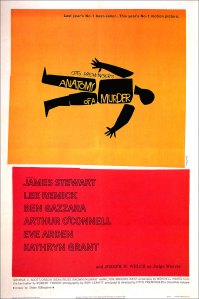
Review: Anatomy of a Murder (Dir. by Otto Preminger)


Last Friday, I randomly selected 10 movies from my DVD library and I asked you, this site’s wonderful readers, to vote on which one of those movies I should watch and then review.  234 votes were cast and the winner (by two votes!) is the 1959 courtroom classic Anatomy of a Murder.

First off, a confession of my own.  When I’m not reviewing movies or chattering away on twitter, I work in a law office.  Before anyone panics, I’m not a lawyer, I just hang out with a couple of them.  For the most part, I answer the phone, I schedule appointments, and I keep all the files in alphabetical order.  On a few very rare occasions, I’ve accompanied my boss to court and the thing that has always struck me about real-life courtroom drama is how boring it all really is.  There are no surprise witnesses, no impassioned closing statements, and those all trail rarely, if ever, jump to their feet and start yelling that they’re innocent.  For the most part, real life lawyers are usually just as poorly groomed and bored with their work as the rest of us.  Don’t even get me started on the judges, the majority of whom seem to have judgeships because they weren’t really making the grade as an attorney. 

As a result, it’s rare that I get much out of seeing lawyer-centric movies or tv shows any more.  After seeing the reality of it, I find fictionalized courtroom theatrics to be ludicrous and, for the most part, evidence of a lazy writer.  However, I’m happy to say that last night, I discovered that — no matter how jaded I may now be about the legal process — Anatomy of a Murder is still one of my favorite movies.

Based on a best-selling novel and directed by the notorious Otto Preminger, Anatomy of a Murder tells the story of Paul Beigler (James Stewart), a former district attorney who is now in private practice after having been voted out of office.  Having apparently fallen into a state of ennui, Beigler spends his time drinking with another alcoholic attorney (Arthur O’Connell) and trying to avoid his secretary’s (Eve Arden) attempts to get paid.

However, things change for Beigler when he is hired to defend an army officer named Frederick Manion (Ben Gazzara).  Manion has been arrested for murdering a bar own named Barney Quill.  Manion says that he was justified in committing the murder because Quill raped his wife, Laura (Lee Remick).  Others claim that Manion is himself just a notoriously violent bully and that the openly flirtatious Laura was having an affair with Quill.  Despite strongly disliking Manion and disturbed by Laura’s own obvious instability, Beigler takes on the case.

Beigler decides to argue that Manion was temporarily insane when he shot Quill and that he was acting on “irresistible impulse.”  As shaky as that line of defense might seem, it’s not helped by the fact that Manion himself is a bit of a brute.  Meanwhile, Beigler finds himself facing not the innefectual D.A. in court but instead a young, ambitious prosecutor from the State Attorney General’s Office, Claude Dancer (played by a young and obviously ambitious George C. Scott).  As the trial begins, small hints start to appear that seem to indicate that there’s a lot more to the murder of Barney Quill than anyone realizes…

Director Otto Preminger is an odd figure in film history.  Up until the early 60s, he was a consistently interesting director who made intelligent, well-acted films that often challenged then-contemporary moral attitudes.  However, once the 60s hit, he became something of a parody of the egotistical, old school, autocratic filmmaker and his films seemed to suffer as a result.  Like many of the film industry’s top directors, he found himself adrift once the 60s and 70s hit.  His decline was so dramatic that, as a result, there’s a tendency to forget that he made some truly great and important films, like Laura, Carmen Jones, The Man With The Golden Arm, and, of course, Anatomy of a Murder.

Anatomy of a Murder represents Preminger at his best.  His own natural tendency towards embracing melodrama and shock are  perfectly balanced with an intelligent script and memorable performances.  Whereas later Preminger films would often come across as little more than big screen soap operas, here he makes the sordid believable and compelling.  Preminger has never gotten much attention as a visual filmmaker but here, he uses black-and-white to perfectly capture the grayness of the both the film’s location and the moral issues that the film raises.  He keeps the camera moving without ever calling attention to it.  As a result, the movie has an almost documentary feel to it.

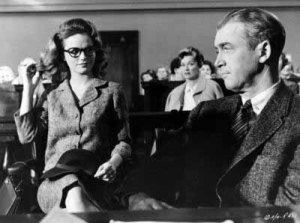
As previously stated, Preminger gets a lot of help from a truly amazing cast.  At first, it’s somewhat strange to imagine a Golden Age icon like Jimmy Stewart appearing in the same film as a dedicated method actor like Ben Gazzara.  These are two men who represent not only different philosophies of acting but seemingly from two different worlds as well.  However, Preminger uses their differing acting styles to electrifying effect.  One of the joys of the movie is watching and contrasting the old style, “move star” turns of James Stewart, Arthur O’Connell, and Eve Arden with the more “naturalistic” approaches taken by their younger co-stars, Gazzara, Lee Remick, and especially George C. Scott.  The contrast in style becomes a perfect reflection of the film’s contrast between what is legal and what is correct.  All the actors, as both individuals and as an ensemble, give memorable performances.  When you look at the cast, you realize that any one of their characters could have been the center of the story without the film becoming any less compelling. 

Lee Remick (a notoriously fragile actress who, for years, I knew solely as the poor woman who kept getting attacked by her adopted son in the original Omen) brings out the best in everyone she shares a scene with.  Whether she’s making Stewart blush or breaking down on the witness stand, she dominates every scene as an insecure young woman who forces herself to be happy because otherwise, she’d have to confront the fact that she’s miserable.  (I should admit that I related more than a bit to Remick’s character.  To me, the movie was about her and therefore, about me.) 

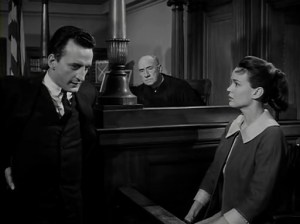
She is perhaps at her best towards the end of the film when she is on the witness stand and is cross-examined by George C. Scott.  Starting out as flirtatious and seemingly confident, Remick slowly and believably falls apart as Scott methodically strips away every layer of defense that, until now, she’s spent the entire movie hiding behind.  By the end of the scene, Remick has shown as every layer of pain that has built up in Laura Manion over the years.  For his part, Scott is simply amazing in this scene.  Determined and focused, Scott doesn’t so much cross-examine Remick but seduces her and the audience along with her.  As a result, when he suddenly turns off the charm and lunges in for his final attack, it’s devastating for everyone watching.  (And, as was correctly pointed out to me by a friend while I was watching the film last night, George C. Scott was quite the sexy beast when he was young.)

Lastly, the film’s judge is played by an actual lawyer by the name of Joseph Welch.  Welch wasn’t a great actor but he did make for a great judge.

Of course, it wouldn’t be a Preminger film is a few contemporary morals weren’t challenged and, at the time it was released, Anatomy of a Murder was considered to be very daring because of its frank discussion of topics like rape and spousal abuse.  It doesn’t seem quite so daring now but it does seem to be remarkably mature in a way that even most modern movies can’t match.  That being said, the film does occasionally embrace the “she must have been asking for it” male viewpoint but still, it’s a remarkably advanced movie for the 1950s.

One of the wonderful things about watching a 51 year-old film is that it provides a chance to see what was considered to be shocking in the years before you or I was born.  From watching this movie, I’ve discovered that, in the year 1959, “panties” was apparently a taboo phrase.  A good deal of the film’s plot revolves around the panties Lee Remick’s character was wearing the night she was raped and their subsequent disappearance.  At one point, there’s even a scene where Welch, Stewart, and Scott struggle to come up with a less offensive term to use when referring to them in the court.  (Scott suggests employing a term he heard in France.)  Seen 51 years later (in a time when we can not only say “thong” in polite conversation but specifically go out of our way to show off the fact that we’re wearing one), this scene, and the actors’ obvious discomfort whenever they have to say the word “panties”, never fails to amuse me.

Preminger’s other grand challenge to the 50s mainstream was in getting Duke Ellington to compose the film’s jazz soundtrack.  At the risk of being called a heretic by some of my closest friends, I’ve never been a big fan of jazz but it works perfectly here.  Ellington, himself, makes a cameo appearance and wow, is he ever stoned.

In conclusion, allow me to thank the readers of the site for “ordering” me to watch, once again, a truly classic film.  Now, seeing as how close the vote was and that I know, for a fact, that some people voted more than once, I think it would be only fair for me to also rewatch and review the other 9 movies (Lost in Translation, Primer, Hatchet For the Honeymoon, Emanuelle in America, Starcrash, Darling, Sole Survivor, The Sweet House of Horrors, and The Sidewalks of Bangkok) in my poll over the next couple of weeks.  I’m looking forward to each and every one of them (well, almost all of them) and, again, thank you for allowing me to start things off with a great film like Anatomy of a Murder.

Song of the Day: Suteki Da Ne (by Uematsu Nobuo)


maxresdefault

The newest Song of the Day is a favorite piece of video game music of mine.

“Suteki Da Ne” is the love theme to Square-Enix’s very popular and long-running rpg series Final Fantasy. The song would mark the point in the game when the lead male and female characters finally realize their love for each other. It’s become a favorite of many game score aficionados and especially those of Japanese game soundtracks. Some consider it one of the best pieces of video game music there is, but that would be going a tad too hyperbolic.

The song is composed by well-renowned game music composer Uematsu Nobuo. He had been instrumental in composing the music for most of the Final Fantasy games until he left Square-Enix in 2004. “Suteki Da Ne” also had other collaborators outside of Uematsu. The lyrics for the song was written by Final Fantasy X scenario writer Nojima Kazushige while the arrangement for the song was done by Hamaguchi Shiro. In the end, most of the credit for the song really belongs to Uematsu-san. He was able to compose a song that worked to not just score a lovely and emotional scene between the two leads in the game but also convey their feelings very clearly through the music.

The lyrics below includes both the original Japanese version as sung by Japanese pop-idol RIKKI and the English translation.

Suteki Da Ne (Isn’t It Wonderful)

Kaze ga yoseta kotoba ni
Oyoida kokoro
Kumo ga hakobu ashita ni
Hazunda koe

(My heart, swimming
In the words the wind has borne
A voice, bouncing
On a tomorrow carried by clouds
)

Tsuki ga yureru kagami ni
Furueta kokoro
Hoshi ga nagare, koboreta
Yawarakai namida

(A heart, trembling
On a mirror where the moon quivers
A star falls, spills
Gentle teardrops)

Suteki da ne
Futari te o tori aruketa nara
Ikitai yo
Kimi no machi, ie, ude no naka

(Isn’t it wonderful
If we could walk, holding hands
I’d want to go
To your town, your house, into your arms
)

Sono mune
Karada azuke
Yoi ni magire
Yume miru

(To your heart
I leave my body
Mixed into the night
I dream)

Kaze wa tomari; kotoba wa
Yasashii maboroshi
Kumo wa yabure; ashita wa
Tooku no koe

(The wind stops; your words
Are a kind illusion
The clouds break apart; tomorrow
Is a distant voice
)

Tsuki ga nijimu kagami o
Nagareta kokoro
Hoshi ga yurete, koboreta
Kakusenai namida

(A heart flowing
In a mirror where the moon has seeped in
A star wavers, spills
Tears you can’t hide)

(kurikaeshi)(repeat)

Sono kao
Sotto furete
Asa ni tokeru
Yume miru

(That face
Touch it, just so
And dream a dream
That melts in the morning)

Found on YouTube: Dean Miller — Zombie Exterminator


Nearly a year ago, I was searching YouTube for the trailer to Umberto Lenzi’s 1980 zombie film Nightmare City and I ended up coming across a tribute to the film’s main character, the virile and bearded TV news anchorman Dean Miller (played, with a notable lack of enthusiasm, by Hugo Stiglitz.)

The video artfully takes Lenzi’s overlong film and reduces it down to 3 and a half minutes of Dean Miller killing people.  Interestingly, not a hint of nuance or plot is lost in the process.  Anyway, the video has always made me smile so I figured why not share it?  I should clarify that I have no idea who actually put this together beyond the fact that I had nothing to do with it.

Actually, I’m being a little bit too hard on Nightmare City.  For a Lenzi film, its actually fairly entertaining and it does feature one of the abosolute worst endings in the history of cinema.  If a hurricane ever hits North Texas and I find myself having to stay inside for a few days, my survival plan is to pass the time writing up a review of Nightmare City.

As previously stated, Miller was played by actor Hugo Stiglitz.  Quentin Tarantino, of course, later borrowed Stiglitz’s name for Inglorious Basterds.  Tarantino’s Stiglitz, it must be said, was a bit more interesting than the actual Stiglitz.

A Quickie From Lisa Marie: The Best Freakin’ Commercial Ever!


If you follow me on twitter then you can probably guess what I consider to be “the best freakin’ commercial ever.”  It premiered (in its full form) during the last Super Bowl and it made me smile whenever I saw it on come on TV.  It was a commercial that I loved so much that it took me a few times to realize it was actually selling something (a car, in this instance).  Up until then, I just thought the commercial was a showcase for Sockmonkey and his friend, the freaky little red thing.

I’m speaking, of course, of the Kia Sorrento “How You Like Me Now” ad campaign.

Don’t get me wrong.  I’m not saying you should buy a Kia and this commercial left me with absolutely no desire to trade in my beloved Chrysler Sebring convertible but it did inspire me to order sockmonkeys for myself, my older sister Erin, and my niece Shannon. 

As great as the song (How You Like Me Now, performed by Heavy) is and as much charisma as that little red monster thingee displays, Sockmonkey really is the star of the commercial.  Seriously, I might actually watch the Daily Show if they fired smug, aging badly, oddly devoted to Stephen Colbert, old Jon Stewart and replaced him with tattooed, fast-driving, water-skiing, mad dancing, fast driving Sockmonkey.

(Yes, I said fast driving twice!  Because that monkey really drives fast!  And, uhmm, not because — as some people claim — I have a five-second attention span…)

The last time I saw this commercial, my friend Jeff commented, “I bet that monkey gets a lot of tail.”

“Silly!” I replied, “He’s already got a tail!”

Later, I realized I may have misunderstood his meaning.

(True story)

But anyway, it’s a fun little commercial whether it makes you want to drive a Kia or not.  And, a definite plus, it’s not half as disturbing as those old Calvin Klein jean commercials.

Warhammer 40K: Dark Millenium Trailer


E3 2010 has made some announcements in regards to several MMORPGs set for release in the near future. One game is Square-Enix’s Final Fantasy XIV which is the sequel to their previous MMORPG in Final Fantasy XI. The second is BioWare’s much-anticipated MMORPG based on George Lucas’ iconic space opera franchise, Star Wars: The Old Republic. Both titles have their fanbase looking forward to play them if just to take a break from the 800 lb. gorilla of the MMO-world: World of Warcraft.

Flying under the radar, but no less anticipated by their own legions of fans is Vigil Studios and THQ’s foray into the MMORPG genre. I am talking about their MMORPG title based on the very popular Games Workshop IP, Warhammer 40,000. Building upon the success and popularity of THQ’s own Dawn of War franchise (also based on the 40k universe), this MMORPG is to be called Warhammer 40K: Dark Millenium Online.

I’m not a huge fan of MMORPG titles since despite how well they play and how much they really look they’re major timesinks that require almost complete dedication from the player to really get into the game. This means almost leaving other games by the wayside and as a gamer that’s a big decision. Either play one game all the time and ignore other great games or only play casually the MMO title and not really get into it.

With this title I may have to rethink about how I feel about MMORPGs since this is one IP that even I am excited over. I have been a huge Warhammer 40K fan since 1990 when I was a senior in high school and my interest has never waned one bit. Now that the franchise has successfully made it’s transition over to video gaming I’m excited for the prospect of enjoying the franchise even more than just reading the lore and playing the tabletop.

The game looks to be like your typical persistent-world MMORPG with two opposing factions having their own unique classes. What I like from looking at the trailer is how heavily it’s based on combat and from the looks of things it might be similar to another scifi-based MMO of the past and that’s Sony’s very own Planetside. I like that vehicles are something that a player can use to fight NPCs and other players of the opposing faction. The only question I and other fans probably have is whether Vigil and THQ will avoid the mistakes Mythic made with Warhammer Online by actually creating a game with an endgame for people to use as their goal.

I’m sure more details will follow as the months pass by. Here’s to hoping that a release date or, at the very least, a beta date for people to participate in, gets announced in the near future. I already know what I shall play and that’s as a Space Marine and hopefully of the Dark Angels Chapter.

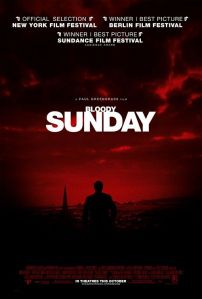
Film Review: Bloody Sunday (dir. by Paul Greengrass)


On January 30th, 1972, in the Bogside area of Derry, Northern Ireland, the British army opened fire on what-was-meant to be a peaceful demonstration.  13 men were killed on the spot, another died later of his injuries.  In the months leading up to the demonstration, the British army had been frequently attacked by pro-independence, largely Catholic “nationalist” groups and the Army was quick to claim that the were acting in self-defense and that they had been fired upon.  Others, however, pointed out that almost all of the men killed (most were just teenagers) had been shot while fleeing the soldiers and none had any weapons on them.  This was the event known that later became known as Bloody Sunday and served as one of the leading catalysts for the decades of “Troubles” that would follow.

Earlier today, 38 years after the fact, British Prime Minister David Cameron finally publicly acknowledged the fact that the 14 men killed on Bloody Sunday were murdered.  Much like the classic Monty Python skit where Eric Idle is convicted of murdering 300 people in one day, Cameron said that he was “very, very sorry.”  (Actually, Idle said that but the idea is the same.)

The Bogside Massacre also served as the basis of one of the best (and most important) films of the first decade of the 21st Century, 2002’s  Bloody Sunday.

Directed by Paul Greengrass (who would later, of course, direct the final two Bourne films), Bloody Sunday is a disturbing recreation of January 30th, 1972.  We watch as the civil rights activist Ivan Cooper (a very likable James Nesbitt) makes his way through the Bogside area of Derry, encouraging people to attend the march while still finding time to beg the local IRA leadership not to start any violence.  While most critical attention is, understandably, given to the scenes that recreate the massacre itself, these early scenes are just as important.  They establish the idea of the people of Bogside as being a community full of actual individuals as opposed to just a collection of pawns in the war between the nationalists and the unionists.

While Cooper tries to ensure peace, we are given contrasting scenes of the British army preparing for the exact violence that Cooper is trying to prevent.  Ironically, in these opening scenes, both Cooper and his military counterparts are motivated by the same basic fear of the IRA.  Its only once the demonstration has started and the first shots are fired that Cooper realizes that the establishment is far more dangerous than the insurgents.

Throughout the film, Greengrass directs in his signature, documentary-style, employing hand-held cameras and rejecting any artistic flourishes that might take the viewer out of the “reality” of the situation.  Each scene ends with a fade-to-black and, as a result, the viewer gets the feeling that he is literally dropping in on the action.  This is not to say that Greengrass is not an artful director.  The power of his artistry, however, comes from his ability to hide the technique.  As a director, he does not demand attention with a lot of showy tricks.  Instead, he earns the attention by perfecting his craft.

Greengrass’s psuedo-documentary style is at its strongest and most devastating during the recreation of the massacre itself.  Perhaps because the film was made for British television at a time when there was still official doubt about what set off the Bogside Massacre, Greengrass leaves hazy the exact reason as to why the army starts firing.  However, what he does make clear is that the 14 men killed were, essentially, murdered.   One of the unfortunate things about being as big a movie fan as I am is that I’ve grown jaded to the sight of people dying on-screen.  However, unlike many other similar films, the deaths in Bloody Sunday are not presented as just being plot devices or as an excuse to get an emotional response from the audience.  Instead, the deaths in Bloody Sunday hurt because you immediately know that, regardless of which you side you support as far as the Troubles are concerned, none of the deaths were necessary.  They were, instead, the product of a nation’s wounded pride.  14 men died so that the British could feel British again.

As you can probably guess, the British don’t come across particularly well in Bloody Sunday and, quite frankly, they shouldn’t.  Watching this movie, you’re left with the impression that the Bogside Massacre was the British Army’s attempt to exorcise the demons of the collapse of the British Empire by killing the Irish.  (Though, in all fairness, the Irish killed a lot of British in the time leading up to Bloody Sunday.)  However, and this is to Greengrass’s credit, individual British soldiers are shown to question the massacre.  Its only when those soldiers are forced give up their individuality and function as a collective that they commit (and, at the film’s end, conspire to cover up) murder.  For just that, this movie should be required viewing for anyone who insists on claiming that “individualism” is a threat to society.

The film ends on a quiet note as a somber Cooper announces that he no longer sees a “peaceful” solution.  This scene gets its power largely from Nesbitt’s own charismatic performance.  Playing the closest thing the film has to a central character, Nesbitt makes his early enthusiasm for the march so infectious that its simply devastating to see him after the massacre, angry and disillusioned.  It also reminds the viewer that, in the years after Bogside, there was no peace and many more innocent people — on both sides of the conflict — would die.  The British army may have thought it was going to scare Northern Ireland into submission but instead, they helped to perpetuate a continuing cycle of death, destruction, and hatred that, regardless of any treaty, continues to this very day.

I should admit that I’m a fourth Irish.  My great-grandparents were born and raised in Ardglass, Northern Ireland.  Though I’ve never been, I hope to visit Ardglass some day.  Though I no longer consider myself to be a member of any religion, I was raised in the Catholic church.  As such, I’ve always had an interest in Irish history and the Troubles in particular.  I’ve also always been biased towards the nationalist side. 

So, it would be fair for someone to ask if I’d have the same reaction to this film if I was a Protestant with family living around London and the honest answer is that I don’t know.

However, the power of Bloody Sunday doesn’t come from political ideology.  Instead, the movie serves as a disturbing but powerful reminder of what can happen when people surrender their free will to groupthink.  Though the oppressors in Bloody Sunday may be British, recent history has proven that, when actively opposed, those with all the power will always react with the same brutal fury.  The forces of oppression remain the same whether they’re in Northern Ireland, Iran, Honduras, or the U.S.A.

A Quickie From Lisa Marie: Subversive Commercials


At the risk of committing heresy, commercials (especially older commercials) fascinate me.  At their best, commercials are textbook exploitation films.  They’re designed to appeal to the audience’s most primal desires and, as a result, are often more truthful reflections of the society that created them than more “mainstream” works of art.  A good commercial is a 1-minute journey into the human subconscious.  (Of course, at their worst, commercials are just commercials, usually for medicines that have a ton of nasty side effects.)

I was recently searching through YouTube for banned or risqué commercials when I came across these Calvin Klein ads from the early 1990s.

I think I vaguely remember seeing one or two of these commercials when I was six or seven.  It may have been the one with the narcissist from Brooklyn because I remember my mom changing the channel as soon as that creepy voice started in with, “You’ve got a nice body.”  I can understand why she did because, if nothing else, these commercials give it out a really creepy vibe.

Supposedly (and I should admit that my source for this info. comes from a bunch of anonymous YouTube commentators), these commercials were pulled off the air and its easy to see why.  These commercials gave mainstream America what it wanted (good-looking, barely legal eye candy) but did so in a way that emphasized just how sordid most people’s fantasies really are.  The creepy and unseen “director” serves as the perfect representative of mainstream, middle-aged America.  (Just check out his confusion over the word “mosh” and his complete loss of composure when the one model refuses to fulfill his fantasy.)  By leaving the director off-screen, the commercials force the viewer into the role of director.  In the best exploitation tradition, these commercials tell the complacent viewer, “This is what the inside of  your head  really looks like.”  At the same time, it also told the young that if they wanted to get the attention of the mainstream establishment, the best way to do so was to tease and offer up implied promises that would never be kept.  Supposedly, a lot of people considered these commercials to almost be pornographic.  Personally, I prefer to think of them as being subversive in the style of a classic film noir.

While the unseen director is the perfect surrogate for the hidden desires of mainstream America, the models themselves all seem to have wandered out of a Larry Clark film, which is perhaps one reason why I worry about what happened to them after their “interviews.”  The first model — Blue-eyed Brandon from Kentucky — is especially cute and I hope he eventually caught the first bus back to Louisville.  He doesn’t look  to be cut out for the big city and I get the feeling that the narcissist from Brooklyn could kick his ass.  I also get the feeling that the older Italian woman ended up making “love on film” with the guy who ripped his shirt in half while the mosher probably ended up impregnating the airhead who wears 30 year-old jeans.  I also get the feeling that the mosher may have been the younger brother of the girl who says, “I won’t dance for you.”  (And good for her!) 

These commercials all feel authentic, even if you’re not quite sure what’s going on.  From the grainy film stock to the shabby studio to the disturbingly intrusive voice of the “director,” these commercials can make your skin crawl.  You watch and you wonder if anyone ever saw these models again after their audition.  Its hard not to suspect that they all ended up either buried in someone’s backyard or maybe on a boat heading to Aruba. 

At the same time, these commercials oddly enough do make you want to go out and buy jeans because, while all of the models appear to be doomed, at least they all look really good.  As a result, the commercials themselves become the ultimate example of the philosophy of “Live Fast, Die Young, and Leave a Good Looking Corpse”