
This last Christmas, along with several other wonderful and sexy gifts, I received The Fabulous Forties DVD box set. Released by the good people at Mill Creek (who have yet to come across a single public domain film that they couldn’t repackage as being a classic), this box set contained 50 films from that wonderful decade.
Since my proclivity for serial reviewing is well-known, you’re probably not surprised that I’ve decided to watch and review all fifty of the films to be found in the Fabulous Forties box set. And, once I’ve finished with the Fabulous Forties, I will move on to the Nifty Fifties, the Sensational Sixties, the Swinging Seventies, and the Excellent Eighties! Since each box set contains 50 films, I will have watched and reviewed 250 films by the time this is all finished. It might take a while but that’s okay. Arleigh keeps us well-supplied with energy drinks here at the Shattered Lens bunker and I am determined to keep going until the job is done.
(And, if need be, there’s always Dexedrine…)
Let’s get things started with the first film in the box set, 1949’s Port of New York!
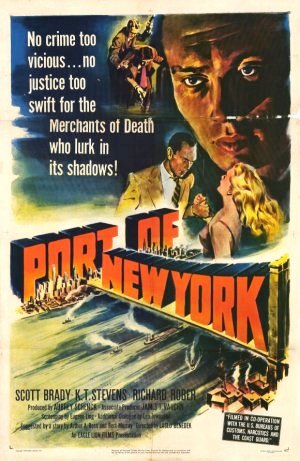
This low-budget, black-and-white film opens with a series of shots of cargo ships sailing into New York Harbor. A narrator, speaking in the type of tone that one would usually associate with an old educational film, informs us that, every day, thousands of ships sail into New York Harbor. Most of those ships are delivering important supplies and conducting important business. However, occasionally, the harbor is used by drug smugglers. (GASP!) Fortunately, both the federal and the state government employ brave and honest men who will stop at nothing to battle the scourge of opium.
(And, fortunately, since this film was made in 1949, they can do whatever they want without having to worry about the Supreme Court getting in the way.)
If it’s not already apparent, Port of New York is a bit of a time capsule. The drug smugglers are unambiguous in their villainy and the decency and honesty of law enforcement is taken for granted. Port of New York was filmed on location in New York and I enjoyed getting a chance to see what New York looked like in 1949.
As for the film’s plot — well, it’s nothing surprising. The port authority discovers that a shipment of morphine, which was meant to be delivered to a pharmaceutical company, has instead been stolen. A million dollars worth of narcotics is missing and the U.S. Government is going to find it! Meanwhile, Toni Cardell (K.T. Stevens) approaches a narcotics agent and says that she has information that could take down one of New York’s biggest gangster. However, before she can tell all the she knows, Toni is murdered.
(The detective who failed to keep Toni from leaving his office and going off to get killed looks down at her body, shrugs, and says, “This one’s on me.”)
Who killed her? That’s what Mickey Waters (Scott Brady) and Jim Flannery (Richard Rober) spend the movie figuring out. However, we already know that Toni was murdered by her boyfriend, a suave gangster named Paul Vicola. Paul is played, in his film debut, by Yul Brynner and he gives a charismatic performance, turning Paul into a memorable monster. Brynner still had a full head of hair when he did this movie, though his hairline was definitely moving backwards.
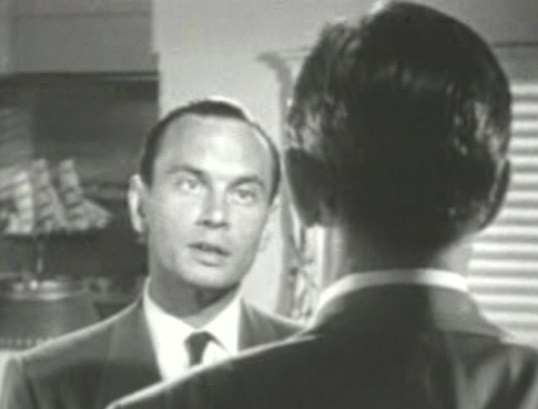
Over the course of their investigation, Waters and Flannery discover that a second-rate comedian named Dolly Carney (Arthur Blake) is being supplied by Vicrola. The scenes where they interrogate Dolly, who is going through withdraw, are some of the best in the film and are distinguished by Blake’s empathetic performance. However, beyond those scenes, there’s really nothing surprising to be found in Port of New York. It’s a thoroughly predictable police procedural that’s distinguished by the presence of Yul Brynner and not much else. That said, the action in this 82-minute film moves quickly and I enjoyed it as a historical artifact.

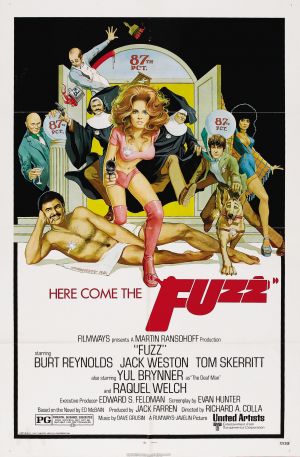 Detective Eileen McHenry (Raquel Welch) has just been given her new assignment and she is about to find out that there is never a dull day in the 87th Precinct. How could there be when the precinct’s top detectives are played by Burt Reynolds, Tom Skerritt, and Jack Weston? Or when Boston’s top criminal mastermind is played by Yul Brynner? There is always something happening in the 8th Precinct. Someone is stealing stuff from the precinct house. Someone else is attacking the city’s homeless. Even worse, Brynner is assassinating public officials and will not stop until he is paid a hefty ransom!


 Through the Shattered Lens