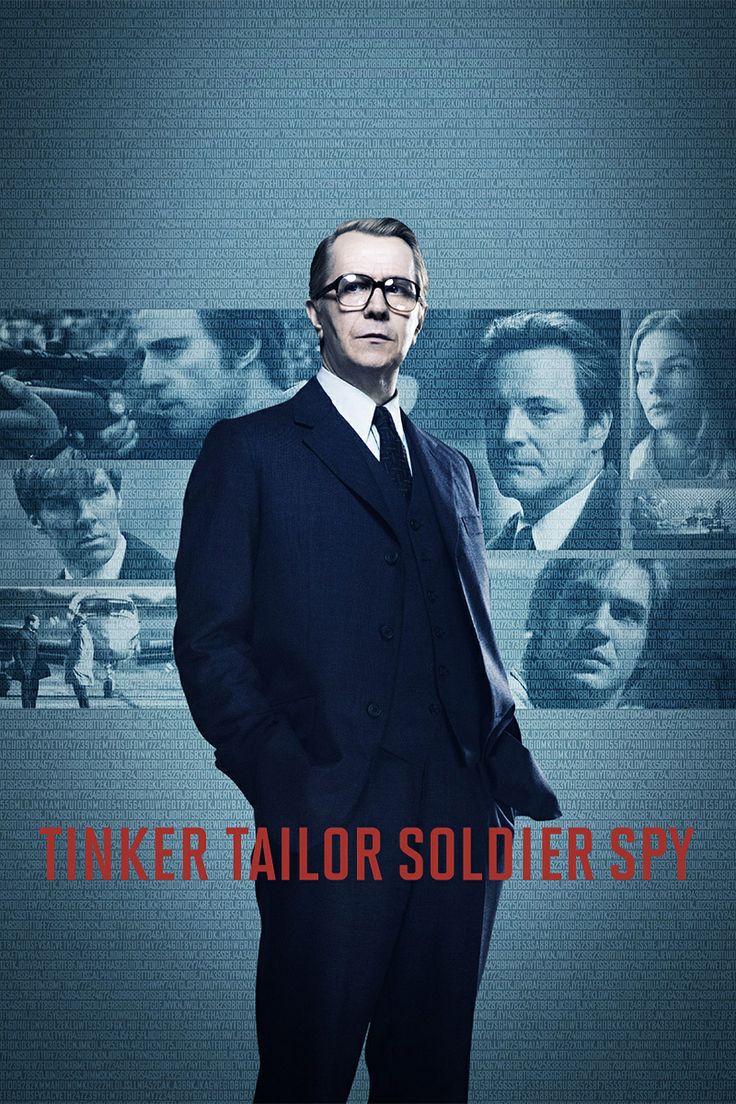
Review: Tinker Tailor Soldier Spy (dir. by Tomas Alfredson)


“We are not so very different, you and I.” — George Smiley

Tomas Alfredson’s Tinker Tailor Soldier Spy (2011) is a cold, coiled, and relentless march into the gray, rain-lashed corridors of British espionage—a film that exchanges Bond’s swagger for bureaucratic unease, where information is traded like poison and every conversation feels weaponized. The film is sheer confidence: so sure of itself, it expects you to keep up, get lost, and piece the puzzle together from the hushed fragments left in close-up reactions and glances across smoke-filled rooms. This is spy cinema not as spectacle, but as slow-burning existential puzzle.

A key element of the film’s mood is its distinctive brutalist aesthetic, which powerfully evokes the Cold War mentality not only behind the Iron Curtain but also in the West. Alfredson and cinematographer Hoyte van Hoytema immerse viewers in a London setting defined by greying, tired walls, bleak drizzle, and decaying interiors that feel as cold and institutional as the very espionage world they depict. This use of brutalism—with its bare concrete textures, utilitarian spaces, and sense of institutional decay—does more than create atmosphere; it visually projects the emotional and material exhaustion of a Britain entrenched in paranoia and internal rot. The characters seem physically and emotionally hemmed in by these spaces, reinforcing the film’s themes of secrecy, alienation, and moral corrosion.

There are no car chases or shootouts to speak of—just a masterclass in stillness where tension arises from precisely what remains unspoken. The film is closer to an autopsy than a thriller, dissecting the social and emotional costs of lives devoted to deception. It begins with a botched operation in Budapest—Jim Prideaux (Mark Strong), one of “the Circus’s” best agents, is captured in a tense, almost wordless scene that sets a tone of brooding unease. The fallout leads to a purge of the leadership, with Control (John Hurt) forced out and George Smiley (Gary Oldman), his quietly watchful confidant, retired—though soon to return for an unofficial mole hunt.

From there, the narrative unfolds elliptically, like a mosaic of recollections and betrayals, requiring viewers to assemble the truth from fractured glimpses. Gary Oldman’s Smiley is the film’s anchor—his performance a masterclass in minimalism and subtext. He’s the ultimate observer, haunted by decades of institutional compromises and personal betrayals.

The supporting cast is nothing short of exceptional, elevating the film through richly textured performances that bring vibrant life to an otherwise reserved script. Colin Firth as Bill Haydon delivers a quietly magnetic portrayal, his charm barely concealing the complexity beneath. Tom Hardy’s Ricki Tarr injects raw energy and restlessness, perfectly contrasting the film’s restrained atmosphere. Benedict Cumberbatch’s Peter Guillam is adept at conveying subtle shifts in allegiance and tension, his nuanced portrayal deepening the intrigue. John Hurt’s brief but potent presence as Control exudes weary gravitas, setting the tone for the murky world of espionage. Mark Strong as Jim Prideaux balances stoicism with vulnerable humanity, particularly in moments laden with pain and regret. Other supporting actors such as Ciarán Hinds, Toby Jones, and Kathy Burke contribute layered, compelling portrayals of individuals trapped within the machinery of the Circus. What binds these performances is a reliance on subtlety—expressing volumes through nuanced gestures and lingering silences, the cast anchors the complex narrative in a palpable human reality.

At its core, Tinker Tailor Soldier Spy is less a whodunnit than an exploration of institutional decay and emotional repression. The brutalist aesthetic mirrors this decline: just as the concrete and ochre walls close in on the agents, so too does the film reveal a Britain worn down by secrets and internal contradiction. Love and loyalty are liabilities in this world where everyone is alienated. The story’s emotional heart revolves around the search for a deeply embedded mole within the Circus—an elusive betrayal that shakes the organization to its core. The film carefully avoids easy reveals, maintaining a deliberate tension and exemplifying the emotional cost that the espionage game of the era had on everyone involved.

The film also explores themes of repressed queerness, class stratification, and misogyny, linking these to the numbing demands of espionage. The gloomy visuals and tightly controlled dialogue echo the emotional constraints on these men, underscoring that beneath the seemingly impenetrable exterior lies a fragile, fragile human cost.

This film is not an easy watch. Its elliptical storytelling, coded conversations, and subtle body language demand patience and multiple viewings. Yet that opacity is part of its power—uncertainty and not-knowing become central to the experience, enhanced by Alberto Iglesias’s restrained score and the claustrophobic mise-en-scène. Unlike many spy films, Tinker Tailor Soldier Spy is about process and detection, not action or glamour. Its cold, meticulous pacing trades on the cerebral seduction of uncovering hidden truths rather than adrenaline-fueled confrontations.

Ultimately, the film refuses easy resolutions. Though Smiley uncovers the mole and the Circus is superficially restored, there’s no real victory—only the acknowledgment of profound damage, both personal and institutional. The brutalist setting, with its unyielding, somber lines, stands as a perfect metaphor for this unresolved tension. Tinker Tailor Soldier Spy is a masterclass in unease and ambiguity, a film that stays with you because it reveals what you’ll never fully know about loyalty, betrayal, and the cost of secrets in a world where the line between friend and enemy is always blurred.
Quick Review: The World’s End (dir. by Edgar Wright)


the_worlds_end_12-620x918A strange thing happened on the way to seeing The World’s End. With the audience seated for the film, we all watched as the credits began. When I saw that Constantin Film was involved, I thought to myself, “Wait, wasn’t Edgar Wright’s films mostly Working Title Productions? This is different.” Turns out the movie that started playing was The Mortal Instruments, the result of which had a few moviegoers groaning and actively talking about the film. Someone actually cried out “It’s the King of the North!” after seeing Lena Headey and her co-star who barely resembled Robb Stark. After about 5 minutes of this, the film was shut down, the reel replaced and The World’s End was ready to begin.

The World’s End marks the final film in Edgar Wright’s Cornetto Flavors Trilogy. The Cornetto (which look like King Cones here in the states) was something of a joke in Shawn of the Dead with the color red, and then had a return appearance in Hot Fuzz with the color blue. The World’s End has a connection with green when it comes to Cornettos.

The film reunites Wright with Simon Pegg and Nick Frost, and in a twist from the previous films together, it’s Pegg whose character is the over the top one with Frost as the straight man. I’ll admit that I walked in this actually expecting the opposite, and found myself chuckling when it didn’t turn out that way.  Surrounded by a cast made up of Wright regulars like Paddy Considine (Hot Fuzz, The Bourne Ultimatum) and Martin Freeman (Love Actually, The Hobbit), along with some new faces in Pierce Brosnan and Rosamund Pike, there isn’t a cast member that feels out of place here. Even when the story feels like it’s about to lull, there’s some weird quip or moment that invoked a laugh or chuckle in the audience.

The World’s End is the story of Gary King (Pegg), who as a teen growing up in small town, dared to do the impossible with his friends. The plan was to make a run to 12 different pubs in the town, have a pint of beer in each one, leading up to the final pub called The World’s End. In the initial attempt, they managed to get about 3/4ths of the way through before getting so smashed that they had to bail out. Time passes, as it always does and the old gang has grown up, moved on to different lifestyles and in some cases, built families. King, on the other hand, is very much stuck in his own time period spending the bulk of his time reliving his glory days. He’s that guy that talks about his High School Football days as if  they were yesterday, some 20 odd years later. This is a running theme through the film – the notion that being caught up in nostalgia is not as great as it ever appears, and that being too nostalgic – living too much in the past –  could possibly suggest that one isn’t appreciating what they have right now, nor are they looking forward to anything. Sometimes, you just can’t go home…or can you?

King decides to get his friends together for one last run on The Golden Mile. As they go from pub to pub, they go over various events in their lives and start to notice (in true Wright fashion) that something really weird seems to be going on in the town. As things begin to unravel, they come to find that actually are in real danger and need to get past all of their issues if they’ll get through it. Just like Shaun of the Dead and Hot Fuzz, the second half of film becomes something of a horror thriller with comedy throughout. Elements of The Thing and Invasion of the Body Snatchers become noticeable as the team tries to survive. That’s pretty much it. Take the recent This is the End, add a few beers and a tighter script and you have The World’s End. The first half of the movie may seem slow, but it does pick up, and pick up well.

Pegg and Frost are the grounding forces to The World’s End. Their performances (particularly Pegg’s) are what keeps it all afloat when it seems like the story might unravel. If the film suffers from any problems, is that it’s something of a downshift for Wright compared to Scott Pilgrim vs. The World. There are a number of action moments in The World’s End, but at the same time, they don’t quite have the umph factor of Wright’s other films. By the time you reach the end, you may actually find yourself scratching your head over what you’ve seen, but then again, the ending of Shaun of the Dead didn’t quite make sense to me either. Not saying that it could have all been better (as I may see it again before the weekend is out), it’s just different.

Overall, The World’s End is a fun ride into the past of a series of characters that will remind you to focus on the present, and laugh while doing so. It’s a fitting close to these films, even if it isn’t the sharpest film in the set (for me that remains Hot Fuzz). If only they served beers at the movie theatres, that would be perfect.

Trailer: Les Misérables (International)


With all my attention on horror-theme last October I had forgotten that the latest trailer for this holiday season’ upcoming feature-length film adaptation of the musical Les Misérables has already come out.

The film will be directed by Academy Award-winning director Tom Hooper (fresh off his win for The King’s Speech) he leads a star-studded ensemble cast in putting on the big screen the much-beloved musical that dominated the 80’s and most of the 90’s. I don’t know any kid growing up during that decade who didn’t get dragged to see the musical in the big cities it entrenched itself in. Instead of hating the experience most kids ended up loving the musical. I know that I was one such highschooler who ended up loving it and musicals in general.

This international trailer shows more of the story compared to the teaser which arrived 5 months earlier. We get to see snippets of Crowe singing as Javert and Seyfried as Cosette. Whilethe West End and Broadway productions have come to an end or at the very least not as popular as they used to be) hopefully this film adaptation will introduce this classic to a new generation of kids. Show them that there’s more to music than the pop hits that dominates the radio waves and internet radio sites.

Les Misérables is set for a December 25, 2012 release date.

Image Source: JWoodhams Deviantart

Trailer: Les Misérables (Teaser)


The moment I saw the news feed that one of my most anticipated films of 2012 finally has an official teaser trailer out I knew that my expectations would only grow with each viewing.

Tom Hooper doesn’t go for small in following up his Academy Award-winning directing work in The King’s Speech by adapting the hugely popular and beloved stage musical Les Misérables which in itself was adapted from the classic Victor Hugo novel of the same name. The cast stars Hugh Jackman and Russell Crowe in the roles of Jean Valjean and Inspector Javert. Anne Hathaway comes away with the role of the tragic Fantine with Amanda Seyfried taking on the role of Fantine’s grown-up daughter Cosette. In what could be a star-making turn, Samantha Barks gets the coveted role of Eponine which was the same role she played as part of the musical’s 25th Anniversary Concert.

Details about this film musical has been scarce, but it’s already been reported that every actor in the cast does their own singing and done so live in front of the camera. This stylistic choice may keep some of the songs from reaching epic levels, but should do well in better conveying the emotional impact for some of the more personal character songs in the musical. In fact, the song that Anne Hathaway sings in the trailer, “I Dreamed A Dream”, is one of those character songs that seem to sound much better with it being less is more style.

Les Misérables is set for a December 14, 2012 release date.