Happy birthday, Clara Bow!
4 Shots From 4 Films
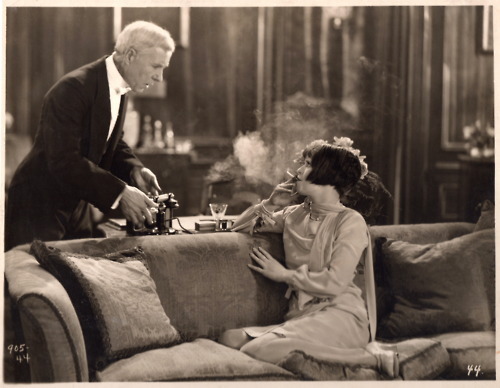
Dancing Mothers (1926, dir by Herbert Brenon)
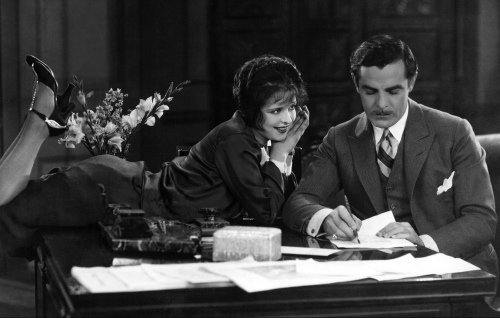
It (1927, directed by Clarence Badger)

Wings (1927, dir by William Wellman)
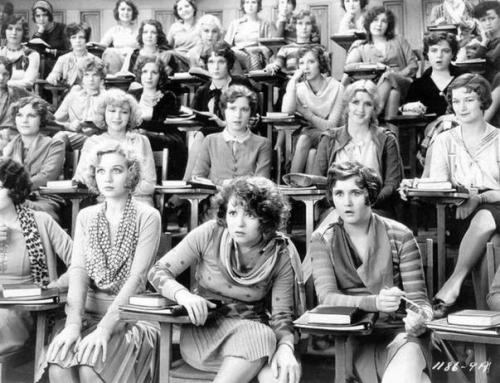
The Wild Party (1929, dir by Dorothy Arzner)
Happy birthday, Clara Bow!
4 Shots From 4 Films
Dancing Mothers (1926, dir by Herbert Brenon)
It (1927, directed by Clarence Badger)
Wings (1927, dir by William Wellman)
The Wild Party (1929, dir by Dorothy Arzner)

Way back in April, I started on a series of reviews. I announced that I would be watching and reviewing all 50 of the public domain films included in Mill Creek’s Fabulous Forties box set.
At the time, I expected that it would take me maybe two weeks. At the most, two and a half. After all, I wondered, how long can I take? Well, needless to say, it took me a little longer than two weeks. In fact, it took me nearly 3 months. (In my defense, May turned out to be a very busy month for me and I wasn’t able to review a single Fabulous Forties film.) However, what’s important is that, after all this time, I am currently writing up the last of my Fabulous Forties reviews!
(And, right now, you’re reading it.)
On the whole, the Fabulous Forties has turned out to be pretty uneven box set. It contains a few classics, like My Man Godfrey, His Girl Friday, and The Last Chance. There are several good films, like The Black Book and Trapped. And then there’s quite a few mediocre and forgettable films, like The Town Went Wild and Jungle Man. (Dear God, Jungle Man…) As I started on the final film in the set, I wasn’t sure what I was about to see…
Well, no worries! The Fabulous Forties ends on a high note! The 50th film is the wonderfully entertaining 1943 comedy-musical-mystery Lady of Burlesque!

Lady of Burlesque (which was released in the UK under the title Striptease Lady) takes place in an old and somewhat decrepit New York burlesque house, the type of place where the audience is almost all male, the owners are somewhat sleazy, and the performers are a cross between cynical veterans and naive newcomers who are hoping for their first big break.
As quickly becomes apparent, the theater would fall apart if not for its main attraction, Dixie Daisy (Barbara Stanwyck). Dixie serves as a mentor for the newcomers and a confidante for the veterans. She knows how to keep the audience entertained, even when two dancers are loudly screaming at each other offstage. She knows how to deal with the sleazy owners and how to placate the owners of the Chinese restaurant next door. Dixie also knows better than to get romantically involved with any of male comics who perform at the theater but that doesn’t stop her from flirting with one of them, Biff Brannigan (Micahel O’Shea, playing his role with an almost poignant earnestness). As I watched the film, I could tell that Barbara Stanwyck was neither a natural dancer nor singer but it didn’t matter because, whether Dixie was trying to keep peace backstage or performing onstage and singing a song called, “Take It Off The E-String, Play It On The G-String,” Stanwyck totally committed herself to the role.
Plus, her outfits were to die for!

Seriously, as I watched Lady of Burlesque, I totally wanted to get a job dancing in an old timey burlesque house! If only I had a time machine…
Of course, it should be understood that the acts in Lady of Burlesque are risqué but, by today’s standards, they’re also rather innocent. The jokes may be full of double meaning but it’s all hidden in the subtext. The costumes may be sexy but they also stay on. (That probably had more to do with the production code than to do with the realities of 1940s burlesque.)
Anyway, Lady of Burlesque is technically a murder mystery but mostly, it’s just an excuse to show the performances happening onstage and a few comedic (and occasionally dramatic) vignettes of what it was like to be backstage in a burlesque house. Two dancers are murdered but the show must go on. Even as Dixie solves the murders and tries to keep everyone calm, the show must go on. In fact, that’s one of the true joys of Lady of Burlesque. Regardless of what madness might be going on backstage, the show never stops! In fact, the film often seems undecided about whether or not the backstage murders are bad because of the loss of life or the fact that they threaten to interrupt the performances onstage. Lady of Burlesque becomes a tribute to the work ethic of entertainers everywhere!
Lady of Burlesque was based on a novel by Gypsy Rose Lee. The name of that novel was The G-String Murders. Not surprisingly, that title was changed for the film version.
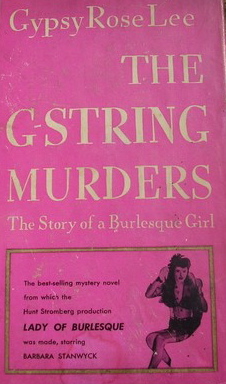
Well, that concludes the Fabulous Forties! In a few weeks, I’ll start in on my next Mill Creek box set, the Nifty Fifties! Until then, enjoy Lady of Burlesque!
4 Shots From 4 Films is just what it says it is, 4 shots from 4 of our favorite films. As opposed to the reviews and recaps that we usually post, 4 Shots From 4 Films is all about letting the visuals do the talking.
All of the scenes below come from films that were made and released between the introduction of sound in the late 1920s and the adoption of the infamous Hays Production Code in 1934. This was truly an exciting time for film as an art form. Not only were filmmakers intoxicated with discovering what they could accomplish through the medium but they were also unhindered by censorship or regulation. The end result was some of the most visually imaginative and narratively daring films to ever be released by the major American studios.
There’s a reason why film lovers continue to eagerly seek out pre-code films. And if you want to experience what made the pre-Code era so memorable, you could not do any worse than to start with the four films featured in this post.
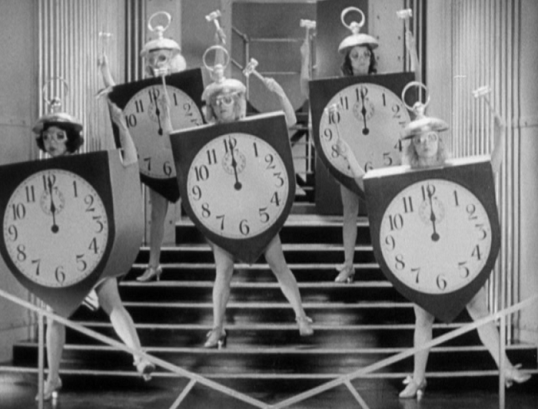
Madam Satan (1930, dir by Cecil B. DeMille)

Safe in Hell (1931, dir by William Wellman)
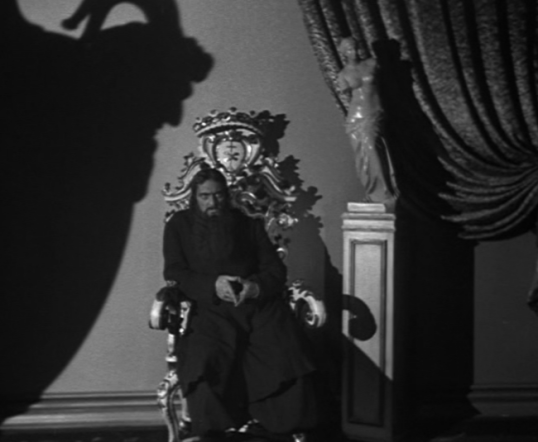
Rasputin and the Empress (1932, dir by Richard Boleslawski)

Search For Beauty (1934, dir by Erle C. Kenton)

“Hello everybody. This is Mrs. Norman Maine.”
— Mrs. Norman Maine (Janet Gaynor) in A Star Is Born (1937)
When I first saw the red neon of the opening credits of the 1937 best picture nominee, A Star Is Born, I thought to myself, “This is a real movie movie.” And I was so impressed by that thought that I even jotted it down in my review notes and now, looking down at my notes, I’m struggling to figure out how to explain just what exactly it was that I meant.
I think that what I was trying to say, in my own way, was that, when we think of a typical big budget Hollywood romance, A Star Is Born is the type of film of which we tend to think. It’s a big, glossy film that is shot in vibrant technicolor and which features a self-sacrificing woman (Esther Blodgett, played by Janet Gaynor) falling in love with a self-destructive but ultimately noble man (Norman Maine, played by Fredric March). It’s a film that has romance, humor, and tragedy. It’s a film that’s designed to make you laugh, cry, and ultimately fall in love. It’s pure melodrama, the type of film that would probably be made for Lifetime today. (And, in fact, it has been remade for Lifetime a number of times, just never under the title A Star Is Born.)
It’s a familiar story that, if I may indulge in a cliché, as old as the movies. Esther is a girl who lives on a farm in North Dakota and she wants to be a star, despite being told by her aunt that she need to start concentrating on finding a man and having children. Esther’s grandmother (Fay Robson) tells Eleanor to pursue her dreams and loans her some money to take with her to Hollywood.
With stars in her eyes, Esther goes out to California and deals with rejection after rejection. (She does, however, manage to rent out an apartment. The weekly rent is $6.00.) Esther does befriend an assistant director (Andy Devine) who gets Esther a job as a waitress at a party. As Esther serves the food, she imitates everyone from Katharine Hepburn to Mae West, all in an attempt to get noticed.
And, amazingly enough, it works! She meets film star, Norman Maine. With Norman’s help, she gets her first screen test and, after her name is changed to Vicki Lester, Esther is put under contract to a studio. She and Norman also fall in love and soon end up married. However, while Vicki Lester is rising to stardom, Norman is descending into irrelevance. He’s an alcoholic who has managed to alienate almost everyone in Hollywood. When Vicki wins her first award, Norman shows up at the ceremony drunk and destroys what little is left of his career.
Will Vicki be able to save Norman from his demons? And will she be able to do so without destroying her own career?
Well, you probably already know the answer. A Star Is Born is one of those stories that everyone seems to know, regardless of whether they’ve actually seen the film or not. (And even if they haven’t seen the 1937 version, chances are that they’ve seen one of the many remakes or ripoffs.) The original Star Is Born is an undeniably familiar and old-fashioned movie but it holds up as a celebration of both old Hollywood glamour and a heartfelt romance.
And it’s in the public domain!
Watch the original A Star is Born below!
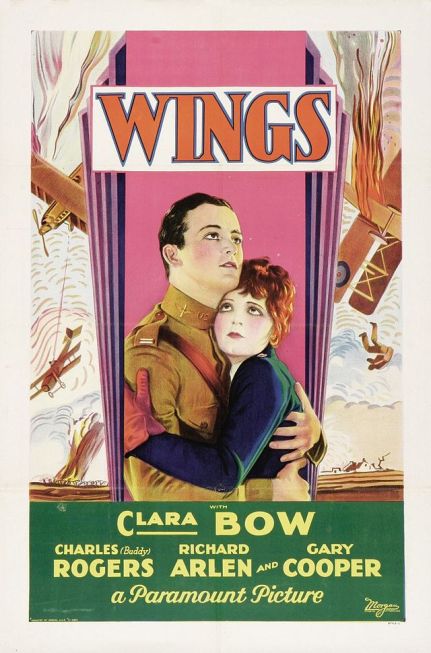
As I mentioned in my previous review, Sunrise may have won the 1927 Oscar for Unique and Artistic Production but the official winner of the first Academy Award for Best Picture was the silent World War I romantic melodrama, Wings. Wings is one of those films that doesn’t seem to get much respect from contemporary critics, many of whom are quick to dismiss the film as being corny and clichéd. It’s not unusual to see Wings cited as being the first example of the Academy honoring the wrong film.
Wings tells the story of David Armstrong (Richard Arlen) and Jack Powell (Charles “Buddy” Rogers), who both live in the same small town and who are both in love with the pretty but self-centered Sylvia (Jobyna Ralston). Sylvia, meanwhile, is in love with the wealthy David but, when Jack asks for a picture of her, she gives him one that she had been planning to eventually give to David. Meanwhile, Mary (Clara Bow), who is literally the girl next door, pines for Jack.
When World War I breaks out, both Jack and David join the Air Force. At first they’re rivals but, under the pressure of combat and the threat of constant death, they become friends. When David flies, he has a tiny teddy bear to bring him luck. Jack, meanwhile, has Sylvia’s picture. Meanwhile, their tentmate — Cadet White (Gary Cooper) — insists that he doesn’t need any good luck charms and promptly suffers the consequences for upsetting God.
Meanwhile, Mary has joined the war effort and is driving an ambulance around Europe. Will Mary ever be able to convince Jack that they belong together? Will David ever catch the legendary German pilot, Kessler? Perhaps most importantly, will this new bromance be able to survive both war and the charms of Clara Bow? And finally, will anyone be surprised when all of this leads to a tragic conclusion with an ironic twist?
Wings has got such a bad reputation and is so frequently dismissed as being the first case of the Academy picking spectacle over quality that I was actually shocked when I watched it and discovered that Wings is actually a pretty good movie. Yes, it is totally predictable. Every possible war film cliche can be found in Wings. (From the minute that handsome and confident Gary Cooper announced that he didn’t need any lucky charms, I knew he was doomed.) And yes, the film does run long and it does feature a totally out-of-place subplot involving a character played by someone named El Brendel (who was apparently a popular comedian at the time). This is all true but, still, Wings works when taken on its own terms.
Here’s the thing with Wings: the aerial footage is still impressive (all the more so for being filmed without the benefit of CGI) and both Charles “Buddy” Rogers and Richard Arlen are handsome and appealing in a 1927 silent film sort of way. In fact, the entire film is appealing in a 1927 silent film sort of way. This is a time capsule, one that shows what films were like in the 20s and, as a result of the combat scenes, also provides a hint of what lay in the future for the film industry. Most importantly, Wings features Clara Bow, who has been my silent film girl crush ever since I first saw It. Whether she’s attempting to flirt with the clueless Rogers or hiding underneath her ambulance and shouting curses at the Germans flying above her, Clara brings a lot of life to every scene in which she appears.
If you’re a film historian, Wings is one of those films that you simply have to see and, fortunately for you, it’s actually better than you may have been led to think.
It’s currently available on Netflix.
I love February.
Why? Well, first off, we all know that February is the most romantic month of the year. February is Valentine’s Day, romantic movies, flowers, lingerie, and chocolate. February is also the month when, in a lead up to the Oscars, TCM devotes a good deal of its programming to showing Oscar nominees of the past.
As I’ve mentioned in the past, one of my dreams is to watch and review every single film that has ever been nominated for best picture. Now, realistically, I’ll never be able to accomplish this goal because the 1929 Best Picture nominee The Patriot is currently a lost film. But, even if it does mean that I’ll only be able to see 510 out of the 511 nominated films, it’s still a dream that I’m pursuing and, with the help of TCM and the month of February, it’s a dream that’ll come true.
Take, for instance, Battleground. This 1949 Best Picture nominee (it lost All The King’s Men) recently aired on TCM. I’m not exactly a fan of war films but, since it was a best picture nominee, I still made sure to DVR and watch it.
Set during the final days of World War II, Battleground follows one platoon of soldiers as they fight and attempt to survive the Battle of the Bulge. The platoon is made up of the type of characters that we usually expect to find in a WWII film but, fortunately, they’re played by an ensemble of likable actors who all bring their familiar characters to life. There’s Jim Layton (Marshall Thompson), the newest member of the platoon who nobody wants to run the risk of getting close to. There’s Holley (Van Johnson), the cheerful soldier who is unexpectedly thrust into a position of leadership that he might not be right for. Roderiques (Ricardo Montalban) is from Los Angeles and is amazed by the sight of snow. “Pops” Stazak (George Murphy) is the type of older soldier who you would totally expect to be nicknamed “Pops.” Bettis (Richard Jaeckel) is scared of combat. Kippton (Douglas Fowley) spends nearly the entire film looking for his lost teeth. And finally, of course, there’s the hard-boiled but warm-hearted Sgt. Kinnie (James Whitmore).
In some ways, Battleground is a very conventional film and it’s easy to wonder how it ended up getting nominated for best film of the year. (Among the eligible films that were not nominated: The Bicycle Thief, Champion, The Fountainhead, On The Town, Sands of Iwo Jima, She Wore A Yellow Ribbon, They Live By Night, and White Heat.) However, the film’s nomination makes a bit more sense when you consider that it was released just four years after the end of World War II. It was a film that appealed both to the veterans who were able to relate to the film’s story and to the patriotic spirit of a country that had just defeated the greatest evil of the 20th Century.
Battleground did not exactly make me a fan of war movies but it’s still a well-made and effective film. As opposed to a lot of other war films, Battleground never makes war look like fun. For the most part, the emphasis is less on strategy and combat and more on the soldiers who are simply trying to survive from day-to-day. The end result is a film that serves as a moving tribute to the soldiers who fought in World War II.
As part of my continuing mission of see every single movie ever nominated for best picture, I’ve been watching a lot of TCM this month. Last week, I caught the 1943 best picture nominee, The Ox-Bow Incident.
Taking place in Nevada in the 1880s, The Ox-Bow Incident is a western that examines both the mob mentality and takes on the issue of lynching. (It should be remembered that when the Ox-Bow Incident was first released, lynchings were still a regular occurrence.) Henry Fonda and Henry Morgan play two prospectors who ride into town one day and discover that everyone is on edge because there are apparently cattle rustlers about. When it’s reported that a rancher has been murdered, the townspeople form a posse and go searching for the rustlers. Realizing that until the real rustlers are caught they’ll be considered prime suspects, Fonda and Morgan join the posse. Led by Major Tetley (Frank Conroy), who falsely claims to be a Confederate veteran, the posse comes across a camp with three men. Though it quickly becomes obvious that the three men are probably innocent, the posse immediately makes plans to lynch the men. Fonda and Morgan find themselves forced to either side with the bloodthirsty posse or to stand up to the mob.
To be honest, I’ve never been a big fan of Westerns. On a personal note, Some of that is because whenever anyone from up north finds out that I’m from Texas, they always ask me if I’ve ever ridden a horse. (For the record, I do not own a horse, I do not ride horses, and I’m pretty sure I’m allergic to them.) On another note, Westerns often strike me as being predictable. All of the dark strangers and the old maid school teachers and the tight-lipped gunslingers spitting tobacco all over the place — it all just makes me want to go, “Bleh!”
However, I was surprised to discover that I really enjoyed The Ox-Bow Incident. While the film’s well-intentioned message was a bit heavy-handed, director William Wellman emphasizes the psychological aspects of the story and the movie itself was well-acted by a large cast who brought a surprising amount of depth to characters who, in lesser hands, could have easily just been stereotypes. Henry Fonda and Henry Morgan were both excellent and sympathetic leads while Jane Darwell dominated the film as one of the more bloodthirsty members of the lynching party. A very young and very suave Anthony Quinn also shows up as one of the accused men. Five decades before either Quentin Tarantino or the Coen Brothers, Wellman and his cast use the standard tropes of the western genre to comment on some very real issues and the end result is a fast-paced film that succeeds in making a moral debate just as exciting as any gunfight or stampede.
Released in 1943, The Ox-Bow Incident was nominated for best picture but, ultimately, it lost to Casablanca. It’s hard to complain about any film losing to Casablanca but taken on its own terms, the Ox-Bow Incident remains an entertaining and intelligent film and one that I’m thankful that TCM gave me a chance to discover.
 Through the Shattered Lens