October True Crime: Murder So Sweet (dir by Larry Peerce)


1993’s Murder So Sweet, also known a Poisoned By The Love: The Kern County Murders (seriously, try to say that ten times fast), tells the story of Steven David Catlin.

Steven David Catlin lived in Bakersfield, California.  Catlin was a career criminal who was married six times and who found some personal redemption for himself as a member of the pit crew for a professional race car driver in Fresno.  Trust me, I’ve lived in enough small, country towns to know that people will overlook a lot as long as someone knows how to work on a car.

One thing that people noticed about Catlin is that the people around him had a habit of dying of mysterious illnesses.  Multiple wives, his adoptive parents, they all died with fluid in their lungs and they left behind not only a medical mystery but also quite a bit of money for Steven David Catlin.  Catlin would always insist on holding a cremation just days after his loved ones passed away.  Not only did that allow Catlin to move on but also kept anyone from being able to do a thorough autopsy.

Eventually, the police figured out that Catlin was just poisoning anyone who got on his nerves or threatened to divorce him.  He wasn’t even a particularly clever poisoner.  He used paraquet, a highly toxic herbicide and he kept the bottle sitting in plain view in his garage.  He might as well have just labeled it his “Poisoning Thermos.”  Catlin was convicted of multiple murders and he was sentenced to die in 1990.  Of course, this being California, Catlin is sill alive and sitting in San Quentin.  This really is a case of “If you lived in Texas, you’d be dead by now.”

In Murder My Sweet, Catlin is played Harry Hamlin, who steals the film as a dumb but charming redneck who walks with a confident swagger and has no fear of hitting on his ex-wife, even after he realizes that she’s trying to convince the police that he’s a murderer.  Helen Shaver played Edie Bellew, the ex who knows better than to trust Catlin.  Her current husband is played by Terence Knox and there’s plenty of scenes of him telling Edie that she needs to back off and that everyone knows that Steve Catlin isn’t a murderer.  In many ways, this is the ultimate Lifetime film in that Edie Bellew not only gets to put her ex-husband in prison but she also proves that her current husband doesn’t know what he’s talking about.

Murder My Sweet takes place in rural California and, as a result, everyone in the film speaks with a shrill country accent and we spend a lot of time in a really tacky beauty parlor.  Indeed, the film portrayal of country eccentricity is so over-the-top that I was tempted to say that it seemed as if the director was trying to rip-off David Lynch.  However, Lynch may have made films about eccentric characters but he never portrayed them as being caricatures.  Lynch loved his eccentrics while this film takes a bit of a condescending attitude towards them.  Still, it’s worth watching for Harry Hamlin’s sleazy turn as Steve Catlin, a guy who enjoys fast cars and making ice cream.

Just don’t eat that ice cream….

Wild Rovers (1971, directed by Blake Edwards)


In Montana, Walter Buckman (Karl Malden) runs his ranch with an iron hand, warning his neighbor, Hansen (Sam Gilman) not to even think of allowing his sheep to graze on his land.  Walter has two sons, hot-headed John (Tom Skerritt) and the laid back and good-natured Paul (Joe Don Baker).  When Walter learns that two of his ranch hands — aging Ross Bodine (William Holden) and young Frank Post (Ryan O’Neal) — have robbed a bank and are heading down to Mexico, he sends John and Paul to bring them back.  Walter is a big believer in the law and he’s not going to allow any of his people to get away with breaking it.

Ross is a veteran cowboy, who only robbed the bank after Walter withheld his pay to cover the damage of a saloon fight between Ross and Hansen’s men.  Frank is the wilder of the two.  He looks up to Ross and Ross is protective of Frank, even if he has a hard time admitting it.  Ross and Frank are heading down to Mexico so Ross can retire in peace.  Instead of going straight to Mexico, though, they make the mistake of stopping by a small town so Frank can play a little poker and visit the town’s brothel.

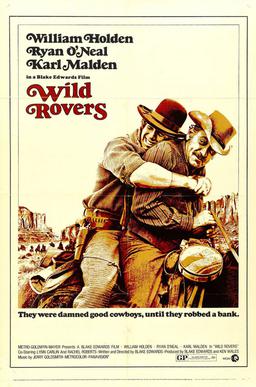
Wild Rovers was Blake Edwards’s attempt to make an epic, revisionist western and he includes plenty of shots of the sun setting over the mountains as well as several violent shoot-outs that are shot in Peckinpah-style slow motion.  Unfortunately, the story itself isn’t really strong enough to support Edwards’s ambitions and all of the shots of the countryside, while nice to look at, don’t really add up too much.  Wild Rovers was also a troubled production, with MGM slashing Edwards’s original three-hour film down to 106 minutes and advertising it with a poster featuring O’Neal hugging Edwards from behind, making the film look like a buddy comedy in the style of Butch Cassidy and the Sundance Kid (or an early version of Brokeback Mountain) as opposed to a violent and elegiac western.  (In 1986, a director’s cut was released, which ran for 136 minutes.)  If you only know Blake Edwards from his Pink Panther movies, the grim and tragedy-filled Wild Rovers will come as a surprise.

One thing that Wild Rovers does have going for it is a good cast.  William Holden and an energetic Ryan O’Neal are a solid team and Karl Malden, Tom Skerritt, Rachel Roberts, James Olson, and Moses Gunn all give good performances too.  This movie also provides Joe Don Baker with a sympathetic role and he’s very likable as the laid back Paul Buckman.  It’s not the type of role that Baker often got to play and it’s obvious that a lot of scenes between John and Paul were cut from the film but, in the truncated version, Joe Don Baker’s Paul Buckman becomes the moral center of the film’s story.

Wild Rovers was a disappointment at the box office, one of many that Edwards suffered in the 70s before he and Peter Sellers brought back Inspector Clouseau.

14 Days of Paranoia #2: Extreme Justice (dir by Mark L. Lester)


What type of justice?

Extreme justice, y’all!

In this 1993 film, Lou Diamond Phillips stars as Jeff Powers.  Who is Jeff Powers?  He’s a cop!  He wants to keep the street safe!  Sometimes, he knows that you have to be willing to break the rules!  He’s a cop who does things his way!

Okay, is that enough exclamation points?  I’m not just using them to be obnoxious.  The film is pretty much just one big exclamation point.  The action is hyperintense and the film is full of characters who always seem like they’re just one step away from exploding.  No one in this film is particularly calm or laid back.  From the start, everything is dialed to eleven and it just keeps going higher and higher.

After Jeff is put on probation for roughing up a suspect, he receives an invitation to join an elite squad of detective.  Led by the charismatic Detective Dan Vaughn (Scott Glenn, giving a performance that is so over-the-top that he yells straight at the camera at one point), the Special Investigative Section is the best of the bed.  Upon joining, Jeff finds himself a member of a sacred fraternity of law enforcers.  Working with men like the always amused Detective Larson (Yaphet Kotto) and the somewhat paranoid Angel (Andrew Divoff), Jeff finds himself tracking some of the biggest criminals in the city.

What Jeff also discovers is that SIS does more than just arrest criminals.  The SIS has been given an unofficial license to kill and they end up executing as many people as they take to jail.  Often times, Vaughn will tells the men to allow a crime to be committed so that they can then dispense their own brand of justice.  In the film’s most disturbing scene, the members of SIS wait until after a woman has been raped in an alley before they move to neutralize her attackers.  When Jeff finally decides that he can’t be a part of all this and tries to reveal what’s going on, he discovers that the SIS has some support in some very high places.  Who cares if the SIS is allowing crimes to be committed or if an innocent person occasionally gets caught in the crossfire?  At least they’re taking care of the criminals!

Extreme Justice is a crude and energetic film and one that is based on some of the stories that spread about the LAPD’s RAMPART division in the 90s.  That the film works is a testament to the performances of Phillips, Kotto, and Glenn and also the direction of Mark L. Lester.  An exploitation vet who occassionally made big studio action films as well, Lester keeps the pace moving at breakneck speed and, even more importantly, he allows both sides to have their say.  While Jeff is upset about SIS’s methods, Detective Vaughn is correct when he says that his unit is targeting the worst of the worst.  It makes for an unusually intelligent exploitation film, one that leaves the audience with a lot to consider.  How far would you go to keep your neighborhood safe?

Previous entries in 2025’s 14 Days Of Paranoia:

  1. The Fourth Wall (1969)

Late Night Retro Television Review: Pacific Blue 1.5 “Out Of The Past”


Welcome to Late Night Retro Television Reviews, a feature where we review some of our favorite and least favorite shows of the past! On Tuesdays, I will be reviewing Pacific Blue, a cop show that aired from 1996 to 2000 on the USA Network!  It’s currently streaming everywhere, though I’m watching it on Tubi.

This show is proving difficult to review.

Episode 1.5 “Out of the Past”

(Dir by Terrence O’Hara, originally aired on March 30th, 1996)

Look, I tried.  I really did.

This episode should have fascinated me.  It featured three storylines.  Palermo was told take a vacation when it became obvious that a serial killer known as The Angel (Tim Thomerson) had returned to the beach and was targeting doctors.  Palermo and The Angel had a history, with Palermo failing to capture The Angel during the killer’s previous spree.  This time, The Angel tried to force a journalist (played by Barry Miller) to record his crimes for posterity.

Meanwhile, Chris and TC went undercover as guests at a hotel so that they could catch a thief and a peeping tom.  Chris and TC pretended to be romantically involved and were so dedicated to maintaining the act that they ended up spending a good deal of the episode hanging out together in their underwear.

Finally, both TC and Del Toro were obsessed with catching a speeding biker who continually managed to outrun and outmaneuver them.  Compounding their embarrassment was the revelation that the biker was a woman.

Mystery, empowerment, and lingerie.  Those are three of my favorites things but this episode still managed to thoroughly bore me.  I had to view it three times because I kept getting distracted whenever I tried to sit down and just watch the show.  Admittedly, with my ADHD, my attention span is on the short side but still, this episode of Pacific Blue was remarkable in that, no matter what happened, I just didn’t care.

Why?  Why can’t this show even work in a so-bad-its-good kind of way?  The characters are just boring and interchangeable.  The men are all grim and serious-minded and, physically, they’re all the same type.  They’re all tall and lean and blandly handsome and none of them have any quirks or interests to really make them stand-out.  The women are also bland and spend most of their time smirking at their male co-workers.  Who are these people?  Who cares?

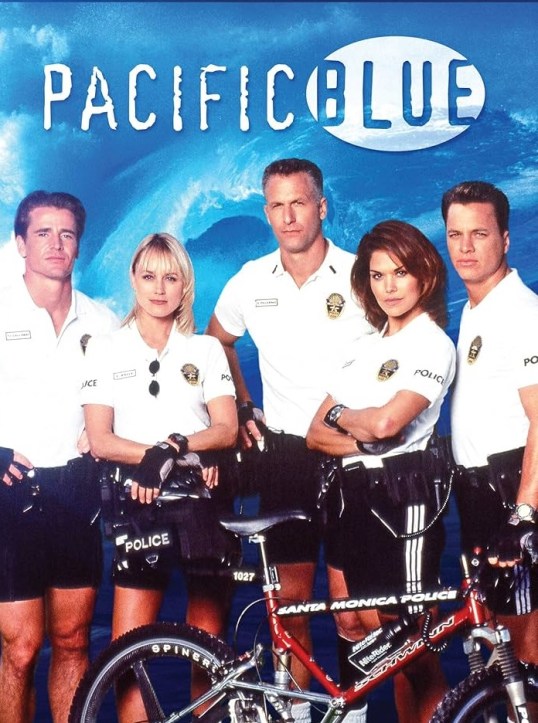
Perhaps the biggest flaw with this episode and the show so far is that the members of the bicycle patrol just look dorky and they peddle around the beach.  The worse thing is when they have to chase a suspect down a flight of stairs and they literally pick and carry their bicycles as they do so.  It’s hard to take bicyclists seriously, even when they’re cops.

Watching the show, I kept thinking about the bicycle cops who used to patrol the campus where I went to college.  No one took them seriously and everyone knew the experience of being yanked over by one of them and being asked, “You been drinking tonight?” when you were totally sober.  It happened to me, one night, when an old ankle injury was acting up and I was walking with a slight limp.  I was already feeling self-conscious about it and getting stopped when all I wanted to do was get home and rest my ankle didn’t help.  The insistence that I must have been drunk or otherwise under the influence and also the assumption that I was obligated to stand around while the cops slowly talked to each other left me feeling violated.  Whenever I see TC or Palermo sitting on their bikes with their oh-so serious “I am a badass” facial expressions, I remember every bad experience that I’ve ever had or I’ve ever seen someone else have with a cop.

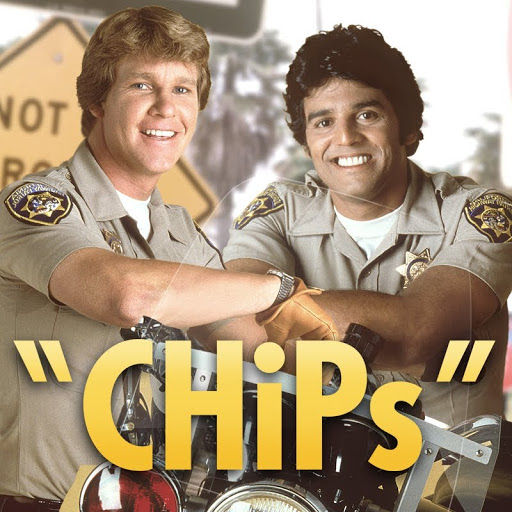
My hope is that Pacific Blue, over the course of its run, eventually found a way to make its characters less annoying and more likable.  (For instance, I don’t mind the cops on CHiPs because at least they’re entertaining.)  I guess we’ll find out!

Retro Television Reviews: Blood Sport (dir by Jerrold Freedman)


Welcome to Retro Television Reviews, a feature where we review some of our favorite and least favorite shows of the past!  On Sundays, I will be reviewing the made-for-television movies that used to be a primetime mainstay.  Today’s film is 1973’s Blood Sport!  It  can be viewed on YouTube.

David Birdsong (played by Gary Busey, who was 29 at the time) is a high school senior with a potentially bright future ahead of him.  He’s the quarterback of his high school’s football team and it looks like he’s on the verge of leading his team to an undefeated season.  He’s getting recruited by all the big schools.  Scouts are coming to his games to watch him play.  He also has one of the highest GPAs at his school, though it’s suggested that might have more to do with his importance to the football team than his actual study skills.

“Don’t you have anything else you want to do with your life?” his high school principal (David Doyle) asks him and David’s reaction indicates that he’s never really given it much thought.  From the time he was born, David’s father, Dwayne (Ben Johnson), has been shaping his son to become a star athlete.  Dwayne is happiest when he’s watching David play, whether on the field or in the highlight reels that he keeps down in the basement.  When Dwayne sees that his son isn’t on the field, he’s the type of father who will get out of the stands and argue with the coach on the sidelines.  Dwayne continually tells David not to stay out too late.  The one time that David does, Dwayne slaps him hard enough to send his son to the floor.

Coach Marshall (Larry Hagman) is determined to get his undefeated season, no matter how hard he has to push his players.  The coach is the type who is convinced that his players respect him for his stern ways and his long-winded speeches but little does he realize that they all secretly despise him.  When one of his players drop dead of a heart attack during practice, Coach Marshall demands that the player stop being lazy and get up.  When he realizes that the player is never going to get up, Coach Marshall angrily asks, “Why did this have to happen now!?”  Later, at a pep rally, Coach Marshall announces that his team had a private meeting and agreed that they would win the final game in the player’s memory.  The team is disgusted but the rest of the town loves their coach.

David is never happier than when he’s on the field, playing football and being cheered by both the crowd and his team.  But, through it all, he sees reminders that the future in uncertain.  On the sidelines, David spots an injured player, watching the game with the knowledge that his dreams of getting a scholarship have ended.  When David visits a college, he’s reminded that being the best high school player doesn’t mean much in college and when he says that he’s a quarterback, he is told that his coach will ultimately decide who he is and David will accept the coach’s decision because David isn’t being offered a scholarship to think for himself.

When the film originally aired in 1973, it was called Birdsong but the title was changed to Blood Sport for both subsequent showings and for a European theatrical release.  Blood Sport is the more appropriate title because, even though the main character is named David Birdsong, the film is ultimately about all of the athletes who are expected to put their health at risk for the people on the sidelines.  It’s not just football that’s a blood sport, the film suggests.  It’s the entire culture that has sprung up around it, the one that cheers when players are at their best but which also looks away at the times when the players need the most help.

At 29 years of age, Gary Busey is a bit too old to be totally convincing as a high school senior but he still does a good job of capturing David’s gradual realization that he’s never really had any control over his own life.  Ben Johnson and especially Larry Hagman also give good performances as the two men who are living vicariously through David’s accomplishments.  Hagman is so believably obnoxious as the coach that you’ll want to cheer when someone finally finds the guts to stand up to him and tell him to just shut up for a minute.

The film ends on an ambiguous note, leaving many questions open about David’s future.  One hopes that he’s started to find the strength necessary to live his own life but it’s ultimately hard to say.  In the end, nothing is guaranteed, no matter how far you can throw a football.