Billy The Kid Versus Dracula (1966, directed by William Beaudine)


Dracula comes to the old west!

The count (John Carradine) has been traveling across the frontier, feasting on settlers and stagecoach riders.  When he comes to a town in the middle of nowhere, he poses as the uncle of saloon owner Betty Bentley (Melinda Plowman).  Using the name Mr. Underhill, Dracula hopes to make Betty into his latest bride.  Everything about Mr. Underhill indicates that he is a vampire but Betty refuses to believe it.  Even when she’s told that Mr. Underhill doesn’t cast a reflection, Betty dismisses it as just being “the old vampire test.”  Two German servants recognize her uncle as being a vampire and Betty again refuses to believe them.  Betty’s fiancé, Billy the Kid (Chuck Courtney), realizes that there is something wrong with Mr. Underhill but can he save his future wife?

The idea of vampires in the old west is one that has inspired a surprising number of movies, most of which are considerably better than Billy The Kid Versus Dracula.  In this movie, Chuck Courtney plays one of the old west’s most notorious outlaws but he’s portrayed as being one of the most upstanding members of his community.  John Carradine plays the world’s most notorious vampire but just comes across as being a grouchy old man.  Chuck Courtney is a convincing westerner but not a very interesting actor.  John Carradine sleepwalks through the role and later said Billy The Kid Versus Dracula was the only one of his many films that he actively disliked.  The movie was shot in 8 days and it looks like it.

This was also the final film of director William Beaudine, who had directed his first film 51 years earlier.  The film was released on a double feature with Beaudine’s Jesse James Meets Frankenstein’s Daughter.  Everyone ended up in the old west eventually.

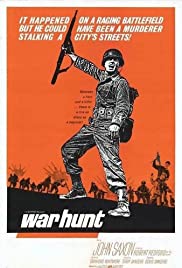
War Hunt (1962, directed by Denis Sanders)


In the last days of the Korean War, Pvt. Roy Loomis (Robert Redford) is assigned to an infantry unit that’s serving on the front lines.  Loomis is an idealist who believes in always doing the right thing and who believes that he’s truly fighting for the American way of life in Korea.  The company’s commander (Charles Aidman) is more cynical.  As he explains it, the job of the soldiers is not to win the war.  Their job is to stall the advance of the enemy long enough to let the politicians and the diplomats get what they want out of a peace settlement.  The soldiers are merely there to be sacrificed.

Loomis soon finds himself in conflict with Pvt. Endore (John Saxon).  Endore spends his night sneaking around behind enemy lines, killing soldiers, and gathering intelligence.  No one goes with Endore on these missions and Endore makes it clear that he doesn’t want to have anything to do with the other solders in the unit.  Because Endore usually returns with valuable intelligence, he’s allowed to do what he wants but it becomes clear that gathering intelligence is not what motivates Endore.  Endore loves war and killing.  In the United States, he would probably be on death row.  In Korea, at the height of the war, he’s a valuable asset.

Charlie (Tommy Matsuda) is an orphan boy who has been adopted as the company’s mascot.  Both Loomis and Endore have a bond with Charlie.  Loomis wants Charlie to go to an orphanage after the war so that he can hopefully be adopted and maybe brought over the United States.  Endore, however, plans to stay in Korea even after the war ends and he wants to keep Charlie with him.  He wants to turn Charlie into as efficient a killing machine as he is.

This low-budget but effective anti-war film may be best known for featuring Robert Redford in his first starring role but the film is stolen by John Saxon, who is frighteningly intense as Endore.  Endore is so in love with war that he continues to fight it even after the Armistice is declared.  Saxon plays him like a cool and calculating predator, a natural born killer.  He’s an introvert who rarely speaks to the other members of the company.  Even though he helps them by killing the enemy before the enemy can kill them, it’s clear that Endore doesn’t really care about the other members of the unit.  He just cares about killing.  He’s close to Charlie because Charlie is too young to realize just how dangerous Endore actually is.

Along with Saxon and Redford, War Hunt also features early performances from Tom Skerritt, Sydney Pollack, and Francis Ford Coppola.  (Coppola, who goes uncredited, plays an ambulance driver.)  Pollack and Redford met while they were both acting in this film and Pollack would go on to direct Redford in several more films.  One of those films, The Electric Horseman, would reunite Redford and Saxon.  Again, they would play adversaries.

Last night, when I heard John Saxon had died, I tried to pick his best performance.  I know that most people know him from his horror work and his role in Enter the Dragon.  Those are all good performances but, for me, Saxon was at his absolute best in War Hunt.


Lisa Reviews An Oscar Nominee: Five Easy Pieces (dir by Bob Rafelson)


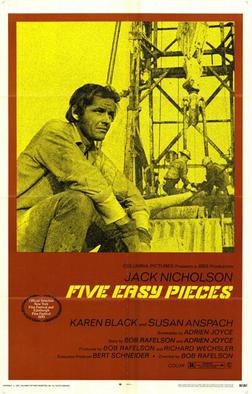
First released in 1970, Five Easy Pieces tells the story of a lost man named Bobby Dupea (Jack Nicholson).

When we first meet Bobby, he’s working at a California oil field.  He likes to go bowling.  He has a girlfriend named Rayette (Karen Black), who is a country music-obsessed waitress.  His best friend is Elton (Billy “Green” Bush), a friendly redneck with a memorable laugh.  Bobby may have a girlfriend and Elton may be married but that doesn’t stop either one of them from going out at night, getting drunk, and trying to pick up women.

Bobby seems to be just another blue-collar guy with a grudge against the bosses but it doesn’t take long to realize that there’s something different about him.  Bobby may be friends with Elton but it’s obvious that the two of them come from very different background.  No matter how much he tries to hide it, Bobby is smarter than everyone else around him.  When he and Elton get stuck in a traffic jam, Bobby spots a piano sitting on the back of a pickup truck.  Getting out of his car, Bobby yells at everyone who is honking and then climbs up to the piano.  He sits down, he puts his fingers to the keys and he starts to play.  Knowing Bobby, you’re expecting him to just bang the keys and make noise.  Instead, he plays beautiful music.

Later, Bobby steps into a recording studio.  Paritia (Lois Smith), a neurotic woman, is playing the piano.  The recording engineers joke about her lack of talent.  Bobby glares at them, annoyed.  It quickly becomes apparent why Bobby is so protective.  Paritia is Bobby’s sister.

Bobby, it turns out, comes from a wealthy family of musicians.  Everyone in the family has dealt with the pressure to succeed differently.  Paritia continues to play, despite not having much talent.  Bobby’s older brother, the buffoonish Carl (Ralph Waite), plays violin and has staid home with their father (William Challee).  Bobby, on the other hand, ran away from home.  He’s spent his entire life trying to escape from both his talent and his family.  However, when Paritia explains that their father has suffered from two strokes and might not live much longer, Bobby reluctantly decides to return home and try to make some sort of peace with his father.

It’s not as easy a journey as Bobby would have liked.  For one thing, Rayette demands to go with him.  On the drive up to Washington, they pick up two hitchhikers (Helena Kallionetes and Toni Basil), one of whom is obsessed with filth.  In the film’s most famous scene, an attempt to get a simple lunch order modified leads to Bobby losing control.

See, that’s the thing with Bobby.  In many ways, he’s a jerk.  He treats Rayette terribly.  While his family is hardly perfect, the film doesn’t hide from the fact that Bobby isn’t always the easiest person to deal with.  And yet, you can’t help but sympathize with Bobby.  If he seems permanently annoyed with the world … well, that’s because the world’s annoying.  And, to Bobby’s credit, he’s a bit more self-aware than the typical rebel without a cause.  When one of the hitchhikers praises his temper tantrum at the diner, Bobby points out that, after all of that, he still didn’t get the order that he wanted.

In Washington, Bobby tells Rayette to stay at a motel and then goes to see his family.  Bobby seems as out-of-place among his wealthy family as he did hanging out in the oil fields with Elton.  He ends up cheating on Rayette with Carl’s fiancee, a pianist named Catherine van Oost (Susan Anspach).

And then Rayette shows up for dinner…

Five Easy Pieces is a sometimes funny and often poignant character study of a man who seems to be destined to always feel lost in the world.  Bobby spends the whole movie trying to find a place where he can find happiness and every time, reality interferes with his plans.  Nicholson gives a brilliant performance, playing Bobby as a talented guy who doesn’t really like himself that much.  Bobby’s search for happiness leads to a rather haunting ending, one that suggests that some people are just meant to spend their entire life wandering.

Five Easy Pieces was nominated for Best Picture but lost to Patton.

The Fabulous Forties #1: Port of New York (dir by Laszlo Benedek)


40s

This last Christmas, along with several other wonderful and sexy gifts, I received The Fabulous Forties DVD box set.  Released by the good people at Mill Creek (who have yet to come across a single public domain film that they couldn’t repackage as being a classic), this box set contained 50 films from that wonderful decade.

Since my proclivity for serial reviewing is well-known, you’re probably not surprised that I’ve decided to watch and review all fifty of the films to be found in the Fabulous Forties box set.  And, once I’ve finished with the Fabulous Forties, I will move on to the Nifty Fifties, the Sensational Sixties, the Swinging Seventies, and the Excellent Eighties!  Since each box set contains 50 films, I will have watched and reviewed 250 films by the time this is all finished.  It might take a while but that’s okay.  Arleigh keeps us well-supplied with energy drinks here at the Shattered Lens bunker and I am determined to keep going until the job is done.

(And, if need be, there’s always Dexedrine…)

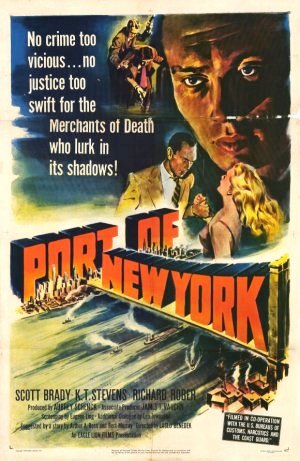
Let’s get things started with the first film in the box set, 1949’s Port of New York!
Port_of_New_York_(film)_poster

This low-budget, black-and-white film opens with a series of shots of cargo ships sailing into New York Harbor.  A narrator, speaking in the type of tone that one would usually associate with an old educational film, informs us that, every day, thousands of ships sail into New York Harbor.  Most of those ships are delivering important supplies and conducting important business.  However, occasionally, the harbor is used by drug smugglers.  (GASP!)  Fortunately, both the federal and the state government employ brave and honest men who will stop at nothing to battle the scourge of opium.

(And, fortunately, since this film was made in 1949, they can do whatever they want without having to worry about the Supreme Court getting in the way.)

If it’s not already apparent, Port of New York is a bit of a time capsule.  The drug smugglers are unambiguous in their villainy and the decency and honesty of law enforcement is taken for granted.  Port of New York was filmed on location in New York and I enjoyed getting a chance to see what New York looked like in 1949.

As for the film’s plot — well, it’s nothing surprising.  The port authority discovers that a shipment of morphine, which was meant to be delivered to a pharmaceutical company, has instead been stolen.  A million dollars worth of narcotics is missing and the U.S. Government is going to find it!  Meanwhile, Toni Cardell (K.T. Stevens) approaches a narcotics agent and says that she has information that could take down one of New York’s biggest gangster.  However, before she can tell all the she knows, Toni is murdered.

(The detective who failed to keep Toni from leaving his office and going off to get killed looks down at her body, shrugs, and says, “This one’s on me.”)

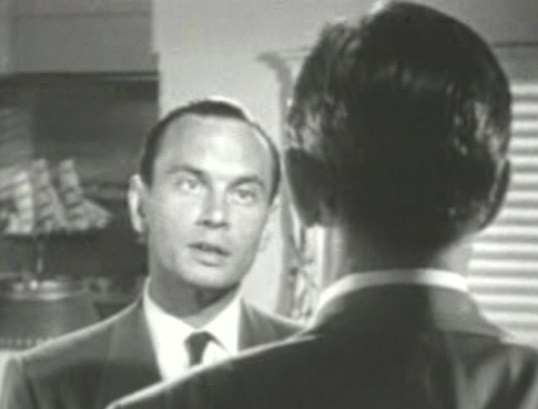
Who killed her?  That’s what Mickey Waters (Scott Brady) and Jim Flannery (Richard Rober) spend the movie figuring out.  However, we already know that Toni was murdered by her boyfriend, a suave gangster named Paul Vicola.  Paul is played, in his film debut, by Yul Brynner and he gives a charismatic performance, turning Paul into a memorable monster.  Brynner still had a full head of hair when he did this movie, though his hairline was definitely moving backwards.
Yul

Over the course of their investigation, Waters and Flannery discover that a second-rate comedian named Dolly Carney (Arthur Blake) is being supplied by Vicrola.  The scenes where they interrogate Dolly, who is going through withdraw, are some of the best in the film and are distinguished by Blake’s empathetic performance.  However, beyond those scenes, there’s really nothing surprising to be found in Port of New York.  It’s a thoroughly predictable police procedural that’s distinguished by the presence of Yul Brynner and not much else.  That said, the action in this 82-minute film moves quickly and I enjoyed it as a historical artifact.

Yul_Brynner_&_K.T._Stevens_Port_of_New_York_01