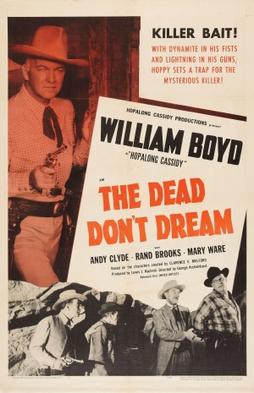
The Dead Don’t Dream (1948, directed by George Archainbaud)


From 1935 to 1948, actor William Boyd played the role of upright, Sarsaparilla-drinking cowboy Hopalong Cassidy in over sixty films.  Though most of these films were standard western programmers, they were still better produced than the average B-western and, despite having never been one in real life, Boyd was considered to be one of the most believable cowboys on the silver screen.

All good things, however, must come to an end and, by 1944, the Hopalong Cassidy films were no longer bringing in the audiences that they once did.  After United Artists announced that they weren’t planning on producing any more Cassidy films,  William Boyd bought the rights to character from producer Harry Sherman and then proceeded to produce and distribute Cassidy’s final film adventures himself.  The Dead Don’t Dream was the 62nd Hopalong Cassidy and it was also one of the last.  Only four more films would follow it.

Though The Dead Don’t Dream is set in the old west and features Hoppy and his two usual sidekicks, Lucky (Rand Brooks) and California (Andy Clyde), it’s hardly a standard western.  Instead, it’s an Agatha Christie-style murder mystery, taking place in a western inn and even featuring William Boyd announcing, “The killer is in this room!”  Hoppy, Lucky, and California are in town for Lucky’s wedding but, when Lucky’s future father-in-law turns up dead, the wedding turns into a murder investigation.  Two other men disappear and are presumed to be dead and with everyone apparently dropping like flies, it’s up to Hoppy to solve the case, catch the killer, and prove that it’s neither him nor Lucky.  The only clue is that all of the men spent a night in the same room.

The Dead Don’t Dream is diverting programmer.  Though the low-budget means that there aren’t a lot of of suspects and the killer’s identity is pretty easy to figure out, Boyd does a good job playing detective and the method that was used to commit the murders is surprisingly inventive.  There’s a lot more talking the shooting in The Dead Don’t Dream, which might disappoint some western fans.  But personally, I enjoyed the film’s change-of-pace approach to the genre.  It was interesting to see old west heroes solving mysteries instead of just shooting bad guys,

Though Strange Gamble, the final Hopalong Cassidy film, was released just a few months after The Dead Don’t Dream, Boyd would keep the character alive on both the radio and television.  Boyd was considered to be the first western TV star and every western program that followed owed him an immeasurable debt.  After finally retiring from acting in 1954, Boyd went on to make millions in real estate before eventually dying, at the age of 77, in 1972.  For the rest of this life, he refused to do interviews or photographs, preferring the people always remember him as Hopalong Cassidy.

Lisa Reviews An Oscar Winner: The Greatest Show on Earth (dir by Cecil B. DeMille)


Jimmy Stewart is Buttons the Clown!

Listen, there’s a lot of things that can be said about the 1952 Best Picture winner, The Greatest Show on Earth.  Not only was it one of three Cecil B, DeMille films to be nominated for best picture (along with 1934’s Cleopatra and 1956’s The Ten Commandments) but it was also the only one to win.  It brought Cecil B. DeMille his first and only nomination for best director.  (DeMille lost that directing Oscar to John Ford but he still took home an award, as the producer of The Greatest Show On Earth.)  The Greatest Show on Earth not only featured Charlton Heston in his first starring role but, with a finale that featured everyone involved in the same spectacular train crash, it also set the standard for the countless disaster movies that would follow.

But, with all of that in mind, the main thing that you’ll remember about this movie is that Jimmy Stewart was Buttons the Clown.

Buttons is a beloved member of the Ringling Bros. and Barnum & Bailey’s Circus.  He travels with the circus across the country, entertaining children and generally helping out wherever he can.  Everyone loves Buttons, despite the fact that no one has ever seen him without his makeup.  (That said, you only have to hear him speak to immediately recognize him as being played by Jimmy Stewart.)  Not even the circus’s no-nonsense manager, Brad Braden (Charlton Heston, naturally), knows what Buttons actually looks like.  Everyone assumes that Buttons is just a dedicated performer, a method clown.

However, it turns out that Buttons has a secret.  Of course, nearly everyone at the circus has a secret but Buttons’s secret is a little bit more serious than just a love triangle or a case of professional jealousy.  There’s a reason why Buttons is surprisingly good at providing first aid to the members of the circus.  Before he was a clown, Buttons was a doctor.  And, while he was a doctor, he killed his wife.

NO!  NOT JIMMY STEWART!

In Buttons’s defense, it was a mercy killing and he feels really bad about it.  That, of course, doesn’t matter to the FBI agent (Henry WIlcoxon) who suspects that the doctor may be hiding among the circus performers.  At first, Buttons views that train crash as the perfect opportunity to escape but then he finds out that many of his fellow performers have been seriously injured.  A doctor is needed.  Perhaps even a doctor in clown makeup….

Even under all that makeup, Jimmy Stewart does a great job of bringing Buttons to life.  Sometimes, we associate Stewart so much with his famous way of speaking that we overlook just what a good actor Jimmy Stewart actually was.  Even before you discover why Buttons is running from the cops, Stewart does a good job of capturing the sadness and the regret that lies at the heart of Button.  He’s truly a tragic clown.

Buttons’s status as a fugitive is just one of the many subplots to be found in The Greatest Show On Earth.  There’s a lot of drama (not to mention parades and performances) to get through before that train crashes.  Brad, for instance, is struggling to keep the circus from going bankrupt.  Meanwhile, his girlfriend, Holly (Betty Hutton), is torn between him and the arrogant but charming Great Sebastian (Cornel Wilde).  In fact, every woman in the circus — including Gloria Grahame and Dorothy Lamour — is in love with the Great Sebastian.  Sebastian is a bit self-centered but he’s famous enough to ensure that the circus won’t have to be closed.  Or, at least, he is until he’s injured in a trapeze accident.  Will Sebastian ever perform again?  Meanwhile, there’s a jealous elephant trainer named Klaus (Lyle Bettinger) and a crooked concessionaire named Harry (John Kellog).  A local gangster, Mr. Henderson (Lawrence Tierney), is trying to muscle his way into the circus’s business.  Is it any surprise that Brad always seems to be in something of a bad mood?  He’s got a lot to deal with!

And yes, it’s all a bit overblown and a bit silly.  And yes, the film really does feel like it was meant to be a commercial for Ringling Bros.  And yet, in its way, the film definitely works.  There’s a sincerity at the heart of the film, one that’s epitomized by Cecil B. DeMille’s opening narration.  “”A fierce, primitive fighting force that smashes relentlessly forward against impossible odds: That is the circus — and this is the story of the biggest of the Big Tops — and of the men and women who fight to make it — The Greatest Show On Earth!”  DeMille was 71 years old when he made The Greatest Show On Earth and he was coming to the end of a legendary filmmaking career.  DeMille was one of the founders of the American film industry and you can argue that, if not for some of his silent spectacles, Hollywood would have always remained just a neglected suburb of Los Angeles.  If anyone understood that importance of that old saying, “The show must go on!,” it was Cecil B. DeMille.  And really, that’s what The Greatest Show On Earth is all about.  It’s a tribute to the performers who refuse to give up.  Love triangles?  Fugitive clowns?  Injured acrobats?  Lawrence Tierney?  No matter what, the show must go on!

The Greatest Show On Earth is often described as being one of the worst films to win the Academy Award for Best Picture.  That has more to do with the quality of the films that it beat — High Noon, The Quiet Man, Moulin Rouge, and Ivanhoe — than the film itself.  The Greatest Show On Earth is old-fashioned and a bit silly but it’s still entertaining.  Should it have beaten High Noon?  That would be a definite no.  But it’s still better than Crash.