The TSL Horror Grindhouse: Blackenstein (dir by William A. Levey)


1973’s Blackenstein tells the story of Eddie Turner (Joe De Sue), a black man who served in Vietnam.  Unfortunately, while serving his country, Eddie stepped on a landmine and lost his arms and his legs.  Now back in Los Angeles, Eddie spends his days laying in a bed in a VA hospital, where he’s taunted by an orderly who, it turns out, is actually just upset because he wanted to join the army but he failed his physical.  Because this film was made on the cheap, Eddie’s limbless state is represented by continually having the covers of his bed drawn up to his neck.

Eddie’s girlfriend, Dr. Winifred Walker (Ivory Stone), is upset because Eddie is having a hard time adjusting to life in the States and, having lost the lower half of his body, Eddie has been rendered impotent.  She gets a job working with Dr. Stein (John Hart), a doctor who has down amazing things with DNA and RNA.  He lives in a castle-like mansion and he has a laboratory that is full of lasers and beakers that are labeled “DNA.”  Apparently, Dr. Stein can inject people with DNA …. don’t look at me like that, I didn’t write this movie …. and not only reverse the aging process but also help people regrow limbs.

Eddie is brought to the mansion to be Dr. Stein’s latest patient.  Unfortunately, Dr. Stein’s assistant, Malcomb (Roosevelt Jackson), has fallen in love with Winifred and is stung when she tells him that her heart belongs to Eddie.  Malcomb sabotages Eddie’s DNA injections so that Eddie, along with growing back his arms and his legs, also transforms into a turtleneck-wearing monster with a flattop.  Eddie spends his days in a coma and his nights stalking Los Angeles.

Blackenstein was released at the height of the blaxploitation boom, when filmmakers were reinterpreting classic genres with black actors.  Some of these films, like Shaft and Superfly, hold up very well and remain a part of the pop cultural landscape.  And others, like Blackenstein, would be largely forgotten if not for the strangeness of their title.  Blackenstein was clearly inspired by the success of Blacula, though it comes nowhere close to being as compelling as that film.

Blackenstein has more than a few problems.  The pacing is abysmal.  The plot requires a lot of smart people to do a lot of dumb things.  As opposed to other films based on Mary Shelley’s novel, the Monster is neither scary nor sympathetic.  Eddie Turner was played by a non-actor named Joe de Sue, who was hired because he was a client of the Frank Salteri, the criminal lawyer-turned-filmmaker who produced the film.  Joe de Sue rarely speaks and when he does, he turns his face away from the camera and it is fairly obvious that his dialogue was dubbed in after the scene was shot.  Ivory Stone and Roosevelt Jackson awkwardly deliver their lines about DNA and RNA in a tone that suggests that neither they nor the filmmakers were exactly sure what either one of those were.  John Hart is perhaps the most mild mad scientist in the history of horror cinema.

One could argue that there’s an interesting subtext to this film, with its scenes of a white scientist conducting a dangerous medical experiment on a black man who is not in a position to refuse.  But let’s not fool ourselves.  This film is not Blacula, with its title character being transformed into a vampire as punishment for standing up to Dracula’s racism.  Blackenstein had very little on its mind, beyond cashing in on the then-blaxploitation boom.  The title promises a certain over-the-top silliness but, ultimately, this film is way too boring for something called Blackenstein.

Hellgate (1989, directed by William A. Levey)


In what we’re told is supposed to be the 1950s (even though everybody looks and dresses as if they’re from 1989, the year this film was shot), a group of bikers murder a young waitress named Josie (Abigail Wolcott).  Josie’s father hacks the biker’s to death with an axe and, years later, uses a magic blue crystal to bring Josie back to life.  However, Josie is inow a succubus who wanders along the highway and waits to be picked up by random travelers.  She brings them back to a ghost town called Hellgate, where her father uses the gem to turn them into zombies or ghosts or something.  Jose’s latest target is a college student named Matt (Ron Palillo), who is heading up  to the mountains to meet up with his girlfriend and another couple.  When Matt gets distracted by Josie, will he be able to escape or will he lose his mortal soul or whatever is that supposed to be going on in the town of Hellgate?

This is a confusing film.  It actually feels like a hodgepodge of outtakes from several other films which were just put together in an attempt to salvage something and hopefully make some money from the undemanding direct-to-video market.  That Hellgate still has a cult following despite being an incoherent mess is proof that the film’s producers were not totally clueless.  People will watch almost anything if there’s a promise of nudity.  Hellgate delivers that, though much of the nudity comes from Ron Pallilo so I can only imagine how the film’s target audience of teenage horror fans reacted to that back in 1989.

This movie does indeed star Ron Palillo, better known for playing Arnold Horseshack on Welcome Back, Kotter.  (In the Gabe Kaplan stand-up routine that inspired the show, Arnold’s last name was actually Horseshit but they had to clean it up for network TV.)  Pailillo was in his 40s when he was cast as a college student and he looked closer to 50.  Still, every woman in the film falls all over herself at the sight of Ron Palillo, even the ones who aren’t trying to steal his soul or whatever it is that Josie is actually doing in this film.  Ron Palillio tries really hard to convince us that he’s a college stud but it’s impossible to look at him without thinking, “That’s Horseshack with a few extra years on him.”

If the story and the acting aren’t bad enough for you, Hellgate was also filmed in South Africa in the late 80s, at a time when Apartheid was still the law of the land and Nelson Mandela was still imprisoned.  Most of the supporting actors are South African.  They try and struggle to sound like they live in the American southwest.  It’s hard to see what the film got out of being filmed in South Africa, other than the fact that it was cheap.

Like most really bad movies, Hellgate has got a cult following but it’s not worth the trouble.  Unless you’re the world biggest Ron Pallilo fan (no judgment here!), this is one you can skip.

Everyone’s Crazy: Committed (1991, directed by William A. Levey)


After her lover and employer commits suicide, nurse Susan Manning (Jennifer O’Neill) needs a new job so she applies at an experimental mental hospital that is known as the Institute.  The director of the Institute, Dr. Magnus Quilly (William Windom), explains to her that he cures his patients by allowing them to live out their fantasies in a controlled environment.  He asks Susan is she’s prepared to “commit” herself to being a nurse.  Susan says that she is and signs the papers that Dr. Quilly hands to her.

Too late, Susan discovers that Dr. Quilly didn’t hand her an employment contract.  Instead, Susan has just signed her own commitment papers and is now a patient at the Institute!  Dr. Quilly tells her that, as he does with all of his patients, he will allow her to live out her fantasy of being a nurse.  After discovering than an electrified fence makes it impossible to escape, Susan starts working as a nurse but she soon discovers that she is not the first person to be tricked into working at the Institute and that almost all of her predecessors died under mysterious circumstances.

Committed is one of many films about what happens when the lunatics literally take over the asylum.  (This is a plot that was first used by Edgar Allan Poe in The System of Dr. Tarr and Professor Fether.)  The film is hurt by its low-budget but veteran B-movie director William A. Levey does a good job playing up the claustrophobia of being trapped in one location and Committed features eccentric performances from actors like Robert Forster, Ron Pallilo, and Sidney Lassick.  Committed asks, “Who is actually sane in an insane world?” and answers, “Everyone’s crazy!”

The best thing about Committed is that it stars Jennifer O’Neill, a beautiful model-turned-actress who found brief stardom when she appeared as the war bride in Summer of ’42.  Though O’Neill’s career never lived up to the promise of her first film, she was a better-than-average actress and she’s pretty good in Committed.  Both she and the film keep it deliberately ambiguous about whether or not Susan is really a nurse or if her whole backstory is just something that she’s fantasized.

Committed is a well-made B-movie from the golden age of straight-to-video thrillers and late night HBO premieres.  Despite a low-budget, this movie shows the good work that a cast and a director can do when they’re fully committed.

Back to School Part II #11: Skatetown U.S.A. (dir by William A. Levey)


Poster_of_the_movie_Skatetown,_USA

Now that I’ve fully recovered from the trauma of writing about Grease, let me tell you about a little movie from 1979.  It’s a movie about teenagers, love, and competition.  It’s also a movie about disco and some actors who had some extra time on their hands.  It has a great soundtrack and the whole movie is pure 70s.  It even features the debut performance of a future movie star!

What film am I talking about?

SKATETOWN, USA, of course!

But before I talk about the movie, check out the trailer.  This is one of my favorite trailers of all time.  It pretty much tells you everything that you need to know about the movie.  There’s not a deceptive moment to be found in this preview:

Skatetown, U.S.A. is one of those movies that you watch and think, “This could only have been made in the 70s.”  Remember how watching Hollywood High caused me to doubt whether or not the 70s were actually all they were cracked up to be?  Well, Skatetown USA has renewed my faith!  Skatetown is such a 70s film that I personally think someone should send me an honorary coke spoon to reward me for watching it.

(Maureen McCormick, who is best known for playing Marcia Brady and who had a small role in Skatetown, wrote in her autobiography that the main thing she remembers about Skatetown is all the cocaine on the set.)

Skatetown USA doesn’t really have a traditional plot.  Instead, it’s a collection of “comedic” skits mixed in with roller skating performances and a nonstop soundtrack.  There is not a second that music is not playing in the background and, for what appears to be a low-budget film, the soundtrack is truly impressive.  Basically, almost every great disco song from the 1970s is heard at some point during Skatetown USA.  (Even that “Boogie Nights” song that Paul Thomas Anderson was apparently not allowed to actually use in Boogie Nights!  Imagine being the copyright holders who said yes to Skatetown but no to Paul Thomas Anderson…)

The film’s main character appears to be an unnamed DJ (Denny Johnston).  The DJ wears a big white afro wig and is always dancing in his booth.  Occasionally, he shoots a lightning bolt from his middle finger and suddenly, professional roller dancers appear and do a routine.  At the end of the movie, he looks at the camera, says that it’s all a fantasy, and winks.

Skatetown is the most popular disco roller rink in town.  Clean-cut teenager and all around nice guy Stan Nelson (Greg Bradford) wants to win Skatetown’s roller dancing contest.  (The prize is $1,000 and a moped!)  His best friend, Richie (Scott Baio), accompanies him and hopes to win a lot of money by betting on the outcome of the contest.  Stan angrily reprimands him, “This isn’t the streets!  This is Skatetown, U.S.A!”

That’s right — don’t mess with the good name of Skatetown!

Anyway, Stan’s actually a pretty good performer and he does this trick where he rides a skateboard while wearing roller skaters so you would think he would be a sure bet to win.

BUT NO!

The reigning Skatetown champion is Ace Johnson (Patrick Swayze, making his film debut) and we know that Ace is a bad guy because he wears all black and he occasionally snaps a whip while he’s rolling around!  Ace isn’t above cheating to win but really he doesn’t have to cheat!  Ace may be the bad guy but, seriously, he totally kicks ass while wearing roller skates.  As soon as he rolls out there, you understand why he’s the reigning champion.

See, here’s the thing with Skatetown: We’re supposed to be rooting for Stan but Ace really is a hundred times better than him.  There’s a reason why Patrick Swayze went on to have a career after Skatetown while Greg Bradford only has 8 credits on the imdb.  Swayze, even in this silly role, had movie star charisma whereas Bradford — well, he’s comes across as a nice guy but there’s nothing special about him.  Swayze, meanwhile, is dangerous and smoldering.

For instance, when Stan does his routine, his background music is The Village People singing “Macho Man” and you can’t help but snicker a little.  Whereas, when Ace performs, his background music is a slightly menacing cover of Under My Thumb.  Stan is the Village People.  Ace is the Rolling Stones.

Anyway, the film might not be good in the traditional sense but I absolutely loved Skatetown, U.S.A.  Why?  Because it’s a total time capsule! Watching it is such a totally 70s experience that I was even tempted to get a frizzy perm, start wearing bell bottoms, and stop wearing a bra.  Fortunately, the temptation passed but still, I enjoyed getting to use my cinematic time machine.

Add to that, the film itself is just so over-the-top and silly that … well, you can really believe that everyone involved in the movie was snorting mountains of cocaine in between takes.  There’s not a subtle moment to be found in Skatetown, U.S.A.  Instead, it’s all bright neon, loud music, flamboyant characters, silly melodrama, and corny humor.

(My personal theory is that Skatetown, U.S.A. was taking place in the same cinematic universe of A Clockwork Orange and it was showing what normal teenagers were doing while Alex and his droogs were seeking out the ultraviolence.  The over-the-top design of Skatetown reminded me of the similar flamboyance of the Korova Milk Bar and the droogs’s bowlers and oversized codpieces weren’t that different from some of the costumes worn by the cast of Skatetown.)

Anyway, Skatetown is one of those films that everyone should see once.  Unfortunately, because of all the music in the film, it’s never been released on DVD or Blu-ray and it probably never will be because life sucks.  It is on YouTube, though it was recorded off an old VHS tape so the transfer is not the best.

Here’s Skatetown, USA:

One final note: Skatetown, USA was directed by the same William Levey who also directed Blackenstein, Hellgate, and The Happy Hooker Goes to Washington.  It was written Nick Castle, who played Michael Myers in the original Halloween and directed a film that is well-liked by several of the writers here at the Shattered Lens, The Last Starfighter.

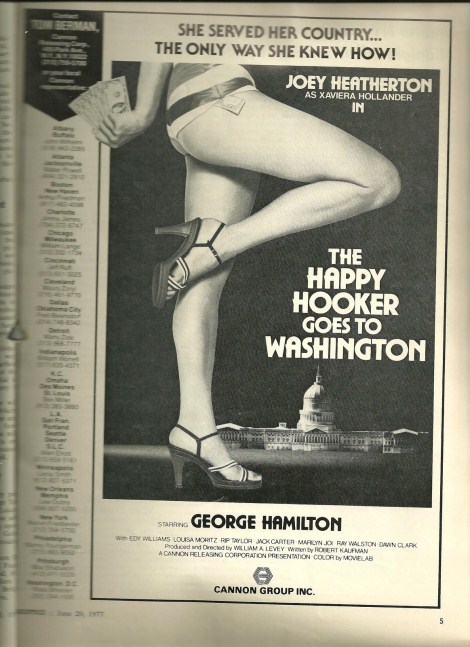
Shattered Politics #40: The Happy Hooker Goes To Washington (dir by William A. Levey)


happy-hooker-470-x-647

“God bless you, Ms. Hollander!  You have saved us from recession!”

— Dialogue from The Happy Hooker Goes To Washington (1977)

Le sigh.

The things that I do for this site!

If I wasn’t currently in the process of watching and reviewing 94 films about politicians and politics, I can guarantee that I would never have watched The Happy Hooker Goes To Washington.  However, while I was looking for films to review for this series, I went over to Netflix and did a search on “Washington.”

Guess which film came up first?

If you guessed The Happy Hooker Goes To Washington, you would be correct!  And you know what?  I watched this movie with an open mind.  As anyone who has read this site knows, I have never been shy about my love of old exploitation films.  The fact of the matter is that some of the most imaginative films ever made were low-budget grindhouse movies.  Nothing angers me more than elitist film bloggers who dismiss a film just because it originally played in grindhouse cinema.

But, honestly, The Happy Hooker Goes To Washington is just bad.  It’s boring.  The acting is terrible.  The jokes fall flat.  The attempts at political satire are about as clever as what you’d find on any site trying to read like the Onion without actually being the Onion.

In the Happy Hooker Goes To Washington, Joey Heatherton plays Xaviera Hollander, a former madam who is now a businesswoman, magazine publisher, and sex advise columnist.  She is apparently the world’s leading authority on sex.  We know this because, when she first appears, she’s surrounded by reporters.  “When sex is news, you’re news!” one of them tells her.

Xaviera has been called to testify in front of the Senate Committee To Investigate Sexual Excess In America.  And goddamn, this movie is stupid.  But anyway, Xaviera goes to Washington to stand up for sexual freedom.  Accompanying her is an attorney named Ward Thompson (George Hamilton) and, quicker than you can say “Fifth place on Dancing With The Stars,” Ward is explaining to Xaviera why her testimony is so important.

“We’re heading right into the teeth of a new puritanism,” he tells her.  “Under the new puritanism, there won’t be any happy hookers!”

Anyway, Xaviera testifies in front of the committee and we get a few flashbacks to some of Xaviera’s past accomplishments.  And then she gets recruited by a dwarf (Billy Barty) and is sent to seduce an Middle Eastern ruler and … well, it just keep going and going.  This is one of the longest 84-minute films ever released.

Anyway, this movie sucks.  (And so does Xaviera!  That’s the level of humor that you can expect when you watch The Happy Hooker Goes To Washington.)  It’s still lurking around Netflix.  Avoid it at all costs.