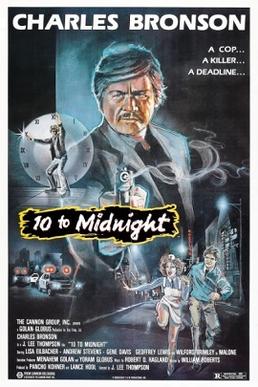
Charles Bronson played a cop a bunch of times in the 1980’s, but my personal favorite is Leo Kessler from 10 TO MIDNIGHT. Kessler wants to be a better dad to his daughter Lori (Lisa Eilbacher), but first he needs to catch a psychotic killer who’s murdering beautiful young women. One of the most interesting things about 10 TO MIDNIGHT is the way it tries to fuse a badass cop film with the popular slasher films of the 1980’s. It’s arguably Bronson’s best Cannon film, and Gene Davis is a certifiable creep as the slasher, Warren Stacy. Enjoy this infamous scene where Kessler confronts Stacy about his, ummm… private sexual activities!
Tag Archives: Wilford Brimley
Brad reviews 10 TO MIDNIGHT (1983), starring Charles Bronson!

Charles Bronson is Leo Kessler, a veteran detective who’s seen it all and has grown sick of a system of justice that he thinks favors criminals over their victims. When girls start getting murdered, he immediately suspects the arrogant Warren Stacy, played by Gene Davis in the best role of his career. When Kessler and his partner Paul McCann (Andrew Stevens) start putting the pressure on Stacy, the killer responds by going after Kessler’s daughter Laurie (Lisa Eilbacher). Needless to say, our hero will do anything to stop the madman, ANYTHING!
10 TO MIDNIGHT is a special movie in my house because it’s my wife’s favorite Charles Bronson film, even when she didn’t have any overall appreciation for Bronson as an actor. Luckily for her, she had me to introduce her to the rest of the iconic actor’s voluminous catalog of movies. I saw 10 TO MIDNIGHT myself when I was pretty young, probably 13 or so. I remember being scared that first night after I watched the movie when I was trying to go to sleep. My wife and I watched it today on my old VHS tape that I’ve owned going back to the late 1980’s.
There are several elements that elevate 10 TO MIDNIGHT above the average cop / slasher thrillers of the 1980’s. First, it’s Charles Bronson in the lead role. Bronson has such a strong presence on screen that his presence alone elevates almost any material. He looks great in the film, and the role gives him some good opportunities, as both a mentor to the young cop, and even more importantly, as a dad who wants to do better for his daughter. It’s a solid role that seems to fit Bronson like a glove. Second, we know from the very beginning of the movie that Warren Stacy is in fact the killer. We also know that the law seems to be working in his favor. And because of that, we’re on Kessler’s side as he goes to extreme lengths to stop his reign of terror. Finally, the script and director J. Lee Thompson go all in on the sex and violence. Examples include Stacy killing his often naked victims while he himself is in the nude. There is much talk in the film about items of a sexual nature and Stacy even has a sexual release device that almost has to be seen to be believed. It definitely adds a decadent and voyeuristic feel to the proceedings. And I haven’t even mentioned yet that it has one of the very best endings of any Bronson film, second only to THE MECHANIC, in my humble opinion.
I highly recommend 10 TO MIDNIGHT!
For a more detailed review of 10 TO MIDNIGHT, check out Lisa’s review from a couple of years back below:
BORDERLINE (1980) – Charles Bronson battles human smuggler Ed Harris (in his first major film role)!
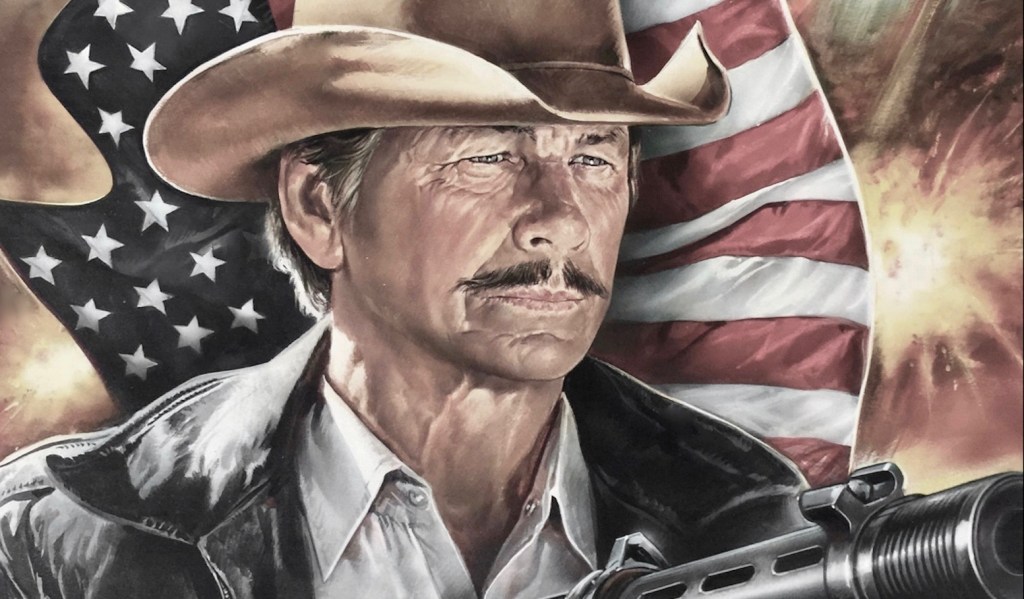
After a couple of decades of toiling away in TV and supporting roles, Charles Bronson became a huge international film star in 1968 when he starred in the films FAREWELL, FRIEND (with Alain Delon), and Sergio Leone’s ONCE UPON A TIME IN THE WEST (with Henry Fonda). For the next 5 years, Bronson would star in successful international co-productions, before hitting it big in the United States with the influential 1974 blockbuster, DEATH WISH. From 1974 to 1977, Bronson had his pick of any role that he wanted. This was probably the most interesting time in his career as he truly tried to expand his range with films like the depression-era HARD TIMES (1975), the romantic comedy FROM NOON TILL THREE (1976), the Raymond Chandler-esque ST. IVES (1976), and the surreal western THE WHITE BUFFALO (1977). But after 1977’s TELEFON and a series of underwhelming box office returns in the states, Bronson’s star was on the wane. He wouldn’t have his next #1 box office hit until he joined forces with the infamous Cannon studios in 1982 for the sequel to his biggest hit and DEATH WISH II. Cannon Studios would provide Bronson with a guaranteed paycheck and a non-stop presence on cable TV and at the video store for the remainder of the decade. I call the films that Bronson made between 1977 and 1982 the in-betweens. They don’t really fit into his European phase (1968-1973), his post-DEATH WISH phase (1974-1977) or his Cannon phase (1982-1989). To be completely honest, it seemed his career was somewhat in limbo at this point, and the movies he made during these years are some of his least well-known.
One of the movies that Charles Bronson made during the in-between years was 1980’s BORDERLINE. In this film, he plays Jeb Maynard, a border patrolman and expert tracker who will stop at nothing to find the human smuggler responsible for killing his friend and fellow patrolman Scooter, played by Wilford Brimley. I like this lower-key Bronson film. Director Jerrold Freedman has made a more realistic film than a lot of the movies in Bronson’s filmography. Outside of the murder that gets the story going, and the final showdown with the lead smuggler (a young Ed Harris), most of the film is made up of good old-fashioned field work and investigation. Bronson even based much of his performance on the technical advice of legendary border patrolman Albert Taylor. Now that doesn’t mean there aren’t some solid, action-packed scenes during the movie. My favorites include a scene where an undercover Maynard goes into Mexico with the mother of a young Mexican boy who was accidentally killed at the same time as Maynard’s friend Scooter. Maynard poses as a family member of the woman in hopes of being smuggled across the border so he can see how the illegal immigrants are being brought in. When thieves intercept the group, all hell breaks loose, and Maynard and the woman must fight their way out. Another badass moment occurs when Bronson beats needed information out of one of the smugglers in a nasty bathroom. This last scene is especially enjoyable for us Bronson fans.
There are so many good actors in this film. Outside of Bronson, Brimley, and Ed Harris, the cast is filled out by other veterans like Bruno Kirby, Bert Remsen, Michael Lerner, John Ashton, and Charles Cyphers. On a side note, Ed Harris gets the “introducing” credit here, even though he had appeared in several TV shows, as well as the movie COMA with Michael Douglas. This was his first major role in a feature film though. I also want to throw out special mention to Karmin Murcelo. She’s not a household name, but she’s excellent as the mother of the young boy who gets killed with Wilford Brimley’s character, who then helps Bronson in his quest to find the killer. Her career extended over 3 decades, and it’s easy to see why based on this performance.
BORDERLINE may not be an explosive action film like some of Bronson’s other work, but it’s an effective drama with a good performance from the star. I think he embodies the character perfectly. It’s also just as relevant in 2025 as it was in 1980, and I give the film a solid recommendation.
Retro Television Review: Homicide: Life on The Street 2.2 “See No Evil”
Welcome to Retro Television Reviews, a feature where we review some of our favorite and least favorite shows of the past! On Sundays, I will be reviewing Homicide: Life On The Street, which aired from 1993 to 1999, on NBC! It can be viewed on Peacock.
This week, no one’s innocent.
Episode 2.2 “See No Evil”
(Dir by Christopher Menual, originally aired on January 13th, 1994)
Watch out! Stanley Bolander’s whining about his divorce again!
Ned Beatty was one of the great character actors and he is certainly convincing in the role of Stanley Bolander, the veteran Baltimore homicide detective who has seen the worst that humanity has to offer and who spends most of his time annoyed with his partner, John Munch. But, as good as Beatty is, I still groan whenever Bolander starts to talk about his ex-wife and his divorce. His bitterness was a recurring theme during the first season. It was annoying but it was understandable because the divorce was still recent.
But now, we’ve started the second season. It’s time move on, Big Man!
This episode finds Bolander very reluctantly taking part in sensitivity training. He avoids meeting with Dr. Carrie Weston (Jennifer Mendenhall) until Giardello threatens to suspend him without pay. Bolander is stunned when Dr. Weston turns out to be sympathetic to his anger over his divorce. Bolander ever tries to ask Dr. Weston out, just for Weston to inform him that she’s just gotten out of a bad relationship and that she believes “birds of a feather should flock together” and, speaking of birds, did you know that there are lesbian seagulls? Bolander gets the hint. Myself, I would probably lie about being a lesbian just to get out of having to spend any more time listening to him cry about his divorce.
Far more interesting than Bolander’s angst were the two cases at the center of this week’s episode. Chuckie Prentice (Michael Chaban) shoots his dying father (played, in a powerful and intimidating performance, by Wilford Brimley) in the head. Though Chuckie claims that his father committed suicide, Lewis has his doubts and takes Chuckie to the station for interrogation. Detective Beau Felton just happens to be Chuckie’s best friend and, after Chuckie tells him that his father specifically asked to be put out of his misery, Felton tries to convince Lewis to say that the shooting actually was a suicide. At first, Lewis refuses but eventually, he agrees to look the other way while Felton takes Chuckie to wash his hands and destroy any evidence of gunpowder residue on his skin. Without any definite evidence proving the he fired the gun, Chuckie is free to go and his father’s death is ruled a suicide.
This was a powerful story and it was all the more effective because it refused to come down on one side or the other. Both Felton and Lewis presented their positions well and the episode ended not on a note of triumph but on a note of weary resignation. Chuckie is free to go on with his life and his father is no longer in pain but Lewis is going to be haunted by his decision to allow evidence to be destroyed. Personally, I’m against assisted suicide and I felt it was selfish for Chuckie’s father to ask Chuckie to pull the trigger. But, having spent the previous few months trying to come to terms with my own father’s passing, I could understand what Chuckie was feeling. There really are no easy answers.
As for the other case, it involved the shooting of a drug dealer. The dealer was shot in the back. A patrolman claimed that he slipped and his gun accidentally fired during the pursuit of the dealer. Pembleton had his doubts about whether the shooting was really an accident or a case of police brutality. Even after Giardello warned him that pursuing the case would turn “brother against brother” in the police force, Pembleton insisted on asking every police officer on the scene to turn in their guns for testing. “You son of a bitch, Pembleton,” Giardello muttered.
And again, this was a storyline that worked because it refused to present an easy solution. The dead man was a criminal and he was shot while fleeing the cops. Even though the cop that slipped was eventually cleared of having fired the shot that killed the dealer, it was obvious that the shot did come from a cop. Pembleton, with his black-and-white view of his job, was determined to find the truth, regardless of the professional consequences. Giardello, with years more experience than Pembleton, spoke from the heart when he told Pembleton that investigating the case would bring harm not just to the cop who shot the dealer but to every cop working the streets, regardless of whether they were involved or not. Felton could convince Lewis to look the other way. Pembleton was not willing to do the same thing.
It was a strong episode, even with all of Bolander’s nonsense. Perfectly acted, morally ambiguous, and fiercely intelligent, this is an episode that I’ll be thinking about for a while.
LAST OF THE DOGMEN – One of my favorites!
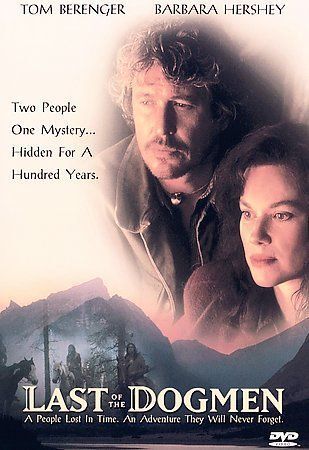
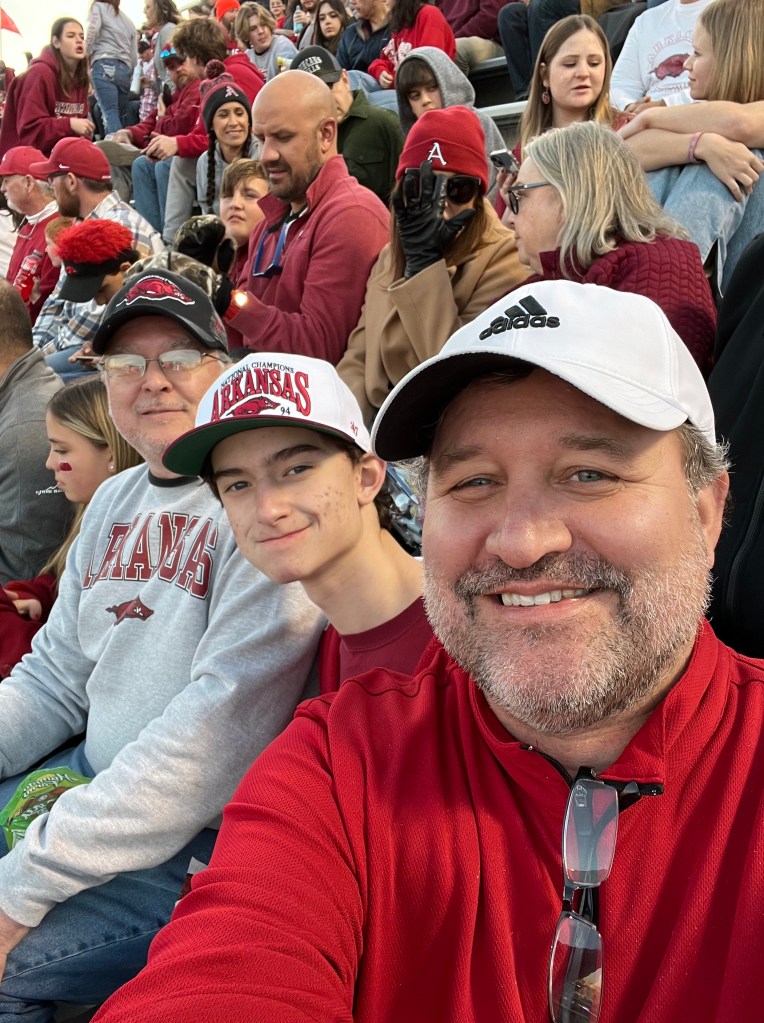
I don’t hear a lot about LAST OF THE DOGMEN, the 1995 modern day western starring Tom Berenger, Barbara Hershey and Kurtwood Smith. I love the movie, and I have for years. My buddy Chuck, his son Carter, and I recently drove up the hill to Fayetteville to watch the Arkansas Razorbacks play football. We had a great day! We ate at the Catfish Hole for lunch and then watched the Razorbacks beat Louisiana Tech 35-14. It was fun (See picture below for the happy crew). We had about a 3-hour drive home so we were talking about things we both love, like the Andy Griffith Show. Out of nowhere, Chuck said, “Do you want to know a movie I love? It’s called the LAST OF THE DOGMEN.” It was the last thing I was expecting to hear. I also love the movie. We talked about it and had a good time, but I made a mental note to watch it again soon. So here we are.
LAST OF THE DOGMEN opens with Sheriff Deegan (Kurtwood Smith) trying to find three escaped convicts in Northwest Montana. Deegan calls in the best tracker he knows, Lewis Gates (Tom Berenger), to go into the mountains to find the convicts. The two men have a history as Gates was married to the sheriff’s daughter, and the daughter died. The sheriff clearly doesn’t like Gates and blames him for his daughter’s death, but he knows he’s the man for the job. With Gates and his genius dog Zip right on their tails, the convicts are mysteriously killed by a group of men on horses who shoot them with arrows. Gates see the men riding off through a fog and is convinced they are Indians. He ends up seeking out the help of Native American historian Lillian Sloan (Barbara Hershey) to help him understand what he may have seen. He’s able to convince Lillian to ride into the mountains with him because he needs a translator if he actually finds anyone, and the two head off into the Oxbow. After a week of roughing it, they’re about to give up when they suddenly find themselves surrounded by the Indian dog soldiers. They’re taken as prisoners to the Indian camp, where the leader of the dog soldiers, Yellow Wolf, has a sick son. It seems he was shot by one of the escaped prisoners. Gates heads back to town to get penicillin for the son, which ultimately saves his life. Gates and Lillian spend some time getting to know and respect this isolated Cheyenne tribe. Meanwhile, Sheriff Deegan, unable to forgive Gates for the death of his daughter, gathers a group of men and they head into the Oxbow to find Gates. Will the Indians be able to have peace and live their lives like they did in the 19th century, or will they be discovered and forced to live out the fates of their ancestors? Well, if you haven’t seen it, just watch and enjoy!
As I said earlier, I’m a big fan of LAST OF THE DOGMEN. I was initially interested in the movie because I like Tom Berenger as a leading man. His SHOOT TO KILL with Sidney Poitier is a big time personal favorite. I also like him in PLATOON, SOMEONE TO WATCH OVER ME, BETRAYED, MAJOR LEAGUE, SHATTERED, SNIPER and THE SUBSTITUTE. He had been a big sex symbol earlier in his career. By the time of this film, he’s getting a little too old and heavy to be a sex symbol. In THE LAST OF THE DOGMEN, he’s actually very funny, and I really enjoy watching him have fun on screen. I’ll also go ahead and say that I’ve never been a huge fan of the actress Barbara Hershey, but she keeps showing up in movies I love. Outside of this, she’s also in HOOSIERS, and it’s one of my favorites. While there’s something about her I don’t really like, she is pretty good, and I do like her chemistry with Berenger. When they finally share a big smooch towards the end of the film, I liked it. And what can I say about Gates’ Australian cattle dog Zip? He’s an integral part of the story and saves Gates & Lillian’s asses on multiple occasions. At one point in the story, Lillian says “it’s disconcerting to know that the smartest member in our expedition is a dog!” It’s true!
I think the thing I like the most about the LAST OF THE DOGMEN is the idea that a group of Cheyenne Indians could be living out their lives the way they did a century ago. Something about that is romantic and magical to me, and it gave me an emotional interest in the film. Isn’t that why we really love movies? The best ones can reach into our souls and find something that’s valuable to us. I love the idea of Cheyenne Indians living out their heritage and protecting it at all costs. There’s something simple and meaningful about that. Director Tab Hunter really leans into this emotional truth. It’s the only film he would direct, and it seems to share the one message that meant the most to him. Most of us would give anything to have an opportunity to share with the world who we really are. Hunter got that opportunity and shared this movie. That’s pretty cool to me.
Film Review: 10 to Midnight (dir by J. Lee Thompson)
The 1983 film, 10 to Midnight, opens with LAPD detective Leo Kessler (played by legendary tough guy Charles Bronson) sitting at his desk in a police station. He’s typing up a report and taking his time about it. A reporter who is in search of a story starts to bother Leo.
“Jerry,” Leo tells him, “I’m not a nice person. I’m a mean, selfish son-of-a-bitch. I know you want a story but I want a killer and what I want comes first.”
It’s a classic opening, even if Leo isn’t being totally honest. Yes, he can be a little bit selfish but he’s really not as mean as he pretends to be. He may not know how to talk to his daughter Laurie (Lisa Eilbacher) but he is also very protective of her and he wants to be a better father than he’s been in the past. He may roll his eyes when he discovers that Detective Paul McAnn (Andrew Stevens) is the son of a sociology professor but he still tries to act as a mentor to his younger partner. Leo may complain that the criminal justice system “protects those maggots like they’re an endangered species” but that’s just because he’s seen some truly disturbing things during his time on the force and, let’s face it, Leo has a point. When one of Laurie’s friends is murdered, Leo is convinced that Warren Stacy (Gene Davis) is the murderer and he’s determined to do whatever he has to do to get Warren off the streets. “All those girls,” Leo snarls when he sees Warren, his tone letting us know that his mission to stop Warren is about more than just doing his job.
Warren Stacy is handsome, athletic, and he has good taste in movies. (He’s especially a fan of Butch Cassidy and the Sundance Kid. Just don’t try to trick him by saying Steve McQueen played the Sundance Kid.) Warren is also a total creep, the type of guy who complains that a murder victim “wasn’t a good person,” because she trashed him in her diary. When Leo takes a look around Warren’s apartment, he finds not only porn but also a penis pump. (“It’s for jacking off!” Leo yells at Warren, enunciating the line as only Charles Bronson could.) Warren is also a murderer but he’s a clever murderer, the type who sets himself up with an alibi by acting obnoxiously in a movie theater. Warren strips nude before killing his victims, in order to make sure that he doesn’t leave behind any evidence. (This film was made in the days before DNA testing.)
Leo knows that Warren is guilty but, as both his gruff-but-fair captain (Wilford Brimley, naturally) and the D.A. (Robert F. Lyons) point out, he has no way to prove it. When Warren starts to stalk Laurie and her friends (including Kelly Preston), Leo decides that he has no choice but to frame Warren. But when Warren’s amoral attorney, Dave Dante (Geoffrey Lewis, giving a wonderfully sleazy performance), threatens to call McAnn to the stand, McAnn has to decide whether to tell the truth or to join Leo in framing a guilty man.
10 to Midnight is a violent, vulgar, and undoubtedly exploitive film, one that features a ham-fisted message about how the justice system is more concerned with protecting the rights of the accused as opposed to lives of the innocent. And yet, in its gloriously pulpy way, this is also one of Bronson’s best films. It’s certainly my personal favorite of the films that he made for Cannon.
Director J. Lee Thompson and Charles Bronson were frequent collaborators and Thompson obviously knew how to get the best out of the notoriously reserved actor. Bronson was not known for his tremendous range but he still gives one of his strongest performances in 10 to Midnight, playing Leo as being not just a determined cop but also as an aging man who is confused by the way the world is changing around him. Stopping Warren isn’t just about justice. It’s also about fighting back against the the type of world that would create a Warren Stacy and then allow him to remain on the streets in the first place. Interestingly, though Leo doesn’t hesitate when it comes to framing Warren, he is also sympathetic to McAnn’s objections. Unlike other Bronson characters, Leo doesn’t hold a grudge when his partner questions his methods. Instead, he simply know that McAnn hasn’t spent enough time in the real world to understand what’s at stake. McAnn hasn’t given into cynicism. He hasn’t decided that the best way to deal with his job is to be a “mean son of a bitch.” Bronson and Andrew Stevens, who had worked together in the past, have a believable dynamic. McAnn looks up to Leo but is also conflicted by his actions. Leo may be annoyed by McAnn’s reluctance but he also respects him for trying to be an honest cop. Their partnership feels real in a way that sets 10 to Midnight apart from so many other films about an older cop having to deal with an idealistic partner.
One of the most interesting things about the film is Leo’s relationship with his daughter, Laurie. Over the course of the film, Leo and Laurie go from barely speaking to bonding over liquor and their shared regrets about the state of the justice system. When McAnn first meets Laurie, she’s offended when McAnn suggests that she takes after her father. But, as the film progresses, she comes to realize that she and Leo have much in common. (To be honest, I related quite a bit to Laurie, especially as I’ve recently come to better appreciate how much of my own independent nature was inherited from my father.) Lisa Eilbacher and Charles Bronson are believable as father-and-daughter and they play off of each other well. The scenes between Laurie and Leo give 10 to Midnight a bit more depth than one might otherwise expect from a Bronson Cannon film. Leo isn’t just trying to protect his daughter and her roommates from a serial killer. He’s also trying to be the father who he wishes he had been when she was younger. He’s trying to make up for lost time, even as he also tries to keep Warren Stacy away from his family.
As played by Gene Davis, Warren Stacy is one of the most loathsome cinematic villains of all time. Warren’s crimes are disturbing enough. (Indeed, the surreal sight of a naked and blood-covered Warren Stacy stalking through a dark apartment is pure nightmare fuel.) What makes Warren particularly frightening is that we’ve all had to deal with a Warren Stacy at some point in our life. He’s the sarcastic and easily offended incel who thought he was entitled to a phone number or a date or perhaps even more. As I rewatched this movie last night, I wondered how many Warrens I had met in my life. How many potential serial killers have any of us unknowingly had to deal with? Warren tries to strut through life, smirking and going out of his way to let everyone know that he knows more than they do but the minute that Leo turns the table on him, Warren starts whining about he’s being treated unfairly. During his final, disturbing rampage, Warren yells that his victims aren’t being honest with him, blaming them for his actions. The film deserves a lot of credit for not turning Warren into some sort of diabolical and erudite supervillain. He’s not Hannibal Lecter. Instead, like all real-life serial killers, he’s a loser who is looking for power over those to whom he feels inferior and for revenge on a world that he feels owes him something. He’s a realistic monster and that makes him all the more frightening and the film all the more powerful. Warren is the type of killer who, even as I sit here typing this, could be walking down anyone’s street. He’s such a complete monster that it’s undeniably cathartic whenever Leo goes after him.
How delusional is Warren Stacy? He’s delusional enough to actually taunt Charles Bronson! At one point, Warren informs Leo that he can’t be punished for being sick. Warren announces that, when he’s arrested, he might go away for a while but he’ll be back and there’s nothing Leo can do about it. (The suggestion, of course, is that Warren will be back because he committed his crimes in California and all the judges were appointed by a bunch of bleeding heart governors. Warren may not say that out loud but we all know that is the film’s subtext. Some people may agree with the film, some people may disagree. Myself, I’m against the death penalty because I think it’s a prime example of government overreach but I still cheered the first time that I heard Clint Eastwood say, “Well, I’m all torn up about his rights,” in Dirty Harry.) How does Leo react to Warren’s taunts? I can’t spoil the film’s best moment but I can tell you that 10 to Midnight features one of Bronson’s greatest (and, after what we’ve just seen Warren do, most emotionally satisfying) one-lines.
The title has nothing to do with anything that happens in the film. In typical Cannon fashion, the film’s producers came up with a snappy title (and 10 to Midnight is a good one) and then slapped it onto a script that was previously called Bloody Sunday. Fortunately, as long as Bronson is doing what he does best, it doesn’t matter if the title makes sense. And make no mistake. 10 to Midnight is Bronson at his best.
Wilford Brimley, R.I.P.
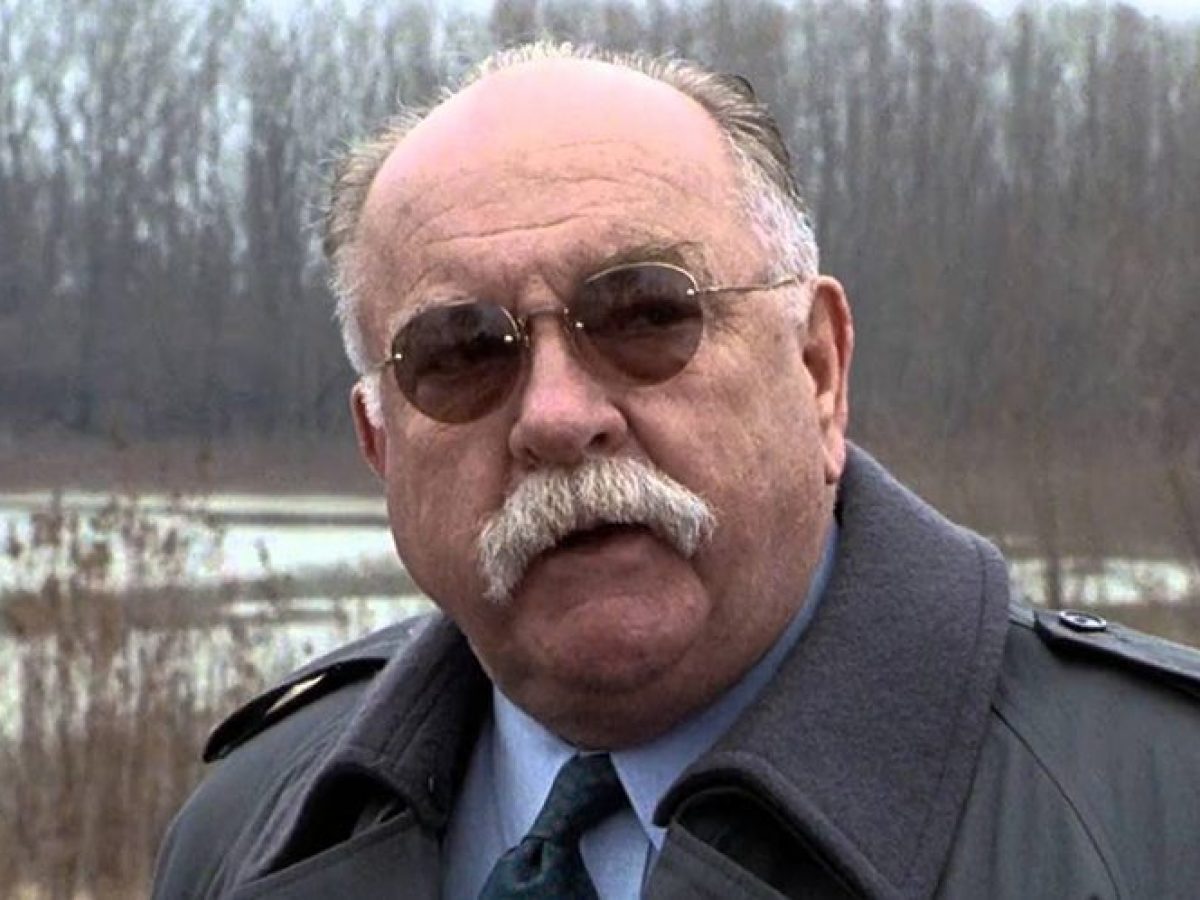
Wilford Brimley has died. He was 85 years old.
There’s not much that I really like about twitter but I did enjoy following Wilford Brimley. Brimley was one of those actors who always played intimidating and serious characters so it was a nice surprise to find his twitter account and discover that he had a sense of humor and that he regularly interacted with his fans. Once, he even posted a picture of Andy Reid and asked, “When did I start coaching football?”
On screen, Brimley almost always played figures of quiet authority. Whenever you saw Brimley in a film or on a TV show, you knew that he was going to be playing a straight shooter who didn’t have any time for any foolishness or bullshit. One of his best performances was in Absence of Malice, where he put a weaselly Bob Balaban in his place. Of course, everyone knows him from his performance in Cocoon and his promise to his grandson that “we won’t ever die.” One of his best performances was in a rare bad guy role in The Firm. Personally, my favorite Wilford Brimley performance was his cameo as Postmaster General Henry Adkins on Seinfeld. “I’m also a general. And it’s the job of a general to, by God, get things done!”
Brimley also sold Quaker Oats and later, for a generation of viewers, he became the face of diabetes. A lot of jokes and memes were made about Brimley’s diabetes commercials but tell the truth. When Wilford Brimley said, “You need to check your blood sugar and you need to check it often,” you know damn well you immediately checked it.
I’m going to miss Wilford Brimley. I know I’m not the only one.
Wilford Brimley, R.I.P.

Blood River (1991, directed by Mel Damski)
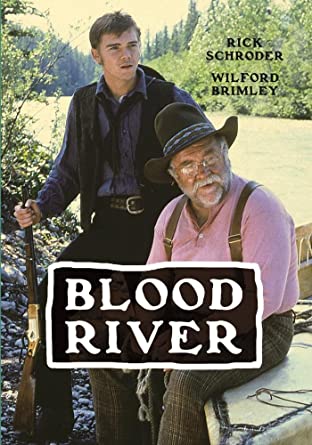 In the old west, Jimmy Pearls (Ricky Schroder), a seemingly dissolute young man, kills the three men who he hold responsible for the murder of his parents. Unfortunately for Jimmy, one of those men was the son of powerful rancher Henry Logan (John P. Ryan) and Logan is now determined to track down Jimmy and get some revenge of his own.
Jimmy only his one ally in his attempt to make it to safety and that’s Winston Culler (Wilford Brimley). In his younger days, Culler was a legend. He tamed the frontier and he lived with the Indians and everyone knew better than to get in his way. Now, Winston is older and no one give him the respect that he deserves. Winston allows Jimmy to stay with him but Winston has more than just Jimmy’s safety in mind. Winston has his own reasons for wanting to get revenge on Logan and, despite their constant bickering, he and Jimmy are soon working as a team.
Adrienne Barbeau has a cameo as a madam and, while she’s always a welcome sight in any film, I imagine her casting has to do with the fact that this film was actually written by John Carpenter. Yes, that John Carpenter! Carpenter actually wrote the script for what would become Blood River in 1971. When he wrote it, he pictured John Wayne as Winston and either Elvis Presley or Ron Howard as Jimmy. (The Duke and Elvis in the same film? That would have been something, regardless of how the film itself turned out.) Carpenter sent copies of the script to both John Wayne and director Howard Hawks but neither one responded. It would be 19 years before the script was finally filmed.
Blood River is an amiable western. It was ultimately produced for television and it first aired on CBS. Despite the fact that the film was originally written to be a theatrical film, it plays more like a pilot than a film. You could imagine a weekly series featuring Winston and Jimmy riding from town to town and getting into adventures. The plot is nothing special but Ricky Schroder and Wilford Brimley make for a good team. Brimley is especially ornery, even for him. Blood River may be a simple film but it will be appreciated by those looking for a likable and old-fashioned western.
Hard Target (1993, directed by John Woo)
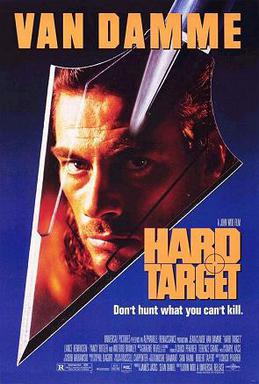 Nat Binder (Yancy Butler) has come to New Orleans to track down the father who she hasn’t seen since she was seven years old. What she doesn’t know is that her father has recently been kidnapped and killed for sport by a wealthy hunter and Most Dangerous Game enthusiast named Emil Fouchon (Lance Henriksen). After a homeless veteran named Chance Bourdeaux (Jean-Claude Van Damme) saves her from a group of muggers, Nat hires him to help her track down her father. This turns out to be a good decision because Fouchon is sending out his private army to track down Nat and Chance is Jean-Claude Van Damme.
Jean-Claude Van Damme has never gotten as much respect as he deserves. Even though most of his action movies were low-budget and often not very good, Van Damme was still a better actor than some of the other B-action stars of the 90s and, unlike most of his contemporaries, he could actually do most of the things that he did in the movies in real life as well. Though Van Damme may have sabotaged his career through cocaine abuse, it’s not a surprise that most action fans would welcome a Jean-Claude Van Damme comeback far more than a comeback by someone like Steven Seagal. Hard Target features Van Damme at his best, emphasizing his athleticism and contrasting his earnest acting style with the more flamboyant villainy of Lance Henriksen, who also brings his best to the role of Emil. The film also features Wilford Brimley, bringing his best to the role of Bourdeaux’s uncle. Van Damme, Henriksen, and Brimley all at their best? How could anyone turn down Hard Target?
Hard Target was the first American film of director John Woo and he proves himself to be the perfect director for the material. With Woo, every scene becomes an operatic set piece and it’s impossible to worry about any plot inconsistencies when Van Damme is gracefully jumping out of the way of bullets and missiles. Woo turns the material into a live-action comic book and, even if it’s not as good as his Hong Kong films or later American films like Face/Off, it’s still undeniably entertaining.
Hard Target is Van Damme’s best film of the 90s. Watch it on a double bill with Surviving The Game.
Love On The Shattered Lens: The Path of the Wind (dir by Doug Hufnagle)
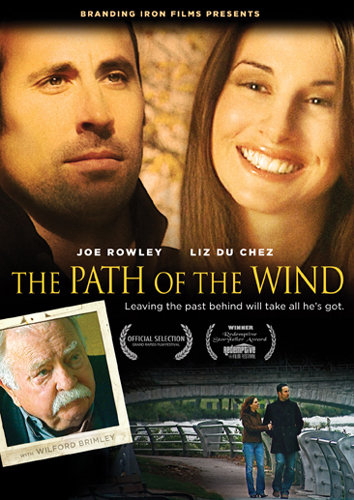
The 2009 film, The Path of the Wind, begins with a man being released from prison and discovering that living in the real world can be just as confining.
Lee Ferguson (Joe Rowley) has spent the last few years locked up, convicted of killing a man. It was a spontaneous fight and Lee didn’t intend for the man to die but that doesn’t change the fact that Lee is responsible for taking another man’s life. He was a model prisoner and he intends to be a model citizen. Fortunately, he’s inherited a nice house and a good deal of money from his father. He’s also got a job waiting for him, as the well-meaning manager of the local grocery store has agreed to give Lee a chance.
From the minute he leaves the prison, Lee feels out-of-place in the world. He’s still struggling to control his temper and, because of his past, he’s hesitant about letting anyone get too close to him. He knows that if he tries to get close to anyone, he’ll eventually have to tell them why, despite his obvious intelligence and education, he’s currently working as a stocker in a grocery store. And, after he tells them that he’s been in prison, he’ll then have to explain what he did to find himself in that situation.
Still, on his first night of working at the grocery store, he meets a young woman named Katie (Liz DuChez). When he first sees her, Katie is being harassed by her violent ex-husband. Lee chases the man off. It turns out that Katie runs the local video store and she thanks Lee by offering him all of the free movies that he wants. Eventually, Lee works up the courage to go to the video store and gets a bunch of western DVDs. Later, he reveals that he not only doesn’t have a DVD player but he’s not totally sure what a DVD player is. I guess Lee was in prison for a while.
It takes a while but Lee and Katie finally start to date. Katie opens up about her past as a stripper and Lee finally tells her about the time that he spent in prison. (It turns out that Katie already knew.) They fall in love but there are still problems. For one thing, Katie is rather religious whereas Lee is a committed agnostic. Secondly, Katie refuses to have sex unless she’s married. Lee, meanwhile, really, really wants to get laid….
Of course, that’s not all that’s going on in The Path of the Wind. There’s about a different dozen storylines running through The Path of the Wind and the film doesn’t do a particularly good job of juggling all of them. Along with having to deal with Katie’s psycho ex-husband, Lee also has to deal with not one but two evil coworkers and his bitter sister. This is one of those films where a lot of plot points are raised but then mysterious abandoned. There is one effective scene, in which Wilford Brimley shows up as the father of the man that Lee killed. Brimley’s only in the film for a few minutes but he brings so much natural authority to his role that he basically takes over the entire movie for the limited amount of time that he’s on screen.
The film’s a bit of a mess but there’s a low-key sincerity to it that’s kind of likable. According to the imdb, it was made for a budget of $100,000 and, with the exception of Wilford Brimley, the cast is largely made up of amateurs. That said, both Joe Rowley and Liz DuChez have enough screen presence to be watchable and, even if the dialogue sometimes sounds a bit awkward, they have a likable chemistry and you can believe them as a couple. Add to that, the film does attempt to deal with a very real issue, the difficulty that ex-cons face trying to rejoin a society that often values punishment and revenge over forgiveness and rehabilitation. This is an amateur film but it may hold your interest.
 Through the Shattered Lens