1957’s I Was A Teenage Werewolf combines two genres that were very popular in the late 50s.
On the one hand, it’s a film about a teenage rebel. Tony Rivers (Michael Landon) is a teenager that means well but he keeps losing his temper. If he can’t learn to control his anger, he could very well be looking at a life behind bars.
On the other hand, it’s also a horror film. When Tony visits a hypnotist (Whit Bissell), the end result is Tony turning into a werewolf and going on a rampage, all while still wearing his letterman jacket.
(Lisa is currently in the process of cleaning out her DVR! It’s going to take a while. She recorded this 1962 literary adaptation off of FXM on January 30th!)
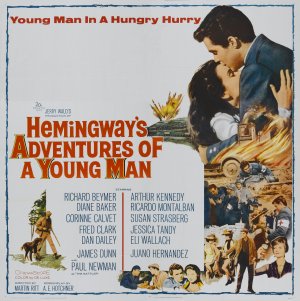
Hemingway’s Adventures Of A Young Man is one of those films that you just know was made specifically to win Oscars. It’s a big prestige production, complete with a historical setting, an epic scope and big, all-star cast. That most of those stars appear in relatively small roles was undoubtedly meant to evidence of the film’s importance.
“Look!” the film seems to shout at times, “This is such an important film that even Paul Newman was willing to stop by for a day’s work!”
The film is based on ten short stories by Ernest Hemingway and, loosely, A Farewell to Arms. The stories all dealt with the early life of Nick Adams, who was a literary stand-in for Hemingway. Since the Nick Adams stories were autobiographical (and, for that matter, so was A Farewell to Arms), the film can also be viewed as biopic. Richard Beymer (who, a year earlier, had starred in West Side Story and who is currently playing Ben Horne on Twin Peaks) may be playing Nick Adams but the film leaves little doubt that he was actually meant to be playing Ernest Hemingway.
The film opens with Nick hunting with his father, Dr. Harold Adams (Arthur Kennedy). He is present when his father travels to an Indian camp and helps to deliver a baby. He respects his father but Nick wants to see the world and the film follows him as he explores America, working odd jobs and meeting colorful characters along the way. Paul Newman shows up as a punch-drunk boxer and proceeds to overact to such an extent that he reminded me of Eric Roberts appearing in a Lifetime film. Nick meets rich men, poor men, and everything in between. He works as a journalist. He works as a porter. Eventually, when World War I breaks out, Nick enlists in the Italian army and the film turns into the 100th adaptation of A Farewell to Arms.
And really, I think it would have been an enjoyable film if it had been directed by someone like Otto Preminger, George Stevens, or maybe even Elia Kazan. These are directors who would have embraced both the pulpy potential of the Nick Adams stories and the soapy melodrama of the war scenes. A showman like Preminger would have had no fear of going totally and completely over the top and that’s the approach that this material needed. Instead, Hemingway’s Adventures Of A Young Man was directed, in a painfully earnest style, by Martin Ritt. Ritt tries to imitate Hemingway’s famously understated style with his understated direction but, cinematically, it’s just not very interesting. Ritt portrays everything very seriously and very literally and, in the end, his direction is more than a little dull.
Sadly, the same can be said for Richard Beymer’s performance in the lead role. Beymer comes across as being the nice guy who everyone says you should marry because he’ll be able to get a good and stable job and he’ll probably never go to jail. Two months ago, when I watched and reviewed Twin Peaks, I really loved Beymer’s performance as Ben Horne. He just seemed to be having so much fun being bad. Unfortunately, in Hemingway’s Adventures Of A Young Man, he never seemed to be having any fun at all. No wonder he temporarily put his film career on hold so that he could fully devote himself to working as a civil rights activist.
In the end, this is a movie that’s a lot more fun to look at than to actually watch. Visually, the film is frequently quite pretty in an early 1960s prestige movie so sort of way. And there are some good performances. Eli Wallach, Ricardo Montalban, Susan Strasberg, Arthur Kennedy — there’s a whole host of performers doing memorable supporting work. Unfortunately, even with all that in mind, this well-intentioned film largely falls flat.
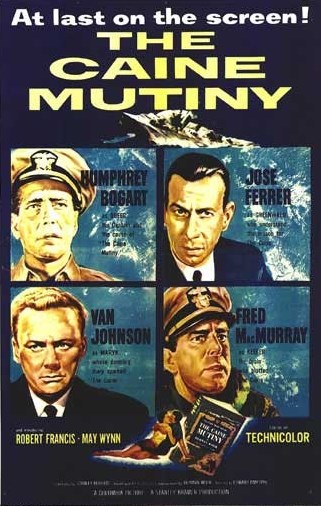
It’s the 1940s and World War II is raging. The U.S. Navy is model of military discipline and efficiency. Well, except for the U.S.S. Caine, that is. The Caine is something of a disorganized mess, where no one takes his job seriously and sailors have names like Meatball (Lee Marvin) and Horrible (Claude Akins). The men love Lt. Commander DeVriess (Tom Tully), largely because he has given up on trying to enforce any sort of discipline. However, DeVriess has recently been relieved of his command. As he leaves, Meatball gives him a new watch, a gift from all the men. DeVriess admonishes them, snapping that the gift is violation of Naval regulations. He then puts the watch on his wrist and leaves the ship.
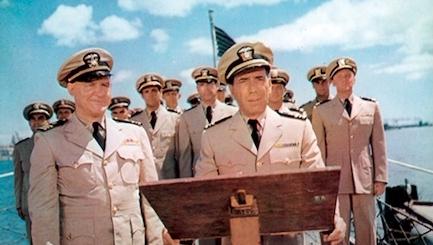
DeVriess’s replacement is Captain Francis Queeg and, at first, we have reason to be hopeful because Captain Queeg is being played by Humphrey Bogart. Surely, if anyone can get this ship into shape, it’ll be Humphrey Bogart! From the moment he arrives, Queeg announces that he’s going to enforce discipline on the Caine and if that means spending hours yelling at a man for not having his shirt tucked in, that’s exactly what Queeg is prepared to do. However, it also quickly becomes apparent that the awkward Queeg has no idea how to talk to people. He is also overly sensitive and quick to take offense. Whenever Queeg makes a mistake (and he does make a few), he’s quick to blame everyone else.
Realizing that the men are turning against him, Queeg even begs his officers for their help. He asks them if they have any suggestions. They all sit silently, their heads bowed as Queeg somewhat poignantly rambles on about how his wife and his dog both like him but the crew of the Caine does not.
Queeg’s officers are a diverse bunch, none of whom are quite sure what to make of Queeg or the state of the Caine. Ensign Willie Keith (Robert Francis) is a wealthy graduate of Princeton University who, at first, likes Queeg but quickly comes to doubt his abilities. On the other hand, Lt. Steve Marsyk (Van Johnson) has doubts about Queeg from the start but, as a career Navy man, his natural instinct is to respect the chain of command above all else.
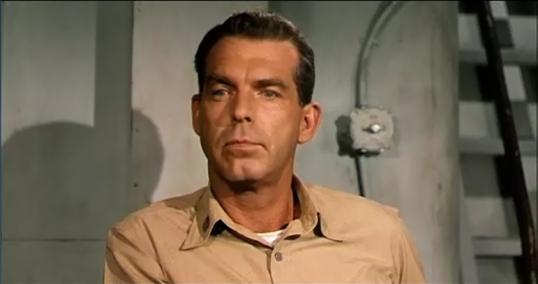
And then there’s Lt. Tom Keefer (Fred MacMurray). Keefer is a self-styled intellectual, a novelist who is always quick with a snarky comment and a cynical observation. (If The Caine Mutiny were remade as a B-horror film, Lt. Keefer’s name would probably be Lt. Sardonicus.) From the minute the viewers meet Lt. Keefer, our inclination is to like him. After all, he seems to be the only person in the film who has a sense of humor. If we had to pick someone to have dinner with, most of us would definitely pick the erudite Tom Keefer over the humorless and socially awkward Francis Queeg. As such, when Keefer starts to suggest that Queeg might be mentally unstable, our natural impulse is to agree with him.
It’s Tom Keefer who first suggests that it may be necessary to take the command away from Queeg. And yet, when it comes time to take action, it’s Keith and Marsyk who do so while Keefer stands to the side and quietly watches. And, once the Caine arrives back in the U.S., it Keith and Marsyk who are court martialed. Will they be found guilty of treason or will their lawyer, Lt. Barney Greenwald (Jose Ferrer), prove that Queeg was unfit for command?
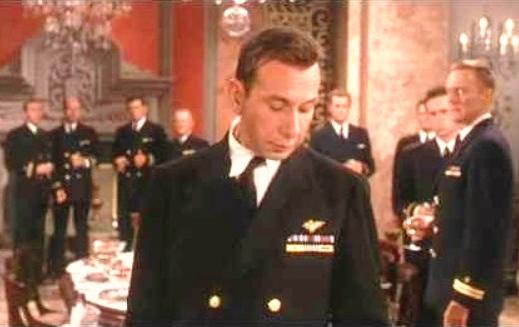
Made in 1954 and based on a novel by Herman Wouk, The Caine Mutiny is one of those big and glossy 1950s productions that holds up a lot better than you might expect. The film has its flaws. In the role of Keith, Robert Francis is a bit on the dull side and a subplot in which he courts May Wynn feels unneccessary and only serves to distract from the main story. But, for the most part, it’s an intelligent and well-directed film. Humphrey Bogart turns Queeg into a pathetic and lonely figure and you can’t help but feel sorry for him when he talks about how his dog loves him. Van Johnson also does well as Marsyk, effectively portraying a well-meaning character who is in over his head. Jose Ferrer gets a great drunk scene at the end of the film and, of course, you can’t go wrong with Lee Marvin as a smirking sailor, even if Marvin only appears for a handful of minutes.
But for me, my favorite character (and performance) was Fred MacMurray’s Tom Keefer. Technically, Keefer is not meant to be a likable character. He’s totally passive aggressive. He’s pretentious. He’s smug. At times, he’s rather cowardly. And yet, Tom Keefer remains the most memorable and interesting character in the entire film. He gets all of the good one-lines and MacMurray delivers them with just the right amount of barely concealed venom. (“If only the strawberries were poisoned…” he says as he considers dinner aboard the Caine.) It’s a great role and Fred MacMurray gives a great performance. And you know what? I don’t care how bad a character he may have been. I still want to read Tom Keefer’s book!
The Caine Mutiny was nominated for best picture of 1954. However, it lost to On The Waterfront.
Stanley Kramer is one of those old school filmmakers who directed several films that were acclaimed when they were originally released but who tends to be dismissed by contemporary film critics. Kramer specialized in making films about social issues and he deserves to be applauded for attempting to look at issues that Hollywood, at that time, would have preferred to ignore. However, as Mark Harris points out in his excellent book Pictures At A Revolution, Kramer started out as a producer and, even after he started directing, he never lost his producer sensibility. As a result, a Kramer film would typically address issues that were guaranteed to generate a lot of free publicity but, at the same time, Kramer would never run the risk of truly alienating his audience by digging too deeply into those issues. As a result, Kramer’s films have come to represent a very safe and middlebrow version of 50s and early 60s style liberalism.
Now, I have previously reviewed 4 Stanley Kramer films on this site and I have to admit that I was somewhat dismissive of most of them. I felt that Ship of Fools was shallow. I thought that Guess Who’s Coming To Dinnercollapsed under the combined weight of a self-satisfied script and Kramer’s refusal to let Sidney Poitier’s character be anything other than idealized perfection. R.P.M. is a guilty pleasure, specifically because Kramer was so out-of-touch with the film’s subject matter. I did give Judgment at Nuremberga good review, describing it as one of Kramer’s rare films that still holds up today.
And now, I’m going to give another Kramer film a good review.
Kramer’s 1958 film The Defiant Ones features a classic Kramer situation. White Joker (Tony Curtis) and black Noah (Sidney Poitier) are both prisoners in the deep south. Joker is an unrepentant and violent racist while Noah … well, Noah is Sidney Poitier. He’s determined, he’s not afraid to speak his mind, and most of all, he’s dignified. That’s not meant to be a complaint about Poitier’s performance in The Defiant Ones. In the role of Noah, Poitier has a great screen presence and it’s impossible not to root for him. Whereas Curtis tends to chew up every piece of scenery that he gets nears (and, again, that’s not really a complaint because Curtis’s overacting is totally appropriate for his character), Poitier keeps the film grounded.
When the prison bus that is transporting them crashes, Joker and Noah are able to escape. Fleeing on foot, they make their way through the wilderness and attempt to hide from the police. As quickly becomes obvious, Joker and Noah hate each other but, because the sheriff had a sense of humor, they have also been chained together. In other words, they’re stuck with each other and, in order to survive, they’re going to have to learn to coexist.
No, it’s not exactly subtle but it works.
As a filmmaker, Kramer was never known for being visually inventive and, as a result, his films often had to resort to heavy-handed monologues to make their point. But, in The Defiant Ones, the chains act as a great visual symbol for race relations in America. Joker and Noah literally can’t escape from each other and they have to work together if they’re going to survive. The chains make that obvious and, as a result, this is the rare Kramer film where nobody has to give a big speech to get across Kramer’s message. As a result, The Defiant Ones preaches without ever getting preachy.
Though the film is dominated by Poitier and Curtis, it also features some excellent supporting work. Lon Chaney, Jr, for instance, has a great cameo as world-weary man who helps the two convicts in their flight. Cara Williams is surprisingly poignant as a lonely, unnamed woman who tries to both protect Joker and get rid of Noah. And finally, there’s Theodore Bikel, playing the role of Sheriff Max Muller. Max is the most surprising character in the film, the head of a posse that’s set out to recapture Noah and Joker. As opposed to most of his men, Max is a humane and caring man who struggles to control the more bloodthirsty men who are serving under him.
Message films tend to get dated rather quickly but The Defiant Ones holds up surprisingly well.
As anyone who knows me can tell you, Lisa Marie doesn’t do water.
Seriously, I have a very intense fear of drowning and, while I might enjoy laying out by the pool during the summer, you’re never going to catch me actually going anywhere near the deep end. I’m the epitome of the girl who loves the beach but hates the ocean. As a result, I have a hard time with movies the feature swimmers thrashing about in the water or ancient monsters coming up to the surface in search of swimsuit-clad victims.
For lack of a better term, these films freak me out.
Sometimes, however, it’s fun to be freaked out. Perhaps that’s why I so love the 1954 monster classic, The Creature From The Black Lagoon.
Like all good B-movies from the 1950s, The Creature From The Black Lagoon starts off with a lot of stock footage and a stuffy narrator telling us about how the Earth was created and how mankind originally evolved from a creature that crawled out of the sea. The narrator manages to cover all the bases by including a few Biblical quotes with his explanation of how evolution works.
From the beginning of mankind, we fast forward to the 1950s. A fossilized claw has been discovered in the Amazon and a group of scientists think that it could be evidence of the missing link in human evolution. Mark (Richard Denning), who is kind of a jerk, funds an expedition to the Amazon to search for more evidence. Accompanying Mark is hunky young scientist David (Richard Carlson) and David’s girlfriend, Kay (Julie Adams). Traveling on a boat captained by the rather gruff Lucas (Nestor Paiva), they go to the camp where the fossil was originally discovered. However, once they arrive, they discover that everyone in the camp has been killed. Lucas suggests that the camp was attacked by a jaguar.
Lucas, needless to say, is totally incorrect. The film isn’t called The Jaguar From The Black Lagoon. It’s called The Creature From The Black Lagoon and the creature, also known as the Gill-Man (played by Ben Chapman when on land and by Ricou Browning whenever he’s underwater), is none too happy about these strangers invading his home. Soon, the Gill-Man is stalking the expedition as they move up and down the Amazon River.
The Creature From The Black Lagoon is probably best known for the dream-like sequence in which Kay, wearing a white bathing suit that is simply to die for, swims in the Amazon River without realizing that the Creature is following just a few feet below her. This scene (which does little to help with my aquaphobia) is one of the most iconic in the history of monster cinema. Expertly framed by director Jack Arnold, this scene is distinguished by the graceful movement of both Julie Adams and Ricou Browning. It’s as close as a monster movie has ever gotten to duplicating ballet.
Ultimately, like all good monster films, the Creature from the Black Lagoon is on the side of the monster. The members of the expedition are, for the most part, interchangeable and, when the Gill-Man attacks, he’s acting more out of self-defense than out of hostility. The expedition, after all, has invaded his home. Like many 50s B-movies, the theme for The Creature From The Black Lagoon is not that people should be careful while investigating mysteries but that most mysteries are best left unsolved.
When you combine one of the genre’s most iconic monsters with Jack Arnold’s atmospheric direction, the end result is one of the best B-movies ever made.


 Through the Shattered Lens