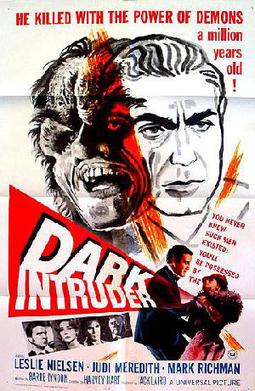
Horror Film Review: Dark Intruder (dir by Harvey Hart)


The 1965 film, Dark Intruder, takes place in San Francisco in 1890.

Murders are being committed on the foggy streets of the city that was once known as Yerba Buena.  Women are being stalked through allies and attacked by a caped figure who seems to thrive on the darkness.  At each murder, a hideous statuette is left behind.  The statuette seems to depict a winged demon emerging from the back of a man’s head.  With each murder, the demon appears to be growing closer and closer to fully escaping from the man.

The police are baffled and the press is suggesting that London’s infamous Jack the Ripper has come to California.  (Well, where else would he go?  I kid, California, I kid!  I love you, California.  Well, I love some parts of California, at least.)  As the police often due when they have a case with supernatural overtones, they turn to local socialite and bon vivant, Brett Kingsford (Leslie Nielsen).

Brett lives in a mansion, where he wakes up nearly every morning with a hangover.  He enjoys life but he’s also found time to become an expert on the occult.  He even has a giant plant in his library that perks up whenever there’s a paranormal presence nearby.  Brett is engaged to Evelyn Lang (Judi Meredith), who speaks in an annoyingly high voice.  When the police bring the statuettes to Brett, he takes them to a psychic named Chi Zeng for advice.  Chi Zeng (played by Peter Brocco, who you may have guessed was not Chinese) reveals that the statuette represent a Sumerian demon that is inhabiting the body of a human.  The demon has to commit seven murders so that it can freed from its host and then allowed to commit as many terrible acts as it wants.

Who is the demon possessing?  Brett’s friend, Robert Vandenburg (Peter Mark Richman), fears that it could be him.  Brett tries to assure Vandenburg that he has nothing to worry about but as Brett continues his investigation, he comes to realize that Vandenburg actually may have a lot to worry about….

Dark Intruder is a short film, clocking in at a little under an hour.  It was originally developed as a pilot for a television series that would have featured Leslie Nielsen solving occult crimes on a weekly basis.  Unfortunately, the series wasn’t picked up (it sounds like it would have been fun!) and Dark Intruder was given a theatrical release as part of a double feature with William Castle’s I Saw What You Did.  It’s an effective little film, full of gothic atmosphere, misty streets, and a frightening (and clawed) villain.  The murder that opens the scene seems as if it would have been quite graphic by the standards of 1966 television.  Perhaps that’s why the pilot didn’t lead to a series.

Of course, for a lot of people, the main appeal here is Leslie Nielsen, playing one of his “serious” roles.  Usually, it’s difficult to watch Nielsen’s dramatic work because it’s impossible not to be amused at his signature deadpan line delivery.  But he’s actually very good in Dark Intruder.  It helps that Brett Kingsford was written as being someone who had a sense of humor, as opposed to the stiff characters that Nielsen usually played in his dramatic roles.  Nielsen appears to be having fun in the role, which is not something you can say about most of Nielsen’s dramatic work.  Again, it’s a shame that Dark Intruder was apparently too ahead of its time for 1965.
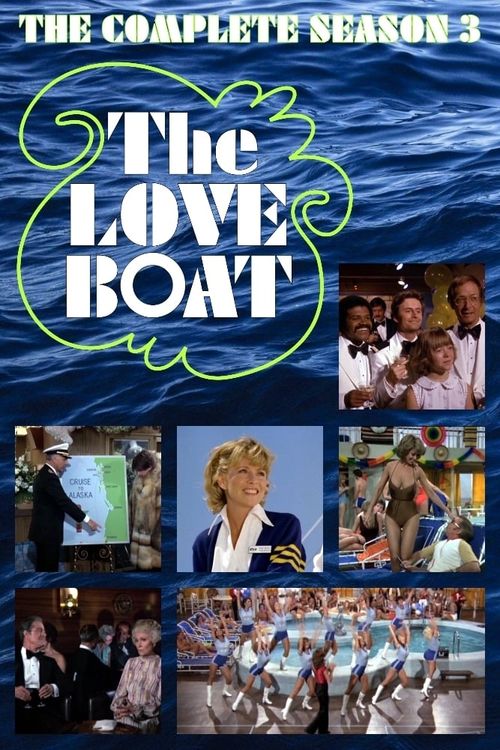
Retro Television Reviews: The Love Boat 3.3 “The Grass Is Greener/Three Stages of Love/Oldies But Goodies”


Welcome to Retro Television Reviews, a feature where we review some of our favorite and least favorite shows of the past!  On Wednesdays, I will be reviewing the original Love Boat, which aired on ABC from 1977 to 1986!  The series can be streamed on Paramount Plus!

For this week’s cruise, Julie learns that she’s not the only person who can do her job!

Episode 3.3 “The Grass is Greener/Three Stages of Love/Oldies But Goodies”

(Dir by Alan Rafkin, originally aired on September 22nd, 1979)

This week, Julie is super excited when her friend, Tina Philips (Joan Hackett), boards the cruise with her young son, Brian (Adam Rich).  Tina and Julie went to cruise director school together, where they were both taught by none other than Captain Stubing.

(As I’ve mentioned before, there have been a lot of weird continuity issues with establishing just how long anyone had actually known Captain Stubing.  During the first season, everyone was unsure of what to make of Captain Stubing and none of them had any experience sailing with him.  But, in the second season, Stubing was suddenly celebrating his five year anniversary as the ship’s captain.  And, in this episode, Stubing is established as being Julie’s mentor.)

Tina had a crush on Stubing while she was a student and Stubing had a bit of a crush on her as well.  Though Tina could have had a great career as a cruise director, she decided to get married and settle down instead.  Now, with her marriage falling apart, Tina boards the boat and immediately starts giving Stubing and Julie advice.  Julie, meanwhile, takes care of Brian while Tina dances with the captain.  Tina lives Julie’s life and Julie lives the life she could have had if she had stayed in Alaska and gotten married.  It turns out that Julie’s a great substitute mom but Tina is a terrible substitute cruise director.  Her idea of throwing a sock hop is a huge bust and, to be honest, it does seem a bit childish for a luxury cruise.  In the end, Tina returns to being a single mom and Julie returns to being childless and career-driven.  Yay, I guess.

Meanwhile, Nora (Amanda Blake) boards the ship with her daughter, Daphne (Karen Morrow).  Daphne is determined to marry a millionaire but Nora is the one who finds love when she meets the wheelchair-bound Phillip (Barry Sullivan).  Unfortunately, Phillip’s stuffy valet, Perkins (Werner Klemperer), insists that Philip needs to stay in his cabin and watch his blood pressure.  Fear not, though.  Daphne finds a millionaire and the millionaire hires away Perkins so now Phillip and Nora are free to have fun.  Yay!

(Though, really, Phillip should keep an eye on his blood pressure….)

Finally, Mike (Eddie Mekka) and Robin (Lani O’Grady) seems like a perfect couple, except for the fact that Mike is convinced that all relationships go through three stages before ending and he has an annoying habit of saying stuff like, “We’ve just entered stage two!”  Robin gets tired of Mike and his cynicism and eventually, Mike decides to give love a try because …. well, I’m not sure why.  I think it was because the episode was nearly over.

This episode was pleasant but, ultimately, rather forgettable.  Nora and Phillip were a nice couple but Perkins was portrayed in an over-the=top villainous light, especially when one considers that he was just doing the job he was hired to do.  Mike and Robin seemed like they were still destined to break up, even as they left the ship in love.  I did enjoy the scenes in which Tina’s sock hop party turned out to be a bust, just because it seemed like a dumb idea from the minute she mentioned it.  That said, the main message of this episode seemed to be that having a family and career were two mutually exclusive things, which I certainly did not agree with.

Again, this was not necessarily a bad episode.  It was just kind of a bland one.

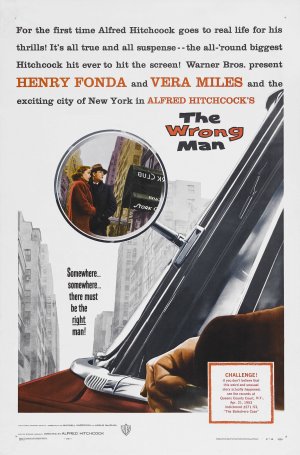
Lisa Marie Does The Wrong Man (dir by Alfred Hitchcock)


Since today is Alfred Hitchcock’s birthday, I figured why not take a few minutes to recommend one of his films that you may not have seen.  First released in 1956 but still painfully relevant today, The Wrong Man is one of Hitchcock’s best but it’s also one of his most underrated.

The Wrong Man deals with a common Hitchcock theme — i.e., an innocent man has been accused of a crime and, despite all of his efforts, cannot seem to convince anyone of his innocence.  The difference between The Wrong Man and something like Saboteur or Frenzy is that The Wrong Man is based on a true story.

Manny Ballestro (Henry Fonda) is a struggling musician.  He makes $85 a week, playing in a small jazz club.  But even though he may not be rich, he’s happy.  He loves his job.  He loves making music.  Even more importantly, he loves his wife, Rose (Vera Miles).  But Rose needs to have her wisdom teeth removed and it’s going to cost $300.  (As a sign of how much things have changed, I would have been relieved if it had only cost me $300 to get my wisdom teeth taken out.)  Desperate for money, Manny tries to borrow money on his wife’s life insurance plan.  What Manny doesn’t know is that the insurance office has been held up twice by a man who bears a vague resemblance to him.  A clerk calls the police and Manny soon finds himself being taken down to the police station.

Two detectives say that they need Manny’s help but they don’t tell him why.  But Manny knows he’s innocent of any crime and he believes that the police are on his side and he agrees to help.  When they tell him to walk into a liquor store, he does so.  When they take him to a deli, he goes in there as well.  When they demand to know why he was trying to borrow money on his wife’s life insurance, he tells them.  When they ask him about his financial difficulties, he tells them about that as well.  Why shouldn’t he?  He’s innocent and the police are just doing their job, right?  And when the cops finally ask him to copy down a few words that were used in the note that the robber slipped the clerk at the insurance company, Manny does so.  And when they then ask him to take part in a line-up, he does that as well…

And when Manny is arrested and charged with a crime … well, that’s when he finally understands that the system is not on his side.  His wife manages to hire a reputable attorney, Frank O’Connor (Anthony Quayle), to defend him but it quickly becomes obvious that the world has already decided that Manny is guilty.  When Manny and his wife try to track down some people who could provide Manny with an alibi, they discover that two of them are dead and one of them cannot be found.  For once, in a Hitchcock film, it’s not a case of conspiracy.  Instead, it’s just bad luck.

And, through it all, Rose continues to blame herself.  In fact, she is so wracked with guilt that she has a nervous breakdown.

It all leads to an amazingly disheartening courtroom scene.  As quickly becomes obvious, the judge has little interest in what’s happening in his court.  Even worse, the jury is unconcerned with the evidence.  Most of them are just annoyed at the inconvenience and punishing Manny seems like the perfect way to release their own frustrations…

It’s a bleak picture of the American justice system.  Watching The Wrong Man today, it’s tempting to say that the film is just a reflection of society in the 1950s and that things have changed today.  But really, have they?  True, the police may now be required to read someone their rights when they’re arrested.  A suspect can now ask for a lawyer.  We’ve got laws against entrapment and all the rest.  But that doesn’t matter.  We still live in a society where people are still widely presumed to be guilty, even after they’ve been found innocent in a court of law.  We still live in a society where the wrong man can have his life ruined because of one mistake.

The Wrong Man doesn’t get as much attention as some of Hitchcock’s other films.  In many ways, it’s an atypical example of his work.  Hitchcock was notorious for his dark sense of humor and his habit of waving away most plot points as just being mere “macguffins.”  With the exception of two scenes, both of which are meant to depict Manny’s mental state, The Wrong Man is filmed in a documentary style, one that occasionally seems more like Sidney Lumet than Alfred Hitchcock.  There’s next to no humor, nor are there any big or flamboyant twists.  In short, The Wrong Man finds the director of Psycho, Vertigo, and Rear Window at his most sincere.  It takes some getting used to.

But, once you do get used to it, The Wrong Man emerges as a powerful and bleak portrait of two innocent people at the mercy of a soulless system.  It’s a must see so be sure to see it!

The-Wrong-Man-poster