Film Review: Speed (dir by Edwin L. Marin)


1936’s Speed takes place in Detroit, at the home of Emery Motors.

When Joan Mitchell (Wendy Barrie) shows up to start her new job in the PR department, one of the first things she sees is a car being driven around a race track at a high speed until eventually it crashes.  Automotive engineer Frank Lawson (Weldon Heybourn) explains that it’s all a part of making sure the car is safe.  At Emery Motors, they crash cars on a daily basis to make sure that both the car and the driver will survive.

Terry Martin (James Stewart), the driver of the crashed car, proceeds to give Joan a tour of the factory.  There’s an obvious attraction between the two of them but Joan also seems to have feelings for Frank.  Terry and Frank are rivals.  Terry may not have Frank’s education but he has instincts and he has common sense.  He and his friend, Gadget Haggerty (Ted Healy), have an instinctive understanding of cars.  They know how to drive them.  They know how to fix them.  They know how to make them go really fast.

In fact, Terry is working on a new carburetor, one that he says will increase the speed of Emery’s cars.  Frank is skeptical but Terry knows that, if he can enter his car into the Indianapolis 500, he’ll be able to prove that he knows what he’s talking about.  Joan comes to believe in Terry and his carburetor.  And, fortunately, Joan has a secret of her own that will be very helpful to Terry’s ambitions.

Speed was not Jimmy Stewart’s first feature role but it was his first starring role.  28 years old when he starred in Speed, Stewart is tall, a little bit gawky, and unbelievably adorable.  From the minute that Terry climbs out of that wrecked car and introduces himself to Joan, Stewart’s a true movie star.  He and Wendy Barrie have a lot of chemistry and are a truly cute couple but Stewart is the one who dominates the film with his straight-forward charisma.  Terry may not be the best educated engineer at Emery Motors but he is determined to prove himself and Stewart does a great job of portraying that determination.

As for the film itself, it’s low-budget and it’s short.  Automotive enthusiasts might enjoy seeing all of the old cars and getting a chance to see what a car race was about in the days when cars themselves were still a relatively new invention.  The film itself starts out as almost a documentary, with Stewart (as Terry) explaining how each car is manufactured on the assembly line.  He points out all the machinery that goes into making the car in an almost-awed tone of voice.  If the information is a bit dry, it doesn’t matter because it’s impossible not to enjoy listening to Jimmy Stewart speak.  In his pre-WWII films, Stewart was the voice of American optimism and that’s certainly the case with Speed.

Speed was not a huge box office success but, in just two years, Stewart would be working with Frank Capra on You Can’t Take It With You, the first Stewart film to be nominated for (and to win) the Oscar for Best Picture of the year.
Horror on the Lens: The Hound of the Baskervilles (dir by Sidney Lanfield)


For today’s horror on the lens, we have 1939’s The Hound of the Baskervilles!

Based, of course, on the novel by Arthur Conan Doyle, The House of the Baskervilles is well-remembered for being the first of many Sherlock Holmes films to star Basil Rathbone as the detective and Nigel Bruce as his loyal sidekick, Dr. Watson.  Interestingly enough, Holmes is absent for a good deal of the film, leaving it up to Watson to do the majority of the investigating.  That said, you can still see why Rathbone’s interpretation of the character proved to be so popular that he would go on to play Holmes in a total of 14 movies and one radio series.

Enjoy!

Film Review: Dead End (dir. by William Wyler)


Originally released in 1937, Dead End is a gangster film with social conscience.  Based on a Broadway play and featuring a screenplay by the iconic progressive writer Lillian Hellman, Dead End is a crime film that’s more interested in the root causes of crime than in crime itself.

Dead End takes place over the course of one day in the slums of New York City.  While tenement children spend their time swimming in the East River and idealizing gangsters, wealthy people live in high-rise apartments and depend on the police and their doorman (played, naturally enough, by Ward Bond) to keep them protected from the poor people living next door.

Among the poor is Drina (Sylvia Sidney), who divides her time between marching on a picket line and trying to keep her younger brother Tommy (Billy Halop) from hanging out with the local street gang, the Dead End Kids (Huntz Hall, Bernard Punsly, Leo Gorcey, and Gabriel Dell).  Drina’s childhood friend is Dave (Joel McCrea), an idealistic architect who is having an affair with a rich man’s mistress (Wendy Barrie).

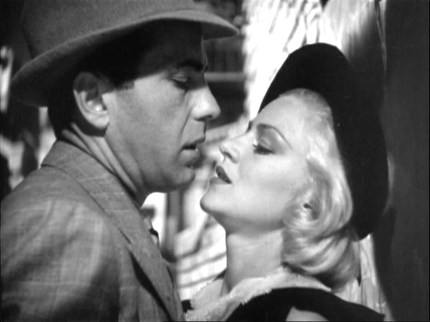
Complicating things is the arrival of Baby Face Martin (Humphrey Bogart).  Like Dave, Martin grew up in the slums.  However, while Dave is trying to escape by making an honest living, Martin has already escaped by choosing a life of crime.  Now, he’s viewed as a hero by Tommy and his friends and with wariness by Dave and Drina who know that Martin’s presence will eventually lead to the police invading their home.  Martin, however, is more concerned with seeing his mother (Marjorie Main) and his ex-girlfriend (Clare Trevor), who has become a prostitute and is suffering from syphilis.

For a film that was made close to 80 years ago, Dead End holds up pretty well.  Is this because it’s a brilliant film or just because the connection between poverty and crime has remained one of the constants of human history?  It’s probably a combination of both.  Considering that Dead End was filmed on a Hollywood backlot, it’s a surprisingly gritty and realistic film that only occasionally feels a bit stagey.  The film’s entire cast does a good job of bringing this particular dead end to life, though the obvious star of the film is Humphrey Bogart.  As played by Bogart, Baby Face Martin is both sympathetic and despicable, the epitome of the potential that can be found and wasted in any American city.

Dead End was nominated for best picture but lost to The Life of Emile Zola.  The film also received a much deserved nomination for best art design but lost to Lost Horizon while Clare Trevor lost the race for best supporting actress to Alice Brady, who won for In Old Chicago.  Perhaps most surprisingly of all, Humphrey Bogart did not even receive a nomination for his excellent work in Dead End.  Meanwhile, the film’s tough gang of street kids proved to be so popular that they, as a group, were cast in several other films.  Originally credited as the Dead End Kids (and later known as the Bowery Boys), they ended up making a total of 89 films together.  With the possible exception of Angels With Dirty Faces, none of those films are as highly regarded as Dead End.

Film Review: The Private Life of Henry VIII (dir. by Alexander Korda)


This afternoon, as part of my mission to see every single film ever nominated for best picture, I watched Alexander Korda’s 1933 biopic The Private Life of Henry VIII.

Now, I have to admit that I’ve never been a big fan of the historical King Henry VIII as I have a hard time finding much sympathy for a man who beheads one wife, not to mention two of them.   I like to imagine that he met his end in much the same way that Joe Spinell meets his end at the end of Maniac, with all of his dead wives suddenly showing up and ripping off his head.  But, Henry is one of those larger-than-life historical figures that always seems to end up as the subject of movies, speculative fiction, and, of course, Showtime television series. 

The Private Life of Henry VIII is one of the better known recreation of Henry’s life on-screen.  For the most part, the film ignores Henry’s policies as king and instead is a darkly humorous recreation of his relationships with five of his six wives.  (His first marriage, to Catherine of Aragon, is ignored.)  The episodic film opens with the execution of Anne Boyelen (Merle Oberon).  This sequence establishes the film’s tone early and it’s actually a lot more cynical than we usually expect a film from 1933 to be.  In between shots of Boyelen waiting to meet her fate, we get extended scenes of two executioners — one French and one English — arguing about which nationality is better when it comes to chopping off heads.  Meanwhile, the members of Henry’s court spend their time whispering innuendo about Henry’s new wife, Jane Seymour (Wendy Barrie).  When Henry (played by Charles Laughton) finally shows up on the scene, he turns out to be a buffoon, a childish man who happens to control the destiny of England.  After Jane dies in childbirth, Henry marries Anne of Cleves (played by Laughton’s wife, Elsa Lanchester).  Anne, however, finds Henry to be repulsive and, in the film’s most obviously comedic segment, she goes out of her way to make herself as sexually unappealing as possible in order to convince Henry to give her a divorce.  (This, of course, led to the split between England and the Catholic Church but the film doesn’t dwell on that.  This is a comedy, not Man For All Seasons.)  After the divorce, Henry finally marries Catherine Howard (Binnie Barnes) who has spent the whole movie pursuing Henry.  For the first time in the movie, Henry is portrayed as being truly in love, unaware (at first) that Catherine only married him for his crown and is actually having an affair with Thomas Culpepper (Robert Donat). 

The Private Life of Henry VIII was not the first movie to be made about Henry VIII but it’s probably the most influential because of Charles Laughton’s Oscar-winning performance in the title role.  Laughton’s performance pretty much set the standard as far as future Henry’s were concerned.  His Henry is buffoonish womanizer who does everything to excess.  (This is the film that pretty much created the whole image of monarchs as men who don’t use forks, knives, or spoons.)  However, as over-the-top as Laughton’s performance may seem, it’s actually full of very subtle moments that suggest the actual human being lurking underneath all of the bluster.  It’s hard not to sympathize with Laughton’s Henry as he struggles to explain what sex is to Anne of Cleves or with his obvious pain when he discovers that he’s been betrayed by the only one of his wives that he actually loved.

(Of course, any similarity between Laughton’s Henry and the real-life Henry is probably a coincidence.)

The Private Life of Henry VIII was the first British film ever nominated for best picture and, perhaps because it wasn’t made by the Hollywood establishment, it hasn’t aged as terribly as most films from the 30s.  While the film does have its slow spots, the performances of Laughton, Oberon, and Lanchester still hold up well and some of the film’s dark comedy almost feel contemporary.  Oddly enough, this British film about English history lost to an American film about English history, Cavalcade

(I should mention that I haven’t seen Cavalcade so I can’t say whether it was a better film.  I’m going to have to see Cavalcade eventually but it’ll be later than sooner as the movie is only available as part of a DVD boxed set that costs close to 300 dollars.  Agck!)