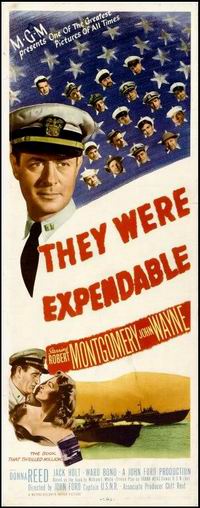
They Were Expendable (1945, directed by John Ford)


In December of 1941, Lt. John Brickley (Robert Montgomery) commands a squadron of Navy PT boats, based in the Philippines.  Brickley is convinced that the small and agile PT Boats could be used in combat but his superior officers disagree, even after viewing a demonstration of what they can do.  Brickley’s second-in-command, Rusty (John Wayne), is frustrated and feels that he will never see combat.  That changes when the Japanese attack Pearl Harbor and then turn their attention to the Philippines.  Brickley gets his chance to show what the PT boats can do but both he and his men must also deal with the terrible risks that come with combat.  Brickley and his men have been set up to fight a losing battle, only hoping to slow down the inevitable Japanese onslaught, because both they and their boats are considered to be expendable.  The hot-headed Rusty learns humility when he’s sidelined by blood poisoning and he also falls in love with a nurse, Sandy (Donna Reed).  However, the war doesn’t care about love or any other plans that its participants may have.  With the invasion of the Philippines inevitable, it just becomes a question of who will be sent with MacArthur to Australia and who will remain behind.

One of John Ford’s best films, They Were Expendable is a tribute to the U.S. Navy and also a realistic look at the realities of combat.  The movie features Ford’s trademark sentimentality and moments of humors but it also doesn’t deny that most of the characters who are left behind at the end of the movie will not survive the Japanese invasion.  Even “Dad’ Knowland (Russell Simpson), the fatherly owner of a local shipyard who does repair work on the PT boats, knows that he’s expendable.  He resolves to meet his fate with a rifle in hand and a jug of whiskey at his feet.  Rusty, who starts out thirty for combat, comes to learn the truth about war.  Ford was one of the many Hollywood directors who was recruited to film documentaries during World War II and he brings a documentarian’s touch to the scenes of combat.

Robert Montgomery had previously volunteered in France and the United Kingdom, fighting the Axis Powers before America officially entered the war.  After the war began, he entered the Navy and he was a lieutenant commander when he appeared in They Were Expendable.  Montgomery brought a hardened authenticity to the role of Brickley.  (Montgomery also reportedly directed a few scenes when Ford was sidelined with a broken leg.)  John Wayne is equally good in the role of the hot-headed Rusty, who learns the truth about combat and what it means to be expendable.  The cast is full of familiar faces, many of whom were members of the John Ford stock company.  Keep an eye out for Ward Bond, Cameron Mitchell, Leon Ames, Jack Holt, and Donald Curtis.

They Were Expendable is one of the best of the World War II movies.  It’s a worthy film for Memorial Day and any other day.
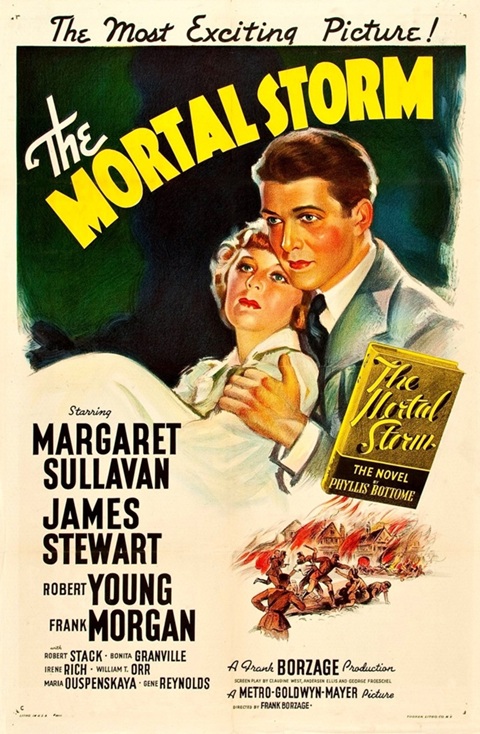
The Unnominated #16: The Mortal Storm (dir by Frank Borzage)


Though the Academy of Motion Picture Arts and Sciences claim that the Oscars honor the best of the year, we all know that there are always worthy films and performances that end up getting overlooked.  Sometimes, it’s because the competition too fierce.  Sometimes, it’s because the film itself was too controversial.  Often, it’s just a case of a film’s quality not being fully recognized until years after its initial released.  This series of reviews takes a look at the films and performances that should have been nominated but were, for whatever reason, overlooked.  These are the Unnominated.

Oh, how this movie made me cry!

Released in 1940, at a time when war was spreading across Europe, Asia, and Africa but the United States was still officially neutral, The Mortal Storm opens on January 30th, 1933.  In the mountains of Germany, near the Austrian border, Professor Viktor Roth (Frank Morgan) is celebrating his 60th birthday.  He starts the day being applauded by his students at the local college.  In the evening, he returns home for a celebration with his family, including wife (Irene Rich), his daughter Freya (Margaret Sullivan), his son Rudi (Gene Reynolds), and his two stepsons, Otto (Robert Stack) and Erich von Rohn (William T. Orr).  Also present are Freya’s fiancé, Fritz (Robert Young) and one of Roth’s students, a pacifist named Martin Breitner (James Stewart).  It’s a joyous occasion and the film takes its time introducing us to Prof. Roth and his extended family.  At first, everyone seems very kind.  They seem like people who most viewers would want to spend time with or live next to….

But then, the family’s maid excitedly enters the room and announces that it’s just been announced that Adolf Hitler is the new chancellor of Germany.  Otto and Erich are overjoyed and head out to celebrate with the other members of the Nazi Youth Leage.  Martin is less happy and excuses himself to return home.  Roth and his wife worry about what this means for people who do not agree with Hitler’s beliefs.  Freya says that they shouldn’t talk politics.  It is jokingly mentioned that Hitler has taken away Roth’s special day but Roth’s young son Rudi says that he’s learned in school that the needs of the individual will never be more important than the needs of the state.  If Hitler wants to take away your day, it’s your duty to give it up or face the consequences.

Based on a 1937 novel, The Mortal Storm was not the first Hollywood production to take a stand against Hitler and the Nazis but it was one of the best.  I say this despite the fact that the film only hints at the fact that Prof. Roth is Jewish, something that was made very clear in the book.  (In the movie, Roth and his wife worry what will happen to “Non-Aryans” and “freethinkers.”)  That said, the film perfectly captures how quickly and insidiously the authoritarian impulse can spread.  The town, which once seemed so friendly, becomes a very dark place as the students at the university put on their swastika armbands and start to hunt down anyone who dissents from the party line.  When Roth says that, as a scientist, he does not believe one race can be genetically superior to another, his students walk out on him.  A local teacher is beaten when he fails to return to the Nazi salute.  When Martin refuses to join the Party, Otto and Erich turn against him despite being lifelong friends.  When Martina and Freya flee for the border, Fritz pursues them.  And even after Prof. Roth is sent to a concentration camp, Otto and Erich continue to follow the orders of Hull (Dan Dailey), the sinister Youth Party Leader.

It’s a powerful film, one that remains just as relevant today as it was when it was first released.  Hull and Erich’s fanaticism would, today, find a welcome home on social media.  The scenes in which the townspeople eagerly threaten to report their former friends and neighbors for failing to salute or show proper enthusiasm for the government have far too many modern day equivalents for me to even begin to list them all.  This film was also the last the James Stewart made with frequent co-star Margaret Sullivan and they both give great performances.  (All-American Jimmy Stewart might seem a strange choice to play a German farmer but he is never less that convincing as Martin, one of the few people in the town not to surrender his principles and beliefs to the crowd.)  The film’s final moments, with the camera panning around the empty Roth home, brought very real tears to my eyes.

Despite being a powerful film, The Mortal Storm was not nominated for a single Oscar.  (Jimmy Stewart did win his only Oscar that year but it was for The Philadelphia Story.)  It’s temping to assume that, at a time when America was still divided about how to react to the war in Europe and when many Americans still remembered the trauma of the first World War, The Mortal Storm was too explicitly political and anti-Nazi to get a nomination but, the same year, The Great Dictator was nominated for Best Picture.  It seems more likely that, in those days when the studios ruled supreme, MGM decided to puts it weight behind The Philadelphia Story rather than The Mortal Storm.

That said, The Mortal Storm was definitely worthy of being nominated, for Picture, Director, Screenplay, Actress (Margaret Sullivan), Actor (Stewart), Supporting Actor (Frank Morgan and Robert Stack), and Supporting Actress (Irene Rich and, in the role of Stewart’s mother, Maria Ouspenskaya).  The film may not have been nominated but it remains a powerful and important work of art.

Previous entries in The Unnominated:

  1. Auto Focus 
  2. Star 80
  3. Monty Python and The Holy Grail
  4. Johnny Got His Gun
  5. Saint Jack
  6. Office Space
  7. Play Misty For Me
  8. The Long Riders
  9. Mean Streets
  10. The Long Goodbye
  11. The General
  12. Tombstone
  13. Heat
  14. Kansas City Bomber
  15. Touch of Evil

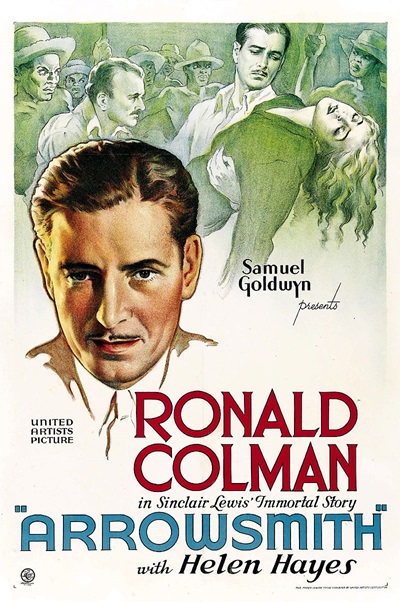
Lisa Reviews An Oscar Nominee: Arrowsmith (dir by John Ford)


In the 1931 Best Picture nominee Arrowsmith, Ronald Colman stars as Martin Arrowsmith, a doctor who is trying to save lives without compromising his ethics.

Arrowsmith is mentored by the famed bacteriologist, Max Gottlieb (A.E. Anson) and married to a nurse named Leora (Helen Hayes).  At first, Arrowsmith makes his living as the local doctor in Leora’s small hometown in South Dakota.  However, Arrowsmith is ambitious and wants to do more with his life and career than just take care of a small town.  He wants to cure the world of disease.  When he’s offered a position at the prestigious McGurk Institute in New York, he enthusiastically accepts.  Having just suffered a miscarriage, Leora supports Arrowsmith’s decision and travels to New York with him.  No matter what happens, Leora is always there to support her husband, even when he doesn’t seem to appreciate it.

When Arrowsmith thinks that he’s discovered an antibiotic serum that appears to be capable of curing all sorts of diseases, he attempts to stay true to the methods taught to him by Dr. Gottlieb.  He takes his time.  He tests carefully.  He doesn’t rush out and give the serum to everyone.  However, Arrowsmith finds his methods continually sabotaged by his colleagues, who hope to raise money by telling the press about a miracle serum that can “cure all diseases!”  When Arrowsmith later finds himself combatting an outbreak of the Bubonic Plague in the West Indies, he again tries to employ the scientific method but finds himself being pressured by government officials to give his untested serum to every single person on the island.  Eventually, Arrowsmith’s ethics are pushed to their limits when even Leora falls ill.

Arrowsmith was based on a best-selling novel by Sinclair Lewis, though the plot was changed to make the story more palpable for film audiences.  In the novel, Arrowsmith is a bit of cad who regularly cheats on his wife.  In the film, Arrowsmith is passionate and driven but the exact nature of his relationship with wealthy Joyce Lanyon (Myrna Loy) is left so ambiguous that it actually leaves one wondering why the character is in the film at all.  What both the film and the novel have in common is an emphasis on the importance of science and the scientific method.  Arrowsmith’s idealism runs into the harsh reality of life during an epidemic.  Government officials are more concerned with saying that they’ve done something as opposed to considering whether their actions have ultimately done more harm than good.  In its way, Arrowsmith predicted the COVID era.

Arrowsmith was the first John Ford film to be nominated for Best Picture and its financial success allowed Ford the freedom to go on to become one of Hollywood’s most important directors.  Seen today, Arrowsmith feels a bit creaky and self-important, with little of the visual flair that Ford brought to his later films.  Ronald Colman’s performance as Arrowsmith seems a bit stiff, especially when compared to the much more lively (and sympathetic) performance of Helen Hayes.  Arrowsmith is a big and serious film and, if we’re going to be honest, it’s a little bit boring.  Still, it’s interesting to see the issues of today being debated 90 years in the past.

As for the Oscars, Arrowsmith was nominated for Best Picture, Adaptation, Cinematography, and Art Direction.  It lost in all four of the categories in which it was nominated.  That year, Best Picture was won by Grand Hotel, which curiously didn’t receive any other nominations at all.

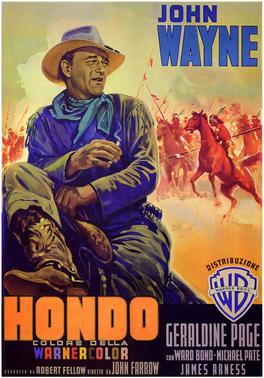
HONDO – John Wayne takes on Apaches!


John Wayne is just one of those actors I love. He’s made so many great movies. My personal favorites are RIO BRAVO, TRUE GRIT, BIG JAKE, THE SONS OF KATIE ELDER, THE MAN WHO SHOT LIBERTY VALANCE, THE SEARCHERS, THE QUIET MAN, RED RIVER, THE SHEPHERD OF THE HILLS and STAGECOACH. But hell, there are so many great ones not listed above. He just knew how to play tough, honorable, flawed men in his uniquely John Wayne way. When I hit play on a John Wayne film, I know I’m in for a good time. 

The 1953 John Wayne movie HONDO starts with a man and his dog walking through a dusty, rocky landscape on their way towards a pond and a rough looking farmhouse. He’s greeted by a woman and her young son. The man, Hondo Lane (Oscar winner John Wayne), is a scout for the U.S. Cavalry who’s just escaped from Apaches but lost his horse in the process. The woman, Angie Lowe (Oscar winner Geraldine Page), allows Hondo to stay at her ranch to rest and get something to eat. She tells him that her husband is away in the hills chasing wildcats for the day, and he asks her if he can buy a horse to get back to his cavalry post. Hondo ends up having to stay a few days at the ranch in order to break a wild, rambunctious horse before it can be ridden. While there, Hondo learns that Angie doesn’t really know where her husband is, as he left months ago and has never returned. Hondo and Angie share some nice conversation and even a kiss. Before he leaves, he tells her that she’s not safe at her remote ranch. It seems that the U.S. government has broken their treaty with the Apaches and no one is safe in the area. Angie refuses to leave her farm as the Apaches have always treated her well, using her spring for water. Hondo heads back to his post and is barely out of sight when the Apaches show up. Will they scalp Angie and her son, Johnny? Will Angie’s husband ever show back up? Will Hondo come back to the ranch and kiss her again in the moonlight? Will Hondo teach Johnny how to swim by throwing him into the pond? Will Hondo have to save a regiment of pony soldiers and settlers from marauding Apaches? It’s my guess that you probably know the answers to these questions, and that’s part of the fun of watching John Wayne movies. 

It should come as no surprise that I enjoyed HONDO. John Wayne plays a variation of his normal tough, honorable, honest character, and I like that character. Geraldine Page was nominated for her first Oscar for her performance as Angie Lowe. It was the first of eight nominations she would receive in her career. She’s an interesting actress. She’s not conventional at all in this role yet she absolutely nails it. I haven’t watched much of her work so I need to check some more of her stuff out. Ward Bond shows up as fellow cavalry scout Buffalo Baker. It’s always fun to see Wayne and Bond work together. They go together like peas and carrots. Leo Gordon is effectively slimy as the deserter Ed Lowe, and James Arness shows up as cocky young man who’s humbled and then redeems himself through battle. It’s a fine cast that helps in the fun factor. 

It’s not a perfect film, especially by the social standards of 2024, but it’s a fun and entertaining western. I liked it. 

4 Shots From 4 Films: Special Ward Bond Edition


4 (or more) Shots From 4 (or more) Films is just what it says it is, 4 (or more) shots from 4 (or more) of our favorite films. As opposed to the reviews and recaps that we usually post, 4 (or more) Shots From 4 (or more) Films lets the visuals do the talking.

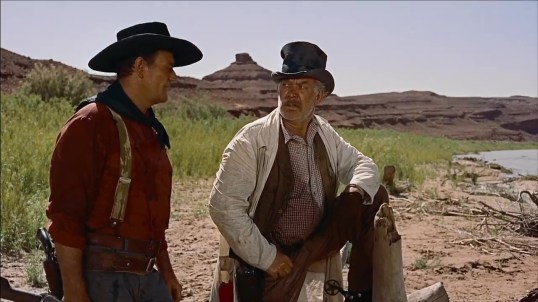
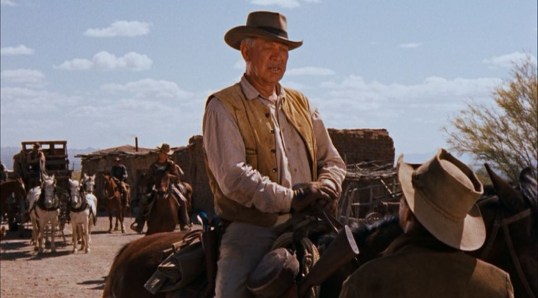
121 years ago today, the great American character actor Ward Bond was born in Benkleman, Nebraska.  In a career that last nearly forty years, Ward Bond appeared in more than 200 films and he currently holds the record for being the actor to appear in the most films nominated for Best Picture.  (He appeared in 13 nominated films, two of which won.)  He did 22 films with John Wayne and was a favorite of both John Ford and Frank Capra.

It’s time for….

4 Shots From 4 Ward Bond Films

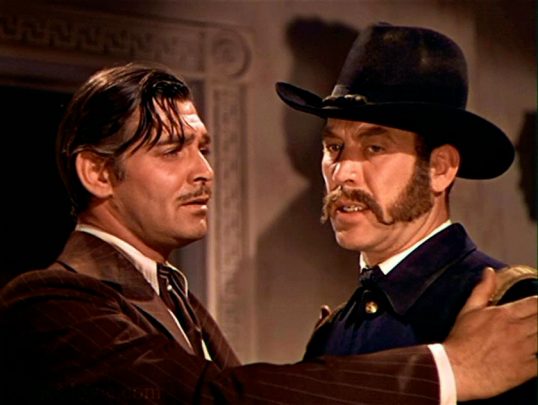
Gone With The Wind (1939, dir by Victor Fleming, DP: Ernest Haller)

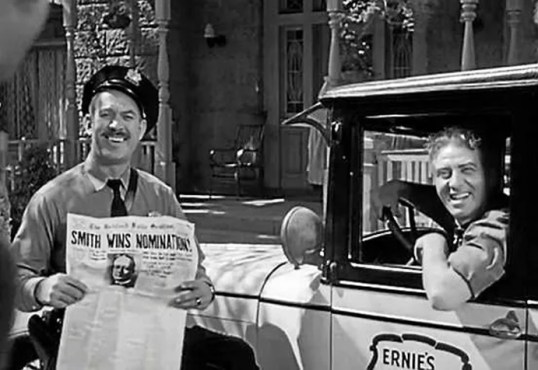
It’s A Wonderful Life (1946, dir by Frank Capra, DP: Joseph Walker and Joseph Biroc)

The Searchers (1956, dir by John Ford, DP: Winston C. Hoch)

Rio Bravo (1959, dir by Howard Hawks, DP: Russell Harlan)

Film Review: Hitler — Dead or Alive (dir by Nick Grinde)


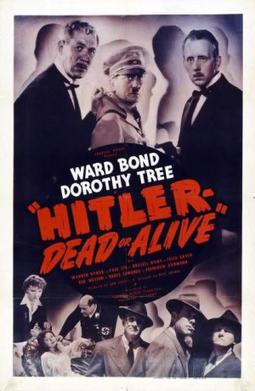
The 1942 film, Hitler — Dead or Alive, opens with two reporters visiting a prominent industrialist named Samuel Thornton (Russell Hicks).  They are curious about a statue of three men that stands outside of Thornton’s mansion.  Thornton proceeds to tell them the story of the three men.

In 1939, shortly after the Nazis invaded Poland and with the United States still pursuing a policy of neutrality, Thornton independently offered a million dollars to anyone who could bring Adolf Hitler to justice, dead or alive.  Accepting the offer were three ex-cons who had just been released from Alcatraz, Steve Maschick (Ward Bond), Hans “The Dutch” Havermann (Warren Hymer), and Joe “The Book” Conway (Paul Fix).  (As you may have guessed “The Book” is the intellectual of the group and yes, he wears glasses.)  After Thornton makes clear to them that they’re going to have to make sure that they either capture or kill the real Hitler and not one of his many doubles, the three men join the Royal Canadian Air Force and, along with ace pilot Johnny Stevens (Bruce Edwards), they head for Germany.

Made for an obviously low-budget, this B-movie is a bit of a curiosity.  It starts out as a comedy, with the three cooks cracking jokes about going straight and a lengthy sequence in which they try to work up the courage to parachute into Germany.  Even after they get caught by the Gestapo and sent to a prison camp, much of the film is played for laughs.  It’s not until they escape from the prison and Johnny sacrifices his life while shooting it out with the Nazis that the film starts to take a more serious turn.  Steve, who starts out the film only caring about the money, comes to realize that there are more important things than just finding a quick payday.

Steve, Hans, and Joe end up at the mansion of Else von Brandt (Dorothy Tree), a secret member of the German resistance who is so trusted by the Nazis that Hitler himself (played by Bobby Watson) will be stopping by for a visit.  By this point, Steve explains that he no longer cares about the money.  As far as he’s concerned, he’s now working for free.  After learning about all of the people who have been killed by Hitler, Steve is determined to stop him, even if it means sacrificing his own life.

There are still moments of humor to the found in the latter half of the film.  When Steve, Hans, and Joe confront Hitler, one of the first things that they do is shave off his mustache.  But the film’s conclusion is ultimately a very serious one and features one particular act of violence that I imagine stunned audiences in 1942.  Having told the story of the three men and their mission to get Hitler, Samuel Thornton ends the film by saying that it doesn’t matter whether Germany is being led by Hitler or Hitler’s double.  What matters is eradicating all of the Nazis from the Earth.  In the end, the message of the film is a simple one.  It’s okay to laugh.  It’s okay to joke.  But, in the end, everyone must do their part.

Hitler — Dead or Alive was made for an obviously low-budget and there are a few scenes, especially in the beginning, where the pace feels a bit off.  Just as with Beast of Berlin, the film’s version of a German prison camp feels like it could have been lifted from a dozen American crime films.  But Ward Bond is a strong hero and he delivers his lines with conviction, especially when he discusses why nothing is more important than stopping Hitler.  He gets good support from both Paul Fix and Warren Hymer.  The film may start out as a comedy but it’s anti-Hitler message comes through loud and clear.  Seriously, how can you not appreciate a film about defeating the Nazis?

The Great Missouri Raid (1951, directed by Gordon Douglas)


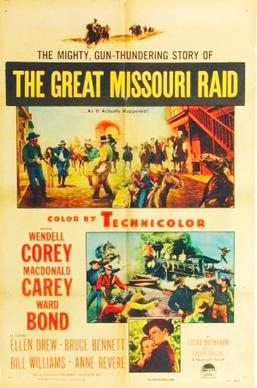
During the Civil War, brothers Frank (Wendell Corey) and Jesse James (Macdonald Carey) leave the family farm and fight as Confederate guerillas under the leadership of the infamous William Quantrill.  When the war ends with the Confederacy’s defeat, Frank, Jesse, and their friend Cole Younger (Bruce Bennett) return home to Missouri and discover that their town is being ruled over the tyrannical Major Towbridge (Ward Bond).  With their farms in ruin and having little opportunity to make honest money, the James Brothers and the Younger Brothers soon resort to robbing banks and trains.  It’s their revenge against not only the soldier occupying their land but also the bankers and land barons who have been taking advantage of their friends and family members.  The James-Younger Gang become heroes to economically oppressed people everywhere.

From the minute that they arrive home, Towbridge is determined to imprison the James brothers.  Not only does he distrust them because of their past with Quantrill but he also blames them for the death of his own brother.  Towbridge becomes so obsessed that he even leaves the army so that he can pursue Frank and Jesse as a private detective.  Even as it appears that Jesse might be on the verge of settling down and abandoning his criminal life, he still has to deal with unexpected visitors like the Ford brothers.

The story of Frank and Jesse James inspired several films, some of which were better than others.  Directed with a good eye for detail by Gordon Douglas, The Great Missouri Raid tells the familiar story with enough skill to be watchable but it never reaches the classic status of Walter Hill’s The Long Riders. 

The main problem is that both Wendell Corey and Macdonald Carey come across as being almost too civilized as the James brothers.  The film is obviously sympathetic to the James brothers and, as westerns tended to do in the 50s, it ignores some of the less heroic details of their lives of outlaws.  (The film, for instance, doesn’t mention that the James brothers were probably already outlaws before the Civil War started and it’s doubtful that a modern film would be as sympathetic to two men who left home to fight for the Confederacy.)  Usually, though, even the most sympathetic film portrayals of the James brothers still portray them as being the type of people who you wouldn’t necessarily want to meet while riding the trail.  Wendell Corey and Macdonald Carey play Frank and Jesse as being so nice that it’s hard to believe that they could have even rode with Quantrill, let along the Younger brothers.  They’re the most reasonable outlaws this side of the Mississippi.  Bruce Bennett and Bill Williams are more believable as the rough and tough Cole and Jim Younger.

Not surprisingly, the film is stolen by Ward Bond.  Bond usually played reasonable authority figures for John Ford and Frank Capra.  As Major Towbridge, though, he’s cast as a martinet who allows his obsession with James brothers to turn him into a fanatic.  For those who are used to only seeing Bond cast as a fair cop or a tough-but-fair military officer, his performance in The Great Missouri Raid is a revelation.

The Long Riders is the best movie about the James Gang but, for western fans, The Great Missouri Raid should be entertaining if not definitive.

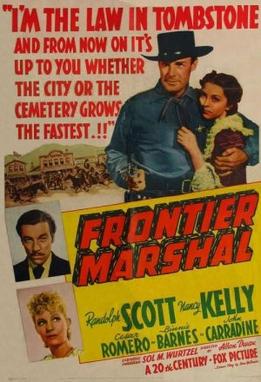
Frontier Marshal (1939, directed by Allan Dwan)


When Wyatt Earp (Randolph Scott) arrives in the town of Tombstone, he takes the law in his own hands by preventing a local outlaw named Indian Charlie (Charles Stevens) from destroying the saloon owned by Ben Carter (John Carradine).  For his trouble, Earp is beaten up by Carter’s men.  Earp, however, does get a  job as the town’s new marshal.

After some initial weariness, Wyatt befriends an alcoholic dentist and gunfighter named Doc Holliday (Cesar Romero).  While Earp keeps the peace in Tombstone, Doc is torn between two women, dancehall girl Jerry (Binnie Barnes) and his ex-girlfriend, Sarah (Nancy Kelly).

With Carter and his man planning on robbing a payroll train and also kidnapping frontier performer, Eddie Foy (played by the real Foy’s son, Eddie Foy, Jr.), it is only a matter of time before Earp takes on Carter at the legendary O.K. Corral.

Frontier Marshal was only the second sound film to be made about Wyatt Earp’s time in Tombstone and it was the first to use Earp’s name.  (In the first film version of the story, also called Frontier Marshal, Earp’s name was changed to Michael Wyatt.)  This was because Wyatt’s widow was offended by some of the material that was included in the biography that served as the basis for Frontier Marshal and threatened to sue anyone who wanted to make a movie out of it.  In order to get her permission to make the film, 20th Century Fox agreed that no reference would be made to Wyatt’s marriage in the film.  Mrs. Earp ended up suing anyways.  20th Century Fox settled.

As for the film, it’s in no way historically accurate and it pales in comparison to My Darling Clementine, Gunfight at the O.K. Corral, Tombstone, and the Star Trek episode where Kirk, Spock, and McCoy thought they were in the old west.  It is, however, better than The Gunfighters episode of Dr. Who.  Randolph Scott is convincing as an upright and law-abiding Wyatt Earp, quite a contrast to the real Wyatt.  The movie though is stolen by Cesar Romero, who plays Doc Holliday as being pathologically self-destructive.  Cesar Romero is not necessarily the first name that comes to mind when you think of a great western actor but he’s very convincing here.  John Carradine is a perfect villain and keep an eye out for Lon Chaney, Jr. as one of his henchmen.  Unfortunately, the final gunfight feels rushed and, for all the build up, it isn’t as exciting as it should be.  Frontier Marshal will mostly be of interest to those curious to see how Doc Holliday, Wyatt Earp, Tombstone and the Gunfight at the O.K. Corral were portrayed in films before they became a sacrosanct part of the mythology of the Old West.

Frontier Marshal was later remade, as My Darling Clementine, by John Ford.  Ward Bond, who played Morgan Earp in Ford’s film, plays the original town marshal in Frontier Marshal.  Charles Stevens, who plays Indian Charlie in Frontier Marshal, was often falsely described by the Hollywood publicity mill as being the real-life grandson of Geronimo.  He also appeared in My Darling Clementine, once again playing the role of Indian Charlie.  It was one of the nearly 200 films he made before he died in 1964.

Film Review: The Last Days of Pompeii (dir by Ernest B. Schoedsack and Merian C. Cooper)


The summer after I graduated high school, I took a trip to Italy.

I absolutely loved it.  There’s nothing more wonderful than being 18 and irresponsible in one of the most beautiful and romantic countries in Europe.  I also loved it because everywhere I looked in Italy, I saw the remains of history.  When I was in Rome, I visited the Colosseum.  When I was in Southern Italy, I visited Comune di Melissa, the village where some of my ancestors once lived.  When I visited Florence, I became so overwhelmed by the beauty of it all that I nearly fainted.

And then there was Pompeii.  I spent a day visiting the ruins of Pompeii and it was an amazing experience.  The eruption of Mt. Vesuvius in 79 AD may have been horrific for the Romans but it’s also gave history nerds like me a chance to step right into the past.  Beyond just the thrill of seeing how the world once was, I have two main memories of Pompeii:

First, there was the visit to Pompeii’s brothel.  An Australian tourist lay down on one of the stone slabs so that his family could take pictures of him.

Secondly, there was the fact that I wore a really pretty red dress for my visit but I failed to take into account that 1) the area around Pompeii is very hilly and 2) it was a very windy day.  So, I can say that I’ve not only visited but I’ve flashed Pompeii as well.

The destruction of Pompeii has inspired several books and more than a few films, as well.  One of the earliest was the 1935 film, The Last Days of Pompeii.

The Last Days of Pompeii opens with Marcus (Preston Foster), an extremely bitter blacksmith who lives in the bustling city of Pompeii.  Marcus is bitter because he’s not rich and his family has been just been run down by some jackass in a chariot.  Marcus does find brief fame as a gladiator but he’s stricken with guilt after he kills a man and then discovers that he’s made an orphan out of the man’s son.  Marcus adopts young Flavius, just to then discover that the boy is seriously ill.  A fortune teller informs Marcus that Flavius will be healed by “the greatest man in Judea.”  Marcus naturally assumes that this is a reference to the Roman governor, Pontius Pilate (Basil Rathbone).  However, upon traveling to Judea, Marcus meets a different great man and then watches as his adopted son is healed.

Jump forward about two decades.  Marcus is now a rich man and is in charge of Pompeii’s gladiatorial games.  Flavius (now played by John Wood) has grown up to be an idealistic young man who barely remembers the day that he was healed. What Marcus doesn’t know is that Flavius has been helping slaves escape from Pompeii.  When Flavius is arrested, it appears that Marcus is doomed to watch his own son be killed in the arena.

But wait a minute — what’s that coming down the mountain?  It’s kinda smoky and red and it looks like it might be really hot and …. oh damn.

Now, there’s two problems here.  First off, from a historical point of view, the film’s timeline doesn’t work out.  Jesus was crucified in 33 AD.  Pompeii was destroyed 46 yeas later, in 79 AD.  Therefore, there’s no way that Flavius should only be in his early 20s.  Secondly, just the fact that the film takes place in Pompeii pretty much gives away the ending before the story even begins.  Since you know that the volcano is eventually going to kill everyone, it’s hard to get too caught up in any of the drama.  You just find yourself sitting there and going, “When isssssssssss the volcano going to eeeeeeeeeeeeerupt!?”

On the plus side, Preston Foster is one of the more underrated of the Golden Age stars and he does a pretty good job here.  Plus, you have to love any film that features Basil Rathbone as a semi-decadent Roman.  Rathbone plays Pilate as both a bored libertine and a guilt-stricken convert and, both times, he’s impressive.

Despite being directed by the team behind the original King Kong, The Last Days of Pompeii is a bit slow but, if you’re specifically a fan of old sword-and-sandal epics, it’s entertaining enough.  See it for Foster, Rathbone, and the ghosts of old Pompeii.

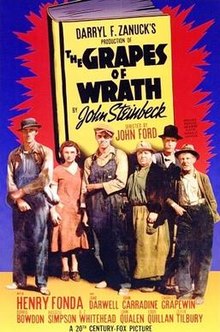
Lisa Reviews An Oscar Nominee: The Grapes of Wrath (dir by John Ford)


(With the Oscars scheduled to be awarded on March 4th, I have decided to review at least one Oscar-nominated film a day.  These films could be nominees or they could be winners.  They could be from this year’s Oscars or they could be a previous year’s nominee!  We’ll see how things play out.  Today, I take a look at the 1940 best picture nominee, The Grapes of Wrath!)

How dark can one mainstream Hollywood film from 1940 possibly be?

Watch The Grapes of Wrath to find out.

Based on the novel by John Steinbeck and directed by John Ford, The Grapes of Wrath tells the story of the Joad family and their efforts to neither get sent to prison nor starve to death during the Great Depression.  When they lose their farm in Oklahoma, they head for California.  Pa Joad (Russell Simpson) has a flyer that says someone is looking for men and women to work as pickers out west.  The 12 members of the Joad Family load all of their possessions into a dilapidated old truck and they hit the road.  It quickly becomes apparent that they’re not the only family basing all of their hopes on the vague promises offered up by that flyer.  No matter how much Pa may claim different, it’s obvious that California is not going to be the promised land and that not all the members of the family are going to survive the trip.

Tom Joad (Henry Fonda) is the oldest of the Joad sons.  He’s just been released from prison and he’s killed in the past.  Having been in prison during the start of the Great Depression, Tom doesn’t realize how bad things truly are until he arrives home and sees someone he grew up with using a tractor to knock down a house.  (It’s just business, of course.  The owners of the house can’t pay their bills so the house gets destroyed.)  The film’s story is largely told through Tom’s eyes and Henry Fonda gives a sympathetic performance, one the gets the audience to empathize with and relate to a character who is a total outsider.

As for the rest of the Joad Family, Ma (Jane Darwell) is the glue who holds them together and who refuses to allow them to surrender to despair.  (And yet even Ma is forced to make some tough choices when the starving children of one work camp ask her to share her family’s meal with them.)  Rosasharan (Dorris Bowdon) is pregnant while Grandpa (Charley Grapewin) is too sickly for the trip but doesn’t have anywhere else to go.  And then there’s Casy (John Carradine), the former preacher turned labor organizer.  Casy is not blood-related but he soon becomes a member of the family.

The Joads have a healthy distrust of the police and other authority figures and that turns out to be a good thing because there aren’t many good cops to be found between Oklahoma and California.  Instead, the police merely serve to protect the rich from the poor.  Whenever the workers talk about forming a union and demanding more than 5 cents per box for their hard work, the police are there to break heads and arrest any troublemakers on trumped up charges.  Whenever a town decides that they don’t want any “Okies” entering the town and “stealing” jobs, the police are there to block the roads.

The Grapes of Wrath provides a portrait of the rough edges of America, the places and the people who were being ignored in 1940 and who are still too often ignored today.  John Ford may not be the first director that comes to mind when you think of “film noir” but that’s exactly what The Grapes of Wrath feels like.  During the night scenes, desperate faces emerge from the darkness while menacing figures lurk in the shadows.  When the sun does rise, the black-and-white images are so harsh that you almost wish the moon would return.  The same western landscape that Ford celebrated in his westerns emerges as a wasteland in The Grapes of Wrath.  The American frontier is full of distrust, anger, greed, and ultimately starvation.  (Reportedly, the film was often shown in the Soviet Union as a portrait of the failure of America and capitalism.  However, it was discovered that Soviet citizens were amazed that, in America, even a family as poor as the Joads could still afford a car.  The Grapes of Wrath was promptly banned after that.)  John Ford is often thought of as being a sentimental director but there’s little beauty or hope to be found in the images of The Grapes of Wrath.  (Just compare the way The Grapes of Wrath treats poverty to the way Ford portrayed it in How Green Was My Valley.)  Instead, the film’s only hint of optimism comes from the unbreakable familial bond that holds the Joads together.

As dark as it may be, the film is nowhere near as pessimistic as the original novel.  The novel ends with a stillborn baby and a stranger starving to death in a barn.  The film doesn’t go quite that far and, in fact, offers up some deus ex machina in the form of a sympathetic government bureaucrat.  (Apparently, authority figures weren’t bad as long as they worked for the federal government.)  That the book is darker than the movie is not surprising.  John Steinbeck was a socialist while John Ford was a Republican with a weakness for FDR.  That said, even though the film does end on a more hopeful note than the novel, you still never quite buy that things are ever going to get better for anyone in the movie.  You want things to get better but, deep down, you know it’s not going to happen.  Tom says that he’s going to fight for a better world and Fonda’s delivers the line with such passion that you want him to succeed even if you know he probably won’t.  Ma Joad says the people will never be defeated and, again, you briefly believe her even if there’s not much evidence to back her up.

Even when viewed today, The Grapes of Wrath is still a powerful film and I can only guess what it must have been like to see the film in 1940, when the Great Depression was still going on and people like the Joads were still making the journey to California.  Not surprisingly, it was nominated for best picture of 1940, though it lost to Alfred Hitchcock’s Rebecca.