Film Review: Speed (dir by Edwin L. Marin)


1936’s Speed takes place in Detroit, at the home of Emery Motors.

When Joan Mitchell (Wendy Barrie) shows up to start her new job in the PR department, one of the first things she sees is a car being driven around a race track at a high speed until eventually it crashes.  Automotive engineer Frank Lawson (Weldon Heybourn) explains that it’s all a part of making sure the car is safe.  At Emery Motors, they crash cars on a daily basis to make sure that both the car and the driver will survive.

Terry Martin (James Stewart), the driver of the crashed car, proceeds to give Joan a tour of the factory.  There’s an obvious attraction between the two of them but Joan also seems to have feelings for Frank.  Terry and Frank are rivals.  Terry may not have Frank’s education but he has instincts and he has common sense.  He and his friend, Gadget Haggerty (Ted Healy), have an instinctive understanding of cars.  They know how to drive them.  They know how to fix them.  They know how to make them go really fast.

In fact, Terry is working on a new carburetor, one that he says will increase the speed of Emery’s cars.  Frank is skeptical but Terry knows that, if he can enter his car into the Indianapolis 500, he’ll be able to prove that he knows what he’s talking about.  Joan comes to believe in Terry and his carburetor.  And, fortunately, Joan has a secret of her own that will be very helpful to Terry’s ambitions.

Speed was not Jimmy Stewart’s first feature role but it was his first starring role.  28 years old when he starred in Speed, Stewart is tall, a little bit gawky, and unbelievably adorable.  From the minute that Terry climbs out of that wrecked car and introduces himself to Joan, Stewart’s a true movie star.  He and Wendy Barrie have a lot of chemistry and are a truly cute couple but Stewart is the one who dominates the film with his straight-forward charisma.  Terry may not be the best educated engineer at Emery Motors but he is determined to prove himself and Stewart does a great job of portraying that determination.

As for the film itself, it’s low-budget and it’s short.  Automotive enthusiasts might enjoy seeing all of the old cars and getting a chance to see what a car race was about in the days when cars themselves were still a relatively new invention.  The film itself starts out as almost a documentary, with Stewart (as Terry) explaining how each car is manufactured on the assembly line.  He points out all the machinery that goes into making the car in an almost-awed tone of voice.  If the information is a bit dry, it doesn’t matter because it’s impossible not to enjoy listening to Jimmy Stewart speak.  In his pre-WWII films, Stewart was the voice of American optimism and that’s certainly the case with Speed.

Speed was not a huge box office success but, in just two years, Stewart would be working with Frank Capra on You Can’t Take It With You, the first Stewart film to be nominated for (and to win) the Oscar for Best Picture of the year.

Lisa Reviews An Oscar Winner: The Life of Emile Zola (dir by William Dieterle)


The Life of Emile Zola, the winner of the 1936 Oscar for Best Picture of the Year, opens with two French artists living in a drafty apartment.

Emile Zola (Paul Muni) is destined to become one of France’s most popular and important writers.  Paul Cezanne (Vladimir Sokoloff) will eventually become one of the most important artists of the post-impressionist movement.  But for now, they’re just two struggling artists who have sworn that they will never sell out their principles.  They are poor but they’re happy.  That changes for Zola after he meets a prostitute named Nana (Erin O’Brien-Moore) and he uses her life story as the inspiration for a novel.  The book is controversial and its frank content scandalizes France.  The public censor comes close to banning it.  But it also becomes a best seller.  It’s the book everyone secretly owns but claims to have never read.

Zola writes several more books, all about the conditions of the working class in France.  Eventually, he becomes what he claimed he would never be, a wealthy man living in a mansion and having little contact with the poor and oppressed.  Cezanne sees Zola one last time, calling him out for having sold his talent for money.  Cezanne explains that, on general principle, he can no longer be Zola’s friend.

Meanwhile, a quiet and rather meek family man named Captain Alfred Dreyfus (Joseph Schildkraut) has been arrested and accused of being a spy for Germany.  There’s little evidence that Dreyfus is a spy.  Indeed, most of the evidence seems to point to a Major Walsin-Esterhazy (Robert Barrat).  But, because Dreyfus is considered to be an outsider, he is convicted in a show trial and exiled to Devil’s Island.

(In real life, it’s generally agreed that Dreyfus was a victim of anti-Semitism.  As the only Jewish member of the army’s General Staff, Dreyfus was viewed with suspicion by his colleagues even before anyone knew that there was a German spy.  The Life of Emile Zola doesn’t specifically state that Dreyfus was a victim of anti-Semitism, with the exception of a brief moment when one of his accusers looks at his personnel file and says, “He’s not one of us,” while pointing at the word “Jew.”  Otherwise, the fact that Dreyfuss was Jewish is never mentioned in the film.  It’s as if the film is going out of its way to avoid offending the very people that the movie is criticizing.)

After speaking to Dreyfus’s wife (played by Gale Sondergaard, who would later become the victim of a show trial herself when she was blacklisted as a suspected communist), Zola decides to take up Dreyfus’s case.  He publishes an open letter — J’Accuse — in which he states that Dreyfus was not given a fair trial and that Dreyfus is innocent of the charges against him.  Zola finds himself in court, accused of libel.  Zola uses his trial to give Dreyfus the hearing that he never received.  While the army boos his every utterance, the people of France rally to his side.

The Life of Emile Zola is an early example of the type of prestige production that today is often referred to as being an “Oscar picture.”  It tells a true story.  As a film that condemns the treatment of Alfred Dreyfus but avoids stating the obvious reason why Dreyfus was targeted in the first place, it’s political without being radical.  And it features a performance from the most acclaimed actor of the era, Paul Muni.  Muni gives a powerful performance as Zola, holding the viewer’s attention even during the lengthy trial scenes that take up most the second half of the film.  That said, the true star of the film is Joseph Schildkraut, who plays Dreyfus as being a kind and trusting soul who finds himself caught up in a Kafkaesque nightmare.  At one point, Dreyfus is given a gun and told that there’s one way that he can avoid being put on trial for treason.  Schildkraut played the scene so well that I wanted to cheer when he refused to surrender.

The Life of Emile Zola is a big and, at times, self-consciously important production.  It was clearly designed to win a bunch of Oscars and it certainly managed to do that.  Compared to some of the other films nominated that year — The Awful Truth, Dead End, A Star is Born, Lost Horizon, Stage Door, In Old Chicago — The Life of Emile Zola can seem a bit stodgy.  However,  the performances of Muni and Schildkraut continue to make the film worth watching.

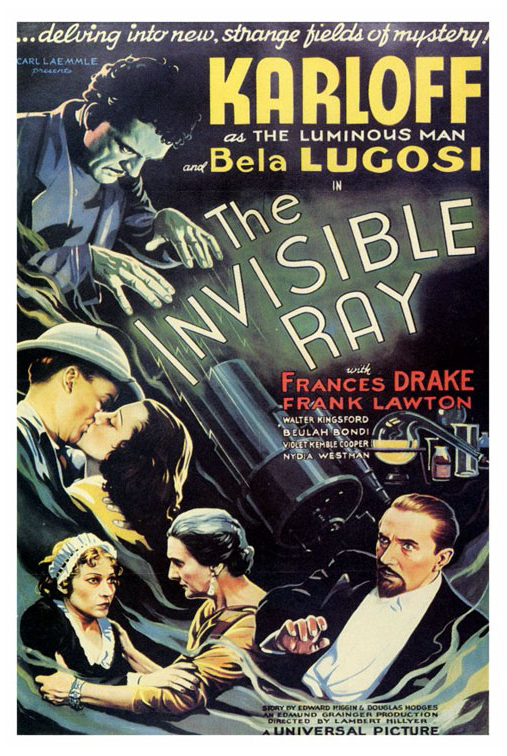
Halloween Havoc!: THE INVISIBLE RAY (Universal 1936)


gary loggins's avatarcracked rear viewer


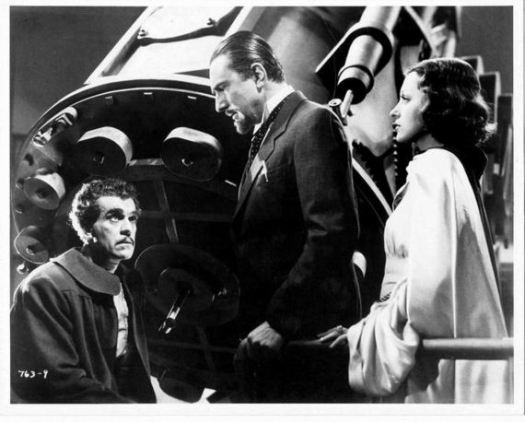
THE INVISIBLE RAY, the third Universal teaming of Boris Karloff and Bela Lugosi , is probably the least discussed of their seven films together. And I don’t quite know why, because I find it an entertaining meld of horror and science fiction that holds my interest for its 80 minute running time. The two stars are well spotlighted, with Bela as one of the good guys (for a change!) and Boris giving a hammy but well crafted performance as a scientist unhinged by his newest discovery.

A curly-haired Karloff stars as Dr. Janos Rukh, awaiting the arrival of a group of his fellow scientists for a demonstration of his Invisible Ray as a storm rages outside. Rukh’s wife Diana and blind Mother Rukh greet them: Sir Francis Stevens and his wife Lady Arabella, French astro-chemist Dr. Felix Benet, and Lady Arabella’s nephew Ronald Drake, who’s along for the ride. Rukh…

View original post 426 more words

Lisa Reviews An Oscar Nominee: Kitty Foyle (dir by Sam Wood)


(With the Oscars scheduled to be awarded on March 4th, I have decided to review at least one Oscar-nominated film a day.  These films could be nominees or they could be winners.  They could be from this year’s Oscars or they could be a previous year’s nominee!  We’ll see how things play out.  Today, I take a look at the 1940 best picture nominee, Kitty Foyle!)

Kitty Foyle opens with a title card informing us that, before the film can tell us the story of Kitty Foyle, it is necessary to remind audiences of how Kitty Foyle — and so many other “white-collar” girls — arrived in their present (which is to say, 1940) situation.

We then get a strange little montage of life at the turn of the century.  A woman meets a man.  The man marries the woman.  They’re a happily married couple.  The man goes to work.  The woman takes care of the house.  The man comes home.  Everything’s perfect.  Then suddenly — oh my God, it’s the suffragettes!  They’re holding rallies!  They’re parading around with signs!  They’re demanding the right to vote!  They’re demanding prohibition!  Suddenly, women are expected to be independent and to have careers…

Which leads us to New York in the 1940s, where a bunch of women in an elevator discuss how difficult it is to find a good husband, especially now that they’re all busy working as salespeople and administrative assistants.  Apparently, this is the price that we all had to pay for the right to vote.  On the one hand, the women who cast their first votes in 1920 elected Warren G. Harding and spared the nation from another four years of Wilsonianism.  On the other hand, it’s now difficult to find a husband.

Fortunately, Kitty Foyle (Ginger Rogers) doesn’t have that problem.  She has a wonderful suitor, a man who has just asked her to marry him.  His name is Dr. Mark Eisen (James Craig).  He may not have a lot of money but he’s handsome, he’s considerate, and he spends all of his time providing medical care to the poor and indigent.  When Mark asks her to marry him, he asks her if she’s sure that she’s over that man from Philadelphia.  Kitty says that she is.

Of course, as soon as Kitty returns home, that man from Philadelphia is waiting for her.  Wyn Stafford VI (Dennis Morgan) is handsome, rich, and totally in love with Kitty.  Of course, he’s also married to his second wife.  (The identity of his first wife isn’t revealed until late in the film but you’ll be able to guess who she is.)  Wyn is in love with Kitty and he wants her to run away to South America with him.  Kitty says yes.

However, as Kitty is packing to leave, her reflection in the mirror starts talking to her.  It turns out to be a pretty judgmental mirror.  The rest of the film is an extended flashback, showing us how Kitty was raised by her single father (Ernest Cossart), how she first moved to New York, and how she met and fell in love with both Wyn and Mark.  Will she run off and live in wealthy sin with Wyn?  Or will she stay in New York and marry honest, hard-working Mark?

The main problem with Kitty Foyle is that there really isn’t much suspense as far as the film’s central dilemma is concerned.   Mark is a living saint who heals children.  Wyn is a heel who wants to abandon his wife and son so that he and Kitty can live in South America.  About the only thing that Wyn has going for him is that he’s got a better sense of humor than Mark but, in 1940, that wasn’t necessarily considered to be a good thing.  There’s really no question about who Kitty is going to pick and, in fact, the answer is so obvious that you kind of lose respect for Kitty when it takes her so long to make up her mind.  It’s like being told you could either marry a Nobel Peace Prize winner or someone who embezzles from a charity and replying, “Let me think about it…”

Of course, the main focus of Kitty Foyle is less on the love triangle and more on Ginger Rogers’s performance as Kitty.  This was one of Ginger’s first films after she stopped making films with Fred Astaire and it’s obvious that the film’s main theme was that Ginger Rogers could do more than just dance with Fred.  In Kitty Foyle, she gets to make jokes.  She gets to cry.  She gets to fall in love.  She gets a huge dramatic scene in which she mourns the loss of a child.  She does it all and yes, she does it very well.  Still, Kitty Foyle is never as much fun as the movies that she made with Fred.

Ginger Rogers won the Oscar for Best Actress for her performance in Kitty Foyle, beating out Katharine Hepburn, Joan Fontaine, Bette Davis, and Martha Scott.  Kitty Foyle was nominated for Best Picture but lost to Hitchcock’s Rebecca.

Film Review: The Loves of Edgar Allan Poe (dir by Harry Lachman)


I have to admit that the 1942 film, The Loves of Edgar Allan Poe, turned out to be far different from what I was expecting.

Just based on the title, I was expecting it would be a highly fictionalized, borderline silly film about Edgar Allan Poe defeating his romantic rivals and winning the hand of the woman he loved while still finding time to write The Raven.  I figured that there would be at least a few gentlemanly fisticuffs, with Poe portrayed as a combination of Rhett Butler and Cary Grant.  Looking at the title, it was easy for me to imagine the film closing with Poe kissing his future wife and then looking straight at the camera.  “Quoth the Raven!” he would say and wink while romantic music swelled in the background…

But no.  The Loves of Edgar Allan Poe is actually a very conventional biopic.  With a running time of only 67 minutes, the movie often feels rather rushed but it still manages to include most of the better known details of Edgar Allan Poe’s short but eventful life.  (An ever-present narrator is always ready to fill us in on every thing that happens off-screen.)  The film doesn’t spend much time on what initially inspired Poe’s macabre imagination.  There’s a scene of Poe, as a child, standing on a desolate hill and looking at a raven perched in a dead tree.  With the exception of an extended section that deals with Annabel Lee, that’s about as deep as the movie is willing to get as far as Poe’s art is concerned.

When Poe grows up, he’s played by actor Sheppard Strudwick, who has a good mustache but never exactly comes across as being the type of tortured genius who would eventually end up both revolutionizing literature and drinking himself to death.  The majority of the film deals with Poe’s advocacy for copyright reform, which is an important issue but not exactly the most cinematic of concerns.  Poe survives college.  Poe tries to sell The Raven for $25.  Eventually, Poe marries Virginia Clemm (Linda Darnell) and her subsequent sickness and death leads to not only Poe’s greatest work but also his own tragic end.

Along the way, Poe meets both Thomas Jefferson and Charles Dickens.  Jefferson shows up long enough to tell a young Poe that he’s a good writer and that he needs to stop gambling.  Dickens meets Poe and encourages him to continue to advocate for better copyright laws.

It is known that Poe and Dickens actually did meet but did Poe also meet Thomas Jefferson?  Legend says that he did but no one knows for sure.   Here’s what we do know:

Poe attended the University of Virginia in 1826.  The University’s founder, former President Thomas Jefferson, was still alive in 1826 and would often invite promising students to Monticello.  Whether Jefferson was still doing that when Poe enrolled at the University of Virginia is questionable.  Jefferson died five months after Poe started his studies.

As for Dickens, Charles Dickens and Edgar Allan Poe admired each other’s writing and they met in Philadelphia during Dickens’s 1842 tour of North America.  No record has been kept of what they discussed, though some think that Dickens told Poe about his pet raven and perhaps inspired Poe’s best-remembered poem.  In the movie, they discuss copyright laws, which is nowhere near as much fun.

(When it comes to Poe’s meetings with both Jefferson and Dickens, it is perhaps best to remember the lesson of The Man Who Shot Liberty Valance and print the legend.)

The Loves of Edgar Allan Poe is a very short film and an obviously low-budget one as well.  When the presence of that somewhat pedantic narrator, The Loves of Edgar Allan Poe feels more like an educational special than a real movie.  It’s an okay introduction to Poe’s life but, ultimately, the best way to get to know Edgar Allan Poe is to sit down and start reading.

Cleaning Out The DVR, Again #12: Naughty Marietta (dir by W.S. Van Dyke)


b70-4632

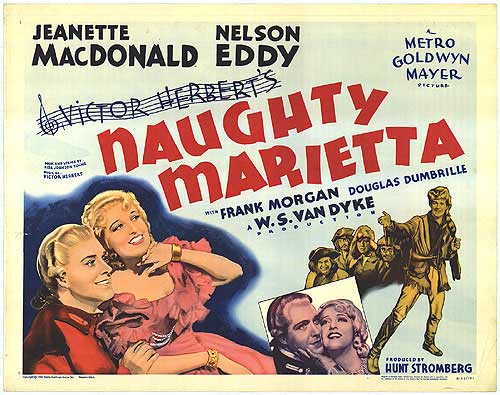
Continuing the process of cleaning out my DVR, I watched the 1935 film, Naughty Marietta.  I recorded Naughty Marietta off of TCM on April 3rd.  Like many of the films that I record off of TCM, Naughty Marietta was nominated for Best Picture.  In fact, if not for that Oscar nomination long ago, Naughty Marietta would probably be totally forgotten.

Instead, it’s only partially forgotten.

Based on an operetta and containing at least one song that I’ve sung while drunk (that song, incidentally, would be Ah!  Sweet Mystery of Life), Naughty Marietta tells the story of Princess Marie (Jeanette MacDonald).  A Spanish princess, Marie is engaged (against her will) to the elderly Don Carlos (Walter Kingsford).  In order to escape a life of forced marriage, Marie pretends to be a servant girl named Marietta and stows away on a boat to New Orleans.  The boat is carrying women to the new world so that they marry French colonists.  The other women on board are shocked when Marietta announces that she plans to never marry.

However, they are even more shocked when the boat is taken over by pirates!  The pirates kill the crew and take the women prisoner.  The pirates take the women to Louisiana where, fortunately, a group of mercenaries led by Captain Richard Warrington (Nelson Eddy) show up and rescue the women.

Marie negotiates for Warrington to take the women to New Orleans and it’s obvious from the start that Marie and Warrington are attracted to each other.  However, Warrington claims that, much like Marie, he plans to never marry!  Oh my God, could it be that these two are meant to get together!?

It has all the potential for being a good musical and Jeannette MacDonald gives a good performance as Marie.  But, unfortunately, Nelson Eddy is a lot less charismatic in the role of Warrington.  Even his singing voice is a bit blah.  Oddly, Naughty Marietta was one of many romantic musicals that Jeanette MacDonald and Nelson Eddy made together.  The reason I use the term “odd,” is because — judging from this film — they didn’t appear to have much onscreen chemistry.  Whereas MacDonald is personable and relatable, Nelson Eddy seems to hold the audience at a distance.  Watching a film like this, you can’t help but regret that Jeanette MacDonald didn’t have someone like Fred Astaire for a co-star.

As for Naughty Marietta‘s best picture nomination — well, it was a big production and it was also an adaptation of a popular operetta.  At a time when 10 films were nominated every year and the studios pretty much controlled which one of their films was nominated for best picture, Naughty Marietta got a nomination.  However, the Oscar went to Mutiny on the Bounty.

The Fabulous Forties #16: Dr. Kildare’s Strange Case (dir by Harold S. Bucquet)


Dr._Kildare's_Strange_Case_FilmPoster

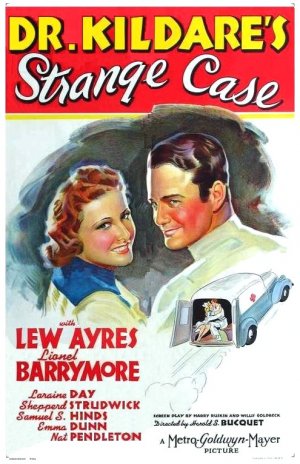
The 16th film in Mill Creek’s Fabulous Forties box set was 1940’s Dr. Kildare’s Strange Case.  It’s about a doctor who investigates a medical case and wow, is it ever a strange case.

Apparently, there was a whole series of Dr. Kildare films that were released in the 30s and 40s.  I guess the films were the cinematic equivalent of a TV show like Grey’s Anatomy or ER or Children’s Hospital or… well, every medical show that’s ever shown up on TV since the beginning of time.  Dr. James Kildare (Lew Ayres) is a passionate young doctor who may break the rules but he gets results!  His mentor is Dr. Gillipsie.  Gillipsie is played by Lionel Barrymore and since the character is cranky and confined to a wheelchair, it was impossible for me to watch him without thinking about Mr. Potter from It’s A Wonderful Life.  Whenever Kildare went to him for advise, I kept expecting Gillipsie to glare at him and say, “You once called me a warped old man…”

Anyway, Dr. Kildare works in a hospital and, when he’s not silently judging everyone else that he works with, he’s busy silently judging the wealthy Dr. Lane (Sheppard Strudwick), a brain surgeon whose patients keep dying.  Kildare and Lane are also both in love with the same nurse, Mary Lamont (Laraine Day).  Mary wants to marry Kildare but Kildare would rather be poor and single than compromise his medical principles.  Lane, on the other hand, sends her a box full of silk stockings.  Plus, he’s rich!

Seriously, how is this even a competition?  Forget Kildare and marry Lane!

Except, as I mentioned earlier, all of Lane’s patients keep dying.  Is Lane incompetent or, as Kildare suggests, is it possible that brain surgery is just really, really hard?  I imagine it was even harder in 1940, when this movie was being made.  While Kildare and Lane are operating on brains, Dr. Gillipsie is still using leeches to suck sickness out of the poorer patients.

(You don’t actually see it happen in the movie but Gillipsie comes across as being a leech man.)

Anyway, eventually, Kildare has to cure a schizophrenic and it turns out that he can do this by putting the man into an insulin coma.  As is explained in great detail, forcibly putting a patient in a coma will cause that patient’s mind to go back to a reset point.  It’s kind of like how Windows sets up a restore point before doing a major update.

And that therapy sounds so crazy that you just know it had to be based in an actual practice.  I checked with Wikipedia and I was not shocked to discover that apparently Insulin Shock Therapy used to be a thing!

Anyway, Kildare’s gets into a lot of trouble for putting his patient into a coma and attempting to erase a huge part of his mind.  Will Kildare’s results vindicate his methods or will Gillipsie have to use leeches to suck the crazy out of the patient’s brain?

Watch the film to find out!  Or don’t.  Dr. Kildare’s Strange Case was directed by Harold S. Bucquet, who did a pretty good job with The Adventures of Tartu.  His direction here is flat and uninspired, which only serves to make this entire film feel like an old TV show.  I’m tempted to recommend the movie just because of the scene where it’s explained that insulin shock therapy causes patients to devolve so that they can re-evolve but otherwise, Dr. Kildare’s Strange Case is forgettable.

If you want to see it, you can watch it below!

http://www.youtube.com/watch?v=8UPFyrlNiGM

Or you can just watch this classic episode of Children’s Hospital!

http://www.youtube.com/watch?v=dpBjqgVaEbk

Cleaning Out The DVR #34: The Story of Louis Pasteur (dir by William Dieterle)


(For those following at home, Lisa is attempting to clean out her DVR by watching and reviewing 38 films by the end of today!!!!!  Will she make it?  Keep following the site to find out!)

The_Story_of_Louis_Pasteur_poster

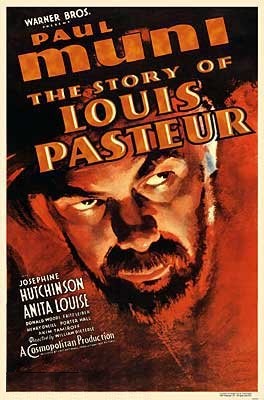
OH MY GOD, LOUIS PASTEUR WAS THE DEVIL!

Okay, maybe not but that’s certainly the impression that you might get from looking at the one sheet for the 1936 film, The Story of Louis Pasteur.  Seriously, Louis looks quite sinister!

As the movie starts, that’s certainly the view of the 19th century French medical establishment.  A doctor has been murdered by a grieving husband and it’s believed that the murder was inspired by one of Pasteur’s incendiary flyers.  What does the flyer demand?  That doctors should wash their hands and sterilize their instruments before operating.

That’s right!  Washing your hands before plunging them into a human body was once considered to be a controversial notion.  Pasteur is put on trial, accused of inciting violence with his quackery.  Even though Pasteur is acquitted, he finds himself a pariah.  The autocratic and close-minded Dr. Charbonnet (Fritz Leiber) declares Pasteur to be guilty of great quackery and even the ducks are offended.  That’s how hated Pasteur has become.

But, of course, we the audience know that Pasteur is not a quack.  Not only do we know that he is responsible for discovering the process of pasteurization but he’s also apparently important enough to have his own 1930s Warner Bros. biopic.  And he’s played by Paul Muni, who made a career out of playing great men in 1930s biopics.

The film follows Pasteur as he discovers cures for anthrax and rabies.  Along the way, he yells at a lot of people and he gives a lot of speeches.  This film might as well have been called The Paul Muni Show and … well, his performance is okay.  It’s not great.  If you’ve seen the very first version of Scarface, you know that Paul Muni was capable of giving a far better performance than he gives here.  But then again, as written, all Louis does is bellow against everyone who disagrees with him.  (And cure rabies, we shouldn’t overlook that.)

The Story of Louis Pasteur is one of those old-fashioned biopics that feels a bit creaky and stiff today.  As I watched it, I kept thinking that it felt like something you might across on PBS at three in the morning.  However, 1936 audiences disagreed with me.  The Story of Louis Pasteur did quite well at the box office and was nominated for best picture, though it lost to another biopic, The Great Ziegfeld.

Cleaning Out The DVR #1: Captains Courageous (dir by Victor Fleming)


Captains_Courageous_poster

For the last few days, I’ve been desperately trying to clean out my DVR.  Ever since this year began, I have been obsessively recording movies and now, I suddenly find myself with just a few hours of space left!  Now, I know that the simple solution would be to just start erasing stuff but that’s just not the way I do things.  I recorded that stuff so you better believe I’m going to watch and review every single minute of it!

Last night, I did a quick count and discovered that I have 38 movies to watch before I can officially declare the DVR to have been “cleaned out.”  While that may sound like a lot, it’s not if you consider that — by watching and reviewing 4 movies a day — I can have the whole job done by the end of the next week!  That’s my plan and my challenge to myself.  Can I watch and review 38 movies in 10 days?

Let’s find out!

So, I started things out by watching the 1937 film, Captains Courageous.  Captains Courageous was aired on TCM as a part of their 31 Days of Oscar.  Not only was Captains Courageous nominated for best picture but it won Spencer Tracy his first Oscar.  Tracy was one of the quintessential American actors so it’s interesting to note that he won his first Oscar for playing a Portuguese fisherman who speaks in exaggeratedly broken English.

Spencer Tracy may have won the Oscar for Best Actor but his role is really a supporting one.  Instead, Captains Courageous is about an extremely spoiled, obnoxious, and annoying 15 year-old named Harvey Cheyne (Freddie Bartholomew).  From the minute that Harvey first appears on screen, it’s difficult to like him.  The son of a rich businessman (Melvyn Douglas), Harvey is hated by everyone.  His family’s butler rolls his eyes whenever Harvey calls for him.  His classmates (and, of course, Harvey attends a snooty private school) want nothing to do with him.  When his father takes him on a trans-Atlantic cruise, even the sailors seem like they want to toss him overboard.

However, before they get a chance to give him one quick shove over the railing, Harvey does their job for them.  He falls overboard and he nearly drowns before being rescued by a fisherman named Manuel (Spencer Tracy).  Manuel takes him back to the fishing schooner, where that ship’s captain (Lionel Barrymore) refuses to believe that Harvey is rich.  Since the rest of the crew quickly decides that they dislike Harvey as much as everyone else does, the captain saves Harvey from being thrown back overboard by “hiring” him as a fisherman.  And, of course, the captain makes Manuel responsible for him.

Though initially hostile, Harvey and Manuel slowly start to bond.  Harvey learns about the importance of hard work and starts to grow up.  And, eventually, it all leads to tragedy.  That’s just how things work in the movies.

As you can probably guess from the plot description above, there’s not a subtle moment to be found in Captains Courageous but, as is so often the case with 1930s Hollywood, that’s actually what makes the film appealing.  Captains Courageous wears its sentiment on its sleeve and it makes for an interesting contrast to the more cynical films of today.  While it takes a while to get used to seeing Spencer Tracy giving such a theatrical performance, he does eventually win you over.  Freddie Bartholomew is vulnerable enough to you can forgive his character for being so obnoxious.  Meanwhile, Lionel Barrymore and Mevlyn Douglas are well-cast in their supporting roles and, if you keep an eye open, you’ll see everyone from John Carradine to a young Mickey Rooney working on the schooner.  Ultimately, Captains Courageous is a well-made and likable coming-of-age film that still holds up today.