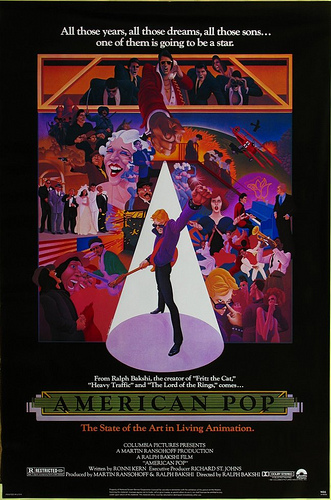
Film Review: American Pop (1981, directed by Ralph Bakshi)


American PopLong before South Park, The Simpsons, and Pixar, there was Ralph Bakshi.  At a time when animation was considered to only be good for children, Bakshi shocked audiences and critics with animated films that dealt with mature themes and were definitely meant for adults.  His first two films, Fritz the Cat (1972) and Heavy Traffic (1973), was the also the first two animated films to receive an X-rating.  Bakshi satirized racism in the controversial Coonskin (1975) and Bakshi’s adaptation of The Lord Of Rings (1978) beat Peter Jackson’s by 23 years.  It was after the critical and commercial disappointment of the heavily flawed but interesting Lord of the Rings that Bakshi decided it was time to make a film that would be more personal to him.  The end result was American Pop.

American Pop tells the story of four generations of a family of Jewish immigrants and how music affects their lives.  In typical Bakshi fasion, this animated film deals with issues of violence, sexuality, drug abuse, and poverty.  American Pop may be animated but it is definitely a film meant for adults.

In the 1890s, Zalmie (Jeffrey Lippa) and his mother escape from Russia after Zalmie’s father, a rabbi, is killed by the Cossacks.  Zalmie grows up in New York and after his mother is killed in the Triangle Shirtwaist Factory fire, he is raised by a vaudeville comedian named Louie (Jerry Holland).  Zalmie wants to be a singer but is shot in the throat during World War I.  His voice ruined, Zalmie marries a stripper named Bella (Lisa Jane Persky) and manages her career.  His partnership with the mobster Nicky Palumbo (Ben Frommer) leads to Bella dying and Zalmie going to prison.

Zalmie’s son, Benny (Richard Singer), is a jazz pianist who, as a favor to his father, marries Nicky’s daughter.  Benny has a son named Tony and tries to pursue his career without using his father’s influence.  Then World War II breaks out.

Benny enlists in the army, seeking redemption from the crimes of his father and father-in-law.  Serving in Europe, he misses his piano and, when he finds one in a bombed-out house in Nazi Germany, he plays a few bars of As Time Goes By.  When a Nazi walks in on Benny, Benny plays Lili Marleen.  For a few seconds, Benny and the Nazi share the common bond of music.  “Danke,” the Nazi says before shooting Benny dead.

Growing up without his father, Tony (Ron Thompson) becomes a beatnik and eventually runs away from home.  He ends up in Kansas, where he has a one-night stand with a waitress and becomes a songwriter for Frankie Hart (Marya Small), a stand in for Janis Joplin.  Both Tony and Frankie start using heroin and Frankie dies of an overdose right before she is supposed to open for Jimi Hendrix.  Abandoned by Frankie’s band, Tony ends up as an addict and dealer in New York.  Accompanying him is his son, Pete, the result of his hookup with the waitress.

After being abandoned by his father, Pete (also played by Ron Thompson), follows in his footsteps and becomes a successful drug dealer.  He is dealing cocaine to all of the big rock bands but, after discovering punk rock, he realizes that he wants something more out of his life.

After announcing that he will no longer sell anyone cocaine unless he is given a chance to record a demo, Pete is given a band and a recording studio.  With the drug-craving record company execs watching, this tough and cocky punk grabs the microphone and sings…

…BOB SEGER’S NIGHT MOVES!?

The use of Night Moves, which is one of the least punk songs ever written, is one of the few false notes in American Pop.  Otherwise, this is one of Ralph Bakshi’s best films.  The majority of the film’s animation was done through rotoscoping, a technique in which animation is traced over live action footage.  (For the gang war scenes, scenes from The Public Enemy were rotoscoped, as was footage of the Nicholas Brothers used in the Sing Sing Sing With A Swing montage.)  Seen today, the technique is crude but effective at showing the contrast between the fantasy of music and the grim reality of life.  Though it has its flaws (*cough* Night Moves *cough*), American Pop is an engaging look at the history and development of American music.

American_Pop

Horror on TV: Baywatch Nights 2.14 “Nights to Dragon One”


Oh my God, y’all are going to love this.

In this episode of Baywatch Nights, David Hasselhoff and Angie Harmon are hired to track down a missing man and his daughter.  Their search leads to them becoming literally trapped inside a virtual reality where they either have to defeat the crazed Game Master (Vincent Schiavelli) or die!  There’s even a scene where Angie Harmon has to pick up and roll a giant die!  Taking full advantage of the inherent ludicrousness of David Hasselhoff’s screen persona, this is an episode that has to be seen to be believed.

So, watch below and believe.

Embracing the Melodrama Part II #85: Ghost (dir by Jerry Zucker)


Ghost_(1990_movie_poster)Along with it being a part of my series of melodramatic film reviews, there are actually two reasons why I recently watched Ghost.

First off, this 1990 film was nominated for best picture and it’s long been my goal to watch and review every single film ever nominated for best picture.

Secondly, my Aunt Kate absolutely loves this movie.  Ever since she first found out that I obsessively love movies, she has recommended that I watch this movie.  And she hasn’t been alone.  A lot of people both in and outside of my family have recommended this film to me.  And, since I tend to be a bit of a contrarian know-it-all, I originally assumed that any film loved by that many people had to be terrible.  However, because I love mi tia, I decided to watch Ghost.

I have to admit that I started to laugh when I saw Demi Moore sitting at her pottery wheel because I’ve seen that scene parodied in so many different TV shows and movies.  As soon as a shirtless Patrick Swayze sat down behind her and joined his hands to hers to help shape a ceramic phallic symbol, I started to giggle.  As Unchained Melody played in the background, I wanted to be snarky.  But then I realized something.  If you can manage watch the scene without comparing it to all the parody versions, it actually works.  Patrick Swayze looked good and he and Demi Moore had the type of amazing chemistry that more than made up for the fact that neither one of them was a very good actor.  (That said, Patrick was very good at projecting decency and Demi was very good at crying and that’s really all that Ghost required.)  And, if the scene has proven easy to parody, that doesn’t change the fact that it’s a very sincere scene.  It’s so sincere that it’s even willing to risk coming across as being silly.

Of course, the entire film isn’t just Demi, Patrick, and a pottery wheel.  There’s also Whoopi Goldberg as a fake medium-turned-real-medium and Tony Goldwyn as the best friend who turns out to be a sleazy villain.  And, of course, there’s the cartoonish demons who pop up every once in a while so that they can literally drag the recently deceased down to Hell.

Sam Wheat (Patrick Swayze) is the world’s most unlikely New York City-based banker.  He owns a beautiful apartment with his girlfriend Molly (Demi Moore) but he has commitment issues.  He can’t bring himself to say that he loves Molly.  Instead, he just says, “Ditto.”  And, from the minute he first utters those words, you know that his habit of saying “Ditto,” is going to be an important plot point.  Anton Chekhov told us that any gun introduced during the first chapter must be fired by the third chapter.  Ghost tells us that any “Ditto” uttered during the first 10 minutes must be repeated by the end of the first hour.

Sam’s best friend and co-worker is Carl (Tony Goldwyn).  At the start of the film, Sam and Carl have a sweet bromance going and some of the best scenes are just the two of them acting like guys.  (There’s a fun little scene where they freak out a group of strangers on an elevator.)  Goldwyn is so likable as Carl that it’s actually genuinely upsetting to discover that he’s arranged for Sam to be murdered.  (Why?  It all involved a lot of financial stuff that basically went right over my head.  Greed is not only the root of all evil but it leads to narrative confusion as well.)  When Sam dies, he comes back as a ghost but nobody can see him but his fellow ghosts.  Vincent Schiavelli has a great cameo as a very angry subway ghost who teaches Sam how “life” works when you’re dead.

(Of course, Schiavelli isn’t on screen for too long because he’s almost too angry for the world of Ghost.)

Eventually Sam discovers that only one living person can communicate with him.  Oda Mae Brown (Whoopi Goldberg) is a fake medium who is just as shocked as anyone to discover that she can speak with the dead.  Whoopi won an Oscar for her performance here and she’s certainly does bring some needed humor and life to Ghost.  With Swayze, Moore, and Goldwyn all giving extremely and sometimes overly dramatic performances, you’re happy to have Whoopi there.

Ghost is designed to appeal to your emotions and it succeeds in doing just that.  If you look at the film logically, you’re missing the point.  In many ways, the film is undeniably silly but I still got some tears in my eyes when I heard that “Ditto.”


Back to School #40: Better Off Dead (dir by Savage Steve Holland)


Better-Off-Dead

There’s something really sad about knowing that John Cusack does not like the 1985 teen comedy, Better Off Dead, despite the fact that he himself starred in the film.

Just how much he dislikes the film depends on who you talk to.  I read an interview with the film’s director — the wonderfully named Savage Steve Holland — in which he said that Cusack approached him after a screening of the film and told him that he totally hated the film and would “never trust” Holland again.  (What’s truly sad is that Holland also said that this encounter caused him to momentarily lose all interesting in film making.)  However, a few years ago, Cusack said, while answering questions on Reddit, that he didn’t hate Better Off Dead, he just felt that it could be better and that he was glad that other people still like it.  In another interview, Cusack said that the “absurdist humor” of Better Off Dead just wasn’t his thing.

John, I understand that you’re a serious actor and I’ve always had a lot of respect for the fact that you’re an outspoken liberal who is still intellectually honest enough to hold Obama up to the same standard to which you previously held Bush.  But honestly, John, maybe you should loosen up just a little.  Not all of your movies have to be The Butler!  There’s nothing wrong with enjoying yourself onscreen.  And there’s nothing wrong with entertaining an audience and leaving them happy.  Better Off Dead may be one of more lightweight films that I’m reviewing for this Back to School series but it’s a lot of fun!  It makes people smile.  And you know what?  A lot of those smiling people are going to be more willing to see you in a film like The Butler because they’ve also seen you in films like Better Off Dead.

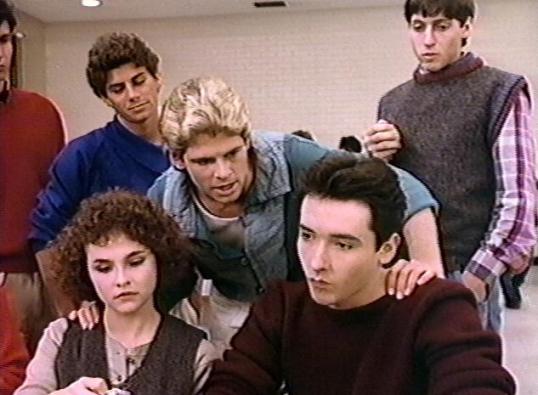
Add to that, you give a pretty good performance in Better Off Dead.  In fact, you provide the film with a much-needed center.  A lot of the comedy in Better Off Dead may be absurd but John, your performance is so likable and so grounded that you keep the film from getting too weird.  You do such a good job as Lane Myer and are so convincing as a well-meaning but dorky high school student who is trying to win back his ex-girlfriend (Amanda Wyss) by skiing down a mountain that it allows everyone else to be as weird as the film will allow.  Without your excellent performance, John, the film would be a total mess.

BOD

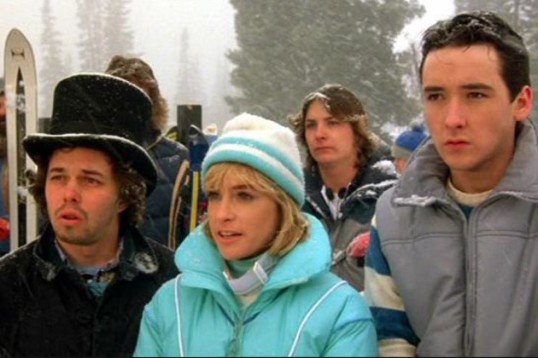
Better Off Dead is essentially a collection of skits.  There’s a plot but the plot is really only there as an excuse for the nonstop jokes.  For instance, there’s Lane’s best friend, Charles (Curtis Armstrong, essentially playing the same character he played in Risky Business) who spends the entire film looking for things to snort and who, when standing atop of snowy mountain, says, “This is pure snow!  Do you have any idea what the street value of this mountain is!?”

And then there’s Monique (Diane Franklin), the foreign exchange student who lives next door to Lane and who pretends that she can’t speak English because she’s trying to avoid being set up with creepy Ricky Smith (Daniel Schneider).

There’s Lane’s mother (Kim Darby), who cooks some of the strangest looking meals ever seen in an American film.  There’s also Lane’s younger brother, who never speaks but who knows how to build a laser gun.  Even Lane’s father (David Ogden Stiers). who seems relatively normal, still manages to destroy the garage door.

There’s the fact that Lane’s romantic rival is named Roy Stalin (Aaron Dozier).  Is that not just the perfect name for a villain?

There’s my favorite scene in the entire film, where a geometry teacher (Vincent Schiavelli) explains a complicated problem to his class and the class responds by cheering him along.  “Who wants to come up here and solve the problem?” the teacher asks.  The entire class raises their hands and goes, “Me!”

There’s quotable and memorable lines like: “I’ve been going to this high school for seven and a half years. I’m no dummy,” ” Now that’s a real shame when folks be throwin’ away a perfectly good white boy like that,” and “Gee, I’m really sorry your mom blow up, Ricky.”

And, of course, there’s that paperboy who wants his two dollars…

Seriously, John, Better Off Dead might not be your favorite movie but it’s really not that bad!

Want to see just how not bad Better Off Dead really is?  Watch it below!

http://www.youtube.com/watch?v=a3Q8oM_AnK8

Back to School #27: Fast Times At Ridgemont High (dir by Amy Heckerling)


Mike Damone

Mike Damone

Mike Damone, you little prick.

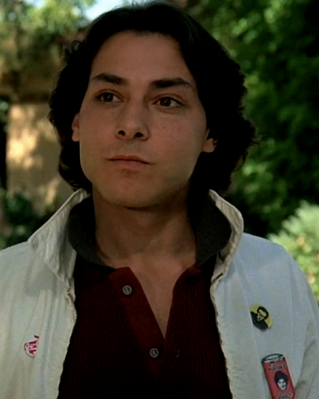
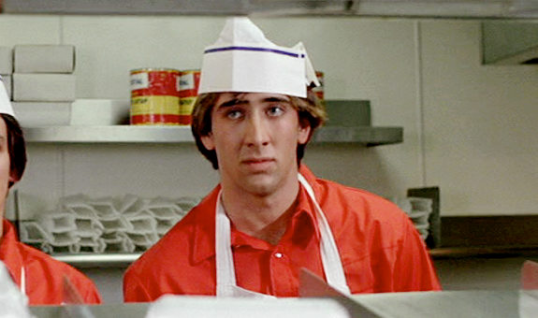
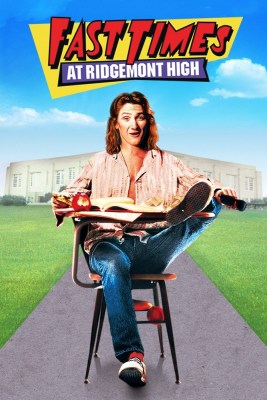
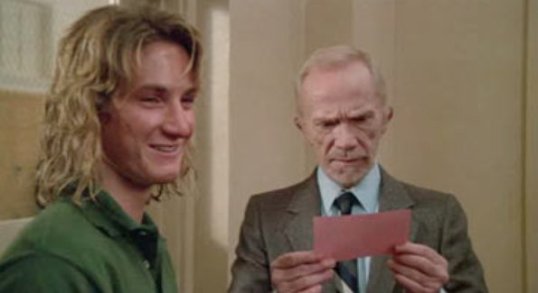
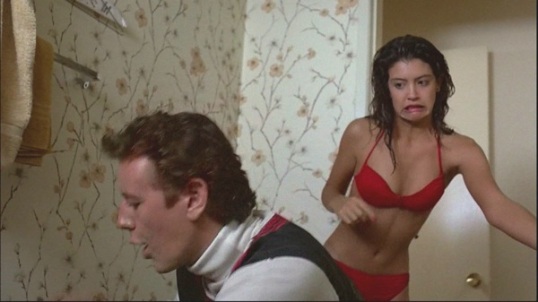
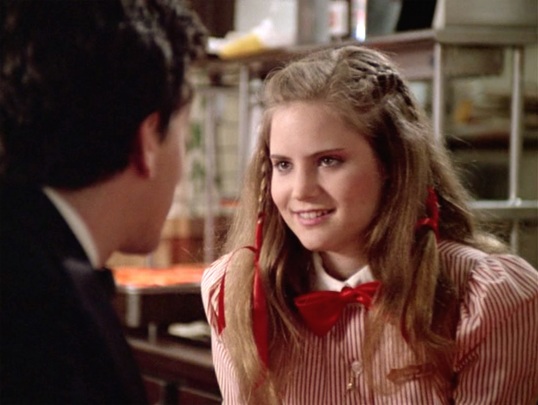
I’ve watched the 1982 high school dramedy Fast Times At Ridgemont High a handful of times.  I’ve reached the point where, every time I watch it, I know exactly what’s going to happen.  I know when stoner Jeff Spicoli (Sean Penn) is going to order pizza.  I know that Charles Jefferson (Forest Whitaker) is going to go crazy during the big game against Lincoln High.  I know that when Stacy (Jennifer Jason Leigh) kisses the sweet but shy Mark Ratner (Brian Backer), he’s going to end up panicking and scrambling for an excuse to go home.  I know that Brad (Judge Reinhold) is going to get caught masturbating.  I even know when Anthony Edwards, Nicolas Cage, and Eric Stoltz are all going to appear in early performances.

Nicolas Cage, 30 years before he would agree to star in a remake of Left Behind.

Nicolas Cage, 30 years before he would agree to star in a remake of Left Behind.

In other words, I know exactly what’s going to happen.

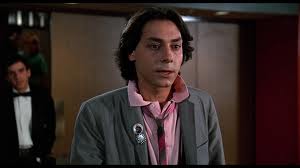
But, Mike Damone (played, very well, by Robert Romanus, who is only an actor and shouldn’t be held responsible for the actions of a fictional character) — every time, I find myself hoping you’ll do the right thing and every time, you let me down.

Oh sure.  I know that you tried to raise the money to help pay for Stacy’s abortion.  I saw the scene of you on the phone in your bedroom, begging people to finally pay for the tickets that you’d sold them.  I know that you tried but when you couldn’t get the money, where were you?  When Stacy had to ask her older brother, Brad, for a ride to the clinic, where were you?  After Stacy left the clinic, she found Brad waiting for her.  Brad agreed not to ask Stacy who had gotten her pregnant.  He agreed not to tell their parents.  Brad was there for his sister.  Where were you, Mike Damone?

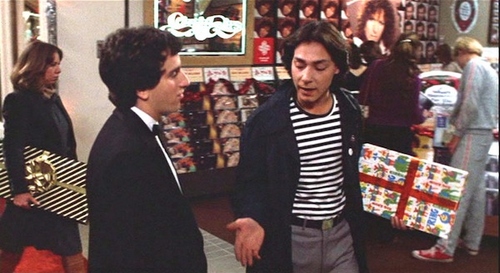
What really upsets me is that, up until you abandoned Stacy, you were one of the more likable characters in Fast Times At Ridgemont High.  I mean, sure — you didn’t get to deliver any classic lines like Spicoli did.  And you weren’t adorably shy like Mark.  But, Mike Damone — I believed in you!  We all believed in you!  (Imagine me doing my best Tyra Banks imitation here.)  You were a cocky guy who spent all of your time selling concert tickets at the mall but you know what?  We all assumed that, underneath all of the attitude, there secretly lurked a good guy.  I mean, we could tell that you sincerely cared about your friend Mark and, because we’re all fools apparently, we even thought that maybe Stacy could bring out the real you.  When Stacy sat there writing “Mrs. Stacy Damone” on her test paper in history class, we understood.  Because, after all, we’ve all had a Mike Damone in our life.

Rat and Mike

Rat and Mike

But then, what happened?  Well, first, you had sex with Stacy despite the fact that you knew Mark liked her.  Of course, for all your bluster and talk, it turned out that sex with Mike Damone amounted to 2 minutes of squirming followed by that classic line, “I think I came.”  And then you left, saying those words that every girl dreams of hearing from someone she’s just been with: “I’ll see you around.”  (Or maybe you said, “I’ll give you a call,” or “I’ve got to go now.”  Either way, it was a pretty shitty thing to say, Damone.)

fast-times-at-ridgemont-high.19729

As you may have guessed, Fast Times At Ridgemont High is not your typical teen comedy.  In fact, over three decades since it was first released, it remains one of the best and most perceptive films about teenagers ever made.  Over on the A.V. Club, Keith Phipps refers to Fast Times as being “a Trojan horse of a teen comedy that balanced lowbrow gags with subtle humor, genuine insight .. and pathos,” and that’s such a perfect description that I’m not at all ashamed to repeat it word-for-word here.

Don’t get me wrong.  Though Fast Times At Ridgemont High has a lot more drama than you would expect from a film with the words “Fast Times” in the title, it’s also an undeniably funny film.  It’s just that, unlike so many other teen comedies, the comedy comes from a very real place.  This is one of those rare films where the characters are funnier than the situations that they find themselves in.  You laugh because you relate to the characters.  (Admitedly, you might also laugh at what some of them are wearing.  Mike Damone’s keyboard print scarf comes to mind…)

Hey I Know That Guy

Spicoli and Hand

Like many classic teen films — American Graffiti, Fame and Dazed and Confused, to cite just three obvious examples — Fast Times At Ridgemont High is an ensemble piece that follows several different students as they survive a year at Ridgemont High.  Sean Penn’s Jeff Spicoli is the character that everyone always mentions as a favorite and indeed, he does get the best lines and his battles with Mr. Hand (Ray Waltson) are definitely a highlight of the film.  People also always mention Linda (Pheobe Cates), who has a boyfriend in college and who walks in on Brad while he’s fantasizing about her.  And yes, Linda is a memorable character and not just because she bares her breasts during Brad’s fantasy.  She’s also Stacy’s best friend and I think we’ve all had a friend like Linda, someone who we looked up to and assumed had all the answers.  For that matter, Brad is also an interesting character and there’s something undeniably fascinating about watching as he goes from being a carefree, popular teen to being a guy working behind the counter at 7-11.

(If only Brad had not gotten Arnold that job at All-American Burger…)

Agck!

Agck!

However, for me, the film will always be about Stacy, if just because she’s the character to which I relate.  I know when I was 15, I felt a lot like Stacy and, every time I watch Fast Times, I feel like some of Stacy’s experiences could have been taken straight out of my diary.  I had the same combination of confidence and insecurity and the same questions about why boys could talk like men but never act like them.  Stacy, of course, is played by Jennifer Jason Leigh who gives a remarkably brave and vulnerable performance in this film.  Off the top of my head, I can’t tell you who won the Oscar for best supporting actress of 1982 but it doesn’t matter.  Jennifer Jason Leigh should have won it.

Jennifer Jason Leigh in Fast Times At Ridgemont High

Jennifer Jason Leigh in Fast Times At Ridgemont High

Fast Times is often referred to as being a Cameron Crowe film, largely because Crowe famously went undercover at an actual high school while writing the book that served as the basis for his script.  And yes, Fast Times is filled with scenes and characters that feel undeniably Cameron Crowe-like.  However, Fast Times was directed by Amy Heckerling and thank God for that.  Heckerling brings a sensitive touch to material that a male director would be tempted to play solely for exploitation.  Cameron Crowe may have written the script but it’s definitely an Amy Heckerling film.

And, sorry, Mike Damone — you’re still a little prick.

Mike Damone, a.k.a. Little Prick

Mike Damone, a.k.a. Little Prick