Jack Mason (Jack Randall) has the most important job on the frontier. He delivers the mail. After he’s chased by the members of the local Indian tribe, he learns that an uprising is imminent because a young brave has been murdered and the tribe blames the citizens of a nearby town. Of course, the murder was actually committed by a gang of counterfeiters led by saloon owner Pollini (Tristram Coffin). Pollini is not only a counterfeiter but he also lies to sweet Mary Martin (Jean Joyce), telling her that he’s hiring her to be a waitress when he’s actually looking for a dance hall girl. Jack has to bring Pollini to justice before a full scale war breaks out.
This is not a bad B-western. It’s short and quick but the story is slightly better than the average Monogram oater and Jack Randall and co-star Dennis Moore are both believable as cowboys and gunslingers. Fans of the genre will be happy to see Glenn Strange as the sheriff and Iron Eyes Cody as the chief of the tribe. I’ve always liked westerns where the heroes were just trying to keep the peace so that they could deliver the mail. We take mail for granted nowadays but in the 1800s, delivering mail was almost as dangerous as delivering money. If you’re not into westerns, Overland Mail won’t change your mind but, if you’re already a fan of the genre, Overland Mail makes for an entertaining 50 minutes.
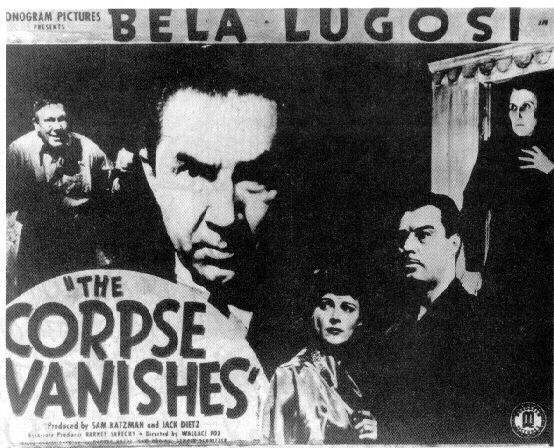
1942’s The Corpse Vanishes opens with a young bride collapsing at her wedding. A doctor runs over to her and says that she’s died. A hearse — or a “stiff wagon,” as one witness puts it — pulls up and takes the body. However, the body never reaches the morgue!
It turns out that this is not the first time this has happened. In fact, there’s an epidemic of brides dying on their wedding day and their bodies disappearing. One would think that this would cause a citywide panic or, at the very least, it would cause some people to maybe get married out-of-town. Considering that the most recent victim was the daughter of one of the richest families in the community, you would think solving this mystery would be the police’s number one priority.
However, the police are useless. And when the police can’t get the job done, it falls to journalists. At least, that’s the way it worked in movies from the 1930s and the 40s. While the cops were busy saying, “Scram!” and “Beat it, buster!,” it fell to the cynical and quick-witted journalist to find out what was going on. In this case, Patricia Hunter (Luana Walters) investigates and discovers that all of the brides received an orchid on their wedding day. (How the police didn’t notice this, I don’t know.) Patricia tracks down the eccentric Dr. Lorenz (Bela Lugosi), who was once quite renowned for his orchids.
Dr. Lorenz now lives in a secluded mansion. He’s polite when Patricia comes to speak to him but it’s obvious that he’s hiding something. A sudden thunderstorm leads to Patricia and Dr. Foster (Tristram Coffin) getting stranded at Lorenz’s mansion. Foster was visiting the mansion to examine Lorenz’s wife, the Countess (Elizabeth Russell).
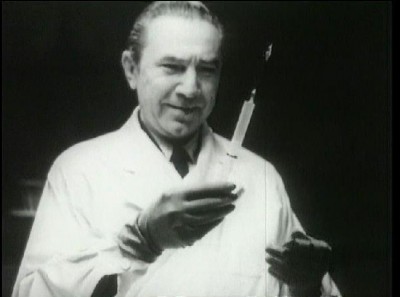
Lorenz, as you probably already guessed, is behind the corpse abductions. Except, of course, the brides aren’t dead. Instead, the orchid has put them into a state of suspended animation. Lorenz is extracting their blood and using it to keep his wife young. Helping him out are his servants, a dwarf named Toby (Angelo Rossitto), Toby’s hulking half-brother, Angel (Frank Moran), and their mother, Fagah (Minerva Urecal). Patricia figures out what is going on but will she be able to convince anyone else!?
From what I read about the film online, it would appear that The Corpse Vanishes has got a terrible reputation but, when I watched it, I actually found it to be entertaining when taken on its own Poverty Row terms. No, the plot doesn’t make any sense. But Bela Lugosi’s smile manages to be both sinister and inviting and Toby and Angel make for good henchmen. The movie only has a 64-minute runtime and, as a result, the plot has to keep moving fairly quickly. The film also features a lot of snappy “newsroom” dialogue between Patricia and her easily-annoyed editor (Kenneth Harlan), all delivered at a fast pace and with the the casually cynical outlook that makes 1940s newspaper movies so entertaining. The Corpse Vanishes is a thoroughly ludicrous film that epitomizes an era and, as such, it’s far more diverting than one might otherwise expect.
Deputy Marshal Ed Garry (Jon Hall) is pursuing two bank robbers in Wyoming when he comes across a wounded man. Harley Masters (Wheaton Chambers) has been shot in the gut but his main concern is holding onto his hat. Ed takes Harley into town. They go into the local saloon, where Harley reveals a map hidden in his hat. He slips the map to Ed before an unseen gunman shoots him a second time. This time, Harley does not survive.
With the current sheriff “laid up,” Ed decides to stay in town and not only catch the bank robbers but also solve Harley’s murder. Ed soon finds himself in the middle of a conflict between two rival women (Frances Langford and Julie Bishop) who own ranches and stand to make a lot of money when the railroad comes through.
Deputy Marshal is one of the B-westerns that was produced by Robert Lippert and directed by William Berke in the 40s and 50s. This one is a step above the usual Lippert production because it combines a murder mystery with the standard western action and there are enough suspects to keep the story interesting. Jon Hall was best-known for appearing in exotic adventure films, often playing islanders. His career was in decline when he starred in Deputy Marshal but he makes for a surprisingly believable western hero. It helps that Hall was older than the typical B-western hero. His weathered looks make him convincing as an experienced lawman who understood the ways of the west.
Frances Langford, who plays the nicer of the two ranchers, was married to Jon Hall when she appeared in this film. She gets to sing two songs because this is a Lippert production and Robert Lippert believed that every western should open with a horse chase and should feature at least one song.
While it obviously never won any awards for originality, Deputy Marshal is a better-than-average B-western with an interesting mystery story and a convincing hero.
The 1947 film, Shoot to Kill (also known as Police Reporter), opens with both a bang and a crash.
The police are chasing a car down one dark and lonely road. When that car crashes, the police are shocked to discover who was inside of it. Two men and one woman, all well-dressed. The men are both dead but the woman is merely unconscious. The police identify one of the men as being the notorious gangster, Dixie Logan (Robert Kent). It makes sense that Logan would be fleeing the police but what about his two passengers, newly elected District Attorney Lawrence Dale (Edmund MacDonald) and Dale’s wife, Marian (Luana Walters)?
The police may not be able to get any answers but fortunately, there’s a reporter around! Mitch Mitchell (Russell Wade) is a crime reporter and, seeing as how he knew both Lawrence and Marian, he seems like the perfect person to get some answers. (In fact, it was Mitch who first suggested that Lawrence should hire Marian as his administrative assistant, therefore setting in motion the whirlwind romance that would end with them married.) Mitch goes to see Marian in her hospital room and he asks her what happened.
It’s flashback time! Yes, this is one of those films where almost the entire film is a flashback. That, in itself, is not surprising. Some of the best film noirs of all time were just extended flashbacks. (D.O.A, Double Indemnity, and Sunset Boulevard, to name just a few examples.) What sets Shoot to Kill apart is the fact that, occasionally, we even get characters having a second flashback while already in someone else’s flashback. We’re through the the film noir looking glass here, people.
Lawrence Dale, we’re told, was elected district attorney because he managed to secure the conviction of notorious gangster Dixie Logan, despite Logan’s insistence that he was no longer involved in the rackets. However, what we soon discover is that not only was Logan actually innocent but Dale specifically prosecuted him as a favor to some of Dale’s rival gangsters. That’s right, Lawrence Dale was on the take! It also turns out that Marian has some secrets of her own. When she first showed up at Dale’s office, she was doing more than just looking for a job. As for her marriage to Dale …. well, I really can’t tell you what the twist is here because it would spoil the entire film.
Shoot To Kill may clock in at just 64 minutes but it manages to pack a lot of twists and turns into just an hour. In fact, I’d argue that it probably tries to do a little bit too much. At times, the film is a bit difficult to follow and a few inconsistent performances don’t help matters. For instance, Russell Wade is likable as the crime reporter but he still doesn’t exactly have a dynamic screen presence. Much better cast are Luana Walters and Edmund MacDonald, who both do a good job as, respectively, a femme fatale and a sap. At the very least, history nerds like me will be amused by the fact that Edmund MacDonald was obviously made up to resemble Thomas E. Dewey, the former Manhattan District Attorney who twice lost the U.S. presidency.
The best thing about Shoot To Kill is the look of the movie. Filmed in grainy black-and-white and full of dark shadows, crooked camera angles, and men in fedoras lighting cigarettes in alleys, Shoot to Kill looks the way that a film noir is supposed to look.
Regardless of whether it was the filmmaker’s original intention, Shoot To Kill plays out like a low-budget, black-and-white fever dream. It’s definitely a flawed film but, for lovers of film noir, still worth a look.
A little over a week ago I wrote about Bela Lugosi’s pairing with The East Side Kids , and mentioned what’s been come to know as “The Monogram Nine”. These Poverty Row horrors were ultra-low-budget schlockfests made quickly for wartime audiences, and though the films weren’t very good, they gave Bela a chance to once again have his name above the titles. From 1941 to 1944, the Hungarian cranked out the rubbish: THE INVISIBLE GHOST, BLACK DRAGONS, THE CORPSE VANISHES, BOWERY AT MIDNIGHT, THE APE MAN, VOODOO MAN, RETURN OF THE APE MAN, and the two East Side Kids entries. Let’s take a look at a typical Lugosi vehicle, 1943’s THE CORPSE VANISHES.
Our story concerns young, virginal society brides who keep dying at the altar, their corpses hijacked by mysterious Dr. Lorenz (Bela, of course). The brides receive an “unusual orchid” whose “peculiar sweet odor” causes them to go into a…
The 33rd film in Mill Creek’s Fabulous Forties box set was 1940’s Boys of the City.
As a classic film lover, I have to admit that I groaned a bit when the opening credits announced that Boys of the City starred “East Side Kids.” The East Side Kids were a group of actors who appeared in a number of B-movies from the 1930s through the 50s. Many of the actors started out as members of the Dead End Kids and a few more were members of a group known as The Little Tough Guys. In the 40s, they merged to become the East Side Kids and then eventually, once the East Side Kids started to hit their 30s, they became known as the Bowery Boys. Their movies started out as tough and gritty melodramas but, by the time they were known as the Bowery Boys, they were making cartoonish comedies. Occasionally, one of their films will show up on TCM. Their early serious films (Dead End, Angels With Dirty Faces) remain watchable but, from what little I’ve seen of them, their later comedies appear to be damn near unbearable.
Boys of the City finds the East Side Kids in transition. The kids still have an edge to them. They are definitely portrayed as being juvenile delinquents who are walking a thin line between either a short life of crime or a long life of poverty. But them film itself, while it may not be as cartoonish as the films that were to come in the future, is definitely a comedy.
Basically, the East Side Kids (Bobby Jordan, Leo Gorcey, Hal E. Chester, Frankie Burke, Sunshine Sammy, Donald Haines, David Gorcey, and Algy Williams) have been arrested for vandalism and are given a choice. They can either go to juvenile hall or they can spend the summer at a camp in upstate New York. Somewhat reluctantly (and hopefully remembering the unlucky fates of Humphrey Bogart in Dead End and James Cagney in Angels With Dirty Faces), the kids agree to go to the camp.
However, on the way to the camp, their car breaks down and they are forced to stay at the nearby home of a crooked judge (Forrest Taylor) until they can get the car repaired. The judge, however, is killed and it’s up to the East Side Kids to solve the murder! Was the judge killed by the gangsters that he was set to testify against? Was he killed by his niece (Inna Gest)? Or maybe it was his housekeeper, Agnes (Minerva Urecal, who appears to be parodying Judith Anderson’s performance in Rebecca)? Or was he murdered by Knuckles (Dave O’Brien), who the judge wrongly sentenced to die and who, following his vindication and release from prison, has become a guardian to the East Side Kids?
Who knows? Who cares? I certainly didn’t.
Clocking in at 68 minutes, Boys of the City is a typical 1940s second feature. Designed to keep audiences entertained without requiring them to think, Boys of the City moves quickly and adds up to nothing. I know that there are some classic film lovers who can tell the difference between the various East Side Kids (or Dead End Kids or Bowery Boys or whatever you want to call them) but they all pretty much blended together for me.
Not surprisingly for a film made in 1940, Boys of the City is full of casual racism. Sunshine Sammy plays an East Side Kid named Scruno. As soon as Scruno sees the cemetery next to the house, his eyes go wide and he says, “G-g-g-ghosts!” Apparently, that was very popular in the 40s but today, it’s impossible to watch without cringing.
Boys of the City has some interest as a time capsule but otherwise, it’s a film that is easily and happily forgotten about.
About a month ago, for reasons that I’m sure made sense at the time, I decided it would be fun to watch and review all 50 of the films included in Mill Creek’s Fabulous Forties box set. If you know anything Mill Creek box sets, then you won’t be surprised to learn that the majority of these 50 films are public domain B-movies. A few of them have been good, a few of them have been bad, and a few of them have been forgettable.
I have to admit that, as much as I love watching old movies, there’s a part of me that’s more than ready to move onto the next Mill Creek box set, the Nifty Fifties. But, before I do that, I have to finish up the Forties. Fortunately, I just watched the 25th film included in the Fabulous Forties and I am happy to say that I am now halfway done with this project! Yay!
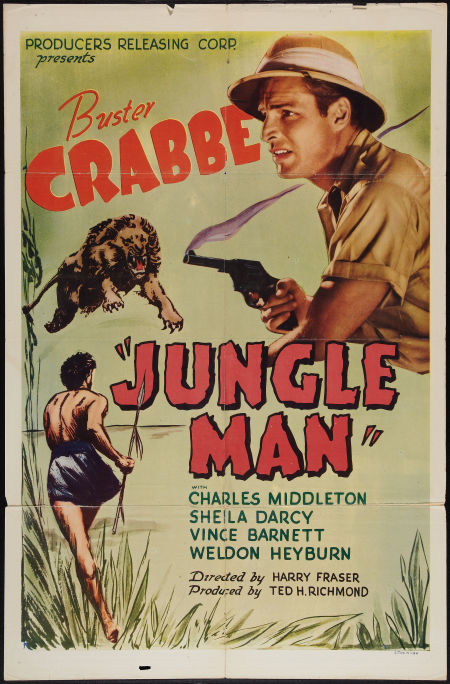
As for the film itself, it’s a 63-minute film from 1941. Though it was later retitled Drums of Africa, it was originally called Jungle Man.
As for what Jungle Man is about … well, it’s mostly about stock footage.
There is kind of a plot. Wealthy Bruce (Weldon Heyburn) and his friend Alex (Robert Carson) want to go to Africa so that they can see the legendary City of the Dead. Bruce’s fiancée, Betty (Sheila Darcy), decides to accompany them because she wants to visit her brother (Charles Middleton), a missionary. Once they get to Africa, they also meet a doctor (Buster Crabbe) who is trying to find a cure for a fever that is wiping out the native population.
But really, the plot is mostly just an excuse for stock footage. We watch as our explorers walk down a jungle trail. Someone says, “Look up in that tree!” We cut to grainy footage of a monkey in a tree. Cut back to everyone looking upward. Cut back to that monkey in the tree. Suddenly, we hear a roar on the soundtrack. Cut to slightly less grainy footage of a tiger running through a field. Cut back to the explorers saying, “Look out, tiger!” Cut back to the monkey climbing up higher in the tree.
(Of course, tigers don’t live in Africa but that’s just the type of film this is!)
Even when our heroes finally reach the City of the Dead, we don’t actually see them walking around the city. Instead, we see them staring into the distance and then immediately cut to some still shots of what Wikipedia identifies as being Cambodia’s Angkor Wat. Of course, no attempt is really made to match any of the shots. If Jungle Man was made today, they could just CGI the Hell out of it. But since it was made in 1941, audiences had to suspend their disbelief and accept shots that didn’t particularly match up with any other shots and a storyline that was pretty much determined by whatever stock footage the producers had available.
On the plus side, it’s only 60 minutes long and some of the stock footage is fun, particularly if you like cute monkeys or fierce tigers. For the most part, it’s silly but inoffensive.
And you can watch it below!
(I should admit that, as I watched it, I kept thinking about those GEICO commercials where Jane and Tarzan are lost in the jungle and Tarzan refuses to ask for directions. “Tarzan know where Tarzan go.” “No, Tarzan does not know where Tarzan go. Excuse me, do you know where the waterfall is? The waterfall?”)
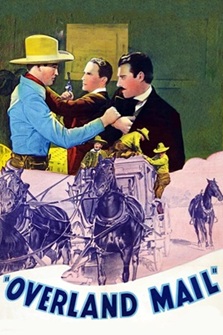 Jack Mason (Jack Randall) has the most important job on the frontier. He delivers the mail. After he’s chased by the members of the local Indian tribe, he learns that an uprising is imminent because a young brave has been murdered and the tribe blames the citizens of a nearby town. Of course, the murder was actually committed by a gang of counterfeiters led by saloon owner Pollini (Tristram Coffin). Pollini is not only a counterfeiter but he also lies to sweet Mary Martin (Jean Joyce), telling her that he’s hiring her to be a waitress when he’s actually looking for a dance hall girl. Jack has to bring Pollini to justice before a full scale war breaks out.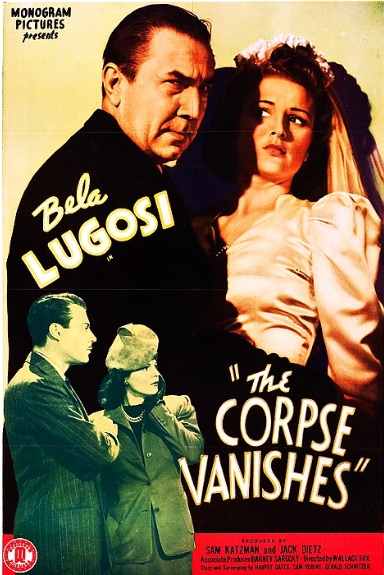




 Through the Shattered Lens