4 Shots From 4 Films: Lord of the Rings: The Fellowship of the Ring, Gangs of New York, V For Vendetta, The Great Gatsby


4 Or More Shots From 4 Or More Films is just what it says it is, 4 shots from 4 of our favorite films. As opposed to the reviews and recaps that we usually post, 4 Shots From 4 Films lets the visuals do the talking!

Because it’s the fourth, this edition of 4 Shots From 4 Films features some classic cinematic moments involving fireworks!

4 Shots From 4 Films

The Lord of the Rings: The Fellowship of the Ring (2001, dir by Peter Jackson, DP: Andrew Lesnie)

Gangs of New York (2002, dir by Martin Scorsese, DP: Michal Ballhaus)

V for Vendetta (2005, dir by James McTeigue, DP: Adrian Biddle)

The Great Gatsby (2013, dir by Baz Luhrmann, DP: Simon Duggan)

Review: V for Vendetta (dir. by James McTeigue)


“Remember, remember the fifth of November, the gunpowder treason and plot. I know of no reason why the gunpowder treason should ever be forgot.”

Alan Moore’s decision to want his name off the final credits for the film adaptation of V for Vendetta now makes sense. Moore has had a hate/hate relationship with Hollywood and the film industry in general. They’ve taken two of his other works in The League of Extraordinary Gentlemen and From Hell. and bollocks’d them up (to borrow a term used quite a bit in V for Vendetta). Outside of Watchmen, Alan Moore sees V for Vendetta as one of his more personal works and after reading the screenplay adaptation of the graphic novel by The Wachowski Brothers his decision afterwards was to demand his name be removed from the film if it was ever made. Part of this was his hatred of the film industry for their past mistakes and another being his wish for a perfect adaptation or none at all. Well, V for Vendettaby James McTeigue and The Wachowski Brothers is not a perfect film adaptation. What it turns out to be is a film that stays true to the spirit of Moore’s graphic novel and given a modern, up-to-the-current news retelling of the world’s state of affairs.

V for Vendetta starts off with abit of a prologue to explain the relevance of the Guy Fawkes mask worn by V throughout the film and the significance of the date of the 5th of November. I think this change in the story from the source material may be for the benefit of audiences who didn’t grow up in the UK and have no idea of who Guy Fawkes was and what his Gunpowder Plot was all about. The sequence is short but informative. From then on we move on to the start of the main story and here the film adheres close enough to the source material with a few changes to the Evey character (played by Natalie Portman) but not enough to ruin the character. Caught after curfew and accosted by the ruling government’s secret police called Fingermen, Evey soon encounters V who saves her not just from imprisonment but rape from these so-called Fingermen.

Right from the start the one thing McTeigue and The Wachowski Brothers got dead-on was casting Hugo Weaving as the title character. Voice silky, velvety and sonorous, Weaving infuses V with an otherworldly, theatrical personality. Whether V was speaking phrases from Shakespeare, philosophers or pop culture icons, the voice gave a character who doesn’t show his face from behind the enternally-smiling Guy Fawkes mask real life. I’d forgiven the makers of this films for some of the changes they made to the story and some of the characters for keeping V as close to how Moore wrote him. Once V and Evey are thrown in together by the happenstance of that nightly encounter their fates became intertwined. Portman plays the reluctant witness to V’s acts of terrorism, murders and destruction in the beginning, but a poignant and emotionally powerful sequence to start the second half of the film soon brings Evey’s character not much towards V’s way of doing things, but to understanding just why he’s doing them. This sequence became the emotional punch of the whole film and is literally lifted word for word from the graphic novel. This is the sequence in the film which should resonate the loudest for most people whether they buy into the rest of the film or not.

The rest of the cast seemed like a who’s who of the British acting community. From Stephen Rea’s stubborn and dogged Chief Inspector Finch whose quest to find V leads him to finding clues about his government’s past actions that he’d rather not have found. Then there’s Stephen Fry’s flamboyant TV show host who becomes Evey’s only other ally whose secret longings have been forbidden by the government, but who’s awakened by V’s actions to go through with his own form of rebellion. Then there’s John Hurt as High Chancellor Adam Sutler who’s seen chewing up the scenery with his Hitler-like performance through Big Brother video conferences (an ironic bit of casting since John Hurt also played Winston Smith in the film adaptation of the Orwell classic 1984). I really couldn’t find any of the supporting players as having done a bad job in their performances. Even Hurt’s Sutler might have seemed over-the-top to some but his performance just showed how much of a hatemonger Sutler and, in the end, his Norsefire party really were in order to stay in power.

The story itself, as I mentioned earlier, had had some changes made to it. Some of these changes angered Moore and probably continues to anger his more die-hard fans. I count myself as one of these die-hards, but I know how film adaptations of classic literary works must and need to trim some of the fat from the main body and theme of the story to fully translate onto the silver screen. The Wachowski Brother’s screenplay did just that. They trimmed some of the side stories and tertiary characters from the story and concentrated on V, Evey and Inspector Finch’s pursuit of both the truth of V and his own journey in finding that truth. This adaptation wa much closer to how Peter Jackson adapted The Lord of the Rings. As a fan of Moore I understood why he was unhappy with the changes, but then Moore was and still is an avowed perfectionist and only a perfect adaptation would do.

Critics on both sides of the aisle have called V for Vendetta revolutionary, subversive, daring to irresponsible and propagandist. All because the film dares to ask serious questions about the nature and role of violence as a form of dissent. But the granddaddy question the film brings up that has people talking is the question: terrorist or freedom fighter? Is V one or the other or is he both? Make no mistake about it, V for all intents and purposes is a terrorist if one was to use the definition of what a terrorist is. The makers of this film goes to great lenghts to describe throughout the film just how Sutler and his Norsefire (with its iconic Nazi-like imagery and extreme fundamentalist Christian idealogy) party rose to power in the UK. Partly due to what seemed like the failed US foreign policy and its subsequent and destructive decline as a superpower and the worldwide panic and fear it caused as a result. V for Vendetta also ask just who was to blame for allowing such individuals to rule over them. V has his reasons for killing these powers-that-be, but he also points out that people really should just look in the mirror if they need to know who really was to blame. For it was the population — whose desire to remain safe and have a semblance of peace — gave up more and more of their basic liberties and rights for a return to order. If one was to look at the past 100 years they would see that it’s happened before. There was the regime of Pol Pot in Cambodia, Milosevic’s Greater Serbia, and the king of the hill of them all being Adolf Hitler and his Nazi Inner Circle.

Another thing about V for Vendetta that will surely talked about alot will be the images used in the film. Not just images and symbols looking so much like Nazi icons, but images from the events of the past decade which have become symbols of oppression and censorship. The film shows people bound and hooded like prisoners from Abu Ghraib. The reason of the war on terror used time and time again by Sutler to justify why England and its people need him and his group to protect them by any means necessary. V for Vendetta seems like a timely film for our current times. Even with the conclusion of the film finally accomplishing what Guy Fawkes failed to do that night of November 5th some 400 plus years ago, V for Vendetta doesn’t give all the answers to all the questions it raises. I’m sure this would be something that’ll frustrate them some audiences. So much of people who go to watch thought-provoking films want their questions answered as clearly as possible and all of them. V for Vendetta doesn’t answer them but gives the audience enough information to try and work it out themselves.

In final analysis, V for Vendetta accomplishes in bringing the main themes of Alan Moore’s graphic novel to life and even does it well despite some of the changes made. It is a film that is sure to polarize the extreme left and right of the political pundits and commentators. But as a piece of thought-provoking and even as a politically subversive film, V for Vendetta does it job well. It is not a perfect film by any respect, but the story and message it tries to convey in addition to its value as a piece of entertainment mor than makes up for its flaws. Alan Moore and his followers might not love and approve of this film, but it doesn’t mean the film in and of itself wasn’t a good one. Sometimes calls for literal adaptations of beloved works or no adaptation at all also becomes a form of creative oppression and censorship.

A Few Thoughts On The Girl With The Dragon Tattoo Remake


Have I mentioned how much I loved The Girl With The Dragon Tattoo?  Have I suggested that the late Stieg Larsson, in the Millenium Trilogy, did for Europe what James Ellroy did for America with the American Tabloid trilogy?  Have I gone into the fact I think Noomi Rapace’s performance as Lisbeth in both the original film and its sequels will probably be remembered as one of the greatest film performances of all time?  Have I explained that I think, even beyond Rapace’s performance, Lisbeth herself is one of the best characters in the history of film?  For that matter, have I talked about the hours that I’ve spent standing with my back to a mirror and looking over my shoulder and debating on which shoulder-blade a dragon would look most appropriate?  Personally, I think my left shoulder-blade is a bit nicer than my right but last night, my friend Jeff was telling me that…

Sorry, I’m losing focus here.  Okay, getting the ADD under control.  Anyway, the point of the matter is that I love The Girl With The Dragon Tattoo. 

That’s why I feel a lot of caution about the upcoming, David Fincher-helmed remake.  First off, quite frankly, I really don’t see what can be improved on the original films.  It’s not as if the original film version of the Girl With The Dragon Tattoo failed to do justice to the book (if anything, the book fails to do justice to the film that eventually made from it).  I suppose a remake would give people who can’t handle subtitles the chance to see the story but honestly, who cares about those losers?  Speaking of the story, the rumors I hear seem to indicate that this remake is going to be an “Americanized” version of The Girl With The Dragon Tattoo, which I’m not really sure can be done as the entire book is basically meant to act as a metaphor for Swedish society.  Of course, it is possible that the remake is going to be set in Sweden as well but if that’s the case, what’s the point of the remake?

I know the usual argument to these concerns is that, as a director, Fincher will not allow the film to be Hollywoodized.  At one point that may have been true but, judging from The Curious Case of Benjamin Button, Fincher’s got more Hollywood in him than most people want to admit.  The fact that he’s also teamed up with Aaron Sorkin (an establishment figure if there ever was one) to direct a movie about Facebook doesn’t exactly fill me with confidence but I’ll hold off on judging until the Social Network actually shows up in theaters.
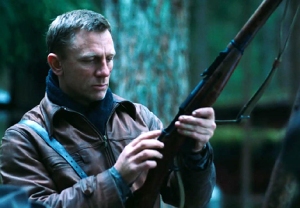
However, I am encouraged by the news (announced yesterday) that Fincher has cast Daniel Craig as the male lead, Mikael Blomkvist (or whatever his name is going to be in the Hollywood version).  Craig’s name had been mentioned for the role ever since the remake was first announced but there were also reports that the role would go to Brad Pitt (who, of course, has already made 3 films with Fincher).  Nothing against Brad Pitt (who I think is a truly underrated actor) but it’s hard to think of a worst choice for the role of Mikael.  Mikael’s defining characteristic is just how ineffectual he is.  He’s the ultimate well-meaning intellectual, the type of guy who wants to fight injustice but is to insulated from the harsh realities of life to effectively do so.  (That’s why he needs Lisbeth, she represents everything he wishes he could do but can’t.)  In short, Mikael is a hero by default and casting an actor like Brad Pitt would throw the entire movie off-balance.

Mikael is not a role for a star.  Mikael is a role for a character actor and, James Bond aside, that’s exactly what Daniel Craig is.  (That’s one reason why Craig’s Bond is dull, regardless of how good a performance Craig gives in the role.)  Not only is Craig the right age, he projects just the right amount of idealistic weariness for the role.  Admittedly, it helps that Craig bears a passable physical resemblance to the original Mikael, Michael Nyqvist which, if nothing else, will make it easier for fans of the original film — like me — to accept him.

(For the record, my personal choice for Mikael would have been Tim Roth.)

Of course, the question now is who will win the role of Lisbeth and why would they want it?  For me, Noomi Rapace is Lisbeth.  She is the girl with dragon tattoo.  It’s hard to think of single mainstream actress in her 20s or early 30s who could hope to match Rapace’s performance.  (Perhaps a young Angelina Jolie could have though physically, Jolie is all wrong for the part.)  However, even beyond what Rapace did with the character, Lisbeth is one of the most vivid and memorable characters in recent literary history.  Even without having to worry about the shadow of Rapace’s previous performance, the role is not an easy one.

Originally, rumor had it that Kristen Stewart was a lock for the role.  At the risk of being burned at the stake as a heretic, I’m going to say that I think Stewart could have been an adequate (though not a great) Lisbeth except for the fact that she’s about ten years too young.  (While Lisbeth is described as looking like a teenager, she also projects a worldliness of someone much older.  Physical appearance can be faked but life experience can not.)  Carey Mulligan, star of An Education (the best film of 2009, by the way), was another actress who was frequently mentioned.

Well, according to Entertainment Weekly, neither Stewart nor Mulligan will play Lisbeth Salander.  Neither will Natalie Portman who, according to EW, was offered the role but turned it down.  The offer to Portman makes sense as she’s physcially right for the role and she’s an undeniably talented actress.  However, much as Pitt could never have been convincing as Mikael, Portman would have been miscast as Lisbeth.  Portman may be a talented actress but she’s also a rather passive one.  Even in her previous “action” roles (Leon, V For Vendetta), Portman essentially played a lost, damaged character (much like Lisbeth) who needed an older male figure to serve as her mentor (which, needless to say, is nothing like Lisbeth).

Again, according to EW, the role of Lisbeth has been narrowed down to four actresses: Rooney Mara, Lea Seydoux, Sarah Snook, and Sophie Lowe.  It’s probably a good sign that none of these actresses are household names exactly.  Competing with the shadow of Noomi Rapace’s Lisbeth is going to be difficult enough without also having to deal with the shadow of their own previous performances.  (For instance, even if Stewart gave a brilliant performance as Lisbeth, it would still be impossible for me to get through the remake without making at least one Twilight joke.)

For me, the real question is not who is going to be cast as Libseth but if Fincher and his producers are going to give us the real Lisbeth — this would be the unapologetically lesbian Lisbeth who can only befriend Mikael once she’s sure that she doesn’t any sort of sexual attraction towards him — or if we’re going to get a more mainstream, Hollywood version of Lisbeth.  Are we going to get the real Lisbeth who needs no one or are we going to get another version of what Hollywood claims to be a strong woman, one who can fight up until the final 30 minutes of the film at which point she’s suddenly rendered helpless by the demands of Mainstream Filmmaking 101.

More than anything, that will be the test that Fincher’s Girl With The Dragon Tattoo will have to pass if it wants to be anything more than an unneeded imitation of the original.

(Incidentally, the perfect Lisebth Salander would be Jena Malone.  End of story.)