Retro Television Review: The Love Boat 4.14 “First Voyage, Last Voyage/April, the Ninny/The Loan Arranger”


Welcome to Retro Television Reviews, a feature where we review some of our favorite and least favorite shows of the past!  On Wednesdays, I will be reviewing the original Love Boat, which aired on ABC from 1977 to 1986!  The series can be streamed on Paramount Plus!

Oh, hey, Charo’s back.

Episode 4.15 “First Voyage, Last Voyage/April, the Ninny/The Loan Arranger”

(Dir by Roger Duchowny, originally aired on January 17th, 1981)

April’s back!

Played by Charo, April Lopez was one of the few recurring characters on The Love Boat.  Whereas other actors appeared frequently but always as different characters, Charo was always April whenever she boarded The Love Boat.  The first time she boarded the ship, she did so as a stowaway.  The next two times, she boarded as the cruise’s entertainment.  This season, however, April boards as someone who has grown tired of show business.  When last we saw her, April was in love with a guy named Tex and planning on playing Las Vegas.  However, when April boards this time, she quickly informs both Julie and Isaac that she and Tex are no longer a couple and Vegas didn’t work out because she was expected to play her guitar while naked.

(“They could have at least gotten you a cello,” Isaac replies.)

April wants a new career, which she gets when she meets Ty Younger (Larry Linville), who is wealthy but who also has two bratty kids who are always chasing off their nannies.  They can’t chase off April, who understands that the best way to calm a bratty child is to grab your guitar and sing to them at night.  April gives up show business to become a nanny but I don’t think it’ll last.  April is too impulsive to settle down, and Ty’s kids really are the worst.  (As well, Charo and Larry Linville didn’t exactly generate a lot of heat in their scenes together.)  April may leave the boat with a new family but hopefully, she’ll return alone in the fifth season.

Speaking of the worst, Cindy Simmons (Maureen McCormick) is dying but her parents (Ty Hardin and Kathleen Nolan) haven’t gotten around to telling her yet.  Cindy thinks that she’s made a full recovery from her recent illness.  Her parents don’t want to upset Cindy but when Cindy meets and falls in love with Paul Harris (Jay Thomas), they realize that they’re going to have to tell Cindy the truth.  Poor Cindy!  Fortunately, this is The Love Boat and Paul isn’t going to let a little thing like impending death get in the way of romance.  I’ve lost track of how many times I’ve seen Maureen McCormick on both The Love Boat and Fantasy Island.  For this episode, McCormick does a pretty good job with her role and she and Jay Thomas make for an attractive couple.

“I guess I’m still getting my sea legs,” Cindy says to Paul.

“Your legs look mighty fine to me,” Paul replies.

That’s about as witty as things get on this cruise.

Finally, Joey (Richard Kline) is a mob enforcer who has been sent to collect a debt owed by Tony Patacchio, a gambling addict.  However, Joey gets distracted when he meets a woman named Antoinette (Lisa Hartman) who enjoys gambling.  Joey falls for Antoinette and, unable to find Tony, he even spends the night in her cabin.  Hmmm …. Tony …. Antoinette …. Toni….

Yes, Joey has fallen in love with the person he was supposed to rough up.  Fortunately, Joey is willing to fix a poker game so that Toni can win enough of his money to pay off her debt.  When Toni realizes that Joey lost his money to her on purpose, she declares that she can’t take his money.  “If we were married,” Joey says, “It would be our money.”

Richard Kline is not a particularly believable debt collector.  (Tony Soprano would have tossed him in a dumpster.)  It’s also strange that his boss would send him to collect a debt without bothering to give him a physical description of the person he was supposed to intimidate.  The whole storyline was full of holes but I’m surprised to say that I did end up rooting Kline and Hartman to get together.  The two of them had enough chemistry to overcome the fact that their story made very little sense.

Previously, whenever Charo was a guest star, she dominated the entire episode, for better or worse.  With this episode, she seems kind of bored with the whole thing, as if Charo was just as fed up with show business as April.  Instead, it was Maureen McCormick and Jay Thomas who dominated the episode with Richard Kline and Lisa Hartman also getting their share of good scenes.  It makes for a bit of an uneven episode but I defy anyone not to feel something when Paul declares that he wants to spend the rest of Cindy’s life with her.  Mixing romantic melodrama and goofy comedy is what made The Love Boat a treasure of American pop culture.

October Positivity: Image of the Beast (dir by Donald W. Thompson)


1981’s Image of the Beast picks up from where A Distant Thunder ended.

The world is in economic and political chaos, largely as a result of millions of people vanishing a few years before.  (The government says the people were abducted by UFOs but everyone left behind knows it was actually the rapture.)  Brother Christopher and the United Nations are controlling the world.  Order is kept by UNITE.  Those who fail to get the Mark on either their palm or their forehead are not allowed to buy food or get healthcare.  In fact, Brother Christopher has declared that the mark is no longer optional and anyone who refuses to get it will be executed.

A Distant Thunder ended with Patty Myers (Patty Dunning) facing the guillotine and that’s where Image of the Beast picks up.  She is given one final chance to voluntarily take the mark before being put under the blade but, in obvious fear and shock, Patty says nothing.  Two UNITE soldiers tie her the ground, with her neck directly under the guillotine’s blade.

Finally, Patty yells, “I want the mark!”

However, at the same time that Patty makes the declaration, an earthquake hits and the skies turn black.  The cowardly soldiers run off, leaving Patty under the blade.  Realizing that she is witnessing the breaking of one of the apocalyptic seals, Patty attempts to free herself from her bounds.  Unfortunately, she moves around so much that the loosened blade comes crashing down and she promptly loses her head.

So much for Patty!

The action then shifts to a new character, a Christian rebel named David Michaels (William Wellman, Jr., who also played a different role in every single Billy Jack movie).  David, who has disguised himself as a member of UNITE, is looking for Leslie (Wenda Shereos), another Christian who escaped from execution during the earthquake.  David doesn’t find her but he does stumble upon Kathy (Susan Plumb), Kathy’s son (Ben Sampson), and the Rev. Matthew Turner (Russell S. Doughten, JR., who not only produced the Thief In The Night films but who also directed films like Nite Song).  Rev. Turner lives in a farmhouse and looks a lot like Santa Claus.  He has a helpful graph on his wall that can be used to understand just how far along the world is into the apocalypse.

As Rev. Turner explains it, computers are the new “golden calf.”  Why, people believe that computer can do anything better than humans!  They’re letting computer run their lives and Brother Christopher is using that to his advantage!  (Keep in mind, this film was made in 1981 so the computer that he’s talking about are those big, boxy computers that took hours to do the simplest tasks.)  Fortunately, David used to be a computer technician and he thinks that he’s come up with a way to 1) create a counterfeit mark and 2) corrupt Brother Christopher’s precious computer system!

(Calculators, interestingly enough, are referred to as being hand computers.  If nothing else, this film proves that paranoia about technology is hardly a new phenomena.)

Much like the previous films in the series, there’s a lot of scenes of the heroes trying to sneak around Des Moines without blowing their cover and revealing themselves to be believers.  And like A Distant Thunder, there’s a lot of talk about events that are happening that we never actually see.  This one of those films that deals with its low budget by having all of the big events happen off-screen.  The characters in this film spend a lot of time listening to breathless news reports on the radio and on television.  And while that can feel a bit anti-climatic, it’s also strangely effective in its way.  It captures the feeling of finding yourself in a situation where you’re never quite sure if you’re hearing the truth and it also captures the feeling of helplessness that comes from knowing that there are huge things happening that you can’t control.  While the film is a bit too talky for its own good, director Donald W. Thompson does a good job of creating an atmosphere of sustained paranoia.  Every time that David and Kathy walk around Des Moines, you’re expecting someone to grab them.  The fact that Des Moines, itself, is hardly a shadowy metropolis adds to paranoia.  “If this could happen in Iowa,” the film seems to be saying, “it could happen anywhere.”

Image of the Beast was a success on the church circuit and it was followed by one final Thief in the Night film, which I will discuss tomorrow.

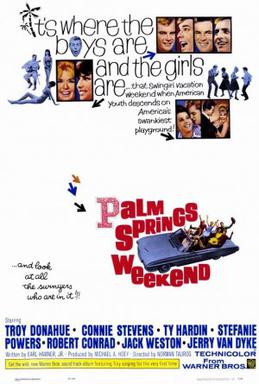
Film Review: Palm Springs Weekend (dir by Norman Taurog)


The 1963 film Palm Springs Weekend asks the question, “When is a beach film not a beach film?”

When it takes place in the freaking desert!

That’s right, Palm Springs Weekend takes place in the middle of the California desert.  There’s no ocean in sight nor are there any beaches on which to frolic.  Instead, there’s just a cheap motel and a swimming pool.  That said, Palm Springs Weekend pretty much follows the same formula as all of the beach films that were released in the early 60s.  A group of college students hop on a bus and head off for the weekend.  One student is wacky.  One student is rich, wild, and dangerous to know.  And, of course, one student is clean-cut, responsible, boring, asexual, and studious and all about doing the right thing.

Troy Donahue, the blandest teen idol of all time, plays the clean-cut student.  His name is Jim and he’s a college basketball star.  Even when he’s on the bus traveling to Palm Springs, he’s still got a book to study.  Jim’s the type who wears a suit and a tie to the pool.  He ends up falling in love with Bunny Dixon (Stefanie Powers) and the two of them spend a lot of time talking about sex in the most chaste way possible.  Bunny’s father (played by Andrew Duggan) is the chief of police and he doesn’t want any crazy college kids causing trouble in his town!  Well, it’s a pretty good thing that all he has to worry about is Troy Donaue asking his daughter if she wants to take a moonlight stroll in the middle of the desert.

(Trust me.  I’ve spent enough time in the desert to know that the last thing you want to do when you live near rattlesnakes is take a moonlight stroll.)

Jim’s best friend is Biff (Jerry Van Dyke).  Biff is the wacky college student, which means that he plays the ukulele and he gets all the comedic moments.  In this film, that amounts to getting babysitting an annoying boy and, at one point, falling into an extremely sudsy pool.  Luckily, Jim’s there to deliver CPR, which leads to soap bubbles floating out of Biff’s mouth and …. you know what?  I’m tired of writing about Biff.

Anyway, Biff and Jim really aren’t that important.  The entire film pretty much belongs to Robert Conrad and Connie Stevens, largely because they’re the only two actors who are allowed to break out of the trap of always either being bumbling and innocent or dramatic and self-righteous.  Robert Conrad plays Eric Dean, who is a spoiled rich kid who owns an expensive and fast car and who is basically a fun-loving sociopath.  Meanwhile, Connie Stevens plays Gail, who is a high senior and who is pretending to be a college student.  And while the film insists that we should somehow be disappointed in Gail because she’s acting wild and breaking curfew and doing more than just talking about whether or not it’s appropriate to kiss on the first date, she’s actually the most compelling character in the film because, at the very least, she’s actually setting her own rules and making her own decisions.  Since Palm Springs Weekend was made in 1963, it ultimately feels the need to try to punish Gail for thinking for herself but that doesn’t change the fact that she’s still a far more interesting character than the blandly innocent Bunny.  Gail’s a rebel.  Gail’s the future.  All hail Gail!

Anyway, Palm Springs Weekend is pretty forgettable and it’s never as much fun as any of AIP’s old Beach Party films.  That said, I’d still recommend it if you’re a history nerd like me.  It’s definitely a film of its time, a time capsule of an era.

Horror Film Review: I Married A Monster From Outer Space (dir by Gene Fowler, Jr)


The 1958 film I Married A Monster From Outer Space tells the story of Marge (Gloria Talbott) and Bill Farrell (Tom Tryon).

Just one year ago, they seemed like the perfect couple.  They were newlyweds, looking forward to starting a family and living in a nice house in the suburbs.  Bill seemed like the perfect guy, warm, friendly, humorous, and loving.

However, things have changed.  On their one-year anniversary, Bill is cold and distant.  He certainly seems to have little interest in romance or anything like that.  When Marge gives Bill a new dog as his anniversary present, he doesn’t seem to be sure how to react to it.  When the dog later ends up dead, Bill gives her an implausible excuse.

Bill has changed but he’s not the only one.  Marge notices that all of her friend’s husbands are acting strange as well.  It’s as if something has magically turned every man into the neighborhood into a stiff, humorless jerk.

(Either that or it’s the 50s!)

One night, Marge decides to follow Bill into the forest and she sees something that challenges everything that she previously thought she knew about her husband.  What does she discover?  Well, it’s right there in the title.  Marge has married a monster from outer space!

I imagine that most people’s natural instinct with a film like this is to make fun of the title and just go on from there but actually, I Married A Monster From Outer Space is an intelligent and well-done sci-fi film.  Gloria Talbott does a great job in the lead role and Tom Tryon’s rather stiff screen presence is perfectly suited for the role of Alien-Bill.  Gene Fowler, Jr. directs the film as if it were a film noir where the usual gangsters and bank robbers have been replaced by humanoid aliens who don’t like dogs.

Since this movie is from 1958, there’s all sorts of subtext creeping around.  The most obvious, of course, is that America is being invaded from within.  You don’t think your husband could be an alien?  Well, Alger Hiss’s mother probably didn’t think her son was a communist spy!  You think it’s a silly idea that normal seeming humans would be working to conquer the world?  Have you not heard of Julius and Ethel Rosenberg?  When Bill and the other men turn cold and impersonal, it’s easy to see that they’ve embraced an ideology opposed to individual freedom and we all know what that means.

However, for me, this film works because it strikes at a very primal fear.  How well do you really know the people who you love?  Is he always going to be as perfect as he seems when you first start going out or is he going to totally change once he’s sure that you’re not going to leave him?  Like many women who have tried to escape from abusive boyfriends and spouses, Marge discovers that no one believes her.  She lives in a world controlled by men and all of the men have been taken over by the same thing that’s taken over Bill.  Even if you’ve never married a monster from outer space, you know what Marge is going through.

So, don’t dismiss this film because of the melodramatic title.  I Married A Monster From Outer Space is an intelligent sci-fi horror film, one that’s still relevant today.

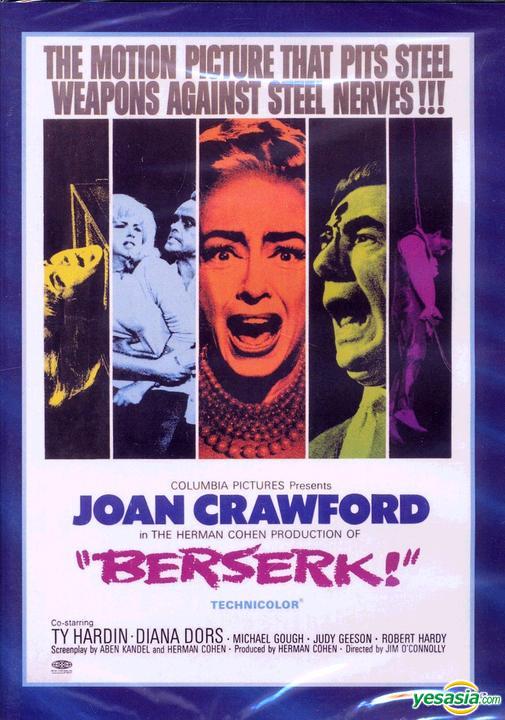
Halloween Havoc!: Joan Crawford in BERSERK (Columbia 1967)


gary loggins's avatarcracked rear viewer

berserk1

Last year I looked at Joan Crawford’s final film  TROG  during “Halloween Havoc” month, where she played an anthropologist.  This time around, Joan stars in her first movie for schlockmeister Herman Cohen, BERSERK, in which she’s in a more believable role as a circus owner/ringmaster whose big top is plagued by a series of gruesome murders.

berserk2

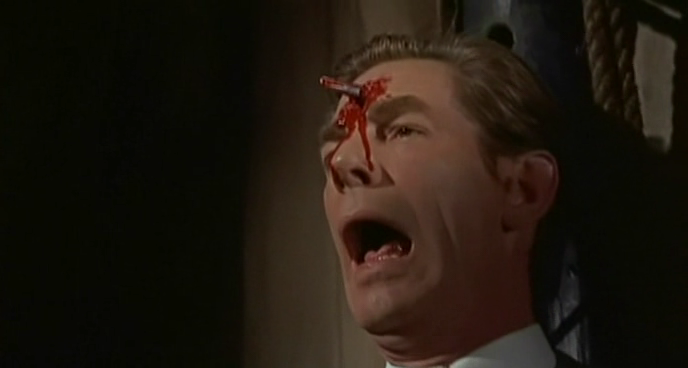
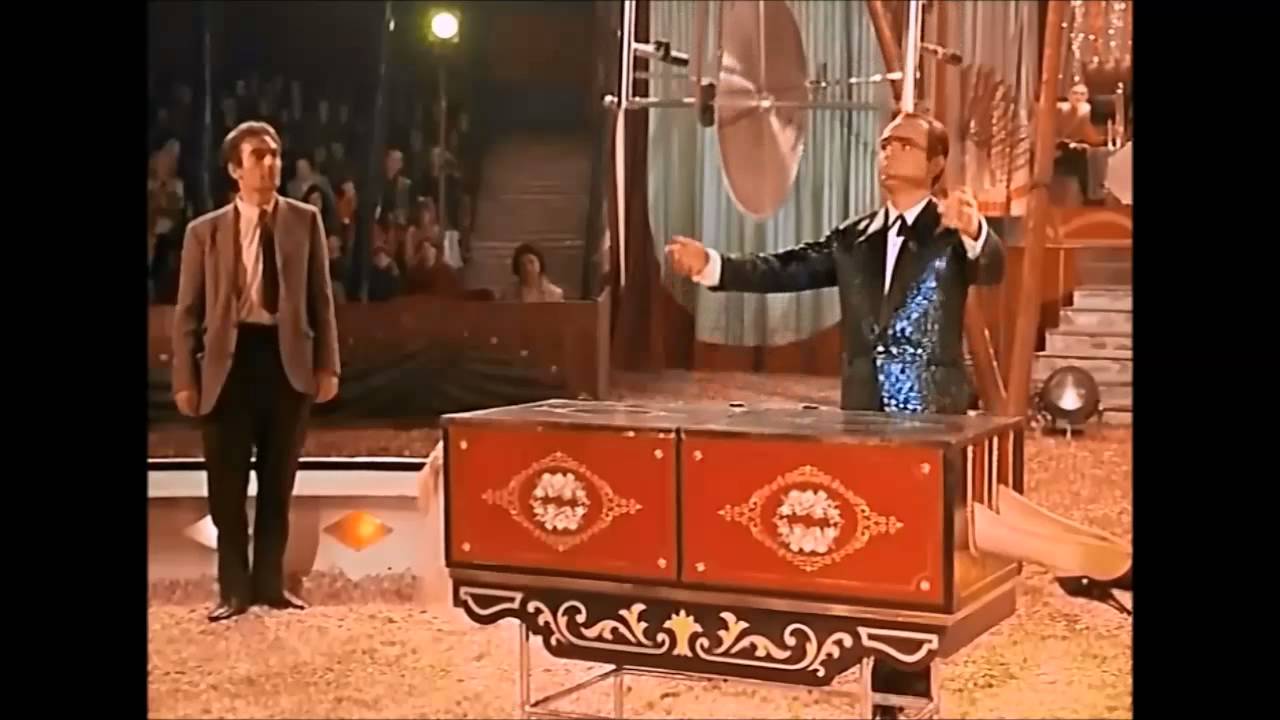
The film starts off with the grisly death of high wire artist Gaspar the Great, whose tightrope breaks, causing him to die from hanging. Frank Hawkins, better known as The Magnificent Hawkins, arrives soon after and replaces Gaspar with his own death-defying act, walking the tightrope while blindfolded over a row of steel spikes. Circus owner Monica Rivers loves the publicity from Gaspar’s demise, which turns off her lover/business partner Durando. Soon Monica takes up with Frank, and Durando winds up with a spike driven through his head!

berserk3

The circus acts think there’s a madman among them…

View original post 293 more words