Film Review: The Cardinal (dir by Otto Preminger)


The 1963 film, The Cardinal, opens with an Irish-American priest named Stephen Fermoyle (Tom Tyron) being instituted as a cardinal.

In a series of flashbacks, we see everything that led to this moment.  Stephen starts out as an overly ambitious and somewhat didactic priest who, over the years, is taught to be humble by a series of tragedies and mentors.  It’s a sprawling story, one that encompasses the first half of the 20th Century and, as he did with both Exodus and Advice and Consent, Preminger tells his story through the presence of several familiar faces.  Director John Huston plays the cardinal who takes an early interest in Stephen’s career.  Burgess Meredith plays a priest with MS who teaches Stephen about the importance of remaining humble and thankful.  When Stephen is in Europe, Romy Schneider plays the woman for whom he momentarily considers abandoning his vows.  When Stephen is assigned to the American South, Ossie Davis plays the priest and civil rights activist who teaches Stephen about the importance of standing up for those being oppressed.  In the days leading up to World War II, Stephen is sent to Austria to try to keep the local clergy from allying with the invading Nazis.  Stephen also deals with his own family drama, as his sister (Carol Lynley) runs away from home after Stephen counsels her not to marry a good Jewish man named Benny (John Saxon) unless Benny can be convinced the convert to Catholicism.  Later, when his sister becomes pregnant and Stephen is told that she’ll die unless she has an abortion, Stephen is forced to choose between his own feelings and teachings of the Church.  Along the way, performers like Dorothy Gish, Cecil Kellaway, Chill Wills, Raf Vallone, Jill Haworth, Maggie McNamara, Arthur Hunnicut, and Robert Morse all make appearances.

All of the familiar faces in the cast are used to support Tom Tryon and Tryon needs all the support that he can get.  Despite Otto Preminger’s attempts to make Tom Tyron into a star, Tryon eventually retired from acting and found far more success as a writer of the type of fiction that Stephen Fermoyle probably would have condemned as blasphemous.  Tryon gives a stiff and unconvincing performance in The Cardinal.  The entire film depends on Tryon’s ability to get us to like Stephen, even when he’s being self-righteous or when he’s full of self-pity and, unfortunately, Tryon’s stiff performance makes him into the epitome of the type of priest that everyone dreads having to deal with.  Tryon gives such a boring performance that he’s overshadowed by the rest of the cast.  I spent the movie wishing that it would have spent more time with John Saxon and Burgess Meredith, both of whom give interesting and lively performances.

The Cardinal is a long and rather self-important film.  The same can be said of many of Preminger’s films in the 60s but Exodus benefitted from the movie star glamour of Paul Newman and Eva Marie Saint and Advice and Consent was saved by an intelligent script.  The Cardinal, on the other hand, is a bit draggy and makes many of the same mistakes that many secular films make when they try to portray Catholicism.  Oddly enough, The Cardinal received more Oscar nominations than either Exodus or Advice and Consent.  Indeed, Preminger was even nominated for Best Director for his rather uninspired work here.  Considering the number of good films for which Preminger was not nominated (Anatomy of a Murder comes to mind), it’s a bit odd that The Cardinal was the film for which he was nominated.  (Of course, in 1944, the Academy got it right by nominating Preminger for his direction of Laura.)  The Cardinal is largely forgettable, though interesting as a type of self-consciously “big” films that the studios were churning out in the 60s in order to compete with television and the counterculture.
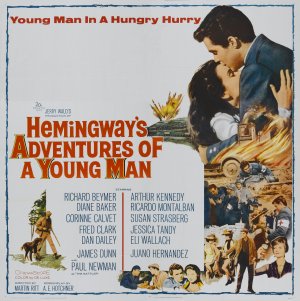
Lisa Cleans Out Her DVR: Hemingway’s Adventures Of A Young Man (dir by Martin Ritt)


(Lisa is currently in the process of cleaning out her DVR!  It’s going to take a while.  She recorded this 1962 literary adaptation off of FXM on January 30th!)

Hemingway’s Adventures Of A Young Man is one of those films that you just know was made specifically to win Oscars.  It’s a big prestige production, complete with a historical setting, an epic scope and big, all-star cast.  That most of those stars appear in relatively small roles was undoubtedly meant to evidence of the film’s importance.

“Look!” the film seems to shout at times, “This is such an important film that even Paul Newman was willing to stop by for a day’s work!”

The film is based on ten short stories by Ernest Hemingway and, loosely, A Farewell to Arms.  The stories all dealt with the early life of Nick Adams, who was a literary stand-in for Hemingway.  Since the Nick Adams stories were autobiographical (and, for that matter, so was A Farewell to Arms), the film can also be viewed as biopic.  Richard Beymer (who, a year earlier, had starred in West Side Story and who is currently playing Ben Horne on Twin Peaks) may be playing Nick Adams but the film leaves little doubt that he was actually meant to be playing Ernest Hemingway.

The film opens with Nick hunting with his father, Dr. Harold Adams (Arthur Kennedy).  He is present when his father travels to an Indian camp and helps to deliver a baby.  He respects his father but Nick wants to see the world and the film follows him as he explores America, working odd jobs and meeting colorful characters along the way.  Paul Newman shows up as a punch-drunk boxer and proceeds to overact to such an extent that he reminded me of Eric Roberts appearing in a Lifetime film.  Nick meets rich men, poor men, and everything in between.  He works as a journalist.  He works as a porter.  Eventually, when World War I breaks out, Nick enlists in the Italian army and the film turns into the 100th adaptation of A Farewell to Arms.

And really, I think it would have been an enjoyable film if it had been directed by someone like Otto Preminger, George Stevens, or maybe even Elia Kazan.  These are directors who would have embraced both the pulpy potential of the Nick Adams stories and the soapy melodrama of the war scenes.  A showman like Preminger would have had no fear of going totally and completely over the top and that’s the approach that this material needed.  Instead, Hemingway’s Adventures Of A Young Man was directed, in a painfully earnest style, by Martin Ritt.  Ritt tries to imitate Hemingway’s famously understated style with his understated direction but, cinematically, it’s just not very interesting.  Ritt portrays everything very seriously and very literally and, in the end, his direction is more than a little dull.

Sadly, the same can be said for Richard Beymer’s performance in the lead role.  Beymer comes across as being the nice guy who everyone says you should marry because he’ll be able to get a good and stable job and he’ll probably never go to jail.  Two months ago, when I watched and reviewed Twin Peaks, I really loved Beymer’s performance as Ben Horne.  He just seemed to be having so much fun being bad.  Unfortunately, in Hemingway’s Adventures Of A Young Man, he never seemed to be having any fun at all.  No wonder he temporarily put his film career on hold so that he could fully devote himself to working as a civil rights activist.

In the end, this is a movie that’s a lot more fun to look at than to actually watch.  Visually, the film is frequently quite pretty in an early 1960s prestige movie so sort of way.  And there are some good performances.  Eli Wallach, Ricardo Montalban, Susan Strasberg, Arthur Kennedy — there’s a whole host of performers doing memorable supporting work.  Unfortunately, even with all that in mind, this well-intentioned film largely falls flat.

Lisa Reviews an Oscar Nominee: Roman Holiday (dir by William Wyler)


roman_holiday

The 1953 film Roman Holiday is one that I’ve watched quite a few times.  If you know anything about the film and/or me, you won’t be surprised by that.  I love Audrey Hepburn.  I love Rome.  I love romance.  And I love bittersweet endings.  And Roman Holiday has all four of those!

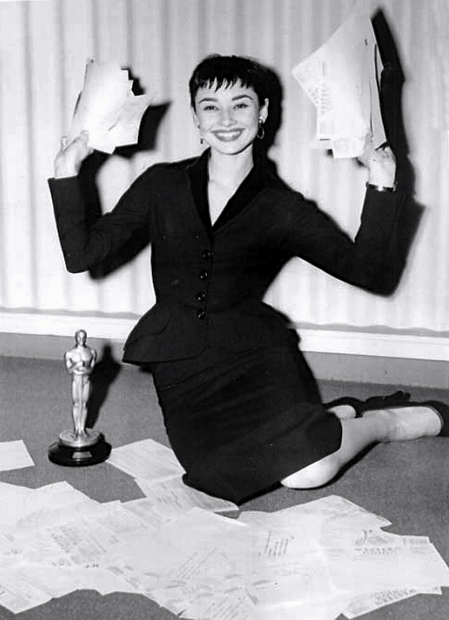
Speaking of Audrey Hepburn, I’ve shared this picture before but I’m going to share it again:

Audrey Hepburn 1954 Roman HolidayThat is Audrey Hepburn, the morning after she won the Best Actress Oscar for Roman Holiday.  Roman Holiday was Audrey Hepburn’s motion picture debut and it continues to hold up as one of the greatest film debuts of all time.  Watching how easily she controls and dominates the screen in Roman Holiday, you would think that she had made over a 100 films previously.

The film tells a simple story, really.  Audrey plays Ann, the crown princess of an unnamed country.  Princess Ann is touring the world.  The press is following her every move.  Her royal handlers are carefully choreographing every event.  Her ever-present bodyguards are always present to make sure that no one gets too close to her.  In public, Ann is the epitome of royal discretion, smiling politely and always being careful to say exactly the right thing.  But, in private, Ann is restless.  Ann knows that she has never been allowed to see the real world and yearns to escape, if just for one night, and live a normal life.  So far, her handlers have managed to keep her under control but then she arrives in Rome and…

…well, who can resist Rome?

Despite having been given a sedative earlier, Ann stays awake long enough to sneak out of her hotel room and see the enchanting Rome night life.  Of course, the sedative does eventually kick in and she ends up falling asleep on a bench.  It’s there that she’s discovered by an American, a cynical reporter named Joe Bradley (Gregory Peck).  Not realizing who she is and, instead, assuming she’s just a tourist who has been overwhelmed by Rome, Joe allows her to spend the night at his apartment.

The next morning, Joe finds out who Ann actually is.  Realizing that getting an exclusive interview with Ann could be his ticket to the big time, Joe and his photographer, Irving (Eddie Albert), rush back to Joe’s apartment.  Joe doesn’t tell her that he’s a reporter.  He just offers to take her on a tour of Rome.  Ann, however, wants to experience Rome on her own.

What follows is a wonderful and romantic travelogue of the glory of Rome.  Though Ann does explore on her own for a while, she eventually does meet back up with Joe and Irving.  Whenever I watch Roman Holiday, I always try to put myself in the shoes of someone in 1953, sitting in the audience during the film’s first week of release.  For many of them, this film may have been their first chance to ever see Rome.  (The opening credits of Roman Holiday proudly announce that the entire film was shot on location, properly acknowledging the Rome is as much a star of this film as Hepburn, Peck, and Albert.)  If you’re not already in love with Rome (and I fell in love with the city — and really, the entire country of Italy — the summer after I graduated high school), you will be after watching Roman Holiday.

(If you truly want to have a wonderful double feature, follow-up Roman Holiday with La Dolce Vita.)

The film’s most famous scene occurs at the Mouth of Truth and… well, just watch…

This scene was improvised, on the spot, by Gregory Peck.  Audrey Hepburn’s scream was very much real as Peck didn’t tell her what he was planning on doing.  As great as this scene is, it’s even better after you’ve actually been to Rome and put your own hand in the Mouth of Truth.

It’s a very sweet movie, one that stands as both a tribute to romance but also proof of what pure movie star charisma can accomplish.  It’s not just that Audrey Hepburn gives a great performance as Princess Ann.  It’s that Gregory Peck gives one of his most natural and surprisingly playful performance as well.  It’s that Peck and Hepburn have an amazing chemistry.  By the end of the film, you know that they deserve Rome and Rome deserves them.

And then there’s that ending, that bittersweet ending that always brings tears my mismatched eyes.  It’s a sad (though not depressing) little ending but somehow, it’s also the only ending that would work.

Roman Holiday was nominated for best picture but it lost to From Here To Eternity.

That’s right — Roman Holiday and From Here To Eternity were released one after another.

1953 was a very good year.

roman_holiday-1

gac_romanholiday