Heldorado, Arizona is a frontier town with a problem. The Tullivers, led by Mike (Tom Tyler), keep robbing the bank and running off anyone who agrees to be the town’s marshal.
The Colonel (Raymond Hatton) and the Mayor (Fuzzy Knight) are at their wits end until a bison hunter named Lucky (Russell Hayden) comes riding into town in search of work. They hire Lucky to be their new marshal, paying him $200 a week and allowing him three free drinks a day.
They also give Lucky a cabin to stay in but when Shamrock Ellison (James Ellison), a dandy from up north, rides into town on a donkey, Lucky decides to rent him the cabin. When Ellison arrives at the cabin, he finds two Tulliver brothers looking for the stolen money that they hid in the fireplace. The brothers try to shoot Ellison but accidentally end up shooting themselves instead.
When Ellison says that he wants to keep a low profile, Lucky takes credit for killing the two Tullivers. When Mike shows up looking for revenge, Lucky has a change of heart and gives all the credit for Ellison. Lucky makes Ellison his deputy but what he doesn’t know is that Ellison is actually a government agent who has been sent to Heldorado to clean the town up.
This B-western does a good job of mixing comedy with action. It was one of many films that Ellison and Hayden made together and Hayden’s bluster plays off well against Ellison’s more serious performance. Much of the humor comes from Ellison having to keep the other townspeople from realizing that he’s a crack shot who knows how ride a horse as well as anyone in town. As well, Fuzzy Knight has his moments as the always drinking mayor. The action scenes are well-choreographed and there’s even a suspenseful scene where Ellison gets a shave from a barber who is actually a relative of the Tullivers. As always, the beautiful Julia Adams is a welcome addition to the cast as the Colonel’s daughter, who falls for Ellison. For fans of the genre, there’s plenty of entertainment to be found in this brisk, 50-minute western.
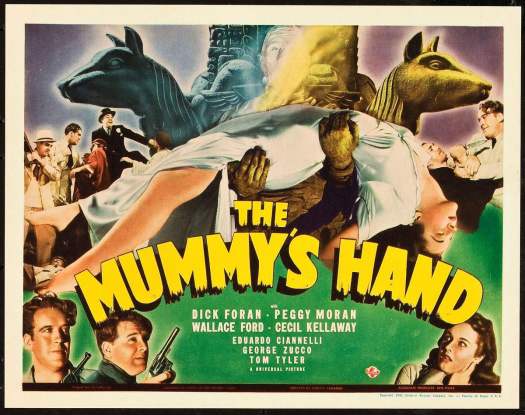
In 1940, having brought back The Invisible Man and Frankenstein’s Monster, Universal Pictures decided that it was also a good time to bring back The Mummy!
The Mummy’s Hand takes place in what we’re told is Egypt, though it’s obvious just a Universal backlot. Two archeologists — Steve Banning (Dick Foran) and Babe Jenson (Wallace Ford) — are penniless and stuck in Egypt. Babe wants to find a way to return to Brooklyn and his ex-girlfriend. Steve is a bit more serious about archeology, though it must be said that he’s no Indiana Jones when it comes to discovering relics and taking them to museums. If Indiana is the type who will risk his life to search a hidden cave in the Amazon Rain Forest, Steve is far more likely to just wander around an Egyptian market until he comes across someone selling an ancient vase.
Which is exactly what happens! Steve finds someone selling a vase and, after he learns where it came from, he buys the vase. He takes the vase to Prof. Andoheb (George Zucco), not knowing that Andoheb is an Egyptian high priest who has been sworn to protect the tomb of Princess Ananka. When Andoheb realizes that the vase could lead to the discovery of the tomb, he lies and claims that it’s a forgery. He then “accidentally” breaks it in order to keep Steve from showing the vase to anyone else. Steve, however, is not deterred and a chance meeting with an American magician named Tim Sullivan (Cecil Kellaway) leads to Sullivan agreeing to finance Steve’s expedition to discover where the vase came from. Sullivan’s daughter, Marta (Peggy Moran), worries that Steve and Babe are just trying to steal her father’s money so she insists on coming on the expedition with Steve. Also following the expedition is Andoheb, who is himself starting to fall for Marta and who is hoping that he can use a secret serum hidden in the tomb to make both himself and Marta immortal.
Of course, the tomb itself is protected by Kharis (Tom Tyler, under a ton of bandages), a mummy who is immortal due to the serum and who has sworn to protect the tomb from any outsiders. Kharis moves slowly but efficiently. He’s a ruthless and silent killer, one whose eyes appears to just be two black holes, the better to reflect his own lack of a soul.
The main problem with The Mummy’s Hand is that it takes forever for the Mummy to actually show up. This is only a 67-minute film and the Mummy mayhem doesn’t really start until around the 50 minute mark. As a result, the viewer spends a lot of time watching Steve and Babe wander around Egypt and essentially act like stereotypical American tourists. Even when the expedition finally gets started, the audience still has to sit through endless scenes of Marta accusing Steve of being some sort of con artist. This is a movie that will truly leave you saying, “When is the mummy going to show up!?”
That said, The Mummy itself is a frightening creature, especially with his empty eyes. Mummy’s are naturally frightening, especially when they’re walking towards you and dragging their decaying bandages behind them. The Mummy is effective, I just wish he had been featured in more of the movie.
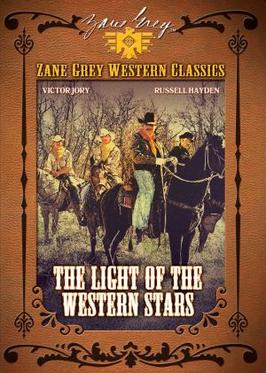
In the dead of night, a train stops in an isolated western town. Only one passenger disembarks. Majesty Hammond (Jo Ann Sayers) is a wealthy Bostonian, who has traveled all the way to the town to try to prevent her bother from marrying a local woman. Majesty takes a seat in the station and waits for someone to come get her.
After a few minutes, a drunken ranch foreman named Gene Stewart (Victor Jory) enters the station. He has made a bet with the local sheriff (Tom Tyler) that he can convince the first new woman to arrive in town to marry him. Stewart’s friends find a priest but before Gene can force the priest to marry them, a local girl named Bonita (Esther Estrella) rides up and tells Gene that one of the ranch hands, Danny (Alan Ladd, the future Shane in one of his earliest roles), has been forced to flee town after getting into a fight with the sheriff.
As if that’s not bad enough, Gene then discovers that Majesty’s brother is going to marry Flo Kingsley (Ruth Rogers), who happens to be Gene’s employer! Ashamed of his behavior, Gene leads Majesty to Flo’s ranch.
After some initial weariness, Majesty is convinced that Flo and her brother really are in love. Flo explains to Majesty how life works out in the frontier and Majesty is even able to forgive Gene for his drunken antics. Majesty decides to buy a ranch in town but what she doesn’t know is that corrupt businessman Hayworth (Morris Ankrum) is using the ranch to smuggle weapons to the Mexican army and that he’s working with the sheriff! Majesty is going to need Gene’s help to run the ranch but, after getting into another fighting with the sheriff, Gene goes into hiding. Can Majesty find Gene and convince him to return to town?
Based on a novel by Western specialist Zane Grey, The Light of Western Stars is only 65 minutes long but it packs a lot of plot and a lot of action into those sixty minutes. Of course, the plot is pretty standard stuff but, for B-movie fans, it’s a chance to see Victor Jory in a rare leading role and also a chance to see what Alan Ladd was doing before he became a noir mainstay. Hard-drinking and occasionally irresponsible, Gene is an interesting hero and Jory does a good job playing him. Alan Ladd doesn’t make a huge impression as Danny but he looks convincing fleeing town on horseback and that’s all the role really requires.
For many viewers, though, the main appeal of Light of Western Stars will be the beautiful Jo Ann Sayers as Majesty. Primarily a stage actress, Sayers only appeared in 16 films before she got married and semi-retired but she made an impression in every one of them. That’s certainly the case here, where her beauty makes it very plausible that even a wanted man would return to town just to be with her.
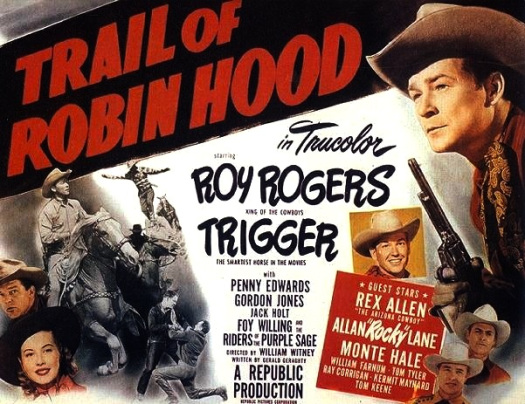
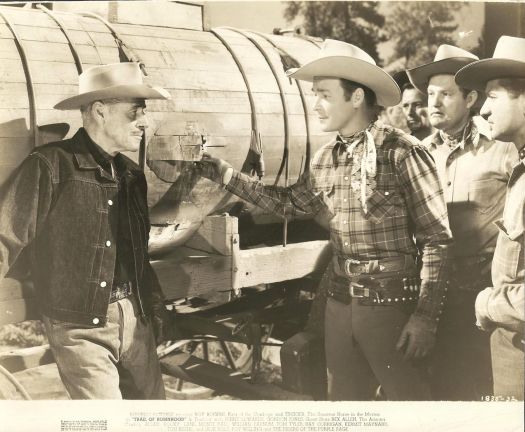
There’s no sign of Robin Hood to be found in the Roy Rogers vehicle TRAIL OF ROBIN HOOD. However, the film has gained a cult following among sagebrush aficionados for the plethora of cowboy stars gathered together in this extremely likable little ‘B’ Western directed by Republic Pictures workhorse William Whitney William Whitney, with plenty of songs by Roy and the Riders of the Purple Sage to go along with that trademark Republic fightin’ and a-ridin’ action (thanks, stuntmen Art Dillon, Ken Terrell, and Joe Yrigoyen!).
Some rustlers have been stealing Christmas trees from ‘retired actor’ Jack Holt’s tree farm. The benign Jack raises his trees to sell at cost to parents of poor kids, but avaricious J.C. Aldridge (Emory Parnell ) and his foreman Mitch McCall (former Our Gang member Clifton Young ) want to put an end to it and corner the Christmas tree market! U.S. Forestry Agent…
Universal revived The Mummy in 1940’s THE MUMMY’S HAND, but except for the backstory (and judicious use of stock footage), there’s no relation to the 1932 Karloff classic . Instead of Imhotep we’re introduced to Kharis, the undead killing machine, as the High Priest of Karnak (Eduardo Cianelli in old age makeup) relates the tale of Princess Ananka, whose tomb is broken into by Kharis, who steals the sacred tanna leaves to try and bring her back to life. Kharis gets busted, and is condemned to be buried alive! For he “who shall defile the temple of the gods, a cruel and violent death shall be his fate, and never shall his soul find rest for all eternity. Such is the curse of Amon-Ra, king of all the gods”. So there!
The High Priest croaks, making Andoheb (George Zucco ) the new High Priest. Meanwhile in Cairo, Americans Steve…
(With the Oscars scheduled to be awarded on March 4th, I have decided to review at least one Oscar-nominated film a day. These films could be nominees or they could be winners. They could be from this year’s Oscars or they could be a previous year’s nominee! We’ll see how things play out. Today, I take a look at the 1940 best picture nominee, The Grapes of Wrath!)
How dark can one mainstream Hollywood film from 1940 possibly be?
Watch The Grapes of Wrath to find out.
Based on the novel by John Steinbeck and directed by John Ford, The Grapes of Wrath tells the story of the Joad family and their efforts to neither get sent to prison nor starve to death during the Great Depression. When they lose their farm in Oklahoma, they head for California. Pa Joad (Russell Simpson) has a flyer that says someone is looking for men and women to work as pickers out west. The 12 members of the Joad Family load all of their possessions into a dilapidated old truck and they hit the road. It quickly becomes apparent that they’re not the only family basing all of their hopes on the vague promises offered up by that flyer. No matter how much Pa may claim different, it’s obvious that California is not going to be the promised land and that not all the members of the family are going to survive the trip.
Tom Joad (Henry Fonda) is the oldest of the Joad sons. He’s just been released from prison and he’s killed in the past. Having been in prison during the start of the Great Depression, Tom doesn’t realize how bad things truly are until he arrives home and sees someone he grew up with using a tractor to knock down a house. (It’s just business, of course. The owners of the house can’t pay their bills so the house gets destroyed.) The film’s story is largely told through Tom’s eyes and Henry Fonda gives a sympathetic performance, one the gets the audience to empathize with and relate to a character who is a total outsider.
As for the rest of the Joad Family, Ma (Jane Darwell) is the glue who holds them together and who refuses to allow them to surrender to despair. (And yet even Ma is forced to make some tough choices when the starving children of one work camp ask her to share her family’s meal with them.) Rosasharan (Dorris Bowdon) is pregnant while Grandpa (Charley Grapewin) is too sickly for the trip but doesn’t have anywhere else to go. And then there’s Casy (John Carradine), the former preacher turned labor organizer. Casy is not blood-related but he soon becomes a member of the family.
The Joads have a healthy distrust of the police and other authority figures and that turns out to be a good thing because there aren’t many good cops to be found between Oklahoma and California. Instead, the police merely serve to protect the rich from the poor. Whenever the workers talk about forming a union and demanding more than 5 cents per box for their hard work, the police are there to break heads and arrest any troublemakers on trumped up charges. Whenever a town decides that they don’t want any “Okies” entering the town and “stealing” jobs, the police are there to block the roads.
The Grapes of Wrath provides a portrait of the rough edges of America, the places and the people who were being ignored in 1940 and who are still too often ignored today. John Ford may not be the first director that comes to mind when you think of “film noir” but that’s exactly what The Grapes of Wrath feels like. During the night scenes, desperate faces emerge from the darkness while menacing figures lurk in the shadows. When the sun does rise, the black-and-white images are so harsh that you almost wish the moon would return. The same western landscape that Ford celebrated in his westerns emerges as a wasteland in The Grapes of Wrath. The American frontier is full of distrust, anger, greed, and ultimately starvation. (Reportedly, the film was often shown in the Soviet Union as a portrait of the failure of America and capitalism. However, it was discovered that Soviet citizens were amazed that, in America, even a family as poor as the Joads could still afford a car. The Grapes of Wrath was promptly banned after that.) John Ford is often thought of as being a sentimental director but there’s little beauty or hope to be found in the images of The Grapes of Wrath. (Just compare the way The Grapes of Wrath treats poverty to the way Ford portrayed it in How Green Was My Valley.) Instead, the film’s only hint of optimism comes from the unbreakable familial bond that holds the Joads together.
As dark as it may be, the film is nowhere near as pessimistic as the original novel. The novel ends with a stillborn baby and a stranger starving to death in a barn. The film doesn’t go quite that far and, in fact, offers up some deus ex machina in the form of a sympathetic government bureaucrat. (Apparently, authority figures weren’t bad as long as they worked for the federal government.) That the book is darker than the movie is not surprising. John Steinbeck was a socialist while John Ford was a Republican with a weakness for FDR. That said, even though the film does end on a more hopeful note than the novel, you still never quite buy that things are ever going to get better for anyone in the movie. You want things to get better but, deep down, you know it’s not going to happen. Tom says that he’s going to fight for a better world and Fonda’s delivers the line with such passion that you want him to succeed even if you know he probably won’t. Ma Joad says the people will never be defeated and, again, you briefly believe her even if there’s not much evidence to back her up.
Even when viewed today, The Grapes of Wrath is still a powerful film and I can only guess what it must have been like to see the film in 1940, when the Great Depression was still going on and people like the Joads were still making the journey to California. Not surprisingly, it was nominated for best picture of 1940, though it lost to Alfred Hitchcock’s Rebecca.
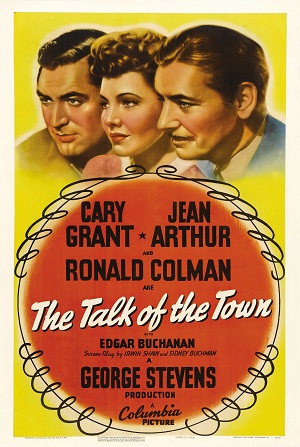
The fourth film on my DVR was the 1942 film, The Talk of the Town. The Talk of The Town originally aired on TCM on March 20th and I recorded it because it was a best picture nominee. As some of our regular readers undoubtedly know, it’s long been a goal of mine to watch and review every single film nominated for Oscar’s top prize.
The Talk of The Town is an odd little hybrid of comedy, melodrama, and a civics lecture. Michael Lightcap (Ronald Colman) is a brilliant attorney and legal professor. He’s been shortlisted for the Supreme Court and he’s also a widely read author. In fact, he’s even rented a house for the summer, so that he may work on a book. The owner of the house — teacher Nora Shelley (Jean Arthur) — will also be acting as his secretary.
As well-read as Prof. Lightcap may be, he’s also rather stuffy and out-of-touch with what’s going on outside of the world of academia. He knows how the law should work but he has little understanding of how the law actually does work. Fortunately, he gets a lesson in reality when he arrives at the house and eventually meets the gardener, Joseph (Cary Grant). Joseph turns out to be surprisingly intelligent and very passionate about politics. Lightcap and Joseph have many debates about whether or not the American legal system actually protects the working man.
What Lightcap doesn’t know is that Joseph is actually Leopold Dilg. Leopold is a labor activist, the type who you always see in old documentaries, standing on a street corner and preaching about unions. Leopold is also a fugitive. He was accused of setting fire to a mill, a fire that apparently led to the death of the foreman. Despite the fact that he loudly proclaimed his innocence, Leopold was arrested and prosecutors announced that they would seek the death penalty. Convinced that he would never get a fair trial, Leopold escaped from jail and fled to Nora’s house.
Nora and Leopold went to school together. They love each other, even though circumstances — mostly his political activism — conspired to keep them apart. When Lightcap moves into the house, Nora and Leopold’s attorney, Sam (Edgar Buchanan), hope that they can convince him to take on Leopold’s case. However, they also have to not only convince Leopold to reveal his true identity but also convince Lightcap to put his supreme court appointment at risk by defending a politically unpopular defendant. Their solution is to trick Lightcap into falling in love with Nora and then convince him to take on the case for her.
However, Nora soons finds herself falling in love with Lightcap for real. Who will she choose in the end? Cary Grant or Ronald Colman? Today, it seems like a pretty easy decision but apparently, in 1942, Columbia Pictures actually shot two different endings for the movie.
The Talk of The Town is an odd little movie. For the most part, it’s a drama. But it also has plenty of comedic elements, mostly dealing with the attempts to keep Leopold’s identity a secret. In the end, it’s a little bit too preachy to really work as either a drama or a comedy. That said, I still liked The Talk Of The Town because it made a strong case for the importance of due process, which is a concept that a lot of people take for granted.
(At the same time, The Talk of the Town was made in 1942 so you never have any doubt that Lightcap’s belief in the American legal system will eventually be vindicated. With America having just entered World War II, 1942 was not a time for cynicism. If Talk of the Town has been made in the 30s, it probably would have been a very different movie.)
Probably the best thing about Talk of the Town is the cast. It may not be a great film but, when you’ve got Cary Grant and Jean Arthur in a scene together, it almost doesn’t matter.
The Talk of the Town was nominated for best picture but it lost to Mrs. Miniver.
 Heldorado, Arizona is a frontier town with a problem. The Tullivers, led by Mike (Tom Tyler), keep robbing the bank and running off anyone who agrees to be the town’s marshal.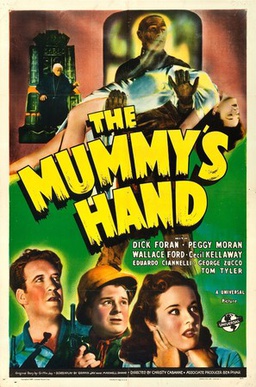



 Through the Shattered Lens