Film Review: Friday the 13th (dir. by Sean S. Cunningham)


(Warning: Spoilers Below)

This month, the 13th is going to fall on a Friday so I figured what better time would there be to watch and review the Friday the 13th franchise?  Through April 13th, I’ll be reviewing each film in the franchise.  Some of these reviews will be positive and quite a few of them will not.  Let’s get things started with the one that started it all, the original 1980 Friday the 13th.

Is there anyone out there who does not know the plot of Friday the 13th?  For those who don’t, here’s a spoiler-filled refresher.  In the late 50s, at the rather crummy looking Camp Crystal Lake in New Jersey, two counselors sneak off from a sing-along so that they can do whatever it was that young people used to do in the 50s.  Suddenly, someone else walks into the room.  “Uhmm, we weren’t doing anything,” one of the counselor says right before a machete is plunged into his stomach.

Jump forward 25 years.  Annie (Robbi Morgan), a bubbly young woman who won’t stop talking about how much she loves children, hitchhikes into Crystal Lake.  She tells the townspeople that she’s looking for a ride to Camp Crystal Lake and everyone give her that “Oh no you didn’t” look.  Crazy old Ralph (played by Walt Gorney) tells her, “You’re doomed.”  Since this is a slasher film, Annie ignores him and ends up getting her throat slashed in the woods by an unseen assailant wearing black gloves.

Meanwhile, at Camp Crystal Lake, the somewhat jerky Steve Christy (played by an actor named Peter Brouwer who never gets enough credit for giving a good performance here) is working hard to get the long-since deserted camp up and ready for its grand reopening.  Helping him out are his fellow camp counselors — lovers of life and fun Marcie (Jeannine Taylor) and Jack (The Kevin Bacon, who is like such a total hottie in this film I don’t even know where to start), boring Bill (Harry Crosby), bossy meanie Brenda (Laurie Bartram), obnoxious practical joker Ned (Mark Nelson), and finally Steve’s girlfriend, Alice (Adrienne King).  Steve tells his counselors to get the camp ready and then heads off to pick up supplies in town.  (Or at least, that’s what Steve says he’s doing.  As far as I can tell, the only thing he does when he gets to town is head over to the local diner and start flirting with the 90 year-old waitress…)

With jerky old Steve gone for the day, the counselors decide to spend their time swimming (and, in Ned’s case, pretending to drown), having sex, smoking pot, and eventually getting killed one-by-one by an unseen murderer.  Eventually, once Alice is the only counselor left alive, she runs into a nice, older woman named Pamela Voorhees (played, with a lot of genuine menace, by Betsy Palmer).  When Alice explains that everyone’s dead, Pamela responds by mentioning that her own son — Jason — drowned at the camp 25 years ago because the counselors were too busy “making love.”  Pamela then tries to kill Alice and Alice ends up chopping Pamela’s head off and then floating out onto the lake in a canoe.  (Meanwhile, the camp is nowhere close to being ready for opening day.)

The next morning, Alice wakes up in the canoe and spots a bunch of police officers on the shore.  As she starts to call out to them, a deformed boy suddenly jumps out of the water and grabs her.  This, of course, is one of the most famous scenes in the history of horror and one that has been parodied and ripped off numerous times.  However, when I first saw Friday the 13th, that scene made me scream and, even today, I still find my heart racing  just a little bit faster whenever I know that it’s coming up.

The first time I ever saw the original Friday the 13th, I was either 8 or 9 and it was all incredibly daring because I was staying up way too late with my older sisters and watching a  cable station for grownups that I knew I wasn’t supposed to be watching.  We didn’t want to wake up mom or dad so we had the volume turned down as low as it would go and we whispered our comments of “Ewwww!” and “Agck!”  (Yes, even at the age of 8, I was already saying “agck.”)  Even though I couldn’t hear the film, I could see it and the end result was thatm when I did eventually go to sleep, I was awake after about an hour, screaming because I had a Friday-inspired nightmare.  I doubt that the movie would scare me as much today because today,I know who Tom Savini is and, if I need proof that Kevin Bacon was actually not killed by Mrs. Voorhees hiding underneath the bed, I can watch my DVD of Crazy,Stupid Love.  But when I was younger, Friday the 13th was the fuel of nightmares and, seeing as I’ve always had my little morbid streak, I think that’s why the franchise continues to interest me.

If there’s one thing that everyone seems to agree about when it comes to Friday the 13th, it’s that the true stars of the film were the disturbingly plausible gore effects designed Tom Savini.   Even when I rewatched the film before writing this review, I was surprised by not only just how bloody a movie Friday the 13th was but also at how realistic it all looked (especially when compared to the intentionally over-the-top gore effects that Savini provided for Dawn of the Dead).  There’s a surprising brutality to the film that reminds us that — unlike future installments in the franchise — the original Friday the 13th was not made for mainstream audiences but instead for the audiences who populated New York grindhouses and dark Southern drive-ins.  The special effect that every other reviewer always seems to point out is the scene where the arrow bursts through Kevin Bacon’s neck.  While that scene is indeed shocking (and sad too, because it’s Kevin Bacon dying), I’m always more disturbed by the scene that immediately follows, where Marcie gets hit in the face with the axe.  That’s the scene that showed up in my nightmare after I watched the film for the first time.

Director Sean Cunningham has said, in numerous interviews, that he was inspired to make Friday the 13th largely because of the box office success of Halloween and there are some pretty obvious similarities between the two films.  What is less often commented upon is just how much of the original Friday the 13th was inspired by the Italian giallo films of Mario Bava and Dario Argento.  Whether it’s the focus on the killer’s black gloves or the use of Harry Manfredini’s iconic theme to signal when something bad is about to happen, the giallo influence is pretty obvious.  Sean Cunningham was hardly an innovative director but when he stole, he stole from the best and the end result, crude as it may have sometimes been, was undeniably effective.

In Peter Bracke’s fascinating history of the franchise, Crystal Lake Memories, there’s an interesting quote from Jeannine Taylor, the actress who  played Marcie.  When discussing her reaction after first reading the script, Taylor says, “To me, this was a small independent film about some very carefree teenagers who are having a great time at summer camp where they happen to be working as counselors.  Then they just happen to get killed.”  Taylor’s comment gets at one reason why Friday the 13th — out of all the slasher films to come out after Halloween — continues to be watched by even people like me who weren’t even alive when it was first released.  Uniquely among the films in the franchise, Friday the 13th is a true ensemble film and, though the performances are somewhat uneven and the characters are pretty one-dimensional, the cast has an easy and likable chemistry.  Watching the film today, it’s a bit hard not to concentrate on the fact that you’re seeing Kevin Bacon in a low-budget slasher film but once you get over that, you realize that Bacon and the entire cast are totally believable as bunch of likable, carefree kids who end up in the wrong place at the wrong time.  A lot of critics have complained that the first half of the film drags as we just watch everyone goofing off around camp.  To me, those early scenes make the film because they get us to care about the characters just enough so that we don’t necessarily want to see them killed.

Another frequent critical complaint is that it’s difficult to have much sympathy for characters who consistently do stupid things that ultimately lead to them getting killed.  Viewers tend to shake their heads as they watch Ned go wandering into a deserted cabin or when Brenda just happens to wander out on the archery range.  Myself, I always tend to roll my eyes whenever the film reaches the point that Marcie decides to run out into the rainy night in just her panties and a shirt.  I always find myself going, “Yeah, like anyone’s really that stupid…”

Of course, even as I type this review, I’m thinking about how, a few nights ago, I thought I heard a catfight at 3 in the morning and my immediate response was to run outside and walk up and down in the alley, wearing only a t-shirt and a thong, calling my cat’s name.*  Even as I searched for our cat, I found myself muttering, “This is like a slasher movie waiting to happen.”  However, I still kept wandering around that alley in my half-naked state because, at the time, I was pretty confident that there weren’t any masked maniacs around.

That’s what people who criticize films like Friday the 13th for featuring stupid characters refuse to admit.  We all do more stupid things than we care to admit because we’re usually pretty confident that there won’t be any negative consequences to our stupidity.  We all know that there are evil psychopaths out there but we’re also confident that we won’t run into them.  The reason why the slasher genre has remained popular is because it forces us to confront our deepest fear, which is that we might not be as safe or have as much control over our fate as we tell ourselves.

Not surprisingly, Friday the 13th and its subsequent sequels has never been as popular with critics as they have with audiences.  In fact, critical reaction upon the initial release of Friday the 13th was so hostile that one critic even printed Betsy Palmer’s address and invited outraged filmgoers to write her letters of protest.  The standard critical complaint about Friday the 13th was that it presented death as a punishment for having sex and smoking weed and here I would say that the critics were mistaken.  While it is true that Jack and Marcie die after doing both of these things, I think there’s actually a far more relevent message to be found within the film.  Consider this: Ned dies after he spots someone in a deserted cabin and says, “Can I help you?”  Steve Christy is killed because he spots someone out in the rain and approaches them, saying, “What are you doing out in this mess?”  Brenda thinks that she hears a child crying for help outside of her cabin and foolishly goes walking around in the middle of hurricane in her nightgown, calling out, “Hello!?” until she’s killed off-screen.  What the critics, so caught up in their moral panic, failed to understand was that the message of Friday the 13th is not that people shouldn’t have sex.  The message is that people shouldn’t offer to help random strangers.

Despite the amount of critical scorn heaped upon it, Friday the 13th was a box-office success and the 18th highest grossing film of 1980.   At the time, for a low-budget, independent film, this was highly unusual.  Despite the fact that Friday the 13th ended with Mrs. Voorhees losing her head and Jason still in that lake, there would be a Friday the 13th Part 2.

We’ll deal with that tomorrow.  Until then, don’t help any random strangers…

——

*Doc, our cat, was fine, by the way.  It turned out, he was sitting in the kitchen the whole time I was outside desperately searching for him.
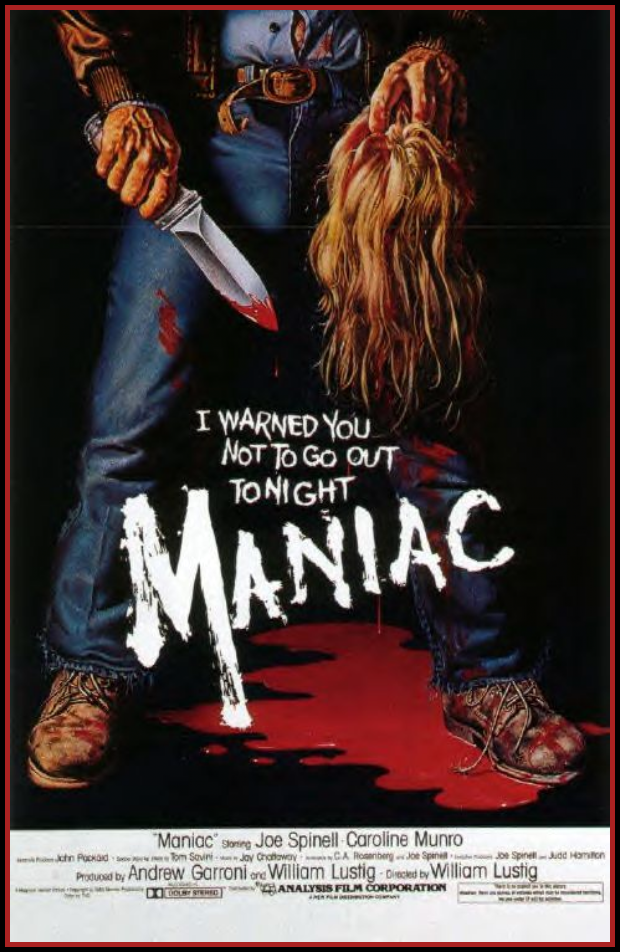
Scenes I Love: Maniac


With news that the remake of Maniac has finally gotten it’s Frank Zito in the form of Elijah Wood I thought it was high time that I shared my favorite scene from the original film by William Lustig. it’s this scene that I hope will make it intact and with little to no CGI to make it happen in as glorious a fashion as the original scene.

The latest “Scenes I Love” comes courtesy of the make-up FX magic by Tom Savini. In fact, this scene actually has him doing double-duty roles as not just the make-up FX artist but as an actor in the scene. This particular scene has been dubbed the “Disco Boy” scene and Savini ably stands in for the role of Disco Boy. We have him and his Disco Girl making out in their car when suddenly we see Frank Zito peeping in like some sort of Son of Sam copycat. Well, Disco Girl freaks out and Disco Boy attempts to act cool and protective. Little does Disco Boy know that he will soon be immortalized in a few seconds of blood and gore that goes down as one of the best “kills” ever put on film.

6 Trailers While You Wait


So, I’m currently still working on my review of Black Swan, which I saw this weekend and loved so much that I ended up having an asthma attack at the end of it.  But anyway, as we wait for me to discover articulation, why not check out 6 more of my favorite grindhouse and exploitation film trailers?

1) Deathdream (a.k.a. Dead of Night)

Now, this is an interesting debut film from the prolific Canadian director Bob Clark (the man who later gave the world both Black Christmas and A Christmas Story).  A young soldier is killed in Viet Nam and shows up back in his hometown one night later without a soul.  The allegory is pretty obvious but it’s still effectively done and crawls under your skin.  This film was also one of Tom Savini’s early films.  The soldier’s father is played by John Marley who later appeared in The Godfather with a horse’s head in his bed.

2) Delinquent Girl Boss: Worthless To Confess

I’ve never seen this movie.  I just like the title.

3) The Black Cat

Director Lucio Fulci made this film around the same time he was making his more famous zombie films but it never got the same attention, despite starring David Warbeck.  I love the cat — he’s so cute and he reminds me of my own cat.  Plus, he’s quite effective at killing people.

4) School of the Holy Beast

Apparently, this is a nunsploitation film from Japan!  That nunsploitation was a very popular genre in Italy, Spain, and Ireland makes sense when you consider that those are three of the most Catholic countries on the planet.  But Japan?

5) The Blood Splattered Bride

The trailer for the 1971 Italian lesbian vampire film goes on for a bit too long but I think it has nice atmospheric feel to it (the same can be said of the film itself). 

6) The Dead Pit

Since we started with a zombie film, let’s end with one as well.  The Dead Pit is pretty silly but I enjoyed it and would happily star in a remake.  Plus, the trailer’s line about “the thickness of the door” just amuses me on so many levels.

The Daily Grindhouse: Maniac (dir. by William Lustig)


The newest flick to make “The Daily Grindhouse” is the controversial slasher/splatter offering from one of the 1980’s masters of the American grindhouse cinema. William Lustig’s Maniac definitely fits the criteria of what makes a grindhouse flick.

Lustig’s flick helped start the so-called “splatter film” subgenre in horror. While more mainstream (and I used that term very loosely) horror like Friday the 13th and Black Christmas brought the “slasher film” genre to the public eye it was the release of Maniac which gave “splatter” the notoriety it craved. It was a flick which was released by it’s distributor as unrated since they refused to let the MPAA screen it for certification knowing the it would automatically get the dreaded “X-Rating”. This rating would kill off any attempt for it to get shown in cinema theaters (even some owners of grindhouse theaters would deny to screen it). But it was a colleague of special effects and make-up artists (also an actor in Maniac) who gave Lustig and it’s distributor the backdoor way to get the flick seen.

George A. Romero’s classic epic zombie film Dawn of the Dead was released unrated and it still made quite the box-office haul that it gave future filmmakers a way out of the MPAA’s X-Rating hell. Maniac would get the same treatment and, while it didn’t get quite the box-office success as Romero’s  zombie opus, it did make enough coin to be become one of Lustig’s moderate successes.

The flick was controversial not just for the decision to release it unrated but also for the label of misogyny it received from film critics who did see it. It didn’t help Lustig’s cause that the film was practically about a pyschotic and schizophrenic man who murders and scalped beautiful women to help decorate the mannequins he kept in his home. This flick was the grindhouse version of Hitchcock’s Psycho (to me a film that would be grindhouse if not for Hitchcock being the filmmaker thus given classic status by the elite cineaste crowd) and where Hitchcock kept the violence as something to be imagined Lustig went for the jugular and showed everything.

The most controversial scene would forever be the slow-motion sequence of Joe Spinelli’s killer, Frank Zito, taking a shotgun and shooting Tom Savini’s character point-blank in the head. The scene was so horrific and realistic in its execution that people left the theater right after the scene ended thinking even worse things were to be shown for the next hour (acclaimed film critic Gene Siskel left right after that scene). Tom Savini’s experience as a combat photographer during the Vietnam War gave him the necessary know-how to create the “Disco Boy Scene” so realisticly and which made him one of the early “fathers of the splatter genre”.

Maniac would propel Lustig to cult-status in the horror genre not because of the quality of his work, but for how he pulled no punches in showing the violence in his films even if got him labeled misogynistic and exploitative in mainstream cinema. His flicks were average for the most part, but they were definitely grindhouse in that they spoke to the most base denominator and that’s sex and violence sells and he didn’t sugarcoat it.

Review: Sgt. Pepper’s Lonely Hearts Club Band (Dir. by Michael Shultz)


In 1978, just based on what I’ve read, everyone in America was regularly doing huge amounts of cocaine.  Whether you were in a disco or at a PTA meeting, you knew that eventually someone would produce a small mirror covered with white powder.  President Carter even snorted it during that year’s State of the Union speech.  Sure, some people used gold spoons and others had to make do with a one dollar bill but, in the end, cocaine brought all Americans together as a nation and helped the country heal after the trauma of Watergate. 

It also contributed to some the year’s best films.  Days of Heaven, Superman, The Deer Hunter, Coming Home, Grease, Animal House, Interiors, Halloween, Midnight Express, Convoy, Go Tell The Spartans, and An Unmarried Woman; these were all films fueled by the Peruvian Headache Powder. 

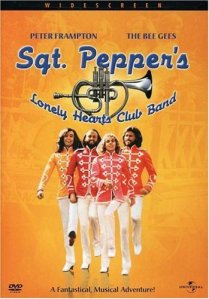
However, no discussion of 1978 cocaine-fueled films would be complete with mentioning Sgt. Pepper’s Lonely Hearts Club Band.  Featuring songs originally performed by the Beatles and starring the Bee Gees, Peter Frampton, and a whole bunch of other people that my mom liked, Sgt. Pepper’s is a film that, quite honestly, should just be retitled 1978.

Plotwise — oh God, do I really have to try to describe the plot?  Seriously, this could take forever.  I mean, the film isn’t quite two hours long but a lot of stuff happens and really the only connection between any of it is that these odd cover tunes of classic Beatles songs keep popping up in the weirdest places.  Okay, let me try to get this all into one paragraph —

There’s a small town called Heartland that is very small and simple but it’s also the home of the legendary Sgt. Pepper who, throughout history, has maintained world peace by playing his magic instruments.  But then Sgt. Pepper dies and apparently turns into a gold weather vane.  His magic instruments are given to the mayor of Heartland, Mr. Kite (George Burns, who also narrates the entire movie).  The world is in mourning.  But then one day, the Henderson Brothers (the Bee Gees) decide to form a new Sgt. Pepper’s Lonely Hearts Club Band and they invite Sgt. Pepper’s grandson, Billy Shears (played by Peter Frampton) to be their lead singer.  Heartland rejoices and George Burns has a surprisingly sweet scene where he sings  Fixing A Hole.

Anyway, the new band is such a hit that the owner of a record company invites them to come to Los Angeles and record an album.  Billy says goodbye to his girlfriend, Strawberry Fields (Sandy Farina) and then joins the Hendersons in a hot air balloon which promptly leaves for California.  En route, the balloon collides with an airplane but nobody is seriously injured. 

In Los Angeles, they meet the record company owner and it turns out that he’s played by Donald Pleasence.  (It’s interesting to think that Pleasence filmed this and Halloween around the same time.)  Pleasence proceeds to sing the creepiest version of I Want You ever heard.  I’d include a clip of the performance but Pleasence manages to go on for a good ten minutes, repeating “I want you,” in an odd little voice while staring at Peter Frampton.

The boys sign a contract with Pleasence.  Billy Shears is led astray by Lucy and her band, the Diamonds.  (Guess which song they get to sing.)  Somehow, this allows Mean Mr. Mustard to steal Sgt. Pepper’s magic instruments.  Mr. Mustard drives around in a yellow van and he’s assisted by two female robots who, at one point, sing She’s Leaving Home in their electronic, robot voices.

The band is informed that the instruments have been stolen.  Outraged, they jump back in their hot air balloon and quickly start a recovery operation.  It turns out that Mean Mr. Mustard has given the instruments to three separate villains.

The first villain is Dr. Maxwell Edison who uses his silver hammer to turn old people into boy scouts.  This may sound ludicrous and silly but fortunately, Maxwell is played by Steve Martin.  His cameo is one of the highlights of the film, if just because he seems to be one of the few people who actually enjoyed himself on set.

The second villain is the Reverend Sun.  He brainwashes people or something.  I’ve seen this movie a few times and I still can’t quite figure out what Reverend Sun’s deal is.  When I first saw this movie, I got excited because I thought that Tom Savini was playing Rev. Sun.  Then I forced my sister Erin to watch the movie and she told me I was stupid because Rev. Sun was obviously being played by Frank Zappa.  Well, I did some reasearch and discovered that we’re both stupid.  That’s neither Savini nor Zappa.  It’s Alice Cooper.

The final villains are played by a very young (and very, very hot!) Aerosmith.  Here, they are called the Future Villain Band and oh my God, Joe Perry…this film needed a lot more Joe Perry.  I mean, it’s understandable that Steve Tyler  gets most of the screen time and young Steve actually looks pretty good in a Mick Jagger sort of way but Joe Perry…Oh. My.  God.  Anyway, Aerosmith does a cover of Come Together and Joe Perry circa 1978 was just so freaking gorgeous, oh my God.  Eventually, Frampton and the Bee Gees come along and ruin things by getting into a fight with Steve Tyler which leads to the camera constantly cutting away from Joe Perry who is really, really, really hot and all kinds of sexy in this movie.  They should have just called this movie Joe Perry.  Oh.  My.  God.

Uhmm, where was I?  Oh yeah — so, anyway, eventually the weather vane comes to life and suddenly, Sgt. Pepper’s a black man who sings Get Back and ends up magically resetting the past and turning Mean Mr. Mustard into an altar boy or something like that.  Oh, and the Bee Gee who looks like a New Age healer ends up singing my favorite Beatles song, A Day in the Life

Finally, it appears that every single person on the planet shows up in the film’s final scene where a huge group of “stars” show up and sing the film’s title tune one last time.  In the end credits, these people are listed as being “Our Guests At Heartland.”  Doing some research (i.e., looking the thing up in Wikipedia), I’ve discovered that these folks were apparently all pop cultural icons in the 70s.  I didn’t recognize a single one of them but I’m sure they probably all snorted a lot of cocaine.

(And, by the way, Joe Perry does not get to return for the finale so bleh on you, movie.)

For some reason, this movie kept showing up on Starz last November and that’s where I first discovered it.  The first time I saw it, I came in right at the start of Steve Martin’s cameo and the film itself was so just plain weird that I had to jump on twitter and let the world know what I was watching.  (Actually, it doesn’t take much to make me jump on twitter and tell the world what I’m doing.)  As a result, I soon discovered that, apparently, I was the only person on the planet who didn’t know about this film.

Sgt. Pepper’s Lonely Hearts Club Band is really a pretty bad movie.  The plot tries way too hard, the pacing is terrible with some scenes lasting forever and others ending before they really start, and Frampton and the Bee Gees are all distinguished by an utter lack of charisma.  The youngest Bee Gee appears to be cheerfully stoned throughout the entire movie while the other two (and Frampton) are trying way too hard to act. 

And yet, the film fascinates me.  After I saw it the first time, I forced my sister to watch it with me a second time.  I then watched it again on my own.  Finally, I went down to the local Fry’s and nearly did a happy little dance when I found it on DVD.  I’ve watched it since several times.  Whenever I’m depressed, it always cheers me up.

 What’s the appeal?  Some of it is definitely the whole “so-bad-its-good” thing.  Actually, that’s probably most of it.  Another thing fascinating thing is how literally the filmmakers choose to interpret the Beatles lyrics.  Considering the fact that the Beatles themselves were rather open about the fact that a lot of their lyrics were simply nonsense and word games, it’s interesting to try to understand logic behind trying to force them into a coherent storyline.  (This is also the appeal of 2007’s Across The Universe, which is technically a better movie than Sgt. Pepper’s but isn’t half as fun to watch.)  For instance, Billy Shears isn’t in the film because he’s an interesting character.  Instead, he’s just here because — 10 years earlier — either John Lennon or Paul McCartney choose to toss the name into a song.  We’re never quite  sure what Mean Mr. Mustard’s dastardly motivation is beyond the fact that the filmmakers had the rights to his song.  If nothing else, the film is an interesting example of what happens when people try to create a novel out of somebody else’s short story.

However, I think the main appeal of Sgt. Pepper’s is the appeal of 1978.  Watching the movie, you feel almost as if you’re literally sitting beside the cast at Studio 54, watching as everyone snorts a line.  I think that, for future historians, this film may very well turn out to be a cinematic Rosetta Stone.

Then again, maybe it really is just so bad that it’s good.

The Kids Are Not All Right: 6 More Trailers That I Love


Continuing my ongoing survey of classic exploitation and grindhouse film trailers, here’s six more.  

1) Simon, King of the Witches — I’ve never seen this film but I caught this trailer on one of the 42nd Street compilation DVDs.  It doesn’t really make me want to see the film but I love the trailer because it is just so totally and utterly shameless.  Seriously, could this thing be more early 70s?  As well, I’ve always wondered — would witches actually have a king?  I mean, seriously, get with the times.

The film, by the way, stars Andrew Prine who apparently had a really promising film career until his girlfriend, Karyn Kupicent, died mysteriously in 1964.  A lot of people believed that Prine killed her though he always denied any guilt and there’s really no evidence to connect him to the crime.  Interestingly, even more people seem to think that Kupicent was murdered because she knew something about John F. Kennedy’s assassination.  Finally, true crime author Steve Hodel has suggested that Kupicent was actually murdered by his father, Dr. George Hodel.  (Steve also claims that George was the Black Dahlia killer, the Zodiac killer, Chicago’s lipstick killer, and that George was responsible for just about every unsolved murder in history.  Oedipus much?)

2) The Town That Dreaded Sundown Though I didn’t consider this while selecting this trailer, this is another film that features the unfortunate Robert Prine.  I’ve seen this film exactly one time when it showed up on late night television once.  Unfortunately, considering that it was 4 in the morning and the movie was obviously heavily edited for television (not to mention that constant commercial interruptions), I didn’t really get to experience the film under ideal circumstances.  As a result, I’ve been trying to track this movie down on DVD ever since.  It’s not an easy film to find.

One of the reasons this movie fascinates me is because it’s not only based on a true unsolved crime but it actually follows the facts of the case fairly closely.  In the late 40s, Texarkana was stalked by a masked gunman known as the Phantom Killer.  The case was never solved and its gone on to become a bit of a local legend in the rural Southwest.  Part of my interest in this case comes from the fact that I grew up in the rural Southwest.  It’s the part of the country I know best and this film was actually filmed in the southwest as opposed to just an arid part of Canada.  Interestingly enough, the Phantom Killer had a lot of similarities to the later Zodiac Killer.  However, as far as I know, Steve Hodel has yet to accuse his father of haunting Texarkana.

The film itself was made by Charles B. Pierce, a filmmaker who was based in Arkansas and made several independent films in that state.  Perhaps this explains why the trailer refers to “Texarkana, Arkansas” even though everyone knows that the only part of Texarkana that matters is the part that’s in Texas.

3) Nightmares in a Damaged Brain This is one of the infamous “video nasties” (trust the English to not only ban movies but to come up with a stupid and annoying label for those movies).  Like many of those films, this is a gory Italian film that seems to bathe in the sordid. 

It’s also fairly difficult film to find.  The DVD I own is actually a copy of the severely cut version that was eventually released in England, of all places.

(Another thing about the English — why is it that a culture that obsessively uses the word “cunt” in casual conversation seems so driven to distraction by a little fake blood?  It’s as if someone told them that banning movies would somehow make up for the attempted genocide of Catholics in Northern Ireland.)   

However, even in cut form, this is a disturbingly dark and frequently depressing film.  Evil seemed to radiate through my entire apartment the whole time I was watching it and that atmosphere is captured in the movie’s trailer.

As a sidenote, the gore effects in this film are credited to Tom Savini.  At the time of the film’s release, Savini announced that he actually had nothing to do with this movie.

4) To the Devil a Daughter — I recently read a biography of Christopher Lee in which he cited this movie, along with the original Whicker Man, as one of his personal favorites.  It was also the film debut of Natassia Kinski, the daughter of Klaus Kinski.  Considering Klaus’s reputation, the title is ironic.

5) Vampire Circus This is another movie that I’ve never seen but I’ve heard great things about it.  Supposedly, its one of the last great Hammer vampire films.  Reportedly, it was controversial at the time of its release because it featured vampires attacking English children.  (Which, if nothing else, at least prevented from growing up to kill little Irish children.)  Seeing the trailer leaves me even more frustrated that it has yet to be released, in the States, on DVD.

6) Dr. Butcher, M.D. — This is actually a rather odd zombie/cannibal film hybrid from Italy.  It was originally titled Zombie Holocaust but the American distributors retitled it Dr. Butcher.  I love this trailer for much the same reason I love the Simon, King of the Witches trailer.  It is just pure and shameless exploitation.  Plus, it features some of the best moments of the great Donal O’Brien’s performance as the “title” character.  I recently forced my sister Erin to watch Zombie Holocaust.  Ever since, whenever I start to ramble too much, she simply looks at me and says, “Lisa’s annoying me.  About to perform removal of vocal chords…”  She actually does a fairly good impersonation.  Consider this just more proof that the Grindhouse brings families closer together.

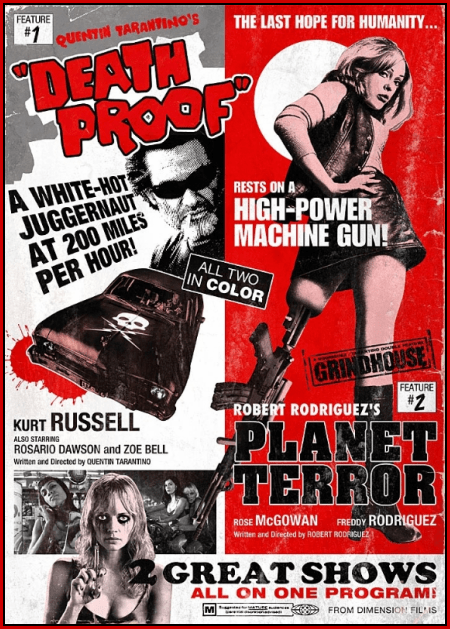
Review: Grindhouse (dir. by Robert Rodriguez and Quentin Tarantino)


Robert Rodriguez and Quentin Tarantino have always professed to anyone within hearing distance their extreme and fanboyish love for the grindhouse days of filmmaking. Both directors’ resume of work look like a modern grindhouse films but with better writing, effects and directing. Anyone who grew up watching grindhouse film’s of the 70’s and 80’s can see it’s heavy influence on films such as From Dusk Til Dawn, Desperado, Pulp Fiction and Kill Bill. With 2007’s Grindhouse, both Rodriguez and Tarantino take their fanboy love for all things grindhouse and exploitation to a whole new level with personal take on the cheap John Carpenter-knock offs, zombie gorefests, slasher film and revenge-driven flicks that made being a young kid during the 70’s and 80’s quite enjoyable.

For those who do not know what grindhouse films are they’re the ultra-cheap and, most of the time, very bad, shlocky horror, revenge, softcore porn, badly-dubbed kung fu flicks and a myriad of other B- to Z-grade movies. These movies were shown in dingy, decrepit (usually former burlesque stagehouses) movie houses which showed double to triple-bills of titles for a low, cheap price all day long (where the popcorn and concession snacks were as stale as week-old coffee). These places and their films were book-ended by the cheap drive-in theaters which grew out of the suburban sprawl boom era of the 60’s and 70’s. One could not avoid the fact that the projector equipment were in bad shape and in desperate need of maintenance while the films played out. Then there’s the film reels themselves with their washed out sequences, out of focus scenes, burnt-in spots and missing film reels where the sex scenes would’ve been. This was the grindhouse experience and with the rise of Hollywood as a corporate entity even moreso than it’s been in the past and urban renewal projects by big city leaders, the grindhouse experience has pretty much faded away and kept alive only in the memories of its fans worldwide.

What Robert Rodriguez and Quentin Tarantino have cranked out with their three-hour long opus to those grindhouse days has been both a literal and thematic homage to an era long since gone. Grindhouse also has allowed Rodriguez and Tarantino to pull out all the stops in filming their respective halves of the film. Rodriguez went all-out in paying literal homage to the zombie gore-fests of George A. Romero, Lucio Fulci and Umberto Lenzi. Planet Terror plays like a hodgepodge of all the zombie movies from these masters of the walking dead but Rodriguez has the use of digital effects to match the over-the-top feel of the past zombie-fests without making the effects look too cheap.

The story for Planet Terror is quite simple yet full of so many incoherent subplots that trying to keep track with whats going on would just confuse a viewer even more. Rodriguez gets the grindhouse feel with such a ludicrous storyline. Whether it was done on purpose or not, the feeling of confusion in addition to the non-stop zombie action was only compounded even more by the digitally-added film stock scratches, burns to the edges of the reel and when the movie was about to get all hot and sexy, missing reel footage. Anyone who watched movies in grindhouse theaters would recognize the look quite well. Rodriguez goes all out in letting his zombie fanboy out. The violence in Planet Terror begins strong and just gets stronger and even more over-the-top right up to the final frame. Zombie’s getting their heads blown apart is shown in scratchy, loving detail with an impossible amount of blood, bone and brain for people to gawk at. The female characters are hot and sexy. Rose McGowan as Cherry Darling holds Planet Terror together with her spunky go-go dancer dreaming to be a stand-up comedienne turning into Ellen Ripley minus a leg but gaining an M16A3 w/ M203 grenade launcher as a leg prosthetic. Freddy Rodriguez as El Wray, her wayward and mysterious lover, almost seem to be channeling a hilariously bad version of Snake Plissken. These two make for quite the explosive couple as they must try and save their small Texas town from the infected townspeople turned pus-oozing, boil-ridden zombies.

Planet Terror sports a nice collection of current B-list actors like Josh Brolin (making like a Nick Nolte at his growliest) and Marley Shelton as a pair of married doctors with marital problems compounded by the increasing amount of zombies their hospital seem to be bringing in for medical help. There’s also genre veterans Michael Biehn, Jeff Fahey and Tom Savini to give Planet Terror the appropriate grindhouse look and feel to it. Ever the good friend and buddy collaborator, Rodriguez even gives Quentin Tarantino a role in his half of the film. He’s shown in the credits for Planet Terror as The Rapist. If any director seem destined to be one, if their love for movies didn’t steer them on the right path, Tarantino seem to look just like one to be called “Tha Rapist”.

There’s explosion and gore galore in Rodriguez’s ode to the zombie genre. Some who sees it might say there’s too much and they would be right if the title of the whole film wasn’t Grindhouse. I, for one, am glad Rodriguez decided to not hold back with what he threw onto the screen. I’m sure that when the dvd finally comes out and the unedited full version of Planet Terror is shown it’ll even surpass the 85-minute running time in the film. I think I can forgive Rodriguez for his gore excess and at times I actually wished for more, but then that would mean taking even more time before I get to Tarantino’s half of the movie. Planet Terror truly got the look of a grindhouse flick, but it’s Tarantino’s Death Proof half which got the spirit of grindhouse down to near-perfect.

Before Tarantino’s Death Proof half of Grindhouse begins the audience gets treated to a sort of intermission involving three fake trailers for movies which celebrate just how ridiculously fun grindhouse movies really were during the 70’s and 80’s. There’s Rob Zombie’s Werewolf Women of the SS which was this weird mish-mash of the women-in-prison flicks with that of the infamous Ilsa: She-Wolf of the SS films that brought about the exploitation in grindhouse. This trailer was great just for the inspired casting of Nicolas Cage as Fu Manchu and Sybil Danning as one of the so-called SS women werewolves. There’s also Edgar Wright’s fake trailer for Don’t (director of Shaun of the Dead and Hot Fuzz) which parodies the trailers for all the gothic, European haunted and horror movies where none of the actors in the trailer speak a word to make sure the film doesn’t get labeled as a “foreign film”. But it’s the third trailer in that intermission trio which had everyone in the audience reacting wildly.

Eli Roth’s Thanksgiving is a throwback to the seasonal-themed slasher flicks like Black Christmas but this time turns the yearly, turkey day and Pilgrim celebration into a trailer with some of the most disturbingly inventive scenes for a fake slasher movie. I don’t know what the Pilgrim serial killer was doing with that turkey at the end of the trailer but I’m sure it will have many people talking about it afterwards. It’s this Eli Roth trailer which fully captures the gritty and gratuitious nature of what makes a grindhouse horror movie. It’s also the one fake trailer I hope Roth would re-visit and turn into a full-length movie.

Now, with the trailers out of the way, Tarantino’s half of Grindhouse begins and we’re treated to a different take on the grindhouse experience. Death Proof begins as if it will continue Rodriguez’s literal examination and homage to the grindhouse experience, but after messing with the film’s focus, adding a few film scratches to the celluloid and even adding a missing reel gag, Tarantino suddenly slows all those grindhouse trickeries and actually ends up making a rip-roaring slasher-revenge-carchase flick. Tarantino takes one part slasher movie adds in a heavy dose of his own Reservoir Dogs (the talking between the female characters in Death Proof are as foul-mouthed and trivial as the diner scene in Reservoir Dogs) then mixes in equal amounts of Vanishing Point, Faster Pussycat! Kill! Kill! and I Spit On Your Grave. Instead of just mimicking these particular grindhouse classics, Tarantino uses his own flair for extended dialogue to slow down the pace of the film thus lulling the audience for the two pay-offs which happen in the middle and the end of Death Proof. Tarantino’s half of Grindhouse could’ve went nowhere with all its estrogen-laced talkies, but Kurt “I AM SNAKE PLISSKEN” Russell really saves the day once he makes his appearance as the automotive-themed serial killer, Stuntman Mike. Where Jason uses farming and bladed implements as his tool of the serial killing trade, Stuntman Mike uses both a 1971 Chevy Nova SS and a 1970 Dodge Charger R/T 440 as his weapons of choice. Both vehicles have been made death proof for filming violent car stunt sequences, but in order to appreciate it’s unique life-saving properties then one has to sit where Mike sits.

Kurt Russell can now add Stuntman Mike to his classic list of badass roles. Mike would feel quite welcome amongst the like of Snake Plissken, John J. MacReady, and Jack Burton to name a few of Russell’s classic characters. Mike comes across as cooly and slickly dangerous, yet not psychotic. His charm is quite disarming until it turns deadly. He really takes the slasher-character stereotype and turns it on its ear. Death Proof once again shows that when Tarantino gets to work with one of his boyhood idols he really gives them a role that they could sink their teeth into.

Death Proof captures the spirit of what makes a grindhouse exploitation film. Even with the heavy references to Vanishing Point, especially with a white 70’s Dodge Challenger used just like in that movie, Tarantino still injects his own brand of craziness to the whole movie. I know many who have complained that Death Proof was too much talk with only the car chase in the end being the saving grace. I politely disagree and say that it’s that very long periods of dialogue between the women in Death Proof that brings some of the spirit of grindhouse to the story. Many forget or don’t remember that most grindhouse cheapies had so much extraneous dialogue to hide the fact that the budget was low to none when the movies were being made so they had to fill-up the movie’s running time with as much nonsensical dialogue before the big effect shots payoff.

The final chase-scene between the Russell’s Stuntman Mike and the female-trio of Rosario Dawson, Tracie Thoms (channeling Jules from Pulp Fiction) and real-life stuntwoman Zoe Bell (she doubled as Uma Thurman in the more dangerous stunts in Kill Bill) has to go down as one of the craziest, whiteknuckling, barnburning car chase sequences of the modern times. No CGI-effects trickery and fancy MTV-style editing was used. George Miller, John Frankenheimer and Richard Sarafian would be proud of what Tarantino was able to accomplish with Death Proof‘s 20-minute long car chase. By the time Death Proof ends the audience have bee put through the wringer and one was hard-pressed not to cheer and root for Stuntman Mike even though we know we shouldn’t. Death Proof proves that “hell hath no fury like a woman scorned” or at least a trio of women endangered.

Grindhouse is a film not for everyone. There’s going to be quite a few people who won’t “get” the film homages and references by both Robert Rodriguez and Quentin Tarantino. Some would say that the movie was too over-the-top, badly made and just out there, but then they would be missing the point of the whole project altogether. For those who grew up watching these kind of films as kids and teenagers, it’s a belated Valentine’s gift from two fanboy filmmakers who finally were able to do the films they grew up idolizing and enjoying. For the rest who are not as well-versed in the grindhouse cinema, this is a good enough starter before they move on to try the classic ones which are now on video (I would suggest they find a worn-out VHS copy of it instead of the cleaned up DVD version). The film is over three-hours long, but one who goes in really can’t say that they didn’t get their money’s worth when they went in to watch Grindhouse.

10 Films I Must See Before I Die


I love movies.  I love watching movies, reading about movies, and talking about movies.  Perhaps most of all, I love the hunt.  I love discovering movies or finding movies that had previously, for me, only existed in reviews or as a collection of screen captures.  To me, there is no greater experience the watching a movie for the first time.  (Even if, as often happens, that first time turns out to be the only time.)  Listed below are ten movies that I have yet to see but desperately hope to at some point in my life. 

1)  Giallo a Venzia (1979) — This is supposedly one of the most graphically depraved Italian horror films ever made.  If that’s not a recommendation, I don’t know what is.  Actually, I haven’t heard a single good thing about this movie but it has still become something of a Holy Grail in my quest to see as much Italian horror as possible.  This is largely because the movie is nearly impossible to find.  When it was first released, it was banned in the UK as part of the so-called “video nasties” scare.  (Trust the English to not only ban a movie but to come up with an annoying name for doing so in the process.)   This led to it never really getting much of a release in the English-speaking world and, now years later, it’s only available on bootleg DVDs.  As such, I imagine that if I ever do see it, it’ll be because I made a deal in a back alley with some bald guy who speaks with a Russian accent.  Much as with drug prohibition, the fact that its “forbidden” has made this movie rather attractive.

The few people who have seen this always mention that towards the end of the movie, Mariangela Giordano’s legs are graphically sawed off.  This makes sense as Giordano was always meeting grotesque ends in Italian horror movies.  In Patrick Lives Again, she is impaled (through her vagina no less) by a fireplace poker while in Burial Ground, she makes the mistake of breast feeding her zombie son.  In many ways, Giordano was like a female Giovanni Lombardo Radice.  However, its odd to consider that while the sight of Giordano’s legs getting sawed off was enough to get the film banned, the sight of poker being graphically driven into her crotch was apparently totally acceptable.  Censorship is a strange thing, no?

One last reason I want to see this movie — its filmed in Venice.  When I was in Italy, I fell in love with Venice.  (I also fell in love with a tour guide named Luigi but that’s another story.)

2) An uncut version of Nightmares in a Damaged Brain (1981) — This is another banned Italian movie.  When Nightmares was originally released, Tom Savini was credited as being behind the special effects.  Savini, however, has long claimed to have had little to nothing to do with the movie.  As Savini, to his credit, has never been embarrassed to claim ownership for his effects (regardless of the movie they appear in), I’m inclined to believe him.

In many ways, Nightmares reminds me of a film that Savini actually did work on, Maniac.  Not so much as far as the plot is concerned but just in the same bleak worldview and almost palpable sleaze that seems to ooze from every scene.  The version that is most widely available on DVD (and the one that I own) appears to be the cut version that was eventually okayed for release in the UK and even cut, this is a film that remains oddly compelling in just how much its willing to immerse itself in sleaze.  The uncut version remains elusive but someday, I will find it.

3) The Day The Clown Cried (1972) — You knew this one was coming, didn’t you?  I think everyone wants to see Jerry Lewis’s never released Holocaust comedy.  Supposedly, Lewis keeps the movie in a locked vault which I just find to be oddly hilarious.  My hope is that, if nothing else, some enterprising filmmaker will make a movie about a crack team of thieves who break into Jerry Lewis’s estate just to steal the only copy of The Day The Clown Cried and sell it to the people at Anchor Bay.  Jerry could play himself.  I also think this film will see the light of day sooner or later.  At some point, either Jerry Lewis or his estate is going to need the money.

4) The Other Side of the Wind — Orson Welles apparently spent the last few decades of his life making this movie.  At the time of his death, the movie was reportedly 95% film but only 40% edited.  Apparently, because of a whole lot of complicated legal things, the movie has spent the last 30 years under lock and key in Iran.  Even if somebody could rescue it, the remaining footage still needs a strong hand to put it together.  While I’m sure that many directors would be happy to volunteer to provide that hand, the two names most frequently mentioned — Peter Bogdonavich and Henry Jaglom — do not fill me with confidence.  I’d rather see the final film put together by Jess Franco, who was assistant director on Chimes at Midnight.

5) The Fantastic Four (1994) — This is not the dull movie that came out in 2005.  This apparently an even duller version of the same film that was made 11 years earlier for legal reasons.  Apparently, Roger Corman would have lost the movie rights to the comic book if he didn’t start production on a film by a certain date.  So, this film was made on the cheap and then promptly shelved.  My main desire to see it comes from the same morbid desire that makes me look at crime scene photos.  How bad can it be?

6) Le Cinque Giornate (1973) — This Italian film is apparently many things.  It’s a comedy.  It’s a historical epic.  It’s a satire of then contemporary Italian politics.  And most of all, it’s also apparently the only non-horror film directed by Dario Argento.  This was Argento’s fourth  film, coming after his celebrated animal trilogy and it was apparently an attempt, on Argento’s part, to break away from the giallo genre that he has since come to symbolize.  Though the film apparently did well enough in Italy, it failed to establish Argento as a director of comedy and that’s probably for the best as Argento’s fifth film would be the classic Deep Red.  Still, it’s hard not to play the “What If?” game, especially when it involves an iconic a figure as Dario Argento.  It’s also interesting to compare Argento’s attempts to go from horror to comedy with the career of Lucio Fulci, who went from comedy to horror.

7) Cocksucker Blues (1972) — Robert Frank’s documentary of the Rolling Stone touring America was officially unreleased because of its title.  While that title certainly played a role, it also appears that the film was unreleased because of just how much hedonism Frank managed to capture backstage.  The Stones apparently went to the court to block the film’s release.  Somehow, this resulted in a ruling that the movie can only be shown if Robert Frank is physically present.  Mr. Frank, if you’re alive and reading this, you have an open invitation to come down to Texas and stay with me anytime you want.  Seriously.

8 ) The Profit (2001) — The Profit is a satiric film about a cult.  The film’s cult is known as The Church of Scientific Spiritualism and is led by a recluse named L. Conrad Powers.  Sound familiar?  The film’s release was (and continues to be) prevented by a lawsuit brought by the Church of Scientology.  Say what you will about the Vatican, at least you can attack them in a movie without having to worry about getting sued or blown up.

9) Superstar: The Karen Carpenter Story (1987) — Probably one of the most famous film that most of us will never see, Superstar tells the story of Karen Carpenter through the use of Barbie dolls.  Director Todd Haynes supposedly failed to get the rights to the music he used in the film and, obviously enough, nobody in the Carpenter camp was all the eager to give him permission. 

9) Can Hieronymous Merkin Ever Forget Mercy Humppe And Find True Happiness (1969) — God, don’t you hate that title?  And, honestly, are you surprised that a film with that title is apparently history’s 1st X-rated musical?  Anyway, this is a movie I’ve come across in various film reference books where it’s either described as a masterpiece or (more often) one of the worst movies ever made.  Myself, I love musicals and if the musical numbers are mixed in with explicit sex — well, why not?  But that title — that title just gives me a bad feeling.  Another thing that gives me a bad feeling is that the movie was apparently the brainchild of Anthony Newley.  I don’t know much about Mr. Newley but what I do know seems to indicate that he personified everything that most people hate about musicals.  The film is apparently autobiographical and its about a really talented composer who treats the women in his life terribly but has a lot of reasons (or excuses) that we learn about in elaborate flashbacks and — wait, I’ve seen this movie.  Oh wait, that was Nine.  Anyway, Merkin was a huge flop and it has never been released on any type of video format.  Yet, it has not been forgotten which can only mean that it must have really traumatized the critics who saw it.  In other words, this is another one of my “how-bad-can-it-be” crime scene movies.

10) The uncut, original, 9-hour version of Erich Von Stroheim’s Greed (1924) — A girl can dream, can’t she?

My Top Ten Books About The Movies


I love movies and I love books so I guess it would stand to reason that I love books about movies the most of all.  (I also love movies about books but there are far fewer of those, unfortunately.)  Below are my personal favorites.  I’m not necessarily saying that these are the ten greatest film books ever written.  I’m just saying that they’re the ones that I’m always happy to know are waiting for me at home.

10) Soon To Be A Major Motion Picture by Theodore Gershuny — This is one of the great finds of mine my life.  I found this in a used bookstore and I bought it mostly because it only cost a dollar. Only later did I discover that I had found one of the greatest nonfiction books about the shooting of a movie ever written!  Gershuny was present during the filming of a movie called Rosebud in the early 70s.   I’ve never seen Rosebud but, as Gershuny admits, it was a critical disaster that managed to lose a ton of money.  The book provides a fascinating wealth of backstage gossip as well as memorable portraits of director Otto Preminger and actors Robert Mitchum (who was originally cast in the lead role), Peter O’Toole (who took over after Mitchum walked off the set), and Isabelle Huppert.   If nothing else, this book should be read for the scene where O’Toole beats up critic Kenneth Tynan.

9) Suspects by David Thomson — A study of American cinema noir   disguised as a novel, Suspects imagines what would happen if George Bailey from It’s a Wonderful Life fell in love with Laura from the movie of the same name.  Well, apparently it would lead to Sunset Boulevard’s Norma Desmond having an affair with Chinatown’s Noah Cross and to one of George’s sons, sensitive little Travis, getting a job in New York City as a Taxi Driver.  And that’s just a small sampling of what happens in this glorious mindfuck of a novel.

8 ) Profondo Argento by Alan Jones — Long-time fan Alan Jones examines each of Dario Argento’s films (even Argento’s obscure historical comedy The Five Days of Milan) and proceeds to celebrate and (in many cases) defend Argento’s career.  Jones also interviews and profiles several of Argento’s most frequent collaborators — Daria Nicolodi, Asia and Fiore Argento, Simon Boswell, Claudio Simonetti, Keith Emerson, George Romero, Lamberto Bava, Michele Soavi, and many others.  Jones’ sympathetic yet humorous profile of Luigi Cozzi is priceless.

7)  Spaghetti Nightmares by Luca Palmerini — Spaghetti Nightmares is a collection of interviews conducted with such Italian filmmakers as Dario Argento, Ruggero Deodato, Umberto Lenzi, Lucio Fulci, and others.  Among the non-Italians interviewed are Tom Savini (who, as always, comes across as appealingly  unhinged) and David Warbeck.  (Sadly, both Warbeck and Fulci would die shortly after being interviewed.)  What makes this interesting is that, for once, Argento, Fulci, et al. are actually being interviewed by a fellow countryman as opposed to an American accompanied by a translator.  As such, the subsequent interviews turn out to be some of the most revealing on record.

6) Sleazoid Express by Bill Landis and Michelle Clifford — Landis and Clifford’s book is both a history and a defense of the old grindhouse theaters of New York City.  Along with describing, in loving and memorable detail, some of New York’s most infamous grindhouses, they also write about some of the more popular movies to play at each theater.  Along the way, they also offer up revealing profiles of such legendary figures as David Hess and Mike and Roberta Findley.  Reading this book truly made me mourn the fact that if I ever did find myself in New York City, I won’t be able to hit the old grindhouse circuit.

5) Beyond Terror: The Films of Lucio Fulci by Stephen Thrower — Fulci has always been a terribly underrated director and, indeed, it’s easy to understand because, in many ways, he made movies with the specific aim of alienating and outraging his audience.  It requires a brave soul to take Fulci on his own terms and fortunately, Stephen Thrower appears to be one.  Along with the expected chapters on Fulci’s Beyond Trilogy and on Zombi 2, Thrower also devotes a lot of space to Fulci’s lesser known works.  Did you know, for instance, that before he became the godfather of gore, Fulci specialized in making comedies?  Or that he also directed two very popular adaptations of White Fang?  Thrower also examines Fulci’s often forgotten westerns as well as his postapocalyptic sci-fi films.  And, best of all, Thrower offers up a defense of the infamous New York Ripper that, when I read it, actually forced me to consider that oft-maligned film in a new light.  That said, Thrower does admit to being as confused by Manhattan Baby as everyone else.

4) Immoral Tales by Cathal Tohill and Pete Toombs — Tohill and Toombs offer an overview of European “shock” cinema and some of the genre’s better known masters.  The book contains perhaps the best critical examination of the work of Jean Rollin ever written.  The authors also examine the work of Jesus Franco and several others.  This is a great book that reminds us that the Italians aren’t the only ones who can make a great exploitation film.

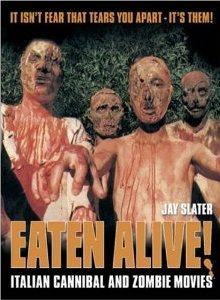
3) Eaten Alive by Jay Slater — This book offers an overview of the Italian film industry’s legendary cannibal and zombie boom.  Along with reviewing every Italian movie to feature even the slightest hint of cannibalism or the living dead (this is one of the few books on Italian cinema that discusses both Pasolini and Lucio Fulci as equals), Eaten Alive also features some very revealing interviews with such iconic figures as Catriona MacColl, Ian McCullough, and especially Giovanni Lombardo Radice.  Radice, in fact, also contributes a memorable “guest” review of one of the movies featured in the book.  (“What a piece of shit!” the review begins.)  Memorable reviews are also contributed by Troma film founder Lloyd Kaufman who brilliantly (and correctly) argues that Cannibal Holocaust is one of the greatest films ever made and Ramsey Campbell who hilariously destroys Umberto Lenzi’s infamous Nightmare City.

2) The Book of the Dead by Jamie Russell — If, like all good people, you love zombies then you simply must do whatever it takes to own a copy of this book.  Starting with such early masterpieces as White Zombie and I Walked With A Zombie, Russell proceeds to cover every subsequent zombie film up through George Romero’s Land of the Dead.  Russell offers up some of the best commentaries ever written on Romero’s Dead films, Fuci’s Beyond Trilogy, Rollin’s Living Dead Girl, and Spain’s Blind Dead films.   The pièce de résistance, however, is an appendix where Russell describes and reviews literally ever zombie film ever made.

1)  All The Colors Of the Dark by Tim Lucas  — This is it.  This is the Holy Grail of All Film Books.  If you’ve ever asked yourself if any book is worth paying close to 300 dollars, now you have your answer.  This one is.  Tim Lucas offers up the most complete biography of director Mario Bava ever written.  In fact, this may be the most complete biography of any director ever written!  Lucas examines not only Bava’s life but also every single movie that Bava was ever in any way connected to, whether as a director or as a cameraman or as the guy in charge of the special effects.  This is 1,128 pages all devoted to nothing but the movies.  This is the type of book that makes me thankful to be alive and I owe a huge debt of gratitude to Tim Lucas for writing it.