It’s strange to hear Leslie Nielsen drop an F bomb.
That was my main though I watched Camouflage. Leslie Nielsen plays a hard-boiled private detective named Jack Potter who reluctantly takes on an apprentice named Matty McKenzie (Lochlyn Munro). Mostly to get Matty, a failed stage actor, out of his hair, Jack sends him to handle a minor case in the small town of Beaver Ridge. The minor case becomes a major case when it becomes clear that a murder is being planned.
Camouflage starts out like a typical Leslie Nielsen mockbuster, with Nielsen providing a ridiculous, Frank Drebin-style narration. But the film itself develops into a dark comedy where Matty finds himself in a small town where everyone’s got secret. Nielsen gives an almost-serious performance as Potter, playing him as a cynic with a tragic backstory and little patience for his protegee. There’s a tonal imbalance between the moments of broad comedy and the more serious moments and the film doesn’t work as a result but it is interesting to see a post-Airplane! Leslie Nielsen playing things relatively straight.
One interesting thing about Camouflage is that it was written by Billy Bob Thornton and Tom Epperson but, in the final cut, the screenplay is credited to Reginald Perry. (The small town setting is one that Thornton used frequently in his scripts and it’s easy to imagine him playing the role of Jack Potter in alternate version of this film.) Camouflage reportedly sat on the shelf for quite a while before it was finally given a release and Nielsen’s narration often feels like it was something that was added in post-production to try to both bring the disjointed film together and to draw in the Naked Gun fans. I have a feeling the story behind this film is probably more interesting than the film itself.
1969’s The Rain People tells the story of Natalie Ravenna (Shirley Knight), a Long Island housewife who, one morning, sneaks out of her house, gets in her station wagon, and leaves. She later calls her husband Vinny from a pay phone and she tells him that she’s pregnant. Vinny is overjoyed. Natalie, however, says that she needs time on her own.
Natalie keeps driving. In West Virginia, she comes upon a young man named Jimmy Kligannon (James Caan). She picks him up looking for a one-night stand but she changes her mind when she discover that Jimmy is a former college football player who, due to an injury on the field, has been left with severe brain damage. The college paid Jimmy off with a thousand dollars. The job that Jimmy had waiting for him disappears. Jimmy’s ex-girlfriend (Laura Crews) cruelly says that she wants nothing more to do with him. Natalie finds herself traveling with the child-like Jimmy, always trying to find a safe place to leave him but never quite being able to bring herself to do so.
Jimmy is not the only man that Natalie meets as she drives across the country. Eventually, she is stopped by Gordon (Robert Duvall), a highway motorcycle cop who gives her a speeding ticket and then invites her back to the trailer that he shares with his young daughter. (Gordon’s house previously burned down.) Natalie follows Gordon back to his trailer, where the film’s final tragic act plays out.
The Rain People was the fourth film to be directed Francis Ford Coppola. Stung by the critical and commercial failure of the big-budget musical Finian’s Rainbow, Coppola made a much more personal and low-key film with The Rain People. While the critics appreciated The Rain People, audiences stayed away from the rather downbeat film. Legendary producer Robert Evans often claimed that, when Coppola was first mentioned as a director for The Godfather, he replied, “His last movie was The Rain People, which got rained one.” Whether that’s true or not, it is generally acknowledged that the commercial failure of The Rain People set back Coppola’s directing career. (Indeed, at the time that The Godfather went into production, Coppola was better-known as a screenwriter than a director.) Of course, it was also on The Rain People that Coppola first worked with James Caan and Robert Duvall. (Duvall, who was Caan’s roommate, was a last-second replacement for Rip Torn.) Both Caan and Duvall would appear in The Godfather, as Sonny Corleone and Tom Hagen respectively. Both would be Oscar-nominated for their performances. (It would be Caan’s only Oscar nomination, which is amazing when you consider how many good performances James Caan gave over the course of his career.)
As for The Rain People, it may have been “rained on” but it’s still an excellent film. Shirley Knight, Robert Duvall, and James Caan all give excellent performances and, despite a few arty flashbacks, Coppola’s direction gives them room to gradually reveal their characters to us. The film sympathizes with Knight’s search for identity without ever idealizing her journey. (She’s not always nice to Jimmy and Jimmy isn’t always easy to travel with.) As for Caan and Duvall, they both epitomize two different types of men. Caan is needy but innocent, a former jock transformed into a lost giant. As for Duvall, he makes Gordon into a character who, at first, charms us and that later terrifies us. Gordon could have been a one-dimensional villain but Duvall makes him into someone who, in his way, is just as lost as Natalie and Jimmy.
The Rain People is a good film. It’s also a very sad film. It made my cry but that’s okay. It earned the tears.
Welcome to Retro Television Reviews, a feature where we review some of our favorite and least favorite shows of the past! On Saturdays, Lisa will be reviewing The American Short Story, which ran semi-regularly on PBS in 1974 to 1981. The entire show can be purchased on Prime and found on YouTube and Tubi.
This week, we have an adaptation of a Mark Twain novella.
Episode #12: The Man That Corrupted Hadleyburg
(Dir by Ralph Rosenblum, originally aired in 1980)
In this loose adaptation of one of Mark Twain’s darkest novellas, Robert Preston stars as The Stranger. When we first meet The Stranger, he’s looking down on the small town of Hadleyburg and it’s hard not to notice that he looks a lot like Mark Twain. The Stranger explains that the people of Hadleyburg consider themselves to be honest and free of sin. The town’s motto is “Lead us not into temptation!” The Stranger has a plan to test them.
Riding into town, the Stranger stops at the home of Edward and Mary Richards (Tom Aldredge and Frances Sternhagen). The Stranger gives them a sack that he claims is filled with $40,000 worth of gold bars. The Stranger says that he was once a poor man and someone in Hadleyburg gave him $20 and some meaningful advice. Now that’s he rich, he wants to pay back the person who helped him. The Stranger explains that there is an envelope inside the sack. In the envelope, the Stranger has written out the advice he was given by his benefactor. The Stranger’s instruction is for the man who helped him to write out that advice and give it to Rev. Burgess (Fred Gwynne), who recently lost his church when the citizens of Hadleyburg tired of him calling them out for their hypocrisies. The honest man who remembers the advice he gave the Stranger will be very rich as a result. The Stranger then leaves.
News of the sack and the gold travels throughout town and eventually the rest of the nation. The most powerful families in Hadleyburg, including the Richards family, receive a letter telling them that the advice given to the stranger was “You are far from being a bad man, go and reform.” Burgess is soon swamped by notes, all featuring that same phrase. At the town meeting, Burgess reads each note, revealing that everyone wrote down the same phrase and that none of the town leaders is as honest as they claim.
The Man That Corrupted Hadleyburg is one of Twain’s most stinging satires, featuring an ending that is surprisingly dark. This adaptation takes a much lighter approach to the material, altering Twain’s ending to something much more gentle and friendly. Unfortunately, changing the ending causes the adaptation to lack the bite of the original short story. Twain’s portrayal of greed and guilt instead becomes a mild story about a quirky town that learns a lesson. It’s well-acted, especially by Fred Gwynne, but this adaptation doesn’t honor Twain’s intentions. It just doesn’t add up to much.
Welcome to Retro Television Reviews, a feature where we review some of our favorite and least favorite shows of the past! On Saturdays, I will be reviewing The American Short Story, which ran semi-regularly on PBS in 1974 to 1981. The entire show can be purchased on Prime and found on YouTube and Tubi.
This week, we have an adaptation of a Stephen Crane short story.
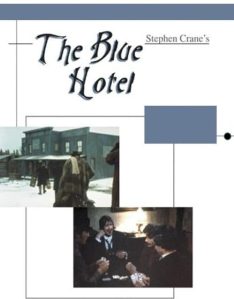
Episode 1.8 “The Blue Hotel”
(Dir by Jan Kadar, originally aired in 1977)
In the dying days of the Old West, a train pulls into a station in a small frontier town. Getting off the train, a Cowboy (John Bottoms), an Easterner (Geddeth Smith), and a Swede (David Warner) head to the town’s only hotel. A blizzard is coming and the three men are seeking shelter for the night. The owner of the hotel, Scully (Rex Everhart), is happy to provide it. As the men wait for dinner to be served, they play a card game with Scully’s son, Johnnie (James Keach).
At first, the game plays out without incident. The men are all friendly, with the exception of the Swede. The Swede remains quiet and seems distrustful. After a few hands of the game, the Swede accuses Johnnie of cheating. Over the next few hours, as the wind howls outside, the Swede rants and raves. Convinced that the wild west is truly full of outlaws and that it’s all exactly like the dime-store novels that he read before boarding the train, he cannot bring himself to accept that the men mean him no harm. It all leads to violence and tragedy.
This episode made excellent use of the shadowy Blue Hotel and the desolate wind blowing outside. Over the course of an hour, the hotel went from being a friendly shelter to an ominous location that seemed to pulse with paranoia. David Warner gave a strong performance as the unstable Swede and the final act of violence (which was changed slightly from the short story’s original conclusion) comes as a genuine shock as does the final twist in the tale. TheBlueHotel becomes a look at how people unknowingly shape their own destiny, for better or worse.
 It’s strange to hear Leslie Nielsen drop an F bomb.
 Through the Shattered Lens