“WILSON!”
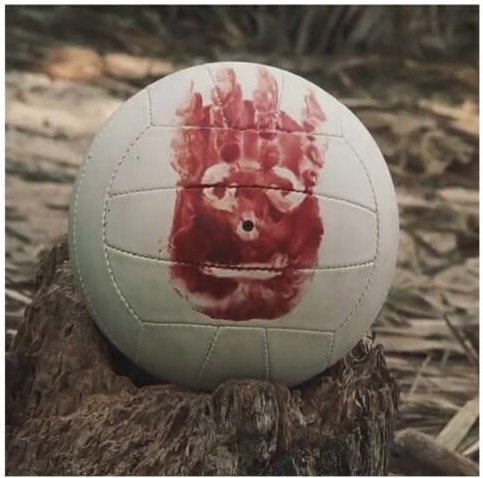
Seriously, I’m usually pretty well-behaved when I watch a movie but every time I see the 2000 film Cast Away, I find myself thinking, “Protect Wilson! You must protect Wilson!” And then, every time, I feel the sting of tears in my eyes as Wilson, with that red-face and that understanding attitude, goes floating away.
Wilson is a volleyball. When a FedEx executive named Chuck Noland (played by Tom Hanks) finds himself stranded on a desert island, Wilson becomes his only companion. A stain from Chuck’s bloody palm creates something that resembles a face on Wilson’s rubber surface and Chuck spends a lot of time talking to Wilson. It’s how Chuck maintains his sanity, even as he loses weight, sheds most of his clothes, and grows a beard.
Chuck learns how to make fire. He learns how to catch fish. He is able to survive due to the supplies that he gathers from the FedEx packages that were being carried on the plane that crashed into the island. But Chuck never stops dreaming of returning home to his girlfriend (Helen Hunt). Eventually, Chuck finds the courage to try to make the journey back to civilization. He brings Wilson with him but ultimately, this is something that Chuck is going to have to do on his own. Of course, Chuck has failed to consider that he’s been gone for years. He is presumed dead. On the Island, time seemed like it was frozen. For the rest of the world, life has continued.
Cast Away is a film that a lot of people, especially online film commentators, tend to criticize. The complaint is usually that the film is essentially a commercial for FedEx, that it’s not believable that Tom Hanks could survive on that island for as long as he did, and that the film itself has a weak ending. I’ll concede that the film does make FedEx look like the nicest corporation on Earth. (FedEx’s CEO appears as himself, which should tell you something about how the company is presented.) And I will admit that the film’s time-advancing jump cut, which abruptly takes Hanks from being clean-shaven and husky to being thin and bearded, does leave a lot of unanswered questions. But I will always defend the film’s ending. The film ends on a note of ambiguity but how else could it have ended? Everyone thought Chuck Noland was dead. His girlfriend had every right to get on with her life and, in fact, it would have been psychologically unhealthy for her if she hadn’t. As for that final shot, it’s an acknowledgment that Chuck doesn’t know what lies ahead of him in the future. All he knows is that he life isn’t over yet. It’s a melancholy ending. It’s a frustrating ending. But it’s also the only way the film could have ended and therefore, it’s a perfect ending.
Cast Away is a film that I will always defend and it’s also a film that really only could have worked with Tom Hanks in the lead role. He plays Chuck as being the ultimate everyman, an affable guy who was just trying to do his job and whose survival of the initial plane crash was largely due to luck. Hanks is one of those actors who is instantly sympathetic and Cast Away uses his screen persona to good effect. You want him to survive because he’s Tom Hanks. He may be playing a character named Chuck Noland but ultimately, he’s Tom Hanks. He survived being trapped in space. Surely, he can survive being stranded on an island. The majority of the film is just Hanks talking to himself. This would have brought out the worst in so many actors but Tom Hanks makes it work. And yes, he’ll bring tears to your eyes as he watches Wilson float away. That’s the power of a good actor.
As for Wilson, I like to think that he washed up in Pensecola. Recently, I played a little volleyball on a beautiful Florida beach. Was that you, Wilson?

 Through the Shattered Lens