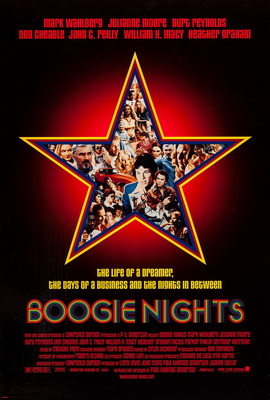
 The 1997 film Boogie Nights (which, amazingly enough, was not nominated for best picture) is a bit of an overwhelming film to review. It’s a great film and, if you’re reading this review, you’ve probably seen Boogie Nights and you probably already know that it’s a great film. And if you haven’t seen Boogie Nights, you really should because it’s a great film. So, this review, in short, amounts to: Great film.
Boogie Nights takes place in the late 70s and the early 80s. Eddie Adams (Mark Wahlberg) is a high school dropout who works as a busboy, lives with his parents, and has a really big cock. (Indeed, one of the film’s most famous lines is, “This is a giant cock.”) When we first meet Eddie, he’s likable and cute in a dumb sort of way. Then he meets adult film director Jack Horner (Burt Reynolds) and becomes a star. At first, everything is great. Eddie changes his name to Dirk Diggler and no longer has to deal with his abusive mother (a chilling Joanna Gleason). Jack and Amber Waves (Julianne Moore) become his new parents. He gets a cool older brother in the form of actor Reed Rothschild (John C. Reilly, totally nailing the “People tell me that I look like Han Solo,” line). He makes friends with other adult film actors, like the desperately unhip Buck (Don Cheadle), the free-spirited (and secretly very angry) Rollergirl (Heather Graham), and the poignantly insecure Jessie St. Vincent (Melora Walters). He gets new admirers, like Scotty J. (Philip Seymour Hoffman). He also gets addicted to cocaine. And while Dirk falls from stardom, the adult film industry is taken over by gangsters like Floyd Gondolli (Philip Baker Hall) and self-styled artists like Jack Horner find themselves pushed to the side.
And you may have noticed that I mentioned a lot of actors in the paragraph above. That’s because Boogie Nights is a true ensemble piece. It’s full of great performances and memorable characters. Along with everyone that I mentioned above, the cast also includes William H. Macy as cinematographer “Little Bill” Daggett. From the minutes we first meet Little Bill, we get the feeling that he might be a little bit too uptight for pornography. Maybe that’s because his wife — played by the inspiring sex positive feminist and veteran adult film star Nina Hartley — is constantly and publicly cheating on him. Macy and Hartley do not have as much screen time as the rest of the cast but, ultimately, their characters are two of the most important in the film.
And then there’s Robert Ridgely, who is marvelously sleazy as the paternal but ultimately icky Col. James. When we first meet the Colonel, he’s almost a humorous character. But then, suddenly, there’s one chilling scene where he opens up to Jack Horner and we are forced to reconsider everything that we had previously assumed about both the Colonel and his business.
And how can we forget Luis Guzman, as a club owner who desperately wants to appear in one of Jack’s films? Or Ricky Jay as a plain-spoken cameraman? Or how about Thomas Jane, playing one of those tightly wound characters who you know is going to be trouble as soon as you see him? And finally, nobody who has seen Boogie Nights will ever forget Alfred Molina, singing along to Sister Christian and running down the street, clad only in black bikini briefs and firing a shotgun.
But it’s not just the actors who make Boogie Nights a great film. This was Paul Thomas Anderson’s second film and, under his direction, we feel as if we’ve been thrown straight into Dirk’s exciting and ultimately dangerous world. When the film begins, the camera almost seems to glide, capturing the excitement of having everything that you could possibly want. But, as things go downhill for Dirk, the camerawork gets more jittery and nervous. A sequence where Anderson cuts back and forth between Jack trying to shoot a movie on video (as opposed to his beloved film) and Dirk nearly being beaten to death in a parking lot remains one of the best sequences that Anderson has ever directed.
And then there’s the music! Oh my God! The music!
And the dancing!
And the singing!
I’ll be the first admit that I have no idea whether or not Boogie Nights is a realistic portrait of the adult film industry in the 70s and 80s. But ultimately, Boogie Nights is not about porn. It’s about a group of outsiders who form their own little family. At the end of the film, you’re happy that they all found each other. You know that Dirk will probably continue to have problems in the future but you’re happy for him because, no matter what happened in the past or what’s going to happen in the future, you know that he’s found a family that will always love him.
As I mentioned at the start of this appreciation, Boogie Nights was not nominated for best picture. Titanic was named the best picture of 1997. As I’ve said before, I loved Titanic when I was 12. But, nearly 18 years later, Boogie Nights is definitely the better picture.
It has stood the test of time.
 Through the Shattered Lens