This October, I’m going to be doing something a little bit different with my contribution to 4 Shots From 4 Films. I’m going to be taking a little chronological tour of the history of horror cinema, moving from decade to decade.
The Shining is one of the few horror movies that still scares me.
I say this despite the fact that I’ve lost track of the number of times that I’ve watched Stanley Kubrick’s 1980 adaptation of Stephen King’s third novel. It’s a film that I watch nearly every October and it’s a film that I’ve pretty much memorized. Whenever I watch the film, I do so with the knowledge that Jack Torrance (Jack Nicholson), the caretaker of the Overlook Hotel, is eventually going to start talking to ghosts and he’s going to try to kill his wife Wendy (Shelley Duvall) and his son, Danny (Danny Lloyd). Whenever I watch this film, I know what Jack is going to find Room 237. I know about the blood pouring out the elevator like the Tampax commercial from Hell. I know what Danny means when he says, “Redrum….” I know about the twins and their request of “Come play with us, Danny.” And, of course, I know about the film’s famous ending.
Whenever I start watching this film, I know everything that is going to happen. And yet, as soon as I hear the booming beat of of Wendy Carlos’s theme music and I see the overhead shot of the mountain roads leading to the Overlook Hotel, I start to feel uneasy. Whenever Barry Nelson (played the hotel’s general manager) starts to blandly explain that a previous caretaker got cabin fever and chopped up his twin daughters, I smile because Nelson delivers the lines so casually. But I also get nervous because I know Charles (or is it Delbert) Grady is going to show up later.
(Incidentally, Barry Nelson never gets enough credit for his brilliant cameo as the friendly but guarded hotel manager. In Stephen King’s original novel, the character was a stereotypically unsympathetic middle manager, a martinet who existed largely to be told off. In Kubrick’s film, the manager is one of the most fascinating of the supporting characters.)
I still get nervous when I see Wendy and Danny, sitting in their disturbingly sterile Colorado home while Jack interviews for the caretaker job. Wendy smokes and Danny talks about how his imaginary friend, Tony, doesn’t want to go to the hotel. With her unwashed her and her tentative voice, Shelley Duvall is a far cry from the book’s version of Wendy. However, Duvall’s Wendy is also a far more compelling character, an abused woman who finds her strength when her son is put in danger. Duvall is the perfect choice for Wendy because she seems like someone who you might see in the parking lot of your local grocery store, trying to load the bags in her car and keep an eye on her young child at the same time. She seems real and her reactions remind us of how we would probably react if we found ourselves in the same situation. Wendy makes the mistakes that we would all probably make but she refuses to surrender to her fear.
Why does The Shining remain so powerful and so frightening, even after repeated viewings? Most of the credit has to go to Stanley Kubrick. Stephen King has been very vocal about his dislike of the film, claiming that The Shining was more Kubrick’s version than his. King has a point. Film is a director’s medium and few directors were as brilliant as Stanley Kubrick. (Along with The Shining, Kubrick also directed Paths of Glory, 2001, Barry Lyndon, Dr, Strangelove, Spartacus, Lolita, The Killing, A Clockwork Orange, Eyes Wife Shut, and Full Metal Jacket. Stephen King directed Maximum Overdrive.) From the minute we see the tracking shots that wind their way through the desolate mountains and the empty hallways of the Overlook, we know that we’re watching a Kubrick film. Those tracking shots also put us in the same role as the spirits in the Overlook. We’re watching and following the characters, observing and reacting to their actions without being able to interact with them. King has complained that Kubrick’s version of The Shining offers up no hope. But, honestly, what kind of hope can one have after discovering that ghosts are real and they want to kill you? Once Jack Torrance finally accepts that drink from Joe Turkel’s Lloyd and meets Phillip Stone’s Grady, there is no more room for hope. King’s book ends with the Overlook destroyed and Jack Torrance perhaps redeeming himself in his last moments. Kubrick’s film suggests that Jack Torrance never cared enough about his family to be worthy of redemption and that the evil that infected the Overlook is never going to be destroyed. In the end, not even the kindly presence of Scatman Crothers in the role of Dick Halloran can bring any real hope to the Overlook.
The Shining is unsettling because, more than being a ghost story, it’s a film about being tapped. Physically, the Torrances are trapped by the blizzard. Mentally, Jack is trapped by his addictions and his resentments. One gets the feeling that he’s deeply jealous of Danny, viewing him as someone who came along and took away all of Wendy’s attention. Wendy is trapped in a bad and abusive marriage and there’s something very poignant about the way Duvall both captures Wendy’s yearning for outside contact (like when she uses the radio to communicate with the local rangers station) and her hope that, if she’s just supportive enough, Jack will get his life together. Danny’s trapped by his psychic visions and his knowledge of what’s to come. The victims of the Overlook appear to be trapped as well. Grady’s daughters are fated to always roam the hallways, looking for someone to play with them. The Woman in 237 will always wait in her bathtub. Were these spirits evil before they died or were the twisted by the Overlook? It’s an unanswered question that sticks with you.
As I mentioned earlier, Stephen King has been very vocal about his dislike of both The Shining and its director. (King once boasted about outliving Kubrick, a comment that showed a definite lack of class on the part of America’s most commercially successful writer.) Why does King hate the Kubrick film with such a passion?
I have a theory. Both King’s second novel, Salem’s Lot, and The Shining feature a writer as the man character. In both cases, King obviously related to the main character. Ben Mears in Salem’s Lot is charming, confident, articulate, and successful. He’s a writer that everyone respects and he’s even well-known enough to have a file with the FBI. Jack Torrance, on the other hand, is a struggling writer who has a drinking problem, resents authority figures (like the hotel manager), and has issues with his father. Torrance is a much more interesting character than Ben Mears, precisely because Torrance is so flawed. (King, and I give him full credit for this, has been open about his own struggles with substance abuse and how he brought his own experiences to the character of Jack Torrance.) I’ve always suspected that, at the time that King wrote Salem’s Lot and The Shining, Ben Mears was King’s idealized version of himself while Jack Torrance, with all of his struggles and flaws, reflected how King actually felt about himself. (That the Wendy Torrance of the novel is a beautiful blonde who sticks with her husband despite his drinking problem feels like a bit of wish fulfillment on the part of King.) When Stanley Kubrick made his version of The Shining and presented Jack Torrance as essentially being a self-centered jerk who, even before arriving at the hotel, had a history of abusing his wife and son, it’s possible King took it a bit personally. Since King had poured so much of himself into Jack Torrance, it was probably difficult to see Kubrick present the character an abusive narcissist whose great novel turned out to be literally a joke. And so, Stephen King has spent the last 45 years talking about how much he hates Kubrick’s film.
King’s opinion aside, Kubrick’s The Shining is probably the most effective Stephen King adaptation ever made, precisely because Kubrick knew which parts of the book would work cinematically and which parts were best excised from the plot. As opposed to later directors who often seem intimidated by King’s fame, Kubrick was able to bring his own signature style to the story. Stanley Kubrick’s The Shining is a masterpiece and one that I look forward to revisiting this October.
4 Or More Shots From 4 Or More Films is just what it says it is, 4 shots from 4 of our favorite films. As opposed to the reviews and recaps that we usually post, 4 Shots From 4 Films lets the visuals do the talking!
With October approaching, it will soon be time for our annual Horrorthon here at the Shattered Lens. We’ve been working hard getting things ready! Here are 4 shots from 4 of the many films that we will be reviewing this October.
4 Shots From 4 Horror Films
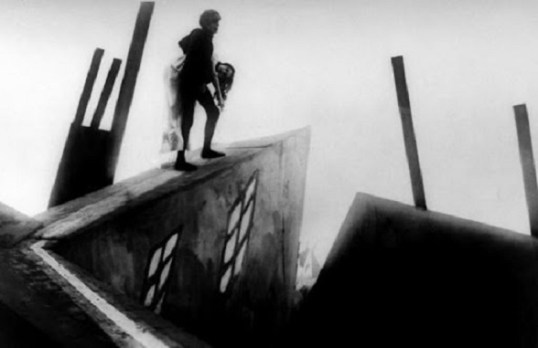
The Cabinet of Dr. Caligari (1920, dir by Robert Wiene)
For today’s song of the day, we have the title tune to Stanley Kubrick’s The Shining. The Shining is a classic horror film and one that I look forward to revisiting on this site for our annual October Horrorthon.
For now, enjoy the greatest road trip music ever recorded.
4 Or More Shots From 4 Or More Films is just what it says it is, 4 shots from 4 of our favorite films. As opposed to the reviews and recaps that we usually post, 4 Shots From 4 Films lets the visuals do the talking!
On this date, 97 years ago, Stanley Kubrick was born in New York City. The rest, as they say, is history.
In honor of one of the world’s greatest directors, here are….
6 Shots From 6 Stanley Kubrick Films
The Killing (1956, dir by Stanley Kubrick, DP: Lucien Ballard)
Paths of Glory (1957, dir by Stanley Kubrick, DP: Georg Kraus)
Dr. Strangelove or: How I Learned to Stop Worrying and Love the Bomb (1964, dir. Stanley Kubrick, DP: Gilbert Taylor)
2001: A Space Odyssey (1968, dir by Stanley Kubrick, DP: Geoffrey Unsworth)
Barry Lyndon (1975, dir by Stanley Kubrick, DP: John Alcott)
The Shining (1980, dir by Stanley Kubrick, DP: John Alcott)
The scene below is, of course, from Stanley Kubrick’s 1980 masterpiece, The Shining.
In this scene, Jack Torrance (Jack Nicholson) stumbles into the Overlook Hotel’s ballroom, still fuming over having been accused of abusing his son. A recovering alcoholic, Jack sits at the bar and thinks about how he would give up his soul for just one one drink. And, on cue, Lloyd (Joe Turkel) appears.
As I was watching this scene, it occurred to me that, way back in 1980, there probably was some guy named Lloyd who saw this movie in a theater and was probably totally shocked when Jack suddenly stared straight at him and said, “Hey, Lloyd.”
The brilliance of this scene is that we never actually see Lloyd materialize. We see him only after Jack has seen him. So, yes, Lloyd could be a ghost. But he could also just be a figment of Jack’s imagination. Jack very well could just be suffering from cabin fever. Of course, by the end of the movie, we learn the truth.
Everyone always talks about Jack Nicholson’s performance as Jack. Some people love it and some people hate it. (I’m in the first camp.) However, let’s take a minute to appreciate just how totally creepy Joe Turkel is in this scene. Turkel was a veteran character actor and had appeared in two previous Kubrick films, The Killing and Paths of Glory. Two years after appearing in The Shining, Turkel played what may be his best-known role, Dr. Eldon Tyrell in Blade Runner. Today, incidentally, would have been Joe Turkel’s 98th birthday.
From Stanley Kubrick’s The Shining, here’s Jack Nicholson and Joe Turkel:
4 Shots From 4 Films is just what it says it is, 4 shots from 4 of our favorite films. As opposed to the reviews and recaps that we usually post, 4 Shots From 4 Films lets the visuals do the talking!
Today is Jack Nicholson’s 88th birthday!
Though he has pretty much retired from acting, Jack Nicholson remains a screen icon with a filmography that is a cinema lover’s dream. He’s worked with everyone from Roger Corman to Stanley Kubrick to Milos Forman to Martin Scorsese and, along the way, he’s become a symbol of a very American-type of rebel. Though often associated with the counter-culture, his style has always been too aggressive and idiosyncratic for him to be a believable hippie. Instead, he’s one of the last of the beats, an outsider searching for meaning in Americana.
Over the course of his career, Nicholson has won three Oscars and been nominated for a total of 12. He’s the only actor to have been nominated in every decade from the 1960s to the 2000s. He is an actor who epitomizes an era in filmmaking, actually several eras. It’s been 15 years since he last appeared in a movie but Jack Nicholson will never be forgotten.
4 Shots From 4 Jack Nicholson Films
Psych-Out (1968, dir by Richard Rush, DP: Laszlo Kovacs)
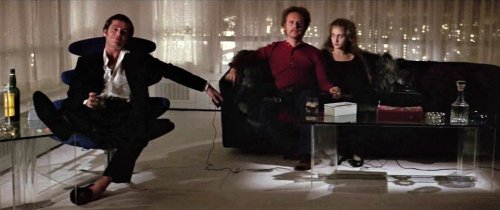
Carnal Knowledge (1971, dir by Mike Nichols, DP: Giuseppe Rotunno)
The Shining (1980, dir by Stanley Kubrick, DP: John Alcott)
The Departed (2006, dir by Martin Scorsese, DP: Michael Ballhaus)
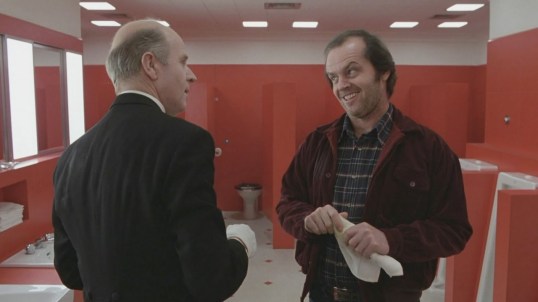
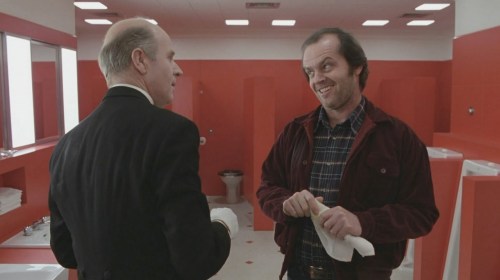
Today would have been the 101st birthday of character actor Philip Stone. While Stone appeared in a lot of films, he’ll probably always be best-remembered for his subtly menacing turn as the ghostly Grady in 1980’s The Shining. Here he is, having a conversation with Jack Torrance (Jack Nicholson) and letting him know that he’s always been caretaker.
(Fair warning to those who may not have seen this scene before or who perhaps have forgotten about it, Grady does use a racial slur at one point. It’s a moment that’s true to his villainous character, even if it’s a bit jarring to hear today.)
I’ve always felt that Barry Nelson’s performance as Ullman is one of the best parts of the early part of the film. Whereas Ullman was presented as being a stereotypical jerk in King’s novel, the film presents him as a blandly friendly bureaucrat who can talk about what happened with the previous caretaker and make it sound like the most normal thing in the world. The scene were he interviews Jack Torrance for the caretaker job is wonderfully ominous, even if it’s hard to describe why. I know that Stephen King disliked this scene because it made Jack look unbalanced from the start but, personally, I think it does a wonderful job of setting the mood.
Finally, Ullman’s office reminds me of Ben Horne’s office in Twin Peaks, right down to the somewhat campy name plate on his desk.











 Through the Shattered Lens