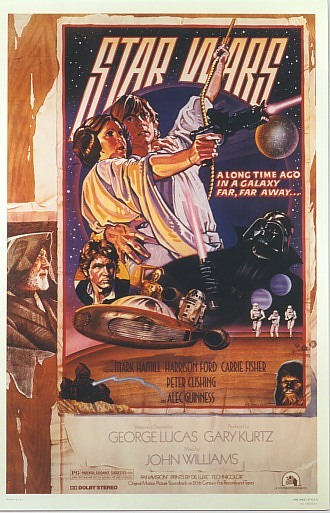
May The Fourth Be With You: Looking Back At Star Wars


Today is Star Wars Day.  (It’s May 4th.  May the Fourth Be With You!  I’ll stop now.)  Five years ago, I ranked all of the Star Wars feature films that had been released up until that point from best to worst.  Here’s how I ranked them:

  1. The Empire Strikes Back
  2. Rogue One
  3. New Hope
  4. The Force Awakens
  5. Revenge of the Sith
  6. Return of the Jedi
  7. Solo
  8. The Rise of Skywalker
  9. The Last Jedi
  10. Attack of the Clones
  11. The Phantom Menace

Since that was a while ago, I decided to take a look back and see if I still felt the same way.  Here are my brief thoughts on each film, in order of release.

Star Wars: Episode IV — A New Hope (1977, directed by George Lucas) — A New Hope may not be the best Star Wars film but it’s still the most entertaining, even if George Lucas doesn’t seem to realize that.  A tribute to the serials and space operas that Lucas grew up with, A New Hope features great action scenes, special effects that hold up well despite not being as slick as modern CGI, and great performances from Alec Guinness and Harrison Ford.  Mark Hamill would eventually become a much better actor, though you might not guess just from his performance here.  Watching New Hope today, I really appreciate that the movie doesn’t get bogged down in overexplaining things.  We don’t need to know what the Clone Wars were specifically about or what the Kessel Run actually was.  They sound cool and that’s all that was really required.  Despite what some claim, there is absolutely no evidence that Darth Vader was meant to be Luke’s father in this move.

Star Wars Holiday Special (1978, directed by Steve Binder) — Only aired once, I debated whether to include it here or not.  I eventually did just because it features the debut of Boba Fett.  It’s as bad as you’ve heard but the special’s real since is that it’s incredibly boring.  Harrison Ford still looks happier here than he did in Return of the Jedi.

Star Wars: Episode V — The Empire Strikes Back (1980, directed by Irvin Kershner) — The best of the original trilogy, this installment was surprisingly dark, downbeat, and violent.  Mark Hamill finally started to show some signs of growth as an actor while Harrison Ford’s Han Solo continued to be the coolest rebel in the universe.  Combining the more thoughtful scenes with Yoda with the action-orientated scenes on Cloud City made this the most intelligent of the Star Wars films.  The battle on Hoth remains one of the best action scenes ever.  I think every kid who saw this movie wanted an AT-AT Walker.  I know I did.

Star Wars: Episode VI — Return of the Jedi (1983, directed by Richard Marquand) — It’s not quite as bad as its reputation, largely due to the opening with Jabba the Hutt’s court.  Jabba is so grotesque and evil in this movie that it’s hard not to regret that the subsequent films made him into more of buffoon than a crime lord.  Brining back the Death Star made this film feel like a retread.  The Ewoks were created to sell toys but so was everything else in this movie.  Harrison Ford looks particularly grouchy at the end.

The Ewok Adventure (1984, directed by John Korty) and Ewoks: The Battle For Endor (1985, directed by Jim and Ken Wheat) — I guess if these had been successful, there would have been an Ewok television show.  The Ewok Adventure feels childish and features a narrator.  Battle for Endor is surprisingly violent for a movie about teddy bears.  Both films are more bland than truly bad.
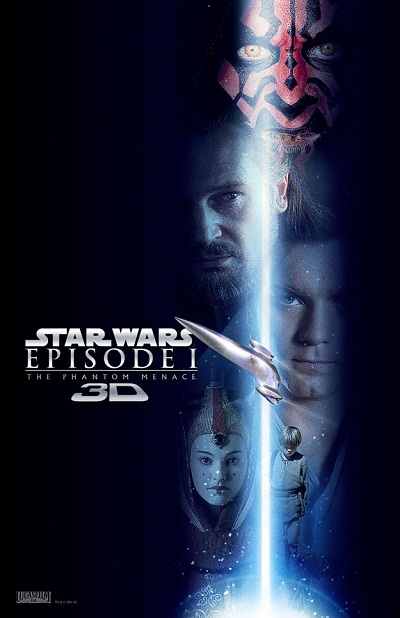
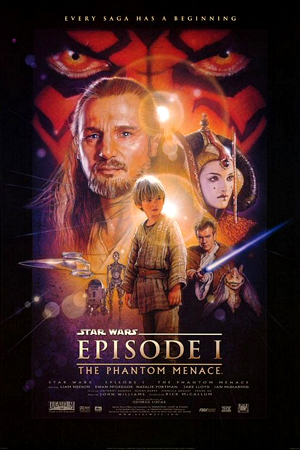
Star Wars: Episode I — The Phantom Menace (1999, directed by George Lucas) — There’s been some revisionism about this film.  Some people actually defend it now.  Not me.  It’s still pointless.  This movie started the trend of every popular film having to have an in-depth “mythology” behind it.  It turns out that the Evil Empire was all about trade routes and tariffs.  Jake Lloyd gets more blame than he deserves.  Overexplaining the Force was a sign of things to come.  This movie would feature Natalie Portman’s worst performance if not for…

Star Wars: Episode II — Attack of the Clones (2o02, directed by George Lucas) — As painfully generic as its title, this movie was responsible for Hayden Christensen having an undeserved reputation for being a bad actor.  I doubt any actor, no matter how talented, could make Lucas’s dialogue feel natural.

Star Wars: Episode III — Revenge of the Sith (2005, directed by George Lucas) — The only one of the prequels that actually added anything to what we already knew, Revenge of the Sith is dark, violent, and it doesn’t have as many slow spots as the other prequels.  Ewan McGregor finally gets a chance to act and Hayden Christensen and Natalie Portman are finally given actual characters to play.  Today, some people say it’s the best of the Star Wars films.  They’re wrong but it’s still pretty good.

The Clone Wars (2008, directed by Dave Filoni) — The only animated Star Wars film doesn’t get much attention and it does get bogged down in the mythology of the of the prequels.  No one really cares about the specifics of the Clone Wars.  The fact that it’s animated and clearly marketed at kids makes the dialogue easier to tolerate.
Star Wars: Episode VII — The Force Awakens (2015, directed by J.J. Abrams) — When this first came out, a lot of people (including myself) were so happy to have a new Star Wars film that we overrated it.  It’s hard to watch today without thinking about how bad things got after it was released but it does still hold up well as a space adventure, though Daisy Ridley’s blandness is more apparent on subsequent viewings.  The performances of Adam Driver and John Boyega still hold up.  The main attraction, though, is Harrison Ford returning as Han Solo.

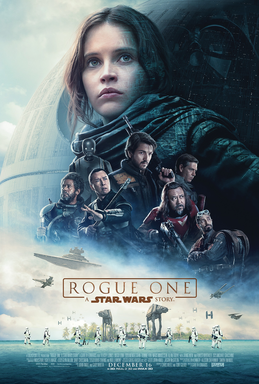
Rogue One: A Star Wars Story (2016, directed by Gareth Edwards) — The first stand-alone live action Star Wars feature film is a thrilling space adventures that holds up on subsequent viewings and works because the stakes actually feel real.  For the first time since New Hope, the Death Star is actually frightening.  This remains one of the best films in the franchise and it’s not surprising that it led to the best of the Star Wars television shows.

Star Wars: Episode VIII — The Last Jedi (2017, directed by Rian Johnson) — The haters are right about much of this film.  For all the complaints about Disney not allowing their Marvel directors much freedom, the Star Wars sequels shows what happens when a franchise isn’t sure where it wants to go.  Rian Johnson tries to bring Star Wars down to Earth but that’s not where we want Star Wars.  Rose Tico was an annoying character and her line about saving what we love deserves all of the mockery it received but Kelly Marie Tran still didn’t deserve to be run off of social media.  Turning Luke into a bitter old man was this film’s greatest sin.

Solo: A Star Wars Story (2018, directed by Ron Howard) — That this wasn’t a box office hit was the a clear warning sign that audiences were getting bored with Star Wars.  This Han Solo origin story isn’t bad.  Ron Howard could direct a film like this in his sleep.  It just feels unnecessary.  Alden Ehrenreich does his best but no one can replace Harrison Ford as Han Solo.

Star Wars: Episode IX — The Rise of Skywalker (2019, directed by J.J. Abrams) — J.J. Abrams tries to undo everything that Rian Johnson did in his film.  I don’t blame Abrams because Johnson’s film wasn’t great but just shrugging it all off doesn’t really work either.  The sequel trilogy, which started with such high hopes, ends with a whimper.  Daisy Ridley’s boring performance doesn’t help.

My rankings, as of 2025, are below:

  1. The Empire Strikes Back
  2. Rogue One
  3. New Hope
  4. Revenge of the Sith
  5. Return of the Jedi
  6. Force Awakens
  7. Solo
  8. Rise of Skywalker
  9. The Last Jedi
  10. Ewoks: Battle for Endor
  11. The Clone Wars
  12. The Ewok Adventure
  13. Holiday Special
  14. Phantom Menace
  15. Attack of the Clones

Sci-Fi Review: Stars Wars Episode 1: The Phantom Menace (1999, directed by George Lucas)


Star_Wars_Phantom_Menace_posterA long time ago in a galaxy far, far away…
The time was May of 1999.  The place was a movie theater in Baltimore, Maryland.  The theater was packed with people waiting to see the most anticipated film of their lifetime.  The film was The Phantom Menace, the first prequel to the original Star Wars trilogy.  For two years, the people in the audience had followed every detail of the film’s production.  Some of them had gone to showings of Meet Joe Black and Wing Commander, just so they could see the first trailers for the film.

Sitting out in that audience was one 16 year-old boy who, a few nights earlier, had been standing outside a Target at midnight so that he could be one of the first to buy Phantom Menace merchandise.  He bought two Jar Jar Binks action figures because, even before Phantom Menace opened, he suspected Jar Jar would be the most controversial character.

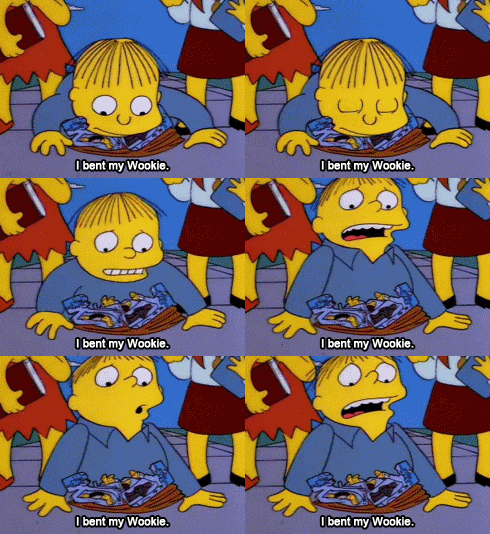
When the lights went down, the audience cheered.  At the start of every trailer, someone in the dark theater shouted, “I bent my Wookie!”  The audience laughed the first two times.  By the fifth time, there were only a few pity titters.

Finally, it was time!  The first few notes of John Williams’s Star Wars theme echoed through the theater.  Again, the audience cheered as the familiar title crawl appeared on-screen.

http://www.youtube.com/watch?v=WQBV9pXleF0

The 16 year-old read the opening crawl and he started to get worried.  What was all this talk about taxation?  Trade routes?  Trade Federation?  Blockades?  It seemed more appropriate for Star Trek or even Dune.  Except for the mention of Jedis at the end of the crawl, it did not sound much like Star Wars.

Things started to look up as soon as Liam Neeson and Ewan McGregor made their first appearance as Qui-Gon and Obi-Wan.  Obi-Wan’s first line was, “I have a bad feeling about this.”  A few people in the audience clapped.  “I bent my Wookie!” a familiar voice shouted.  Nobody laughed.

When a hologram of Darth Sidious appeared and told the Trade Federation goons to kill Qui-Gon and Obi-Wan, everyone in the audience knew that Darth Sidious was Palaptine, the future Emperor, and the excitement was palpable.  When Qui-Gon and Obi-Wan fought off the battle droids and escaped to the besieged planet of Naboo, the audience started to relax.  Maybe this wouldn’t be as bad as the critics were saying.

Then Qui-Gon and Obi-Wan met Jar Jar Binks and the whole movie went to shit.

http://www.youtube.com/watch?v=IIQVAShJzLo

In the months leading up to the release of The Phantom Menace, everyone had heard about Jar Jar Binks and how he was a totally computer-generated character.  Jar Jar Binks was the future of movie technology and, from the minute he first appeared, the future was fucking terrifying.  Jar Jar was a Gungun, an amphibious creature who was characterized as being clumsy and cowardly.  He shrieked in a high-pitched voice and spoke in an indescribable dialect.  As much as the audience tried, there was no way to avoid or ignore Jar Jar Binks.  He was not in the entire movie but he was at the center of every scene in which he did appear.

As Jar Jar led Obi-Wan and Qui-Gon to the underwater city of the Gunguns, a voice in the dark theater shouted out, “I bent my Wookie!”

“Shut the fuck up!” the 16 year-old snapped back.

The 16 year-old was not sure if anyone heard him but the voice was silent for the rest of the movie.

Sorry, Ralph.

Sorry, Ralph.

No sooner had the audience recovered from their introduction to Jar Jar then they met young Anakin Skywalker.  Anakin’s story was the whole reason that The Phantom Menace had been made.  The audience knew that the prequels would show how Anakin Skywalker would grow up to the greatest and most evil badass in the universe, Darth Vader.  But in Phantom Menace, he was just a 9 year-old slave on the planet of Tatooine, conceived by immaculate conception.  Even before Phantom Menace was released, the word was out that Jake Lloyd, the child cast as young Anakin, was not exactly the best actor in the world.  But even though they had been forewarned, the audience was not prepared for just how terrible little Jake Lloyd was in the role.  There was no darkness to Jake Lloyd’s cutesy performance.  There was no sadness or toughness.  Jake Lloyd came across like the type of hyperactive child who would end up in the ensemble of a Christmas play, breaking character and waving to his parents during the Crucifixion.  Not only could the audience not see him growing up to be Darth Vader but they could not imagine him as a slave living on an inhospitable desert planet.

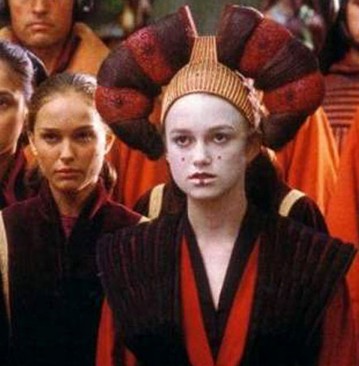
Qui-Gon, Obi-Wan, Jar Jar, Queen Padme (Keira Knightley), and Padme’s handmaid, Amidala (Natalie Portman) were stranded on Tatooine when they first met Anakin.  Qui-Gon felt that Anakin was “the chosen one,” who would bring balance to the force.  It was hard for the audience to believe him when they heard Anakin shout, “Yippe!”

For that 16 year-old who had stayed up past midnight to buy two Jar Jar Binks action figures, that “yippe” was the final straw.  He had watched the original Star Wars trilogy on VHS tapes.  He had gone to the re-releases.  He loved Star Wars and he wanted to love The Phantom Menace.  Instead, he felt so let down by the film that he could barely look at the screen.

The 16 year-old wondered why C3PO and R2D2 were in the film.  Phantom Menace revealed that they were built by the future Darth Vader.  R2D2 would even help Anakin in the film’s final battle.  It made no sense.  The 16 year-old wondered if anyone else in the audience was as confused as he was.  He wondered why, if he could see that this made no sense, George Lucas could not understand the same thing.

Anakin won a pod race and was allowed to leave Tatooine.  The film’s action was moved to the Coruscant, a planet that was covered with one huge city.  Samuel L. Jackson appeared as Mace Windu and, when he stared out at the audience, he seemed to be saying, “I fucking dare you to yell anything about bending your motherfucking Wookie!”  There were scenes set in the galactic senate, presumably to appease everyone who wanted a meticulously detailed portrait of how a galactic Republic would be governed.  Padme turned out to be a fake and Amidala was revealed as the real queen.  There was a final battle between the forces of the Republic and the Trade Federation.  Qui-Gon was killed in a duel with the evil Darth Maul (Ray Park) but Obi-Wan promised to train Anakin in the ways of the Jedi.  Palpatine promised that he would be watching Anakin’s development.

And, of course, there was this:

http://www.youtube.com/watch?v=FoVpSPXGCvc

For many in the audience who truly loved the original trilogy and who had spent the past two years scouring every corner of the Internet in search of news about The Phantom Menace, the midi-chlorians was the point that they give up on the movie.  The Force added a hint of mysticism to the original trilogy.  Because it was so mysterious and its origins so deliberately obscure, fans of Star Wars could imagine that The Force was inside of them as well as Luke and Darth Vader.  “May the force be with you,” was more than just a catch phrase to those fans.  It was a reminder that, even in a galaxy far far away, there was still mystery and faith.  When Qui-Gon talked about midi-chlorians, fans realized that not only did they understand the appeal of Star Wars better than George Lucas but George Lucas did not even care why they loved his film.  For those fans, the midi-chlorians not only ruined The Phantom Menace but cheapened the original trilogy as well.  The Force was no longer special or mystical.  Anakin might as well have just been bitten by a radioactive spider.

For the 16 year-old, it was somehow even worse that, before asking about the Force, Anakin apologized to Qui-Gon for causing so much trouble.  Sitting out in the theater, he knew that the boy who would grow up to be Darth Vader would never yell “yippie!” and he would never apologize for causing any trouble.

At the end of the movie, the audience did not know how to react.  The 16 year-old talked to his friends as they filed out of the theater.  Everyone was in a state of denial.  They knew that they had seen something very disappointing but, after all the excitement leading up to the release of The Phantom Menace, they did not want to admit how disappointed they really were with the actual movie.  They talked about what did work.  They talked about the pod race, which had been fun.  They talked about the exciting light saber duel between Qui-Gon, Obi-Wan, and Darth Maul.  Being teenage boys, they also talked about Natalie Portman and Keira Knightley.

Natalie Portman and Keira Knightley

They tried not to talk about Jar Jar Binks, beyond agreeing that he sucked.  They tried not to talk about Jake Lloyd as Anakin.  It was too painful to know that Star Wars had been reduced to Jar Jar Binks and Jake Lloyd.  They did make fun of the “I bent my Wookie” guy.  In the face of grave disillusionment, it was all that the 16 year-old and his friends could do.

Today, enough time has passed that it is easier to laugh about Jar Jar Binks and The Phantom Menace.  Though the initial trauma may have faded into memory, it all came rushing back to me as soon as Lisa asked me if I would be willing to review The Phantom Menace for this site.  I cautiously agreed and hoped that, since I already knew what I was getting myself into, The Phantom Menace would not be as disappointing the second time around.

It was a strange experience rewatching The Phantom Menace.  While I remembered how bad the movie was, I’d forgotten how equally boring it was.  Jar Jar Binks was even more annoying than I remembered and Jake Lloyd was even worse.  Of the film’s best scenes, the pod race went on too long and the duel with Darth Maul was too short.  For such a badass villain, Darth Maul was underused for much of the film, as if George Lucas did not understand that the kids he claimed to have made the film for would be far more interested in the dynamic Darth Maul than the histrionic Jar Jar Binks.

Emphasizing Jar Jar Binks over Darth Maul made as much sense as emphasizing the Ewoks at the expense of Boba Fett.

Emphasizing Jar Jar Binks over Darth Maul made as much sense as emphasizing the Ewoks at the expense of Boba Fett.

Worst of all, the entire movie felt even more pointless the second time around.  When the prequels were first released, George Lucas always said that all three of them should be viewed in the context of the larger story that they were telling.  But what do we really learn from The Phantom Menace or any of the prequels?  Did anyone really want to know about how trade was regulated before the Empire?  Did we really need to know the exact details of how Anakin became a Jedi?  Watching The Phantom Menace, the answer is no.

I was especially surprised by how bad the CGI looked.  When The Phantom Menace was first released, the CGI was often the only thing that was critically praised.  Critics may have hated Jar Jar Binks as a character but they all agreed that it was impressive that a major character had been created by a computer.  It is easy to forget just how big a deal was made about The Phantom Menace‘s special effects.  At the time, we had yet to take it for granted that an entire movie could be made on a computer.

But seen today, the CGI not only seems cartoonish but, like the midi-chlorians, it feels like a betrayal of everything that made the original Star Wars special.  The universe of New Hope and Empire Strikes Back felt lived in.  It was imperfect and real.  It was a universe where even the most fearsome storm trooper could accidentally bump his head on a doorway.

But the CGI-created universe of The Phantom Menace was too slick and too perfect.  There was no chance for spontaneity or anything unexpected.  The universe of the original Star Wars trilogy was one in which you could imagine living but the universe of The Phantom Menace seemed only to exist in the computers at Lucasfilm.  With The Phantom Menace, George Lucas seemed to be reminding those who loved his films that the Star Wars universe belonged to him and him alone.  Our imagination was no longer necessary.

As for that 16 year-old who first saw The Phantom Menace in that Baltimore theater, I still have those Jar Jar Binks action figures.  I keep one of them on my desk at work and I enjoy the strange looks that it gets.  If you push down its arms, Jar Jar sticks out his tongue.

It just seems appropriate.

Quick Review: Star Wars – Episode I: The Phantom Menace 3D


This isn’t so much a review of The Phantom Menace, as it’s one about the 3D aspect of it. I can’t imagine there isn’t a single person who doesn’t know what The Phantom Menace was about.

Historically, Unless it happens to be a cartoon, I really don’t do very well when it comes to 3D films. The effect for me tends to wear off really quick. The only real movie exception for me lately was last year’s Drive Angry 3D and Hugo (which to talk about in full requires it’s own review). The tail end of 2011 saw some of cinema’s Old Schoolers jump into the 3D scene, with Steven Spielberg’s The Adventures of Tintin adding to the lot. So really, it was just a matter of time before George Lucas would blow the dust off his legacy and take all six of the Star Wars films into the 3-Dimensional arena.

I grew up on Star Wars, like many kids born early enough to have seen the Originals. I remember the lines, the scenes, all of that. With the release of the Prequels, I took my little brother on Midnight premieres for all three of them. Those are by far the biggest and best memories of the series, the sharing of those “wow” moments either with my family or with friends growing up. Of all of the films, The Empire Strikes Back remains my favorite (as it is for a number of people).

So, here I was, back for The Phantom Menace on 3D. You’d think that Lucasfilm and ILM would go to some great lengths to make sure that the effects were great, and I have to admit that there were really only a few key scenes in the movie where the 3D really shined – The Opening Credits, the Podrace and one of the fight sequences. Still, for me the ability to see the 3D faded within 15 minutes, so I was pretty much left with watching a film I wasn’t particularly fond of, save for the key scenes.

That isn’t to say that The Phantom Menace is a dreadful film, Jar Jar and all. The movie was made with kids in mind, and watching it from that position, the story does make some kind of sense. Ideally, 3D really isn’t a compelling reason to have the Star Wars films return to the cinema, yet at the same time, that they’re there may actually warrant a theatre visit if you like watching them. If any film is going to use the 3D well, it’ll probably be one of the Originals. What the film does excel at is it’s use of sound. Ben Burtt is always great when it comes to sound cues and The Phantom Menace is easily a good example of this. Lightsabers hum, sparks are loud and it flows well.

Back in 1999, George Lucas it was necessary to give us a reason why Darth Vader became the man he was, and decided to create the first installment of Star Wars films that would focus on Anakin Skywalker’s rise and eventual fall. Sitting in the theatre and hearing the Fox fanfare go up, one can’t help but smile as the “A Long Time Ago…” phrase appears. Of course, that quickly fades as the cast actually starts talking. Man, the Phantom Menace was a hot mess, but a beautiful mess at that.

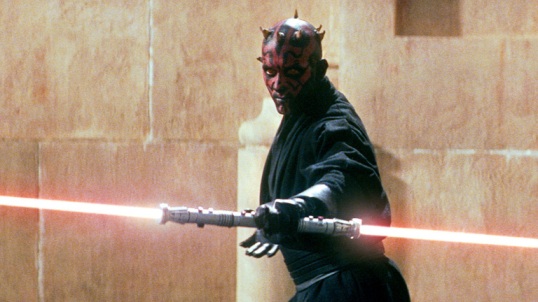
The Podracing scene was just as fun as it always was, and the Darth Maul Double Bladed Lightsaber reveal is just as hair raising, but watching it, I had moments where (just as I did on the first run), I wondered how much better it could be if Lucas didn’t hold on so tightly to his creation. Star Wars overall is an awesome concept, but there are just so many better writers and filmmakers out there. The material feels a little wasted, just a little.

If anything, The Phantom Menace does work as something to bring the kids to see, but if you already have the movie on video, it’s not completely required.


Poll: What Are You Looking Forward To In February?


So, at the end of each month, we ask you, our loyal readers, what movies are you looking forward to seeing in the future?  Last month at this time, we asked you what you were looking forward to seeing in January and the clear winner (with 42% of the vote) was the 3-D rerelease of Beauty and the Beast.

So, what about February?  Are you most excited about seeing the re-release of the Phantom Menace? And, if so, why?  I was only 13 when that movie first came out and even then, I thought it was the most boring thing I had ever seen.  Or perhaps your enthusiastic about a new film coming out?  And again, I have to ask why.  There usually aren’t that many good films released in January and February.

So, with all that in mind, what are you planning on seeing? 

As always, you can vote for up to four films and write-ins are accepted!  

Happy voting!