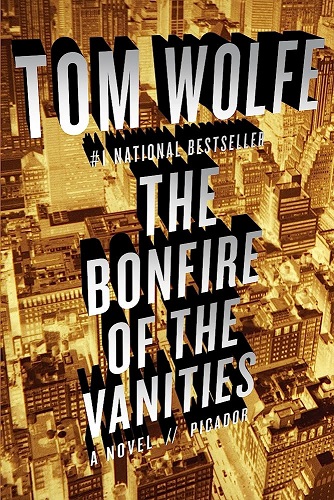
Novel Review: The Bonfire of the Vanities by Tom Wolfe


When it comes to The Bonfire of Vanities, after watching the movie and then reading the book about the making of the movie, you might as well order a copy of the original 1987 novel by Tom Wolfe and see where it all started.

At nearly 700 pages, The Bonfire of the Vanities is a big book about New York City in the mid-80s.  It’s a book about economics, racism, municipal politics, high society, and what happens when one very privileged person loses everything that he felt defined him.  As a writer and a satirist, Wolfe’s described the foibles and the mistakes of the book’s large cast of characters with a definite delight.  The reader may end up feeling sorry for stockbroker Sherman McCoy after he is arrested and put on trial for the hit-and-run of a young black teenager but, at no point, does Sherman ever become a truly sympathetic character.  As a character, Sherman never has the self-awareness necessary to truly confront his own mistakes and attitudes.  Reading the original novel, one realizes just how miscast Tom Hanks was when he was cast in the lead role for the film adaptation.  There are many ways to describe the aristocratic, arrogant, and ultimately hapless Sherman McCoy, but he is definitely not Tom Hanks.

Of course, Sherman is not the only character to lack self-awareness.  There’s really not a shred of self-awareness to found amongst any of the characters.  Both Sherman’s mistress and his wife are more concerned with how the trial is going to effect their social lives.  District Attorney Abe Weiss sees the prosecution of McCoy as a way to further his own political career.  Assistant District Attorney Jed Kramer finds himself obsessed with one the jurors.  Sleazy British journalist Peter Fallow amplifies the more sordid aspects of the story and blithely turns Sherman McCoy into the epitome of everything that everyone hates about the wealthy, with the great irony being that Sherman and his social set have patterned their own social style after their idealized view of the British.  The Mayor of New York obsesses over every little slight while a collection of detectives and attorneys do their job with blue collar efficiency and a cast of activists and grifters go out of their way to make headlines and to keep New York on the verge of exploding.  In the end, there’s only one truly heroic character in the novel and that’s Judge Myron Kovitsky, a loud and profane New Yorker who rules his courtroom like a benign tyrant but who is the only character who truly cares about seeing justice done.  In the end, the book suggests that the price of Kovitsky’s honorable stand will be the loss of his career.

(Kovitsky, the most vividly characterized of the many characters in the novel, was also one of the many characters to be changed for the film, becoming Judge Leonard White, the voice-of-God judge played by Morgan Freeman.)

In the end, the main character of the book really is New York City and Wolfe’s mix of love and disdain for the city comes through in every passage, from the detectives casually cursing around the station house to the waiters who efficiently handle the sudden death of a diner in restaurant to the politicians who hate and fear their own constituents.  Reportedly, Wolfe said that the novel was about capturing what New York City was like in the 80s and it’s definitely a novel of that era.  At the same time, when I read it in 2021, the story still felt relevant.  If anything, it was easy for me to picture Sherman McCoy as one of those people who brags about how they would have voted for Obama a third time while, at the same time, protesting the idea of any sort of affordable housing units being built in his neighborhood.  It was easy to imagine Fox and MSNBC and CNN all covering every moment of Sherman McCoy’s trial.  It was easy to imagine Peter Fallow showing up on TMZ and it was just as easy to imagine all of Fallow’s articles being breathlessly shared on social media.  Reading the novel, it was easy to see that the bonfire is still burning.

Icarus File No. 11: The Bonfire of the Vanities (dir by Brian De Palma)


In 2021, I finally saw the infamous film, The Bonfire of the Vanities.

I saw it when it premiered on TCM.  Now, I have to say that there were quite a few TCM fans who were not happy about The Bonfire of the Vanities showing up on TCM, feeling that the film had no place on a station that was supposed to be devoted to classic films.  While it’s true that TCM has shown “bad” films before, they were usually films that, at the very least, had a cult reputation.  And it is also true that TCM has frequently shown films that originally failed with audiences or critics or both.  However, those films had almost all been subsequently rediscovered by new audiences and often reevaluated by new critics.  The Bonfire of the Vanities is not a cult film.  It’s not a film about which one can claim that it’s “so bad that it’s good.”  As for the film being reevaluated, I’ll just say that there is no one more willing than me to embrace a film that was rejected by mainstream critics.  But, as I watched The Bonfire of the Vanities, I saw that everything negative that I had previously read about the film was true.

Released in 1990 and based on a novel by Tom Wolfe, Bonfire of the Vanities stars Tom Hanks as Sherman McCoy, a superficial Wall Street trader who has the perfect penthouse and a painfully thin, status-obsessed wife (Kim Cattrall).  Sherman also has a greedy mistress named Maria (Melanie Griffith).  It’s while driving with Maria that Sherman takes a wrong turn and ends up in the South Bronx.  When Sherman gets out of the car to move a tire that’s in the middle of the street, two black teenagers approach him.  Maria panics and, after Sherman jumps back in the car, she runs over one of the teens.  Maria talks Sherman into not calling the police.  The police, however, figure out that Sherman’s car was the one who ran over the teen.  Sherman is arrested and finds himself being prosecuted by a power-hungry district attorney (F. Murray Abraham).  The trial becomes the center of all of New York City’s racial and economic strife, with Sherman becoming “the great white defendant,” upon whom blame for all of New York’s problems can be placed.  Bruce Willis plays an alcoholic journalist who was British in the novel.  Morgan Freeman plays the judge, who was Jewish in the novel.  As well, in the novel, the judge was very much a New York character, profanely keeping order in the court and spitting at a criminal who spit at him first.  In the movie, the judge delivers a speech ordering everyone to “be decent to each other” like their mothers taught them to be.

Having read Wolfe’s very novel before watching the film, I knew that there was no way that the adaptation would be able to remain a 100% faithful to Wolfe’s lacerating satire.  Because the main character of Wolfe’s book was New York City, he was free to make almost all of the human characters as unlikable as possible.  In the book, Peter Fallow is a perpetually soused opportunist who doesn’t worry about who he hurts with his inflammatory articles.  Sherman McCoy is a haughty and out-of-touch WASP who never loses his elitist attitude.   In the film, Bruce Willis smirks in his wiseguy manner and mocks the other reporters for being so eager to destroy Sherman.  Hanks, meanwhile, attempts to play Sherman as an everyman who just happens to live in a luxury penthouse and spend his days on Wall Street.  Hanks is so miscast and so clueless as how to play a character like this that Sherman actually comes across as if he’s suffering from some sort of brain damage.  He feels less like a stockbroker and more like Forrest Gump without the Southern accent.  There’s a scene, written specifically for the film, in which Fallow and Sherman ride the subway together and it literally feels like a parody of one of those sentimental buddy films where a cynic ends up having to take a road trip with someone who has been left innocent and naïve as result of spending the first half of their life locked in basement or a bomb shelter.  It’s one thing to present Sherman as being wealthy and uncomfortable among those who are poor.  It’s another thing to leave us wondering how he’s ever been able to successfully cross a street in New York City without getting run over by an angry cab driver.

Because the film can’t duplicate Wolfe’s unique prose, it instead resorts to mixing cartoonish comedy and overwrought melodrama.  It doesn’t add up too much.  At one point, Sherman ends a dinner party by firing a rifle in his apartment but, after it happens, the incident is never mentioned again.  I mean, surely someone else in the apartment would have called the cops about someone firing a rifle in the building.  Someone in the press would undoubtedly want to write a story about Sherman McCoy, the center of the city’s trial of the century, firing a rifle in his own apartment.  If the novel ended with Sherman resigned to the fact that his legal problems are never going to end, the film ends with Sherman getting revenge on everyone who has persecuted him and he does so with a smirk that does not at all feel earned.  After two hours of being an idiot, Sherman suddenly outthinks everyone else.  Why?  Because the film needed the happy ending that the book refused to offer up.

Of course, the film’s biggest sin is that it’s just boring.  It’s a dull film, full of good actors who don’t really seem to care about the dialogue that they are reciting.  Director Brian De Palma tries to give the film a certain visual flair, resorting to his usual collection of odd camera angles and split screens, none of which feel at all necessary to the story.  In the end, De Palma is not at all the right director for the material.  Perhaps Sidney Lumet could have done something with it, though he would have still had to deal with the less than impressive script.  De Palma’s over-the-top, set piece-obsessed sensibilities just add to the film’s cartoonish feel.

The film flopped at the box office.  De Palma’s career never recovered.  Tom Hanks’s career as a leading man was momentarily derailed.  Bruce Willis would have to wait a few more years to establish himself as a serious actor.  Even the normally magnanimous Morgan Freeman has openly talked about how much he hated being involved with The Bonfire of the Vanities.  That said, the film lives on because  De Palma allowed journalist Julie Salomon to hang out on the set and the book she wrote about the production, The Devil’s Candy, is a classic of Hollywood non-fiction.  (TCM adapted the book into a podcast, which is how The Bonfire of the Vanities came to be featured on the station.)  Thanks to Salomon’s book, The Bonfire of the Vanities has gone to become the epitome of a certain type of flop, the literary adaptation that is fatally compromised by executives who don’t read.

Previous Icarus Files:

  1. Cloud Atlas
  2. Maximum Overdrive
  3. Glass
  4. Captive State
  5. Mother!
  6. The Man Who Killed Don Quixote
  7. Last Days
  8. Plan 9 From Outer Space
  9. The Last Movie
  10. 88