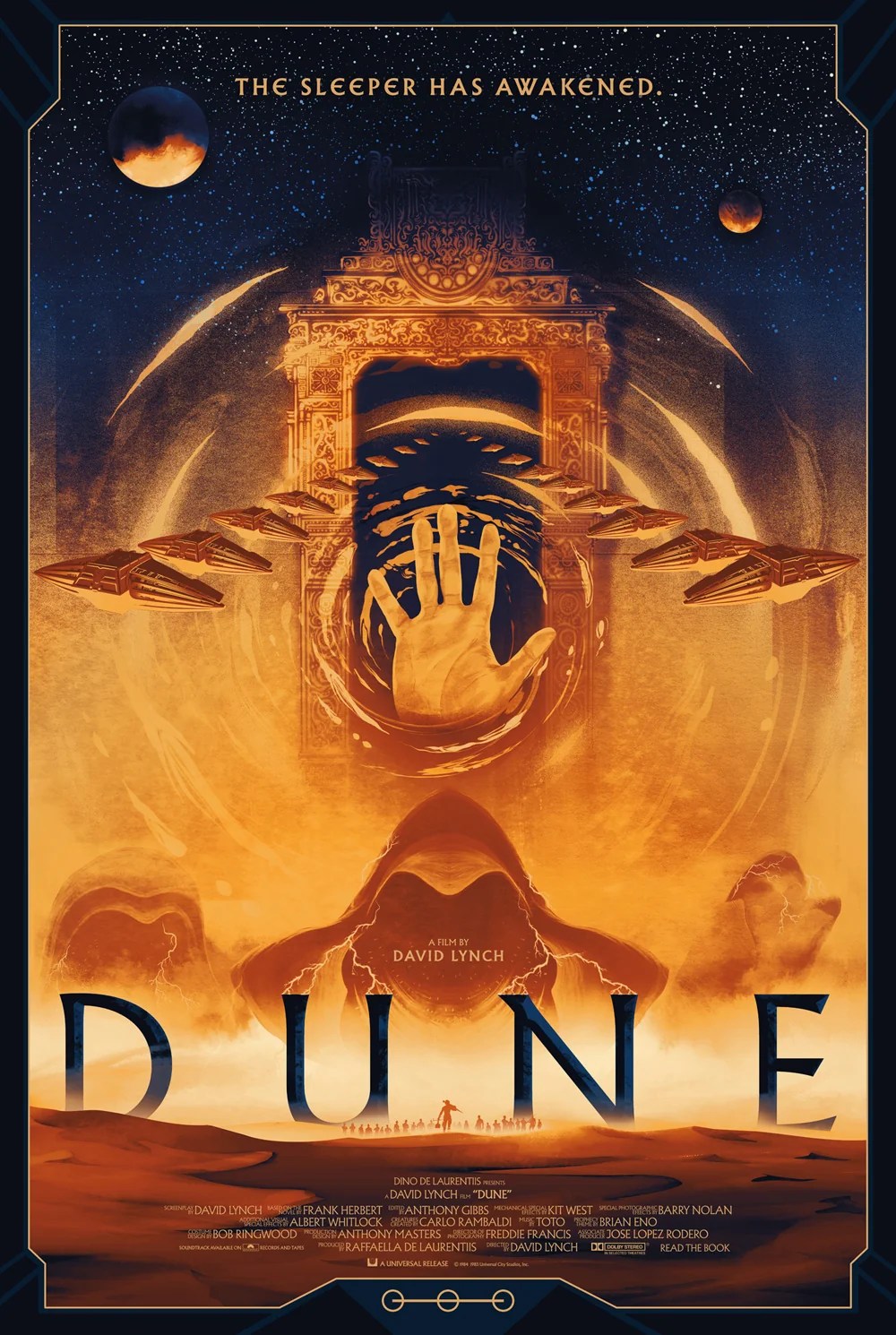
Review: Dune (dir. by David Lynch)


“The sleeper has awakened.” — Paul “Muad’Dib” Atreides

David Lynch’s Dune is one of those movies that somehow manages to be both a spectacular failure and a strangely hypnotic piece of cinema at the same time. It feels like a film willed into existence through pure creative tension: on one side, Frank Herbert’s dense, political, and spiritual sci‑fi novel; on the other, David Lynch’s surreal, psychological, dream‑logic sensibility. The result is a singular oddity—visually bold, dramatically uneven, and endlessly fascinating if you’re in the mood for something that feels more like a hallucination than a conventional space opera.

To call the adaptation ambitious is underselling it. After the collapse of Alejandro Jodorowsky’s infamous attempt to adapt Dune, the project eventually landed at Universal with producer Dino De Laurentiis, and Lynch—fresh off The Elephant Man—was brought in to turn Herbert’s galaxy‑spanning book into a two‑hour‑ish feature. On paper, it seems like inspired casting: Lynch had the visual imagination and emotional intensity to do something memorable with the material. But he was never a natural fit for streamlined blockbuster storytelling. His instincts live in mood, subconscious imagery, and uneasy psychological textures rather than clean plot mechanics. You can feel that clash all over the final film, and it’s part of what makes it so weirdly compelling.

Right from the opening, Dune doesn’t hold your hand. Princess Irulan’s floating head lays out a massive info‑dump about spice, the Imperium, and Arrakis that plays like someone reading you the glossary at the back of a sci‑fi novel. It’s dense, awkward, and kind of charming in its sincerity. The movie takes Herbert’s universe extremely seriously—no wink, no irony, no attempt to sand off the stranger edges. The Bene Gesserit, mentats, feudal houses, and prophecies are all presented straight, as if the audience will either keep up or be left behind. There’s something almost punk about that level of commitment.

Kyle MacLachlan, in his debut as Paul Atreides, is perfectly cast for Lynch’s take on the character. He’s got this earnest, slightly naive presence that gradually hardens as the story pushes him toward messiah status. Instead of leaning into a swashbuckling hero archetype, Lynch frames Paul’s evolution as something interior and dreamlike, almost like a spiritual awakening happening inside a hostile universe. Paul’s visions aren’t giant, crystal‑clear CGI prophecy sequences; they’re fragmented, flickering images, whispers, and flashes of desert and blood. You can feel Lynch trying to drag the sci‑fi epic into his own subconscious, even if the narrative doesn’t always keep up.

The supporting cast is packed with strong, sometimes delightfully bizarre performances. Francesca Annis gives Lady Jessica a sensual, haunted calm that fits the Bene Gesserit’s mix of discipline and manipulation. Jurgen Prochnow’s Duke Leto radiates dignified doom; he feels like a man who knows he’s walking into a trap but can’t step off the path. Then you get to the Harkonnens, where Lynch just lets his freak flag fly. Kenneth McMillan’s Baron is a grotesque comic‑book monster, oozing, cackling, floating on anti‑grav tech, and reveling in cruelty. It’s not subtle, but it is unforgettable. And of course Sting as Feyd‑Rautha, stalking around in barely‑there outfits and sneering like a rock star beamed in from another film entirely, just adds to the movie’s fever‑dream energy.

Visually, Dune is a feast and sometimes a bit of a choke. The production design leans into a kind of retro‑futurist baroque: cavernous sets, ornate technology, and spaces that feel less like functional environments and more like places out of a dark fantasy. Lynch and cinematographer Freddie Francis infuse everything with shadow, smoke, and texture, so even the quiet scenes feel heavy and loaded. The sandworms are huge, tactile, and worshipful in scale; the way they burst from the desert feels more like a religious manifestation than a monster attack. Even if you’re lost in the plot, the images stick with you—daggers, stillsuits, weirding whispers, blood on sand.

The sound and music do a ton of work in giving the film its identity. The score, primarily by Toto with contributions from Brian Eno, is this fusion of 80s rock sensibility and orchestral grandeur. It shouldn’t work, but it does; the main theme swells with tragic heroism, while other cues veer into eerie, synthy territory that matches Lynch’s off‑kilter tone. The sound design around the “weirding” abilities, the internal monologues, and the roar of the sandworms all help sell the world even when the script is sprinting past exposition. It’s one of those films where you might not fully grasp every detail, but the combined force of image and sound makes you feel like you’ve visited a real, deeply strange place.

The big structural problem, and the thing that most clearly separates Lynch’s adaptation from Denis Villeneuve’s two‑part version, is time and emphasis. Lynch is trying to cram the entire arc of Dune into a single film, and that means the plotting goes from methodical to breakneck halfway through. The first half lingers on the setup—Caladan, the move to Arrakis, the betrayal—while the second half rockets through Paul’s Fremen transformation, the guerrilla war, the sandworm riding, and the final confrontation. Subplots are hinted at and dropped, character arcs feel truncated, and the voiceover is forever trying to patch gaps the edits created. Themes like ecological transformation, the manipulation behind religious prophecy, and the long‑term horror of Paul’s rise are mostly reduced to gestures.

The best way to see Dune in Lynch’s version is actually through the extended cut, which adds a bit more context to certain scenes and lets the film breathe slightly more than the theatrical release. The theatrical cut is so aggressively compressed that pieces of motivation and setup just vanish, leaving the story feeling even more disjointed. The extended version restores some of the connective tissue—especially around Paul’s early time with the Fremen, the political maneuvering in the lead‑up to the final act, and the way certain characters orient themselves in the larger conflict. It doesn’t magically fix the studio‑driven structure or the inherent weirdness of Lynch’s choices, but it does make the film feel a little more complete, a little closer to the director’s original vision. It’s still messy, but less like a rushed homework assignment and more like a genuinely eccentric, if compromised, longform take on Herbert’s world.

Tonally, Lynch and Villeneuve are almost mirror images. Lynch’s film is cramped, loud in its weirdness, and often grotesque, playing like a baroque horror‑opera about destiny. Villeneuve’s is stately, slow‑burn, and solemn, more interested in the weight of empire, colonialism, and religious manipulation. Even their takes on Paul are distinct. In Lynch’s film, Paul ultimately plays more like a triumphant chosen one; whatever ambiguity is there gets overshadowed by the climactic victory and the literal act of making it rain as a grand, almost celebratory miracle. Villeneuve leans harder into the darker implications: Paul is framed as a potentially dangerous figure whose rise may unleash something terrible, and his two‑part arc emphasizes the holy war and fanaticism coalescing around him instead of treating his ascension as a clean win. Where Lynch’s ending lands somewhere between pulp myth and studio‑mandated uplift, Villeneuve’s execution feels closer to a tragedy about messianic power.

Knowing all that, Lynch’s Dune ends up feeling like a relic from an era when studios occasionally handed gigantic, unwieldy properties to filmmakers with intensely personal styles and just hoped for the best. It doesn’t “work” in a conventional plot sense, and if you’re coming to it after the sleek coherence of Villeneuve’s films, it can feel like a chaotic, cluttered alternate‑universe version of the same story. But that alternate universe has its own power. There’s a raw, handmade intensity to Lynch’s take—a sense that he’s trying to turn Dune into a waking dream about destiny, decay, and the seduction of power, even as the studio scissors are hacking away at his vision.

In the end, David Lynch’s Dune is a beautifully broken thing: a movie that fails as a straightforward adaptation but succeeds as a cinematic experience you can’t quite shake. Villeneuve gives you a clearer, more faithful, and philosophically aligned Dune, the one that explains itself and lets you sit with its implications. Lynch gives you the nightmare version, messy and compromised, but pulsing with strange life. If Villeneuve’s two‑part saga is the definitive modern telling, Lynch’s film—especially the extended cut—remains the haunting alternate path, a vision of Arrakis filtered through a very particular mind, sandblasted, grotesque, and unforgettable.
Scene That I Love: Kyle MacLachlan in Dune


Today, the Shattered Lens wishes a happy birthday to the one and only Kyle MacLachlan!

Today’s scene that I love comes from MacLachlan’s film debut, 1984’s Dune.  MacLachlan played Paul Atriedes in David Lynch’s unfairly maligned film and his otherworldly vibe made him as perfect for the role as he would later be for Agent Dale Cooper in Lynch’s Twin Peaks.  As good as Timothee Chalamet was in the more recent adaptations of Frank Herbert’s novel, I still feel that MacLachlan is the superior Paul.

In this scene, Paul confronts the people who have been trying to destroy him and he proves his worth in an armed duel with Sting.

The Sting trailer brings the creepy crawly Nightmare Fuel!


Spiders.

If there’s one creature on the planet that gets a bad rap, it’s the spider. They have too many legs, too many eyes (save for Tarantulas), and they were designed with faces perfect for making people shudder. Without them, however, we’d be overrun with insects. I don’t even to look at this trailer to know this is pure Nightmare Fuel. One rapidly growing alien spider running loose in an apartment complex? There’s so much Nope in this, I don’t even know where to start.

At least the hero’s named Charlotte. That’s pretty cool. In Sting, we have an apartment complex and an alien spider that seems to be growing both in size and in appetite.

Sting will be out in theatres this April.

Music Video of the Day: Redlight by Swedish House Mafia and Sting (2022, dir by ????)


Before clicking on play, please be aware that this video features flashing lights and comes with an epilepsy warning.  If you watch, enjoy!

You don’t have to put on the red light,
Those days over
You don’t have to sell your body to the night
You don’t have to wear that dress to night
Those days are over
You don’t have to put on the Redlight
Those days are over
You don’t have to put on the Redlight
Those days are over
You don’t have to put on the Redlight
Those days are over
You don’t have to put on the Redlight
Those days are over
You don’t have to put on the Redlight
Those days are over
You don’t have to put on the Redlight

Music Video of the Day: Demolition Man by Grace Jones (1982, directed by Jean-Paul Goude)


Demolition Man is a song that’s had a long history. It was first written in 1980 by Sting, while he was staying at Peter O’Toole’s home in Ireland. It was written for the Police but they never got around to recording it. In 1981, Grace Jones requested that Sting send her a song. Sting sent over the demo for Demolition Man and Grace Jones was then the first artist to release a recording of the song. It was only after the release of Grace Jones’s version that The Police released their own version and, of course, Sting has gone on to regularly perform the song as a solo artist. And, of course, the song reached a whole new level of popularity with the release of the Sylvester Stallone/Wesley Snipes/Sandra Bullock action film of the same name.

The music video for Grace Jones’s version was shot during her One Man Show tour. The video was included on compilation that was released in 1982 to promote interest in Jones’s latest album, Living My Life. Like all of the videos shot during the tour, it was filmed at either London’s Drury Lane Theater or The Savoy Theater in New York City. The video was directed by Jean-Paul Goude, the French artist who was a long-time collaborator with Grace Jones and the father of her son, Paulo.

Enjoy!

Music Video of the Day: Money for Nothing by Dire Straits (1985, directed by Steve Barron)


In a 1984 interview, Dire Straits guitarist Mark Knopfler had this to say about the song that would not only become the band’s biggest hit but also one of the best known videos from the early years of MTV:

The lead character in “Money for Nothing” is a guy who works in the hardware department in a television/​custom kitchen/​refrigerator/​microwave appliance store. He’s singing the song. I wrote the song when I was actually in the store. I borrowed a bit of paper and started to write the song down in the store. I wanted to use a lot of the language that the real guy actually used when I heard him, because it was more real….

According to Knopfler, he was in a New York appliance store when he heard a man who worked there complaining about all of the TVs in the shop being tuned to MTV.  (Urban legend has it that the man was watching a Motley Crue video.)  Knopfler wrote down the man’s exact words, which included the famous line about “money for nothing and chicks for free,” and later set them to music.  (Knopfler also included the man’s controversial description of a rock star as being “that little faggot with the earring and the makeup.”  In 2011, 26 years after the song’s initial release, that line would lead to the  Canadian Broadcast Standards Council banning the song from being played on Canadian radio stations.)  After hearing the band’s initial recording of the song, Sting suggested the “I want my MTV” line and was rewarded with a co-writer credit.

The ground-breaking music video was one of the first to feature computer animation.  Under the direction of Steve Barron, Ian Pearson and Gavin Blair (who later founded Rainmaker Studios) created the animation using a Bosch FGS-4000 CGI system and a Quantel Paintbox system.

Money for Nothing spent 3 weeks as the number one single in the United States and the video was named Video of the Year at the 3rd Annual MTV Music Awards.

A Movie A Day #292: The Bride (1985, directed by Franc Roddam)


The Bride opens where most films about Frankenstein and his monster end.
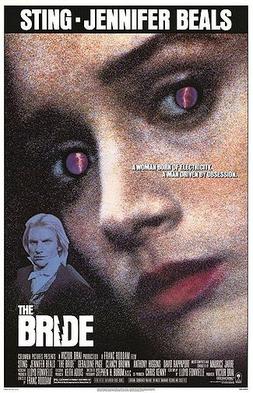
The Baron (played by fucking Sting, of all people) has agreed to create a bride for his creation, who in this movie is named Viktor and played by Clancy Brown.  Jennifer Beals plays the Bride, who is named Eva.  Eva looks like a normal, beautiful wielder-turned-dancer so when she first sees Viktor, she screams.  Viktor gets upset and starts to trash the laboratory.  “Don’t be impertinent!’ snaps the Baron’s assistant (Quentin Crisp).  A fire breaks out.  Quentin Crisp dies and so does another assistant played by Timothy Spall.  The monster escapes.  The Baron takes Eva into his household.  The Baron is obsessed with controlling Eva, who wants her independence and who has fallen in love with Cary Elwes.  When Eva sees a cat, she screams.  “You never told me about cats,” she tells the Baron, “I thought it was a tiny lion!”

The rest of the movie is a bewildering collection of cameos from respected thespians forced to recite some of the worst dialogue in film history.  Viktor befriends Rinaldo the dwarf (David Rappaport), who tells Viktor about how much he dreams of one day seeing Venice.  After Rinaldo is murdered by Alexei Sayle, Viktor swears that he will go to Venice and he will take Eva with him.

(Timothy Spall,  Quentin Crisp, and Alexei Sayle are not the only British performers to be strangely miscast in The Bride.  Keep an eye out for Phil Daniels, Ken Campbell, and Tony Haygarth, all wasted in small roles.)

The Bride attempts to put a revisionist, feminist spin on the story of Frankenstein but it ultimately just looks like a two hour Duran Duran video, with a guest vocals provided by Sting.  The scenes with Clancy Brown and David Rappaport work but otherwise, every important role is miscast.  Jennifer Beals is monotonous as the Bride and Sting never comes close to suggesting that he is capable of the type of mad genius that would be necessary to create life.  When it comes to the Bride of Frankenstein, stick with the original.

One final note: Both Sting and Phil Daniels also appeared in a much better film from Franc Roddam, Quadrophenia.  I recommend seeing Quadrophenia almost as much as I recommend forgetting about The Bride.

Cleaning Out The DVR Yet Again #16: Zoolander 2 (dir by Ben Stiller)


(Lisa recently discovered that she only has about 8 hours of space left on her DVR!  It turns out that she’s been recording movies from July and she just hasn’t gotten around to watching and reviewing them yet.  So, once again, Lisa is cleaning out her DVR!  She is going to try to watch and review 52 movies by Wednesday, November 30th!  Will she make it?  Keep checking the site to find out!)

zoolander_2_poster

On October 14th, I recorded Zoolander 2 off of Epix.

A sequel to the 2001 cult hit, Zoolander 2 came out earlier this year and got absolutely terrible reviews and quickly vanished from theaters.  Watching the film last night, I could understand why it got such terrible reviews.  Zoolander 2 is not only a terrible movie but it’s also a rather bland one.  Somehow, the blandness is even more offensive than the badness.

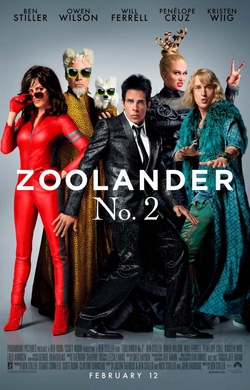
Zoolander 2 opens with Justin Bieber getting assassinated and Derek Zoolander (Ben Stiller) being forced to come out of retirement and discover why pop stars are being targeted.  And, of course, Zoolander can’t do it without the help of Hansel (Owen Wilson)!  Penelope Cruz is in the film as well, playing  Zoolander’s handler and essentially being wasted in a role that could have been played by anyone.

Oh!  And Will Ferrell returns as well.  Ferrell gives a performance that essentially shouts out to the world, “Fuck you, I’m Will Ferrell and no one is going to tell Will Ferrell to tone his shit down!”

Actually, I think everyone in the world is in Zoolander 2.  This is one of those films that is full of cameos from people who probably thought a silly comedy would be good for their image.  For instance, there’s a huge number of journalists who show up playing themselves.  Matt Lauer shows up and I get the feeling that we’re supposed to be happy about that.  There was a reason why people cheered when the sharks ate him in Sharknado 3.

You know who else shows up as himself?  Billy Zane!  And Billy Zane has exactly the right type of attitude for a film like this.  He shows up and he mocks the whole enterprise by giving the Billy Zaniest performance of Billy Zane’s career.  For that matter, Kiefer Sutherland also shows up as himself.  I’m not really sure what Kiefer was doing in the film but he makes sure to deliver all of his lines in that sexy growl of his.  Kiefer knows what we want to hear.

You may notice that I’m not talking about the plot of Zoolander 2.  That’s largely because I couldn’t follow the plot.  This is an incredibly complicated film but it’s not complicated in a funny way.  Instead, it’s complicated in a way that suggests that the film was made up on the spot.  It’s as if the cast said, “We’re all funny!  Just turn on the camera and we’ll make it work!”

The problem with Zoolander 2 is obvious.  The first film pretty much exhausted the comic possibilities of making a spy film about shallow and stupid models.  Don’t get me wrong — the first film did a good job but it’s not like it left any material untapped.  But I would ask you to indulge me as I imagine an alternate reality.

Consider this: Terrence Malick was reportedly a huge fun of Zoolander.

Let’s take just a minute to imagine a world in which Ben Stiller asked Terrence Malick to write and direct Zoolander 2.  And let’s say, just for the sake of argument, that Malick agreed!

Just think about it — 4 hours of Zoolander and Hansel staring up at the sky and thinking about nature.  “What is this thing that causes the heart of man to beat?” Zoolander asks.  “Are we nature or has nature become us?” Hansel replies.

That would have been a fun film!