Cleaning Out The DVR: Sodom and Gomorrah (dir by Robert Aldrich)


I think we all know the story of Sodom and Gomorrah.

As told in the book of Genesis, Sodom and Gomorrah were two of the wickedest cities in what was then the civilized world. God grew so sick of their wickedness that he decided to wipe both of the cities and all of their inhabitants out of existence. However, because Abraham’s son, Lot, was living in Sodom with his family, God sent two angels to Sodom to warn Lot. Lot tried to argue that, if he could find 10 good people in the city, Sodom should be spared. However, then the people of Sodom showed up and demanded to “know” the angels and that pretty much sealed their fate. Lot and his family were told to leave the city and to not look back while it was being destroyed. Unfortunately, Lot’s wife just couldn’t resist the temptation and she ended up turning into a pillar of salt.

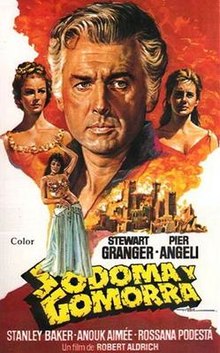
The 1962 film, Sodom and Gomorrah, recreates the Biblical story, though it takes a lot of liberties with the established narrative. Stewart Granger plays Lot. Anouk Aimee plays Bera, the decadent queen of Sodom who refuses to believe that the incoming destruction of her city is anything more than a dust storm. Pier Angeli plays Lot’s wife, who is imagined here as formerly being one of Bera’s slaves. Though she loves Lot, she loves her former life more and …. well, we all know the story. And then there’s several characters who were created specifically for the film. The most prominent of these is Astaroth (Stanley Baker), who is Bera’s scheming brother and who later is attracted to one of Lot’s daughters. The film was directed by Robert Aldrich. If you know anything about Aldrich’s filmography (Kiss Me Deadly, Twilight’s Last Gleaming, and Hustle among others), he’s not exactly the first name that comes to mind when you think of a director who you would expect to find directing a Biblical epic. And indeed, when compared to his other films, Aldrich often does seem to just be going through the motions when it comes to telling the film’s story.

Sodom and Gomorrah suffers from a problem that afflicted many Biblical epics. It takes forever to get to the good stuff. We’re all watching because we want to see the cities get destroyed and we want to watch Lot’s wife get transformed into a pillar of salt. However, this film — which has a running time of two and a half hours — takes forever to reach that point. First, we have to spend a lot of time listening to Astaroth plotting against his sister and scheming how to take over the Salt Trade, which is the source of the wealth of both of the cities. Then we spend an endless amount of time with Lot and his family wandering through the desert. There are a few good battle scenes but the film still feels dragged out. It takes forever to get to the destruction of Sodom and Gomorrah and it’s a bit of a let down when it finally does happen. The ground shakes, Dust fills the sky. Buildings start falling on people. Throughout it all, the Sodomites continue to behave wickedly, which leads to a few odd moments. (A man and a woman stop fleeing for a few minutes to make out against a wall. Naturally, the wall is the next thing to collapse.) After all of that build-up, the destruction scenes are maddeningly pedestrian.

Lot is probably one of the most interesting characters in Genesis, an imperfect man who tried to do the right thing but who often seemed to have terrible luck. Unfortunately, Stewart Granger is a bit of a stiff in the lead role and he’s never convincing as someone who could lead his people through the desert. He doesn’t have the innate authority that Charlton Heston had in The Ten Commandments. Far more successful are the performances of Stanley Baker and Anouk Aimee. Aimee, in particular, seems to being having a blast being bad. Or at least, she is until the walls come tumbling down.
Cleaning Out the DVR Pt. 22: Winter Under the Stars


gary loggins's avatarcracked rear viewer

I haven’t done one of these posts in a while, and since my DVR is heading towards max capacity, I’m way overdue! Everyone out there in classic film fan land knows about TCM’s annual “Summer Under the Stars”, right? Well, consider this my Winter version, containing a half-dozen capsule reviews of some Hollywood star-filled films of the past!

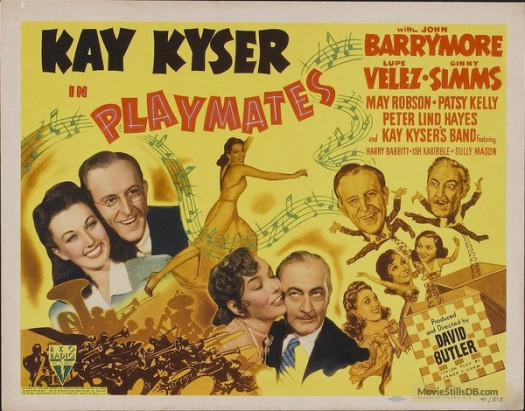
PLAYMATES (RKO 1941; D: David Butler ) – That great thespian John Barrymore’s press agent (Patsy Kelly) schemes with swing band leader Kay Kyser’s press agent (Peter Lind Hayes) to team the two in a Shakespearean  festival! Most critics bemoan the fact that this was Barrymore’s final film, satirizing himself and hamming it up mercilessly, but The Great Profile, though bloated from years of alcohol abuse and hard living, seems to be enjoying himself in this fairly funny but minor screwball comedy with music. Lupe Velez livens things up as Barrymore’s spitfire…

View original post 1,088 more words

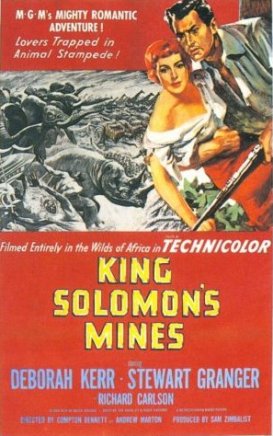
Lisa Reviews An Oscar Nominee: King Solomon’s Mines (dir by Compton Bennett and Andrew Marton)


Kingsolomonsmines1950

So, this is a weird one.

As we all know, today is Oscar Sunday!  As I wait for the big show to begin, I’ve been watching some of the Oscar-nominated films that I have collected on the DVR over the past month.  For instance, this morning, I watched 1950’s King Solomon’s Mines.

King Solomon’s Mines was nominated for best picture of the year and watching it … well, you really have to wonder why.  It’s an adventure film, one that was shot on location in Africa and it features a lot of footage of wild animals.  It also features several scenes that were shot in actual African villages and a good deal of time is devoted to documenting tribal rituals.  It’s true that the film has a plot but, for the most part, it’s a travelogue.  One gets the feeling that it was mostly sold as a chance for American and European audiences to see a part of the world that, up until that point, they had only read about.  Not only would they get to experience Africa from the safety of the neighborhood movie theater but they’d get to see it in a color as well!

(Seriously, it’s difficult to watch the nature footage in King Solomon’s Mines without imagining a serious voiced narrator saying, “However, one gazelle has strayed too far from its mother.  The lion cubs will eat tonight…”)

As for the plot, King Solomon’s Mines is based on a novel by British adventure enthusiast H. Rider Haggard.  Allan Quartermain (Stewart Granger) is an experienced guide and hunter.  When we first meet him, he’s helping two rich Englishmen hunt an elephant.  It’s a disturbing scene, largely because it’s obvious the footage of the elephant dying is real.  Allan prevents his clients from killing more than one elephant and later talks about how much he hates his job but still, it’s pretty much to impossible to really like him after watching that elephant die.

Anyway, Allan gets hired by Elizabeth Curtis (Deborah Kerr) and her brother John (Richard Carlson).  It seems that Elizabeth’s husband disappeared in Africa while searching for a legendary treasure.  Allan tells Elizabeth that her husband is probably dead.  Elizabeth still insists on searching for him…

…and, from that point on, you can pretty much predict everything that is going to happen.  Though the footage of Africa looks great, it’s just not a very interesting film.  Playing the type of role that would probably be played by Gerard Butler if the movie was made today, Stewart Granger comes across as being bored with it all.  For that matter, even the great Deborah Kerr seems as if she’d rather be hanging out with Robert Mitchum.

Still, it is interesting to note that Hugo Haas shows up as a villain.  Who is Hugo Haas?  He was a Hungarian actor who, after playing a bad guy here, went on to direct several idiosyncratic B-movies, like Hold Back Tomorrow, The Girl On The Bridge, Bait, and One Girl’s Confession.  If nothing else, watching King Solomon’s Mines has inspired me to, someday, do a little Hugo Haas film festival here on the Lens.

King Solomon’s Mines seems like an odd best picture nominee.  Its triumphs are largely technical and even those successes no longer seem that special.  It was, however, a big hit at the box office and I imagine that probably has something to do with its nomination.  However, when the Oscars were awarded, best picture went to All About Eve.

Stewart Granger was no match for Bette Davis.

Review: The Wild Geese (dir. by Andrew V. McLaglen)


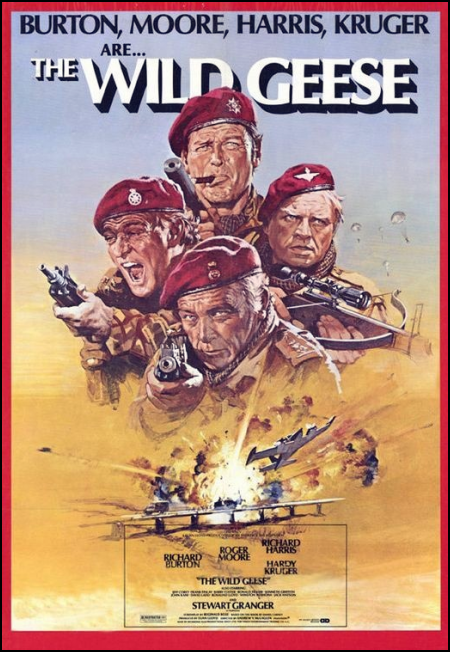
1978’s action war film The Wild Geese is an adaptation of Daniel Carney’s unpublished novel about a group of mercenaries on a mission during the turbulent revolutionary times that beset Central Africa during the 1960s and early 70s. The film features an all-star cast of British actors, a true who’s who of the era. Under the direction of Andrew V. McLaglen, The Wild Geese manages to be an action-packed and well-told film with memorable performances.

The character Colonel Allen Faulkner, played by Sir Richard Burton, is loosely based on the real-life mercenary legend Michael “Mad Mike” Hoare. Hoare not only inspired this central character but also served as the film’s military and technical advisor. Adding to the film’s authenticity, one of the actors portraying a mercenary, Ian Yule, had served with Hoare in his mercenary company. This infusion of real-life experience gives the film a vivid sense of art imitating life and lends credibility to its portrayal of mercenary warfare.

The story begins with a meeting between Faulkner and British banker Sir Edward Matheson about a rescue mission in the fictional Central African nation of Zembala. The first third follows Faulkner’s recruitment of a 50-man mercenary team, including his reluctant old friend Rafer Janders (Sir Richard Harris). The film portrays the mercenary company training and preparing for the mission before being inserted behind enemy lines. The second half details the rescue of their target: a deposed African leader about to be executed by the man who overthrew him.

During the second third of the film, the action intensifies. Though tame by today’s standards, the sequences were energetic and well-shot for their time. The mercenaries are shown not as idealized heroes but as pragmatic soldiers who use ruthless tactics—such as cyanide gas and poisoned crossbow bolts—that may shock modern audiences. This realism reflects Hoare’s influence and presents mercenaries as professionals doing a dangerous job for pay, blurring the moral lines of warfare. Betrayal during the mission tests their survival in enemy territory.

Burton and Harris deliver excellent performances as hardened war veterans, while a younger Sir Roger Moore adds roguish charm as the Irish pilot Shaun Fynn. Strong supporting roles include Hardy Kruger as Pieter Coetzee, an initially racist Afrikaner who gains new perspective on the continent’s upheaval, and Stewart Granger as the principled banker Matheson.

Though relatively small budgeted compared to other war epics of the era, The Wild Geese carries an epic feel and should have appealed more to American audiences. Unfortunately, financial difficulties with the production company affected its U.S. release. Over time, video and DVD releases built it a cult following among war and mercenary film fans, a subgenre often dominated by lesser films. McLaglen’s straightforward direction keeps the film’s pacing steady, and the story balances action with political and philosophical themes in its final act.

The Wild Geese stands as a rare gem in war cinema that delves into a little-known subgenre. With strong performances by knighted British actors, a former Hitler Youth, and real-life mercenaries as extras, the film distinguishes itself from the many flawed war movies flooding late-70s and early-80s cinema. Its roots in actual mercenary experiences, highlighted by Hoare’s real-life involvement and character inspiration, make it a compelling and underappreciated classic for aficionados of the genre.