Horror Film Review: The Wind (dir by Nico Mastorakis)


In 1986’s The Wind, Meg Foster stars as Sian Anderson.  Sian is a novelist who lives in Los Angeles with her wealthy boyfriend, John (David McCallum).  How wealthy is John?  He’s so wealthy that he can sit out by his pool with a telephone.  (That’s 80s wealthy!)  He’s so wealthy that, when Sian says that she’s going to go to Greece so she can work on her next novel, John rents out the Goodyear Blimp and has it say, “Bon Voyage.”

(It would have been funnier if it had said, “The World Is Yours.”)

On the Greek isle of Monemvasia, she rents the home of Elias Appleby (Robert Morley), an eccentric man who tells her that she must be careful during the night because the heavy winds can be deadly.  He probably also should have warned her that the handyman, Phil (Wings Hauser), was crazy.  No sooner has the wind started howling outside and Sian has started work on her latest novel (which, from what we hear of her writing, sounds absolutely awful), then wild-eyed Phil starts acting crazy and homicidal.  Isolated and too stupid to figure out how to use a Greek phone (and yes, that actually is a plot point), Sian tries to survive the night.

The Wind was directed by Greek journalist-turned-filmmaker Nico Mastorakis.  Anyone was has seen a previous Mastorakis film will immediately be able to spot that The Wind is a product of his somewhat unique aesthetic vision.  As with almost all of Mastorakis’s films, The Wind is both a thriller and a travelogue.  Yes, Phil is trying to kill Sian but — hey!  Look at how pretty the island is!  As well, in typical Mastorakis fashion, the cast is a hodgepodge of familiar faces who don’t all seem as if they belong in the same movie.  Along with Meg Foster, Wings Hauser, Robert Morley, and David McCallum, the film also features Steve Railsback as a friendly sailor who, stranded on the island by the wind, attempts to help Sian out.

The other big Mastorakis trademark is that none of the characters in the film seem to like each other.  That makes sense when it comes to Sian and Phil.  But what is one to make of the scene where Appleby gives Sian a tour of the home and the two of them, who have just met, immediately start snapping at each other for no reason?  They’ve just met and they really don’t have any reason to be arguing with each other.  But that’s what they do because this is a Nico Mastorakis film.

For me, the funniest part of the film involves John.  Worried that Phil is going to kill her, Sian finally gets to talk to John on the phone.  The connection is bad but John, who is sitting out by his pool, still clearly hears Sian say that someone is trying to kill her.  The line then goes dead.  John contacts the international operator and says that he has to make an emergency call to Greece but he’s not sure about the exact number.  The international operator replies that a call cannot be made with an exact number.  So, what does John?  He shrugs, hangs up,  gets in the swimming pool, swims a few laps and nearly misses it when Sian, hours later, calls him again.  To reiterate: John, a wealthy man with Goodyear Blimp connections, heard that the love of his life was isolated and in fear of her life and his response was to go for a swim.

On the plus side, The Wind is actually decently paced and Nico Mastorakis makes the use of his limited locations.  Meg Foster and Wing Hauser are both such eccentric performers that it’s impossible not be entertained by the sight of them acting opposite each other.  Even by his usual standards, Hauser is memorably unhinged here.  This film is ludicrous and a lot of fun.  It’s a Nico Mastorakis film, after all.

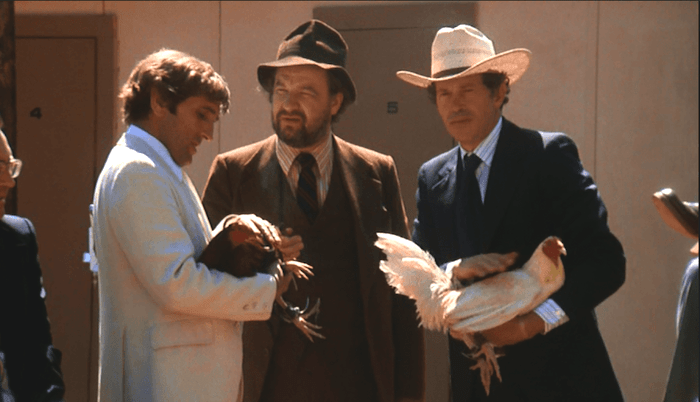
Brad reviews COCKFIGHTER (1974), starring Warren Oates!


I read about the movie COCKFIGHTER many years ago, and I remember the review being very positive. I had never watched the film before, but with today being Warren Oates’ birthday and it being available on Amazon Prime, I decided I’d finally watch it. 

Directed by Monte Hellman and based on Charles Willeford’s 1962 novel, COCKFIGHTER introduces us to Frank Mansfield (Warren Oates), a man completely obsessed with the southern “sport” of cockfighting. As we meet him, he’s in the process of losing a bet and a cockfight with Jack Burke (Harry Dean Stanton). The loss isn’t just a setback, it costs him all of his cash, his truck, his trailer, and his current girlfriend Dody White (Laurie Bird). We also notice in these early scenes that Frank only communicates through sign language and writing notes. It seems that he’s been living under a self-imposed vow of silence. Two years earlier, on the eve of the big, season-ending cockfighting grand finale, Frank’s big-mouthed braggadocio caused him to lose his prized cock, and the prestigious “Cockfighter of the Year” medal in a meaningless hotel bet, also against Jack Burke. Frank vows not to speak again until he wins that medal. Coming up with cash in the only way he can by selling his family’s home, Frank buys a new cock named White Lightning from Ed Middleton, played here by the film’s writer Charles Willeford. Armed with new fowl and a new, capital rich partner named Omar Baradansky (Richard B. Shull), Frank will not let anything stop him, including the love of his life Mary Elizabeth (Patricia Pearcy) or an axe wielding competitor (Ed Begley, Jr.), from being named “Cockfighter of the Year” and finally regaining his voice and the respect he desires!

COCKFIGHTER definitely has some things going for it. First and foremost, Warren Oates is so good in the lead role as the obsessed man who puts success in cockfighting above anything else in his life, including every other person. He literally sells the family home out from under his alcoholic brother Randall (Troy Donahue) in order to fund his next cock purchase after he’s gone bust. This sets up quite the sight gag for such a gritty and realistic film as a large truck and trailer drives away the family home taking up the entire state highway. When his long time fiancé asks him to give up cockfighting, he just gets up, leaves her shirtless and heads back out on the circuit. He writes her a letter from the road and tells her he loves her, but he also makes it clear that life without cockfighting is a life that he’s unwilling to live. Oates’ Frank Mansfield is not the kind of person you’d ever want to depend on in life, but he’s also an uncompromising individual who is determined to live life wholly on his own terms, accepting of the successes and failures that come with it. I watched the film because it features Warren Oates, and after having done so, I can say that his performance is truly special. 

COCKFIGHTER is one of those movies that makes us feel like we’re watching real people, and that’s kind of fascinating even if they reside in a world that we don’t really want to live in. The primary credit for that has to go to director Monte Hellman and Oscar winning cinematographer Nestor Almendros (DAYS OF HEAVEN). The restraint that is shown in the storytelling, as well as the sweaty, ramshackle authenticity of the Georgia locations, brings the story to life. The supporting cast also does its part to create the world of COCKFIGHTER. Harry Dean Stanton as Jack Burke, Frank’s primary rival in the cockfighting game, is excellent as you might expect, and he seems a lot like a regular guy. I really like Richard B. Schull, who plays Frank’s outgoing and talkative partner Omar. His friendly and gregarious personality seems a little untrustworthy at first, but he turns out to be the most likable person in the film. And finally, I want to shoutout Charles Willeford. Not only did he write the source novel and screenplay for COCKFIGHTER, he also gives a solid performance as Ed Middleton, an old-timer in the game who treats Frank with honesty and decency when he’s hit rock bottom. 

With all the positive things I’ve said above, I have to address the graphic depiction of cockfighting in COCKFIGHTER. This was the 70’s, and the scenes shown here are real and were very difficult for me to watch. It’s not fun to see animals fight and kill each other, and this is coming from a person who loves fried chicken and is not particularly an animal lover. The scenes are presented as matter of fact and in service of the story, but that still doesn’t make them easy to watch. Director Monte Hellman has gone on record to express his personal disgust at even filming these scenes. While a movie made in the 1970’s probably couldn’t have been made without these sequences, I just wanted to make it clear that this film is probably unwatchable for a lot of people.

Overall, COCKFIGHTER is a relic of the 1970’s. It’s a gritty and realistic film, featuring a great central performance from Warren Oates. It’s also an ethically troubling film that features real animal on animal violence. Based on that I don’t necessarily recommend the film. Rather, I just want to share my own thoughts, and you can determine if you want to watch it or not. That’s what I’ve tried to do above. 

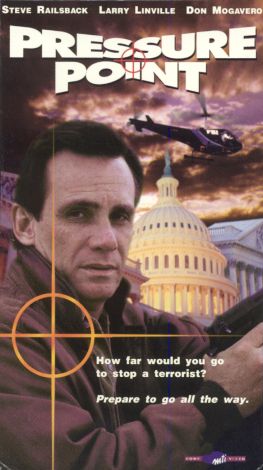
Pressure Point (1997, directed by David Giancola)


Sebastian “Della” Dellacourt (Don Mogavero) is a balding, mild-mannered, and middle-aged businessman who has all the screen presence of a halibut.  That is just his cover because, in reality, Della is the CIA’s best assassin.  When his handler (played by Larry Linville of M*A*S*H fame) promises him that he only has to do “one last” job, Della is relieved.  But when he discovers that the job involves killing not only an ambassador but also the ambassador’s children, he intentionally botches it.  Della is arrested and his secret life is exposed.  His wife leaves him.  Convicted of murder, Della is sent to prison but he won’t be there for long.  His handlers have one last “one last” job for him.

After they arrange for him to escape from prison, Della makes his way to Vermont where he is assigned to infiltrate a militia movement led by local businessman, Arno Taylor (Steve Railsback).  Arno hates the government and he loves apples and he wants to blow up the U.S. Congress.  It turns out that Arno has some powerful friends backing him up and Della is meant to be a patsy.  Can Della and his new cop girlfriend (Linda Ljoka) stop Arno or will Della be set up to take the fall for the worst act of terrorism in American history?

Before talking about the movie, let’s spare a thought for Larry Linville.  Larry Linville was not a bad actor but he never recovered from playing Frank Burns on M*A*S*H.  It didn’t have to be that way.  During the first season of M*A*S*H, Frank was self-righteous, annoying, and not a great surgeon but he was still recognizably human and Linville played him as just being insecure and not as quick-witted as the other surgeons.  But as the series went on, Frank was written to be more and more cartoonish and soon he became downright evil.  While every other character got to grow and develop, Frank regressed until eventually there wasn’t any room left for him on the show.  Realizing that Frank would never be allowed to become a fully-rounded character, Linville left the show after the fifth season.  The show went on for 6 more seasons without him but Linville never escaped the shadow of Frank Burns and his post-M*A*S*H movie career was spent playing villains in low-budget films like this one.

As for Pressure Point, it comes from the same people who did Icebreaker and Time Chasers so you know what you’re getting into when you start watching it.  Moments of mild action are mixed in with scenes that only exist to pad out the running time.  Even though I like the idea of action movies that star people who like actual everyday people, Don Magovero is still the least convincing action star that I’ve ever seen.  Whenever he has to run or jump or do anything requiring any sort of physical exertion, he looks like he is about to faint.  Having him go up against Steve Railsback, who actually is a good actor and who is convincing as someone who could organize and lead a militia group, just seems unfair.

The TSL’s Horror Grindhouse: Scissors (dir by Frank De Felitta)


The plot of the 1991 film, Scissors, is not easy to describe. That’s not because the plot is particularly clever as much as it’s because it doesn’t make much sense.

Basically, Sharon Stone plays a woman named Angela Anderson. She is oddly obsessed with scissors and terrified about getting close to anyone. She’s been getting hypnotherapy from Dr. Carter (Ronny Cox) in an effort to understand why she’s so repressed but she doesn’t seem to be getting anywhere. This could possibly have something to do with the fact that Dr. Carter is continually distracted by the adulterous activities of his wife, Ann (Michelle Phillips).

Angela lives in a lonely but surprisingly big apartment with only her cat for company. Her cat is named Midnight and he’s a black cat so he automatically became my favorite character in the film. Living next door to her are two twin brothers. Alex (Steve Railsback) is a soap opera star. Cole (Railsback, again) is an artist in a wheelchair who continually paints cartoonish pictures of Angela being attacked by a man with a big red beard.

Then, one day, Angela goes out to buy some scissors. When she returns and gets on the elevator to head back up to her apartment, she’s attacked by a man …. A MAN WITH A RED BEARD! Fortunately, Angela is able to stab him with her scissors. After the man with the red beard runs off, Angela is discovered in the elevator by Alex and Cole. Alex and Angela fall in love. Cole’s not too happy about that.

Following so far?

Angela get a call about a job interview, one that requires her to go to a stranger’s apartment. Despite the fact that the film has spent nearly an hour setting up Angela as being intensely agoraphobic, she has no problem going to this apartment. However, once she enters the apartment, she finds herself locked in! She also discovers that the red-bearded man is also in the apartment. Fortunately, he’s dead. Unfortunately, it appears that he was killed by Angela’s scissors. There’s also a raven in the apartment. The raven continually taunts Angela, saying, “You killed him!” Let’s just be happy that Edgar Allan Poe wasn’t around to see this.

Trapped in the apartment, Angela has flashbacks to her past. Is Angela the murderer? Is all of this just happening in her mind? Or is someone trying to drive her over the edge?

Though Scissors is set up as a psychological horror film, it’s really more of an extended acting exercise for Sharon Stone. Stone wanders around the apartment. She talks to herself. She had a nervous breakdown or two. She discusses life with a puppet. Every single scene seems to be designed to make audiences go, “Wow, she really can act!” but, despite all of the histrionics on display, Angela is still a very one note character. By making her obviously unstable from the start, the film doesn’t really leave the character with much room to develop or take us by surprise. The film attempts to end on a bit of an ambiguous note as far as Angela’s character is concerned but that type of ambiguity has to be earned. There’s nothing to Stone’s performance to indicate that there’s anything about Angela that isn’t totally on the surface. To suggest that there was more to her than originally appeared is to insult the audience’s ability to discern hidden depths.

The film does eventually wrap up its mystery and present a solution of sorts. Unfortunately, it’s a totally unsatisfying solution and one that’s dependent on otherwise intelligent people coming up with a ludicrously overcomplicated scheme to deal with one not particularly complicated problem. It’s all pretty forgettable but at least the cat survives.

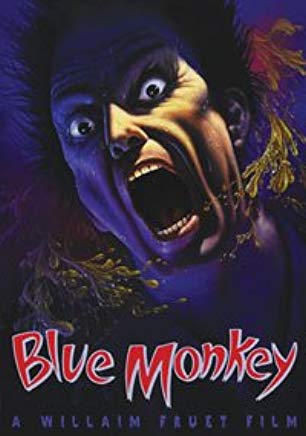
The TSL’s Grindhouse: Blue Monkey (dir by William Fruet)


1987 Blue Monkey

Last night, as I sat down to watch the 1987 Canadian film, Blue Monkey, I found myself singing a song in my head:

How does it feel
When you treat me like you do
And you’ve laid your hands upon me
And told me who you are?

I thought I was mistaken
And I thought I heard your words
Tell me, how do I feel?
Tell me now, how do I feel?

Unfortunately, it turned out that the only thing Blue Monkey had in common with the classic New Order song, Blue Monday, was an enigmatic title.  Just as the song never really mentions anything about Monday, Blue Monkey does not feature a single monkey.  One minor character does mention having a dream about a monkey but, otherwise, there are no monkeys in the film.  Speaking as someone who believes that almost any film can be improved the presence of a monkey, I was disappointed.

(Seriously, Nomadland would have been a hundred times better if Frances McDormand had a pet monkey.)

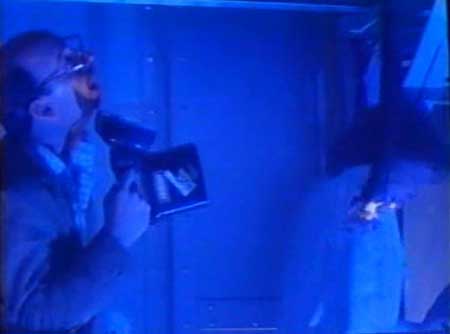
What Blue Monkey does have is a lot of blue.  The characters wear blue shirts and some wear blue uniforms.  Another wears a blue hat.  The film takes place in a hospital where almost all of the walls are painted blue.  Even worse, the majority of the film’s scenes are saturated with blue lighting.  

Here’s just two screenshots:

blue-monkey-1987-movie-image-7Blue-Monkey-1987-movie-William-Fruet-4

Seriously, some scenes were so blue that I was reminded of John Huston’s decision to suffuse Reflections in a Golden Eye with the color gold.  Personally, I think Huston made a mistake when he did that with Reflections but I can still understand the reasoning behind the decision and I can see what Huston was attempting to accomplish.  The blue in Blue Monkey feels like a distraction, as if someone realized, on the day before shooting, that the title didn’t make any damn sense.  “We’ll just make the whole movie blue!”

The problem, of course, is that the film goes so overboard with the blue lighting that it actually becomes difficult to look at the screen for more than a few minutes.  I had to keep looking away, specifically because all of those blue flashing lights were starting to make me nauseous and were on the verge of giving me a migraine.  At times, the image is so saturated in blue that you literally can’t make out what’s happening in the scene.  Of course, once you do figure out what’s happening, you realize that it doesn’t matter.

Blue Monkey takes place in a hospital.  A handyman has been having convulsions after pricking his finger on a plant that came from a mysterious island.  Perhaps that’s because a mutant larvae is now using his body for a host.  The larvae eventually develops into a giant grasshopper — NOT A MONKEY! — who stalks around the hospital and kills a few people.  The Canadian government is threatening to blow up the hospital unless something is done about the blue grasshopper.

It’s a Canadian exploitation film but Michael Ironside isn’t in it so it somehow feels incomplete.  That said, John Vernon plays a greedy hospital administrator and it’s fun to watch him get irritated with everyone.  A very young Sarah Polley has an early role as an annoying child.  There’s actually several children in this film and you’ll want to throw something at the screen whenever they show up, that’s just the type of film this is.  (Some of my fellow movie-watching friends were actually upset that the children survived that film.  I wouldn’t go that far but I still found myself hoping John Vernon would tell them all to shut up and let the adults handle things.)  Susan Anspach plays a doctor, showing that anyone can go from Five Easy Pieces to Canadian exploitation.  The film’s nominal star is Steve Railsback, playing a cop who comes to the hospital to check on his wounded partner and who ends up on grasshopper duty.  Steve Railsback has apparently said that he’s embarrassed to have appeared in this film.  Consider some of the other films that Steve Railsback has appeared in and then reread that sentence.  

In the end, Blue Monkey doesn’t add up too much.  There’s no Michael Ironside.  There’s no monkeys.  There’s just a lot of blue.

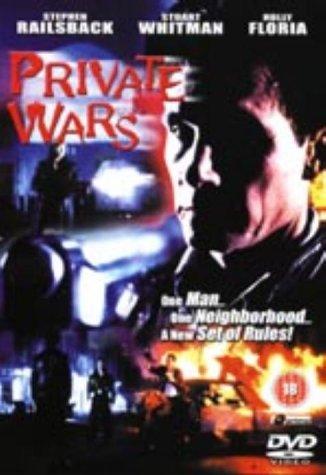
The TSL’s Grindhouse: Private Wars (dir by John Weidner)


The 1993 action film, Private Wars, tells the story of a neighborhood, a big evil businessman, and one drunk private investigator who likes to shoot things.

The big evil businessman is Alexander Winters (played by Stuart Whitman).  Winters is so evil that he probably spends at least three hours every night practicing his smirk.  He’s the type who will plot someone’s death and then laugh about it just to make sure that it’s understood that he’s totally evil.  Winters wants to build a new business complex but there’s a neighborhood sitting on the land that he wants to use and no one’s willing to move.

However, Winters has a plan to bring about change.  If the people in the neighborhood won’t move voluntarily, he’ll just make them flee for their lives.  Winters pays off some local gangs to create trouble in the neighborhood.  Soon, stores are exploding and windows are getting broken and obscene graffiti is showing up on walls.  Everyone in the neighborhood keeps going to the community center and debating what to do.  You have to wonder why the gangs are wasting their time vandalizing storefronts when they could have just blown up the community center and taken out every who was in their way.

Eventually, the community decides to hire someone to teach them how to defend themselves.  After auditioning a series of ninjas and other wannabe soldiers of fortune, the community hires Jack Manning (Steve Railsback).  Why do they hire Jack Manning?  Well, he’s a friend of one of the community leaders.  He’s also an alcoholic who shoots his car whenever the engine starts giving him trouble.  How exactly anyone could look at Jack — who is not only almost always drunk but also a bit on the short and scrawny side — and think that he could protect the neighborhood is an interesting question that the film doesn’t really explore.

Anyway, the community is soon fighting back, which turns out to be a lot easier than anyone imagined.  Eventually, Jack ends up in jail as a result of Winters’s corruption but fortunately, it’s while in jail that Jack meets a few guys who all have mullets and who all come back to the neighborhood to help Jack out when a bunch of ninjas try to take over the streets.  Winters may have ninjas but Jack has a bunch of petty criminals who look they’re all heading to a hockey game in Toronto.  It’s a fair fight.

To be honest, the main thing that I will always remember about Private Wars was just how unnecessary Jack eventually turned out to be.  For all the money that he was apparently being paid, he really doesn’t do much.  I guess he does teach people in the neighborhood the techniques of self-defense but the film is so haphazardly edited that it’s hard to be sure of that.  It’s entirely possible that everyone already knew how to fight but they were just hoping Jack would do it for them.  Watching the film, it’s easy to get the feeling that the folks in the community center took one look at Jack and said, “Well, shit …. I guess we gotta do this ourselves.”  Even the final confrontation between Jack and Winters is resolved by a third character.  Imagine Roadhouse if Patrick Swayze spent the whole movie sitting at the bar and you have an idea what Private Wars is like.

Private Wars is really silly but, possibly for that very reason, it’s also occasionally fun in its own stupid way.  If nothing else, Stuart Whitman and Steve Railsback appeared to be enjoying themselves.  The movie’s on YouTube.  I watched it last Monday as a part of the #MondayActionMovie live tweet and I enjoyed myself.

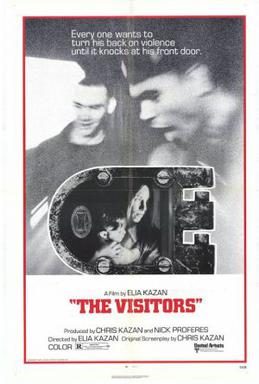
The Visitors (1972, directed by Elia Kazan)


Haunted by his experiences in Vietnam, Bill Schmidt (James Woods) lives in an isolated farmhouse with his girlfriend, Martha (Patricia Joyce), their young son, and Martha’s tyrannical father, Harry Wayne (Patrick McVey).  Harry is a hard-drinking writer who is proud of his previous military experiences and who is frustrated by Bill’s reluctance to talk about his time in Vietnam.  Harry views Bill as being a wimp who lost a war that America should have won.

One wintry night, two visitors show up at the house.  Mike (Steve Railsback) and Tony (Chico Martinez) served in Bill’s platoon.  The three of them were once friends but then something happened in Vietnam that changed all that, something that Bill refuses to talk about.  Harry is happy to welcome Mike and Tony into the household and he enjoys hearing their war stories.  While the hapless Bill watches, Mike flirts with Martha.  However, as the night continues, it becomes obvious that Mike and Tony aren’t paying an innocent visit on a friend.  Instead, they’re looking for revenge.  Bill testified against Mike at a court-martial and, in the process, ruined both of their lives.

The idea of “bringing the war home” was a popular one in the late 60s and the early 70s.  Radical groups like the Weathermen justified their terroristic actions by saying that they were forcing complacent Americans to face what every day was like in Vietnam.  Books like David Morrell’s First Blood featured psychologically damaged vets waging war on an America that they felt had abandoned them while the new wave of counterculture filmmakers made films that were groundbreaking in their portrayal of death and violence.  The Visitors, which features one traumatized vet being victimized by two other angry vets, was one of those films that was meant to bring the war home.

Directed by Elia Kazan and written by Kazan’s son, Chris, The Visitors is a simple film that sometimes seems more like a stage play than a movie.  The script is talky and heavy-handed, the characters are thinly drawn, and the film’s portrayal of Martha comes close to being misogynistic.  Chris Kazan’s script is openly critical of the United States’s role in the Vietnam War but Elia Kazan is more concerned with presenting Bill as a martyr.  Elia was a former communist who infamously named names during the McCarthy era and, from On the Waterfront on, every film that he made was more or less an attempt to justify his actions.  Like Waterfront‘s Terry Malloy. Bill loses everything because he testifies.  Unlike Malloy, no one comes to Bill’s aid afterwards, which suggests Kazan’s bitterness only grew over the years following his testimony.

The Visitors is a lesser film in Kazan’s filmography but notably, it was the first film for both James Woods and Steve Railsback.  Railsback plays Mike as a charismatic brute, giving a performance that owes more than a little to Marlon Brando’s performance as Stanley Kowalski in Kazan’s A Streetcar Named Desire.  James Woods brings his nervous intensity to the role of Bill, making him a far more intelligent but no less victimized version of Brando’s Terry Malloy.  Though The Visitors was Kazan’s second-to-last film, both Woods and Railsback would go on to emerge as two of the most interesting character actors in Hollywood.

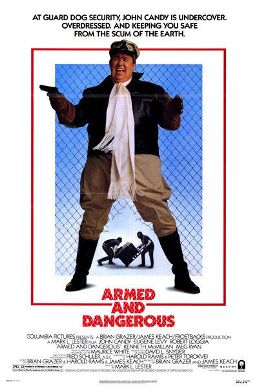
A Movie A Day #224: Armed and Dangerous (1986, directed by Mark L. Lester)


John Candy and Eugene Levy make a great team in the underrated comedy, Armed and Dangerous.

John Candy plays Frank Dooley, a member of the LAPD.  One of the first scenes of the movie is Frank climbing up a tree to save a little boy’s kitten and then getting stuck in the tree himself.  When Frank discovers two corrupt detectives stealing televisions, Frank is framed for the theft and kicked off the force.

Eugene Levy plays Norman Kane, a lawyer whose latest client is a Charles Manson-style cult leader who has a swastika carved into his head.  After being repeatedly threatened with murder, Norman asks for a sidebar and requests that the judge sentence his client to life in prison.  The judge agrees on the condition that Norman, whom he describes as being “the worst attorney to ever appear before me,” find a new line of work.

Frank and Norman end up taking a one day training course to act as security guards and are assigned to work together by their tough by sympathetic supervisor (Meg Ryan!).  Assigned to guard a pharmaceutical warehouse, Frank and Norman stumble across a robbery.  The robbery leads them to corruption inside their own union and, before you can say 80s cop movie, Frank and Norman are ignoring the orders of their supervisors and investigating a crime that nobody wants solved.

Armed and Dangerous was one of the many comedy/cop hybrid films of the 1980s.  Like Beverly Hills Cop, it features Jonathan Banks as a bad guy.  Like the recruits in Police Academy, all of Frank and Norman’s fellow security guards are societal misfits who are distinguished by one or two eccentricities.  There is nothing ground-breaking about Armed and Dangerous but Mark Lester did a good job directing the movie and the team of Candy and Levy (who has previously worked together on SCTV) made me laugh more than a few times.

Armed and Dangerous was originally written to be a vehicle for John Belushi and Dan Aykroyd.  It’s easy to imagine Belushi and Aykroyd in the lead roles but I think the movie actually works better with Candy and Levy, whose comedic style was similar to but far less aggressive than that of Belushi and Aykroyd.  One of the reasons that Armed and Dangerous works is because John Candy and Eugene Levy seem like the two last people to ever find themselves in a shootout or a car chase.  With Belushi and Aykroyd, it would have been expected.  After all, everyone’s seen The Blues Brothers.


A Movie A Day #197: Scissors (1991, directed by Frank De Felitta)


This is another dumb movie starring Sharon Stone.

In this one, Stone plays Angela Anderson.  Angela is a sexually repressed artist who is obsessed with scissors.  When she is attacked in an elevator by a man with a red beard, her neighbor, Alex (Steve Railsback), comes to her rescue.  Alex is an actor who lives with his twin brother, the bitter and wheelchair-bound Cole (Steve Railsback, again.)  When Angela finds herself locked in an apartment with a dead man (who has been stabbed with a pair of scissors and who has a red beard), who is responsible?  According to the dead man’s pet raven, it’s Angela.  But could it also have something to do with Angela’s obviously evil psychiatrist (Ronny Cox) and his politician wife (Michelle Phillips)?

This extremely ill-thought attempt at Hitchcockian suspense came out after Total Recall increased Sharon Stone’s profile but before Basic Instinct made her (briefly) a superstar.  Scissors, much like the later Intersection, is a film where Sharon Stone attempts to show that she has range by playing a frigid character.  Instead, Scissors just reveals how limited Sharon Stone’s range was.  For all of the film’s attempts to duplicate Repulsion, Stone is never believable as someone on the verge of losing her mind.  To her credit, Stone does try really hard, which is more than can be said for anyone else in the cast.  Railsback, normally a good actor, can barely summon up enough interest in the material to play one character, let alone two.  To buy what Scissors selling, it is necessary to believe that someone would come up with an elaborate scheme to drive Angela crazy but would still be careless enough to accidentally leave a door open at a key moment.

Dumb.  Just dumb.

Film Review: Nukie (1987, dir. Sias Odendal and Michael Pakleppa)


IMG_7476

Wow! I’ve watched and reviewed 60 Hallmark movies in a row. I then watched two more and started another one when I cracked. I’ll remember those two movies, but I need a break. So of course I watched Nukie! You know when you watch The Cinema Snob or AVGN, then you watch the movie or play the game and find out it’s not quite as bad as they made it seem. No, not here. Brad Jones wasn’t exaggerating about Nukie. Not at all.

So what is Nukie? It’s a message film chastising America while simultaneously begging for it’s help, but just being a total and complete mess of filmmaking instead. I really hope IMDb isn’t correct because it says that Nelson Mandela said this was one of his favorite films of 1988. I’m going to assume that must be wrong cause IMDb also says it premiered in South Africa in 1987, but based on the content, I think it’s probably true. Really really sad, but true.

IMG_7392

The movie begins with two flying lights in space. They are talking about what they call “the blue planet” as they fly over it. They are two aliens called Miko and Nukie. Miko is like a two year old who spotted something shiny because he gets too close and goes careening downwards. His brother Nukie chases after him. Nukie crashes in the middle of Africa and I kid you not, Miko appears to land at the front door of the “Space Foundation” that has things that say NASA inside it. I say this because Miko is instantly captured. By that I mean he is just wheeled in like he literally landed at their front door.

IMG_7424

This film gets stupid really quick. First, Steve Railsback’s character is introduced with this shot.

IMG_7414

He looks happy to be there doesn’t he? Did he even know they were filming him? The funniest thing is that they use that exact same shot later in the movie when they call him at home again. Well anyways, take a look at this.

IMG_7418

If you are going to watch Nukie, then you better get used to that shot because they will cut to it over and over again. Each time a voice that doesn’t match anyone in the lab will either tell you what is going on or that nothing is going on. Let’s get this over with.

IMG_7450

You see that shot there? That’s Nukie using the moon as some sort of satellite to communicate with Miko in the science lab. It’s the last time you will see him do that. No, I don’t mean the last time he talks to his brother, but the last time he will use the moon. After that, they just seem to be able to hear each other. The magic of inconsistent powers that plagues this film. Wonder if anyone involved in the production of Nukie worked on Heroes.

IMG_7460

Now Nukie knows that his brother is a prisoner of America, but he doesn’t know what that is. He asks a giraffe if it’s America. That’s the screenshot at the start of this review. In short order, Nukie runs into two little kids that are twins. This is the first time Nukie displays powers that apparently he can’t use to get to America. This time it’s to teleport. One moment he’s one place, and then suddenly next to the kids surprising them. Yet, you’ll see him walk throughout most of the movie. Considering this is a message movie, I’m sure it’s meant to match the many refugee marches that we have seen on the news. Hopefully, you haven’t actually been part of one. But I’m sure if you were and could teleport, then you would have used that handy ability instead of just walking. Not Nukie though. And this is just one of many powers Nukie will display.

IMG_7559

Yep, when Nukie sleeps, he becomes invisible. So we’ve seen teleportation and that he can become invisible. Yet, Miko isn’t teleporting and is completely visible while we are told he is in a deep sleep. While we are frustrated that Nukie isn’t using his powers to get to America, we are also left wondering why Miko isn’t escaping.

IMG_7568

Also, keep that shot in mind. Nukie says the “light beam transformer” is working again. Then he turns into the light he was at the beginning and flies around. Not to America mind you, but instead he lands somewhere near water.

IMG_7585

Nukie looks into the water and sees he looks like a pregnant bag of trash. Apparently, that’s news to him. So, in the horrible Highlander sequel, they become immortal when they come to Earth. In Nukie, they look like that. Bummer for them. Then this happens.

IMG_7638

Yep, no explanation how he got down there or how he is instantly on his feet again in a few seconds. However, we actually do get an explanation of what he was doing down there. Despite the fact that what we see happen is a storm in the nearby village, Nukie was down there causing earthquakes. Why? Who knows, but it gets him a reputation as a “bad god” by the villagers nearby. Not dumb enough for you yet? Don’t worry, there’s more. We now meet a talking monkey.

IMG_7648

The other monkeys/apes/whatever also talk. Of course Nukie asks them about America. They point him to the monkey above who lives with the humans. Oh, then Nukie freezes someone.

IMG_7681

I really wish a plane would fly over and dump massive numbers of Coke bottles on Nukie. No such luck, but there is plenty of product placement in this. Clearly we are meant to see these things in the science lab, then in Africa to see how the worst things about America are being brought to Africa. That, and there’s an ad for South African tomato sauce. Back in the science lab, Miko comes out to quote Scotty from Star Trek IV.

IMG_7748

IMG_7749

This is when we really get introduced to EDDI. That’s the computer at the Space Foundation. It’s a weird weird computer. It can put Miko to sleep, it can make one of the scientists dance, it tries to hit on a lady named Pam, and at one point I swear Miko was giving it a hand job via the keyboard, but actually he was just giving it a heart. Of course, right after getting the heart, he hits on Pam. Meanwhile, back in Africa.

IMG_7788

Yep, don’t use that light transformation thing to save your brother, but go ahead and nearly kill people by trying to fly a chopper. That will certainly convince them you’re not a bad god. Especially after you used telekinesis to push over and explode pots. Oh, and at this point Railsback is in Africa to investigate Nukie and Glynis Johns is there as a missionary of sorts named Sister Anne. She was there at the beginning of the film. Honestly, they’re not important.

IMG_7867

Because that crap landed on there the way it did, and because Nukie has been acting like a jackass, the twins from earlier are banished into the wilderness. Something to do with an old legend about twins and bad gods. Who cares? We need Nukie to show more powers.

IMG_7920

After flying around for no good reason, and certainly not to reach America, Nukie lands and shoots a lightning bolt from his hand to start a fire for the kids. Then this happens.

IMG_7946

To help the kids sleep, Nukie goes into a dance number. He also does a fireworks display. But that’s not the dumbest part. No, no, no. This is where Nukie, who can’t fly to America, flies into space, around the moon, and back to to the kids.

IMG_7968

IMG_7969

Meanwhile, back in the science lab.

IMG_8042

Really, once you see Nukie fly around the moon and that guy regress to childhood, you’re numb to the rest of the movie. After Sister Anne gives us a speech about the evils of Americanization, one of the kids is bit by a cobra. Unfortunately, his brother sucks out the poison. But fortunately, this happens.

IMG_8105

IMG_8111

I love when the kid cries out “Nukie! Nukie! You killed my friend!” At this point you are crossing your fingers, but of course you don’t get your wish. This is when the film finally decides to wind things down, and it does it pretty fast. I will do the same.

Nukie is captured and nearly killed, but gets away. The twins are separated. One is in a hospital and the other is out and about. Nukie briefly stops at the hospital to heal the kid with his magic hand. Miko finally decides to do more than just talk to the computer and hides in a trashcan. Pam finds it and that stupid voice tells us the program was shut down and classified. Railsback goes back to Africa. At this point the one kid joins Nukie and they go on a final march to reach America. Nukie gets really tired and then Nukie finally does what we have been begging him to do all along. He tells the kid that the two of them can fly to America. Seriously, after almost 100 minutes, they finally use this power that has been paraded in front of our face the whole movie.

IMG_8278

They don’t reach America, but land on some beach, then Nukie seems to die. The boy makes a wish that everything will just magically resolve and it does. His mom, Sister Anne, Railsback, and Miko just show up on this random beach. With Nukie and Miko reunited it’s time for them to leave, right? Well, almost. I forgot to mention that the talking monkey also shows up on the beach. They take the talking monkey with them. THE END.

IMG_8330

If there is a worse E.T. ripoff film out there, then I’m really scared. I can’t even imagine that the E.T. porn films are more annoying than Nukie. Just a little gross.

IMG_8216