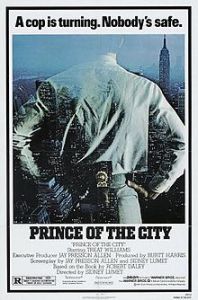
 In 1970s New York City, Danny Ciello (Treat Williams) is a self-described “prince of the city.” A narcotics detective, Ciello is the youngest member of the Special Investigations Unit. Because of their constant success, the SIU is given wide latitude by their superiors at the police department. The SIU puts mobsters and drug dealers behind bars. They get results. If they sometimes cut corners or skim a little money for themselves, who cares?
It turns out that a lot of people care. When a federal prosecutor, Rick Cappalino (Norman Parker), first approaches Ciello and asks him if he knows anything about police corruption, Ciello refuses to speak to him. As Ciello puts it, “I sleep with my wife but I live with my partners.” But Ciello already has doubts. His drug addict brother calls him out on his hypocrisy. Ciello spends one harrowing night with one of his informants, a pathetic addict who Ciello keeps supplied with heroin in return for information. Ciello finally agrees to help the investigation but with one condition: he will not testify against anyone in the SIU. Before accepting Ciello’s help, Cappalino asks him one question. Has Ciello ever done anything illegal while a cop? Ciello says that he has only broken the law three times and each time, it was a minor infraction.
For the next two years, Ciello wears a wire nearly every day and helps to build cases against other cops, some of which are more corrupt than others. It turns out that being an informant is not as easy as it looks. Along with getting burned by malfunctioning wires and having to deal with incompetent backup, Ciello struggles with his own guilt. When Cappalino is assigned to another case, Ciello finds himself working with two prosecutors (Bob Balaban and James Tolkan) who are less sympathetic to him and his desire to protect the SIU. When evidence comes to light that Ciello may have lied about the extent of his own corruption, Ciello may become the investigation’s newest target.
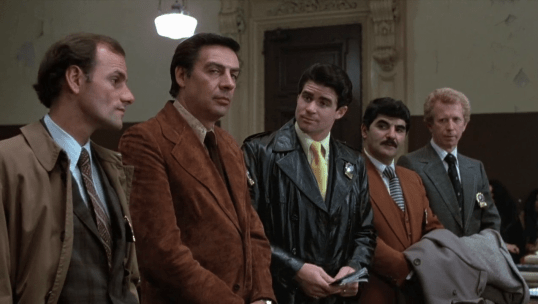
Prince of the City is one of the best of Sidney Lumet’s many films but it is not as well-known as 12 Angry Men, Dog Day Afternoon, Network, Serpico, The Verdict, or even The Wiz. Why is it such an underrated film? As good as it is, Prince of the City is not always an easy movie to watch. It’s nearly three hours long and almost every minute is spent with Danny Ciello, who is not always likable and often seems to be on the verge of having a nervous breakdown. Treat Williams gives an intense and powerful performance but he is such a raw nerve that sometimes it is a relief when Lumet cuts away to Jerry Orbach (as one of Ciello’s partners) telling off a district attorney or to a meeting where a group of prosecutors debate where a group of prosecutors debate whether or not to charge Ciello with perjury.
Prince of the City may be about the police but there’s very little of the typical cop movie clichés. The most exciting scenes in the movie are the ones, like that scene with all the prosecutors arguing, where the characters debate what “corruption” actually means. Throughout Prince of the City, Lumet contrasts the moral ambiguity of otherwise effective cops with the self-righteous certitude of the federal prosecutors. Unlike Lumet’s other films about police corruption (Serpico, Q&A), Prince of the City doesn’t come down firmly on either side.
(Though the names have been changed, Prince of the City was based on a true story. Ciello’s biggest ally among the investigators, Rick Cappalino, was based on a young federal prosecutor named Rudy Giuliani.)
Prince of the City is dominated by Treat Williams but the entire cast is full of great New York character actors. It would not surprise me if Jerry Orbach’s performance here was in the back of someone’s mind when he was cast as Law & Order‘s Lenny Briscoe. Keep an eye out for familiar actors like Lance Henriksen, Lane Smith, Lee Richardson, Carmine Caridi, and Cynthia Nixon, all appearing in small roles.
Prince of the City is a very long movie but it needs to be. Much as David Simon would later do with The Wire, Lumet uses this police story as a way to present a sprawling portrait of New York City. In fact, if Prince of the City were made today, it probably would be a David Simon-penned miniseries for HBO.
 Through the Shattered Lens