Retro Television Reviews: A Great American Tragedy (dir by J. Lee Thompson)


Welcome to Retro Television Reviews, a feature where we review some of our favorite and least favorite shows of the past!  On Sundays, I will be reviewing the made-for-television movies that used to be a primetime mainstay.  Today’s film is 1972’s A Great American Tragedy!  It  can be viewed on YouTube!
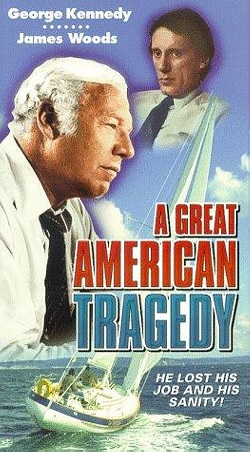
Brad Wilkes (George Kennedy) had a good career, working as an aerospace engineer.  He was able to buy a nice house.  With his wife, Gloria (Vera Miles), he was able to raise a good family.  He was even able to buy a sailboat, one that is the pride of the entire marina.  But then, one day, he’s told that the company is letting him go.

Returning to his home, Brad tells Gloria that he’s lost his job but that everything’s going to be okay because not only does he have a $10,000 pension but he’s sure he can find a new job.  “Of course, I might not be making $35,000 a year….” he says.

(Watching at home, I said, “Pfffft!  I make more than that!”  But, of course, Brad is talking about $35,000 in 1972 money, which would be the equivalent of a quarter of a million today.)

However, Brad soon discovers that getting a new job will not be as easy as he assumed.  It turns out that there are a lot of people out there looking for work and most of them are younger, cheaper, and better educated than Brad.  The bills start to pile up.  His former boss (Robert Mandan) informs Brad that his pension is going to be $7,000 less than he thought.  Brad forces himself to go down to the unemployment office so that he can collect $25 a week and then suffers the humiliation of being offered a loan by his well-meaning son-in-law (played by a youngish James Woods).  Gloria gets a job at the same clothing store where she used to shop and her lecherous boss (Kevin McCarthy) starts to hit on her.

For Brad, the final humiliation comes when he has to sell the boat.  A younger boat owner (Tony Dow, with a huge mustache) puts Brad in contact with a woman named Paula (Natalie Trundy).  Paula wants to buy the boat and, after they take it out on the water, Brad finds himself tempted to cheat on his wife.  It all gets to be too much for Brad and soon, he’s on a plane to Nevada where hopefully one good night at the craps table will be enough to pay his bills….

Watching this film, I found myself feeling very sorry for Brad while, at the same time, becoming very frustrated with him.  On the one hand, his company tossed him out after years of loyal service and then tried to screw him out of his pension.  On the other hand, Brad spent almost the entire movie in denial about how bad things actually were.  It’s one thing to be proud and it’s another to just be stubborn.  Knowing that he has next to no money, Brad still insists on throwing his annual 4th of July party and he even invites his former boss to come over and celebrate.  Brad simply cannot bring himself to admit that his old life is over but really, who can blame him?  He’s not the one who chose to be fired.

A Great American Tragedy was directed by J. Lee Thompson, who also did Cape Fear, The Guns of Navarone, the Planet of the Apes sequels, and several Charles Bronson films.  There are no fight scenes to be found in A Great American Tragedy but Thompson does get good performances from his cast and the film makes great use of George Kennedy’s likability.  The viewer remains sympathetic to Brad, even when he makes mistake after mistake.  A film about a formerly secure family suddenly discovering just how much the economy sucks, A Great American Tragedy remains just as a relevant today as when it was first made.

Film Review: Countdown (dir by Robert Altman)


Earlier tonight, on TCM, I watched the 1968 science fiction film, Countdown.

Who will be the first man to walk on the moon?  Will it be Chiz (Robert Duvall), who is a colonel in the Air Force and who has been training for years and who really should get the chance just because he has a really cool name like Chiz?  Or will it be Chiz’s best friend, Lee (James Caan)?  Lee may not have Chiz’s experience but he’s a scientist and selecting him would allow NASA to portray the mission of being one of peace as opposed to one of war.  Add to that, Lee has a full head of hair and he looks like a young James Caan, who was an undeniably handsome man back in his younger days!  I mean, seriously — who would you rather have as the face of the space program: Tom Hagen or Sonny Corleone?

Of course, it might not really matter who NASA picks because the Russians are determined to get to the moon as well.  And you know what that means!  If the Russians land on the moon first, they’ll turn it into a Socialist utopia and that’ll mean ugly architecture, bread lines, and a three-month wait for toilet paper.  The stakes have never been higher!

Countdown was made and released at the height of the space race, at a time when Americans really did feel that they were competing with the Russians to be the first to reach the moon.  (Of course later, it would be learned that the Russian space program actually managed to kill far more cosmonauts than it successfully sent into orbit.)  It came out a year before Apollo 11 landed on the moon and Neil Armstrong became the first Earthling since Stanley Kubrick to ever step on the lunar surface.  As such, it’s interesting to see how Countdown imagines the experience of exploring the moon.  I won’t spoil who reaches the moon first but I will say that he moves remarkably quickly and with great ease for someone in a gravity-free environment.

Countdown is a good example of what I like to call a “time capsule” film.  Seen today, it’s kinda slow and a bit predictable.  For all the time that is spent on getting the astronauts ready to go into space, very little time is actually spent in orbit.  This is a very Earth-bound film.  And yet, if you’re a history nerd like me, it’s hard not to be a little bit fascinated by a movie like this.  In everything, from its fashions to its dialogue to its cultural outlook, this is very much a document of its time.  It may be a while until we have the technology necessary to travel through time.  Until then, watching a film like this might be as close as I’ll ever get to experiencing what the straight, non-Hippie crowd was doing in 1968.

If you’re a student of film history, Countdown is significant for being one of the first films to be directed by Robert Altman.  To be honest, if not for his name in the opening credits, you would probably never guess that Countdown was directed by one of America’s most influential and iconic directors.  Altman specialized in making film that were almost defiantly iconaclastic and there’s very little of that to be found in Countdown.  Admittedly, there are a few scenes that make use of overlapping dialogue and there’s a party scene that’s definitely Altmanesque.  However, the only reason I really noticed that party scene is because I was specifically looking for evidence of Altman’s style.  For the most part, the most identifiably Altmanesque element of Countdown is the casting of Michael Murphy in a small role.

The film is dominated by Robert Duvall and James Caan and, especially if you’re a fan of The Godfather, it’s undeniably fun to see these two acting opposite each other in something other than an epic gangster film.  (Duvall and Caan also acted together in The Rain People and The Killer Elite and were reportedly great friends off-camera as well.)  Duvall is especially good in Countdown, playing Chiz as a man torn between an innate sense of loyalty and his own competitive nature.  The scenes between Duvall and Caan have a charge to them that occasionally bring some much-needed life to this film.

In the end, Countdown is a fairly forgettable film but it’s worth seeing as a piece of history.