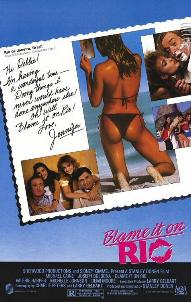
When I was growing up in Baltimore, I used to go down to this independent video story every weekend and check out movies. Every time that I stepped into the store, the first thing I saw was the poster for Blame It On Rio hanging over the front register. The store did not actually have any copies of Blame It On Rio in stock and I don’t think anyone working there had ever seen it but it only takes one look at the poster to guess what they were thinking when they hung it at the front of the store.
Blame It On Rio is one of the films that Michael Caine made during that period when he was willing to accept any paycheck. (The Jaws 4 years.) Caine plays Matthew, who goes on a vacation to Rio with his 17 year-old daughter, Nikki (Demi Moore), his best friend Victor (Joseph Bologna), and Victor’s daughter, Jennifer (Michelle Johnson). Both Matthew and Victor’s marriages are falling apart and Victor encourages Matthew to hit on every topless woman they see. Instead, Matthew ends up fooling around with Jennifer. When Victor discovers that his daughter to having an affair with an older, married man, he recruits Matthew to help him discover the man’s identity. In between the scenes of all the action in Brazil, Matthew and Jennifer appear in interview segments that do no add up to much.
It may be hard to believe but this forgettable movie was co-written by Larry Gelbart and directed by the same director responsible for Singin’ In The Rain, Charade, and Two For The Road, Stanley Donen. For a film about a 43 year-old man having a sexual relationship with a 17 year-old, Blame It On Rio is a hopelessly square movie. Caine and Bologna walking along a topless beach and accidentally leering at their own daughters is about as funny as things get. Michael Caine’s a trooper and does the best that he can but Michelle Johnson is bland as Jennifer. She and Demi Moore should have switched roles.
It’s a sad fact of life that not everyone who deserves an Oscar gets one. For instance, Alfred Hitchcock received five nominations for best director but never won once.
That said, at least Hitchcock was nominated! Some of our greatest directors have never even been nominated! This list below is hardly exclusive but still, these 16 directors have somehow never been nominated. Ten of them could still be nominated in the future. Sadly, for six, the opportunity has forever passed.
Dario Argento
Sadly, Dario Argento will probably never be nominated for best director. None of his films — even the early, acclaimed work — were typical Oscar films. But, consider this: Argento is one of the most influential directors of all time. Regardless of what might be said about some of Argento’s more recent films, his earlier films are classics of their genre. Deep Red, Suspiria, Inferno, Tenebrae — his work on any of these films would have been worthy of a nomination.
2. Andrea Arnold
This British director is responsible for two of the best films of the past ten years — Fish Tank and American Honey. She deserved a nomination for both of them (and a win for American Honey). Hopefully, she will be recognized in the future.
3. Tim Burton
I’m not the world’s biggest Tim Burton fan but he has a fan base that will follow him almost anywhere. It seems like every year, we hear that Burton has finally made the film that will win him some Oscar recognition. Remember Big Eyes? As I said, I’m not a huge Burton fan but, if I was to nominate him, it would probably be for his work on Sweeney Todd.
4. John Carpenter
Carpenter deserved all sorts of nominations for his work in the 70s and the 80s. Being the rebel that he is, Carpenter will probably never get the Oscar recognition that he deserves. (He did win an Academy Award for Best Live Action Short.)
5. David Cronenberg
It’s hard to believe that this Canadian director has never been nominated. While it’s obvious that the Academy would never recognize Cronenberg’s earlier work (even if he did deserve some recognition for that exploding head in Scanners), it still seems like he’s destined to be nominated eventually.
6. Terry Gilliam
Much like Tim Burton, Gilliam sadly seems to be destined to be one of those directors who will have to be content with a devoted fan base. Sadly, as of late, Gilliam’s become better known for the film projects that were canceled than the ones that were actually produced. I would have nominated him for Brazil.
7. Werner Herzog
How has Werner Herzog gone his entire career without receiving at least one nomination for Best Director!? I would nominate him for the chance to hear the acceptance speech alone.
8. Christopher Nolan
Christopher Nolan is another director who I’m shocked to realize has never been nominated. He certainly deserved a nomination for Inception. Maybe, just maybe, he’ll finally get some recognition for Dunkirk.
9. Lars Von Trier
With his controversial aesthetic and his talent for offending the masses, Lars Von Trier will never be nominated, no matter how much he might deserve it.
10. Joe Wright
Personally, I think that Joe Wright is responsible for two of the best films of the past ten years, Hannaand Anna Karenina. Unfortunately, both were left out of their respective best picture races. Even when Atonement was nominated for best picture, Wright did not receive a corresponding nomination. Fortunately, with Darkest Hour, Wright will have another chance this year.
And here are six directors who are no longer with us. Sadly, these six will never have a chance to receive their first Oscar nomination:
Mario Bava
Much like Dario Argento, there was never really any chance that the Academy would actually honor Mario Bava. That’s a shame because Bava truly was one of the greatest directors of all time. Check out Black Sabbath and Shock for proof.
2. Stanley Donen
It’s hard to believe that Donen wasn’t even nominated for Singin’ In The Rain.
3. John Frankenheimer
It’s also hard to believe that Frankenheimer never received a nomination. While he directed his share of bad films, he also directed Seven Days in May, The Manchurian Candidate, Seconds, and Ronin.
This directing team was a major influence on Martin Scorsese. Black Narcissus remains one of the most visually stunning films of all time. The Red Shoes was nominated for best picture but Powell/Pressburger were snubbed.
4 Shots From 4 Films is just what it says it is, 4 shots from 4 of our favorite films. As opposed to the reviews and recaps that we usually post, 4 Shots From 4 Films is all about letting the visuals do the talking.
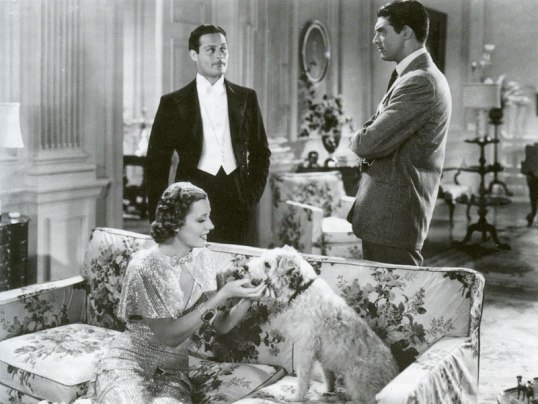
Happy birthday, Cary Grant!
4 Shots From 4 Films
The Awful Truth (1937, dir by Leo McCarey)
Notorious (1946, dir by Alfred Hitchcock)
North by Northwest (1959, dir by Alfred Hitchcock)
I’ve done numerous music videos inspired by movies so far. Yesterday’s Opposites Attract by Paula Abdul is based off of Anchors Aweigh (1945) with Gene Kelly. However, this is the first one that not only explicitly remade a particular film, or part of a film, but also got the director of said film. Stanley Donen actually directed this music video for Lionel Richie.
It was shot by Daniel Pearl because of course it was. For those of you counting, that makes four music videos shot by Daniel Pearl that I have spotlighted so far. That is out of his around 450+ documented music videos.
According to Wikipedia, this was shot at Laird Studios in Culver City and at the LeMondrian Hotel in West Hollywood on a budget that was somewhere between $350,000 and $500,000.
The music video’s main influence is of course Royal Wedding (1951), which Stanley Donen directed. But it also has a nod to The Seven Year Itch (1955).
This music video was such a big deal at the time that HBO aired a half-hour special about the making of it.
Michael Peters did the choreography. He also did the choreography for Beat It and Thriller as well as Love Is A Battlefield.
Rodney Dangerfield and Cheech Marin make cameo appearances. Diane Alexander, who would later marry Lionel Richie, is also in the music video as one of the dancers.
Donen and Glenn Goodwin produced the music video.
While the song did well when it was released, it still made Blender magazine’s list of the 50 Worst Songs Ever. Of course they are using WatchMojo’s definition of “ever”. That means there are only four songs that pre-date the 1980s, they had to be “hit songs”, and somehow their staff had heard every “hit song” that had ever been “released” at the time.
Judging by the songs on the list, Blender magazine thought Wake Me Up Before You Go-Go–not on the list–is a better song than The Sounds Of Silence by Simon & Garfunkel–on the list. Or if we are to take its title for what it says the list is, it means Anger Is My Middle Name by Thor–not on the list–is a better song than Broken Wings by Mr. Mister–on the list. Let that one sink it. Kudos to the trolls who came up with this list. That is unless it was meant to be a parody of these kinds of lists. That’s probably a stretch. Regardless, it is amazing when you stop to think about it. This song was #20, mainly on the grounds that it was probably written with the music video in mind. That never happens.
All that said, there are far better Lionel Richie songs and music videos out there. I just happened to stumble upon this one the other day and it paired well with Opposites Attract that did a much better job being based off of an Old Hollywood movie–even if it did imply that Abdul has sexual relations with a cat.
Enjoy!
Footnote: One of the underlying themes behind Blender’s choices is whether the song offended them in some way, such as their portrayal of minorities. That’s rich considering one of their comments on Kokomo by The Beach Boys is:
“It’s all anodyne harmonizing and forced rhymes (“To Martinique, that Montserrat mystique!”) that would have driven Brian totally nuts had he not been totally nuts already.”
They also complain about We Didn’t Start The Fire by Billy Joel this way:
“Can you fit a cultural history of the twentieth century into four minutes? Uh, no
Despite its bombastic production, ‘We Didn’t Start the Fire’ resembles a term paper scribbled the night before it’s due. As the song progresses, Joel audibly realizes he can’t cram it all in: The ’70s get four bellowed words amid the widdly-woo guitars and meet-thy-maker drums. The chorus denies responsibility for any events mentioned, clearing up the common misconception that Billy Joel developed the H-bomb.
Worst Moment: “China’s under martial law, rock & roller cola wars!”: No way does conflating Tiananmen Square with Michael Jackson selling Pepsi trivialize a massacre.”
Truly, the period between 1949-1989 is the cultural history of a century.
Yes, it is weird that a song about Billy Joel’s memories of growing up in a world that was already filled with a history of horrible things would go from fine details to jumping over decades with mentions of only a few things from them. It’s almost as if when you grow older, the things that occurred when you were a child affected you more than the ones you encountered later in your life. Specifically, his list of events start to drop off exactly when he would have turned 21 in 1960. What followed was an uprising during a frightening period most visibly shot down by civil rights leaders being murdered and then a further clampdown on that period of change afterwards. Crackdowns on freedom and living under the threat of nuclear annihilation would be relevant to kids growing up in the 1980s. After that, it makes sense that he would lose track of events and just see them as horrors that his generation has left the next one despite attempts to change things. He would also go through them fast since that clampdown did occur so fast that America went in the span of ten years from Woodstock to Reagan being the president-elect.
Oh, and he mentions Watergate, Punk Rock, Menachem Begin, Former Governor Ronald Reagan starting his bid for the Presidency, Palestine (the Israeli-Palestine conflict was still going on after Begin was elected), the airplane hijackings of the 1970s, the rise of Ayatollah in Iran, and Russians invading Afghanistan. That’s four things from the 70s, right?
I can also understand how they could misunderstand the chorus that is interwoven with the events that occurred in the world that Joel grew up with, lived threw as a young man, and is now seeing a new generation inheriting along with new problems as meaning that there’s a denial of responsibility for those events. It’s almost as if the song takes you through the life of one person who lived through a period when even with large numbers of people uprising, it still only caused changes, but not an alteration to the trajectory of the world that continues to burn and appeared to only speed up after those changes.
Finally, I am truly offended that Joel would end the song with China being under martial law and Coke & Pepsi running ads using rock & roll stars to sell soda being mentioned back-to-back. Being so confused at the end that he says “I can’t take it anymore” bothers me. Rock and Roll being a driving force in causing people in communist countries to uprise during the 80s with that same genre being used to make people think the important battle in their life is between two types of sugar-water truly is to “trivialize a massacre.” The Tiananmen Square protests were also the height of the popularity of Chinese rocker Cui Jian when his song Nothing To My Name became an anthem for the protestors. That reminds me, one of these days I’ll have to review the 1989 Soviet film Gorod Zero where Rock and Roll is portrayed as the savior of their country.
Sorry, I just had to mention that here since I already did that music video before I found this amazingly ignorant list. I also wanted to mention it because it really makes me think that this was purely intended to troll people or outright parody these kinds of lists. I would love to have an actual copy of the magazine so I would have more context than text excerpts.
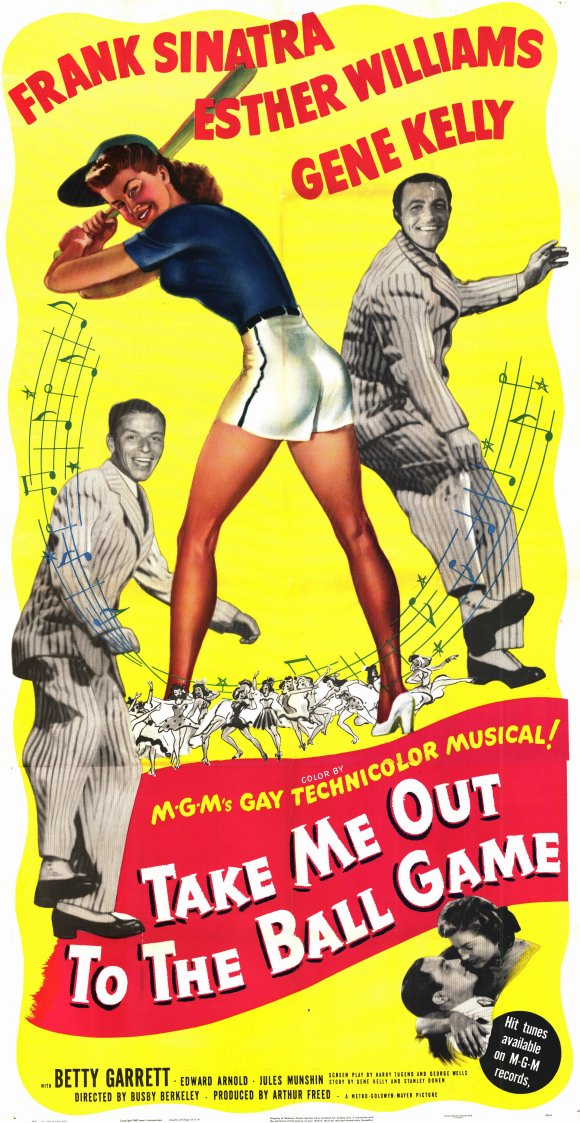
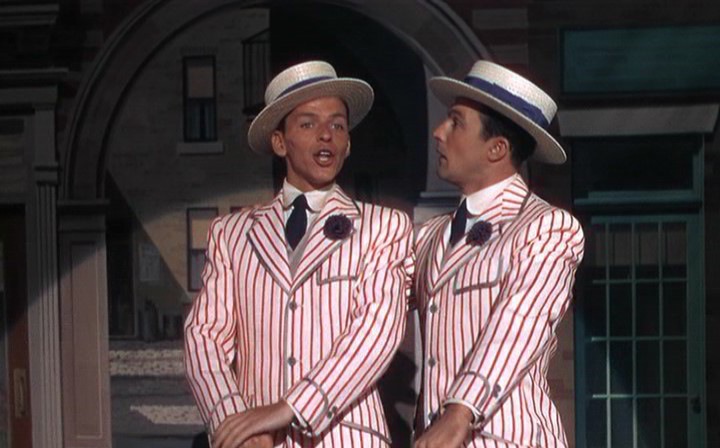
The National Pastime is just a frame for TAKE ME OUT TO THE BALL GAME to hang its picture in. That’s okay though, because producer Arthur Freed and the MGM Musical Dream Factory put together a rollicking, colorful romp with turn of the (20th) century baseball as an excuse to let Gene Kelly, Frank Sinatra , Esther Williams, Betty Garrett, and company razzle-dazzle us with plenty of songs, dancing, romancing, and comedy.
There’s not much of a plot in this outing. The World Champion Wolves are at spring training, awaiting the arrival of star diamond duo Eddie O’Brien and Denny Ryan, who’re off on a vaudeville tour. Eddie (Kelly) is a skirt chaser with Broadway dreams, while Denny’s (Sinatra) a shy, geeky guy who lives and breathes baseball. They get to camp just in time to hear the Wolves’ owner has died and left the club to his only relative, K.C. Higgins (Williams), who…
Lisa Marie were talking tonight and the conversation went from her hurting herself dancing to our love of musical films. Yeah, our minds tend to go off on such predictable tangents. Well, for us at least it makes sense I don’t know about the rest of you people.
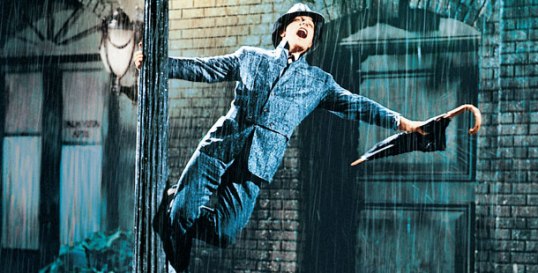
One such musical that we both seem to agree on was our love for the Gene Kelly-directed and starred musical film classic, Singin’ In The Rain. It’s from this musical that the latest “Scenes I Love” comes from. It’s a sequence that’s become an icon of a bygone era of Hollywood. Sure, there’s been musical films even up to the last year or so, but never in the same style, extravagance and joy shown in the musical films of the Freed-era of the 50’s and the following Golden Age of the 60’s.
It’s Gene Kelly singing the signature title song while dancing in the rain. There’s not much else to say other than it’s a scene that even the most cynical and elitist film snob can’t deny for it’s utter joy.
 When I was growing up in Baltimore, I used to go down to this independent video story every weekend and check out movies. Every time that I stepped into the store, the first thing I saw was the poster for Blame It On Rio hanging over the front register. The store did not actually have any copies of Blame It On Rio in stock and I don’t think anyone working there had ever seen it but it only takes one look at the poster to guess what they were thinking when they hung it at the front of the store.



 Through the Shattered Lens