Horror Comics Review: Evil Ernie


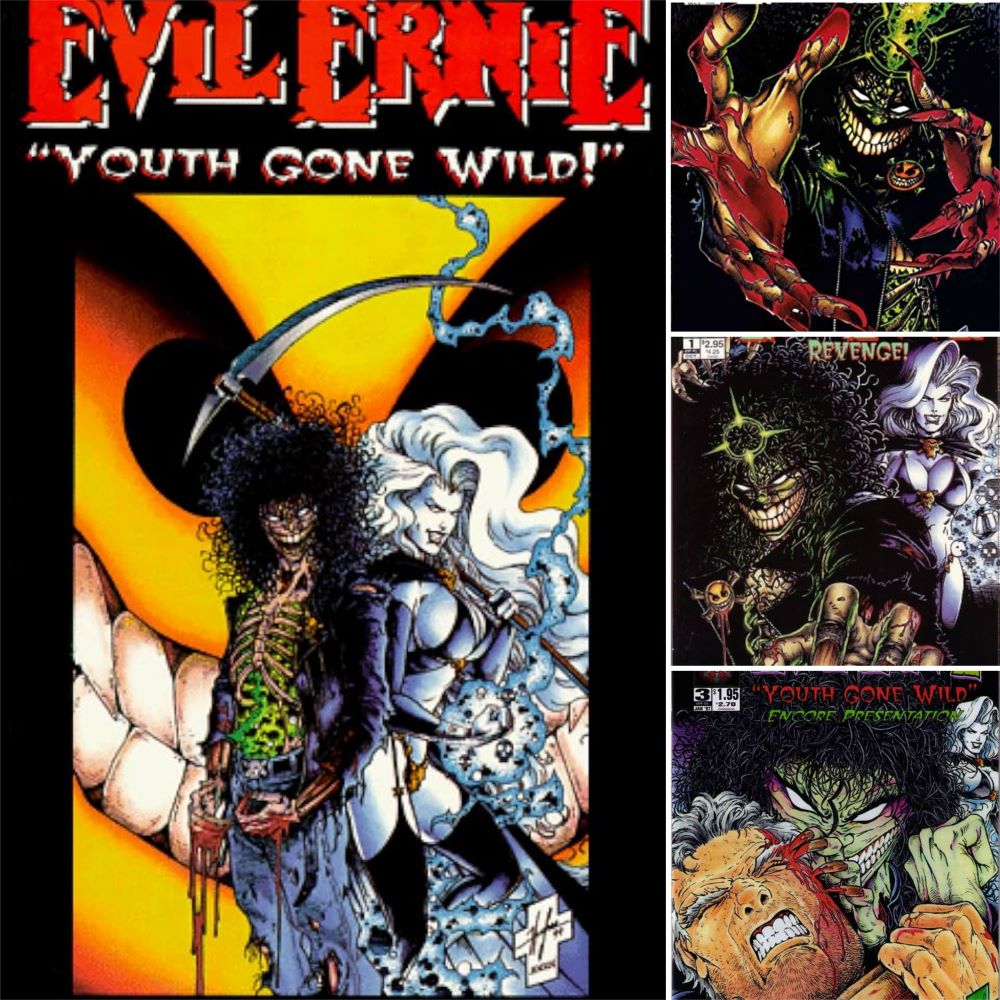
Evil Ernie’s legacy began with two key comic series that deeply shaped his character and cemented his place in horror comic history. Firstly, the original Evil Ernie mini-series, published in 1991 by Eternity Comics, introduced readers to Ernest Fairchild—a tortured, telepathic boy whose severe abuse and trauma spiraled into the transformation that birthed Evil Ernie. This five-issue series laid the foundation for the character’s dark mythology, blending psychological horror with supernatural violence and heavy metal influences. Here, Ernie’s pact with Lady Death and the introduction of his iconic “Smiley” button set the tone for his psychotically violent crusade against humanity, portraying him as a vengeful, undead antihero fueled by rage and heartbreak.

Following the original run, the Chaos! Comics imprint expanded on Ernie’s mythos with significant titles like Evil Ernie: Resurrection and Youth Gone Wild. These series pushed the narrative further into apocalyptic territory, showcasing Ernie’s increasing power, his undead army, and the world-spanning consequences of his rampage. Resurrection delved into Ernie’s return from death with amplified powers, setting the stage for his global campaign of destruction. Youth Gone Wild, evokes the rebellious spirit captured both visually and thematically, tying Ernie’s anger and chaos to a larger cultural moment reflective of 1990s heavy metal and punk ethos.

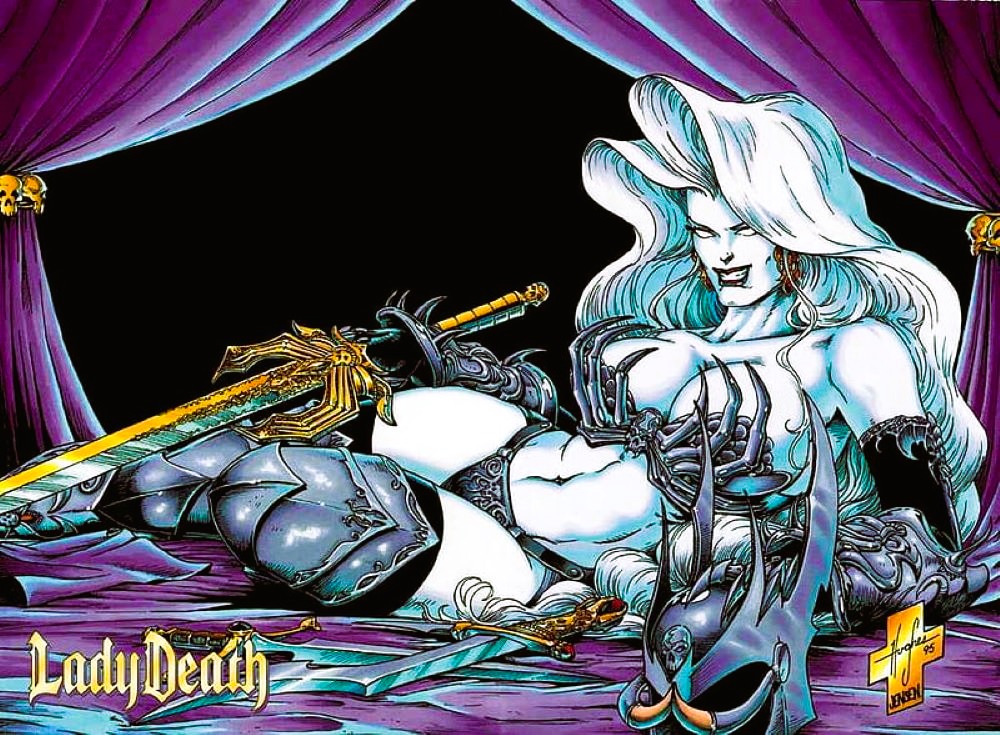
Crucially, the role of Lady Death in these series cannot be overstated. Initially a spectral figure who offers Ernie the love and acceptance he craves in exchange for his violent pledge, Lady Death evolved into the defining character of the Chaos! Comics universe. Her complex origins as the mortal Hope, betrayed and transformed into the queen of Hell, give the stories emotional depth and mythic resonance. Her “bad girl” gothic aesthetic and tragic backstory resonated powerfully with fans, propelling her to overshadow even Ernie himself in popularity and cultural impact.

Evil Ernie’s narrative and character design were heavily influenced by the prevailing heavy metal and splatter punk subcultures of the time. His wild hair, leather attire, and violent, nihilistic persona echoed the sonic aggression and rebellious imagery of bands like Slayer and Overkill, who also explored themes of alienation, death, and wrath. This cultural synergy imbued the comics with an authenticity that attracted a dedicated fanbase attuned to these genres. The explicit violence and body horror scenes showcased the splatter punk influence, pushing boundaries in graphic storytelling to depict raw, unapologetic gore that underscored Ernie’s tragic antiheroism.

The Evil Ernie series was more than just a comic about zombies and destruction; it was a cultural artifact infused with the angst, aggression, and rebellion of ‘90s youth subcultures. It forged a new path in horror comics by blending psychological trauma, supernatural terror, and social outcast narratives while crafting a mythos that was both cosmic and personal. The enduring popularity of Ernie, alongside characters like Lady Death and Purgatori, validated Brian Pulido’s vision and solidified a franchise that remains influential in horror and dark fantasy comics.

In summary, the original Evil Ernie mini-series set the brutal, tragic tone that defines the character, while subsequent series like Resurrection and Youth Gone Wild expanded his mythic scope, fueled by a unique fusion of horror, metal, and punk. Lady Death’s rise within these narratives added emotional complexity and gothic grandeur that enriched the universe Pulido created, creating a layered, compelling world that still captivates cult fans today. Together, these series and characters have left an indelible mark on horror comics, affirming the powerful cultural interplay between music, graphic storytelling, and dark fantasy.

Horror Book Review: Off Season (by Jack Ketchum)


“Man is the cruelest animal.” — Friedrich Nietzsche

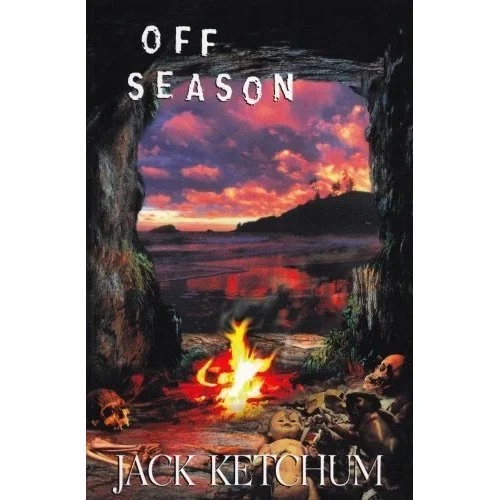
Jack Ketchum’s Off Season wasn’t my first venture into extreme horror, but it was an important stop along the way in my continuing exploration of splatterpunk—those raw, confrontational horror stories that don’t flinch from showing you every grisly detail. I’d already spent time in the grand guignol worlds of Edward Lee, Richard Laymon, Poppy Z. Brite, and Brian Keene, and I thought I’d built up a decent resistance to the genre’s more intense offerings. Then I opened Off Season, and within a few chapters, I realized this was going to hit differently. It’s less a fun horror romp and more of an ordeal—one that leaves you feeling like you’ve just crawled out the other side of something vicious, primal, and deeply unsettling.

Ketchum builds his novel around the infamous legend of the Sawney Beane clan—a family of cannibals who, according to folklore, hunted travelers along the Scottish coast in the 15th century. He strips that story out of its historical setting and drops it into the rocky, isolated coast of Maine, replacing the medieval backdrop with an environment that still feels dangerous and untamed. The setup is simple enough: a group of friends from New York rent a secluded cabin, expecting a peaceful getaway, and instead find themselves hunted by a clan that’s every bit as savage as their legendary counterparts. There’s a vibe here that’s partly Romero zombie survival horror, partly John Carpenter claustrophobic menace, but the big difference is that these villains aren’t supernatural—they’re unsettlingly human, real in their hunger and their primal needs. They do what they do because it sustains them, and somehow that makes them worse than any ghost or monster.

While Wes Craven’s The Hills Have Eyes mined similar ground with a more stylized, exploitation-film aesthetic, Ketchum’s take leans hard into plausibility. His cannibal clan feels like a natural, if disturbing, product of generations of isolation and inbreeding, kept alive through hunting, killing, and eating whoever wanders too close. That realism is what makes the violence hit so hard. Ketchum describes their assaults on Carla, her sister Marjie, and their companions with an unapologetically matter-of-fact tone—no flourish, no dramatics. The worst moments aren’t always the attacks themselves, but what he shows inside the clan’s cave home. Kids scamper across jagged stone like feral animals, gnawing meat straight off the bone. Adults pair up in incestuous “unions” meant only to keep the bloodline going. It’s both grotesque and disturbingly believable.

That refusal to hold anything back is part of why Off Season has been linked to splatterpunk, the horror subgenre that gained fame (and infamy) for pushing gore, moral transgression, and human depravity to the forefront. Some critics wrote it off as “horror pornography,” too focused on shock value, but fans saw it differently. In Ketchum’s hands, it’s not about gore for gore’s sake—it’s about stripping away all the comfort zones and exposing something ugly yet honest. When you finish one of these novels, you’re not left thinking “That would never happen.” You’re left thinking “That could happen. Under the wrong circumstances, that would happen.”

One of Ketchum’s storytelling choices is speed. The pacing is fast—there’s just enough time to understand who the characters are before the horror crashes down. That keeps tension high but also means the victims aren’t deeply fleshed out. They’re more representative than personal, standing in for civilization as a whole rather than pulling us into their emotional worlds. You don’t get many chances to connect with them deeply. Instead, you watch them transform from vacationers into survivors, and in some cases, those survivors become something just as savage as the people hunting them.

That shift happens in the second half, when the remaining characters fight back. The counterattack is satisfying in its own crude way, but Ketchum never dresses it up as righteous victory. The brutality of revenge feels just as ugly and unrelenting as the initial assault. By the end, what’s been preserved isn’t humanity—it’s just the body count in favor of the people we started with. The survivors get out, but they’re not unchanged. It’s not the kind of ending that makes you breathe a sigh of relief. More like an exhale that admits, “We made it, but look at what it cost.”

When Off Season first came out in 1980, it caused an immediate stir. Its content was so graphic that some bookstores wouldn’t carry it, and an edited version had to be released to calm the outrage. Years later, Ketchum went back and put out the uncut edition, restoring everything that had been stripped away. Reading that version today is reading the novel as he intended—nothing softened, nothing taken off the table. And in the world of extreme horror, that kind of authenticity is prized. It’s part of what’s given Off Season its staying power; it’s not just a book, it’s a dare.


Underneath all the blood and carnage is a question that sticks with you: If people were cut off from society long enough—if they lost the rules, the moral codes, the comforts—how far would they regress? Ketchum’s cannibals don’t feel like the spawn of evil forces. They feel like us, just pushed far enough in the wrong direction. Their behavior doesn’t come from cruelty for cruelty’s sake. It comes from basic survival drives—hunger, reproduction, and dominance. That’s why they’re such unnerving villains. They’re an evolutionary throwback you can imagine existing somewhere out there, beyond the maps, waiting for someone else to wander too close.


Finishing Off Season doesn’t give you that neat sense of closure other horror stories sometimes aim for. It doesn’t even give you release. It leaves you worn down, a little grimy, and maybe even unsettled in ways you didn’t expect. That’s the difference between horror built on supernatural scares and horror built on human brutality. The latter lingers; it’s harder to shake because you can’t make it go away just by telling yourself, “It’s only fiction.” With Ketchum, you’re never entirely sure.


As far as splatterpunk milestones go, Off Season earns its reputation. It’s both a challenge and a gut-punch—the sort of book that reminds you horror can still be dangerous. It’s not for every reader—if you’re expecting subtle ghost stories or stylish monster tales, you won’t find them here. What you’ll find instead is a grim, fast-paced nightmare about people who’ve let go of everything we’d call human and replaced it with something primal, something real in their hunger and their primal needs. And in the end, that may be the most disturbing thing about them—they’re not from another world. They’re from ours.

Horror Book Review: Wet Work (by Philip Nutman)


“Wet work” – intelligence community slang for covert operations involving assassination or killing, named for the ‘wet’ bloodshed such missions entail.

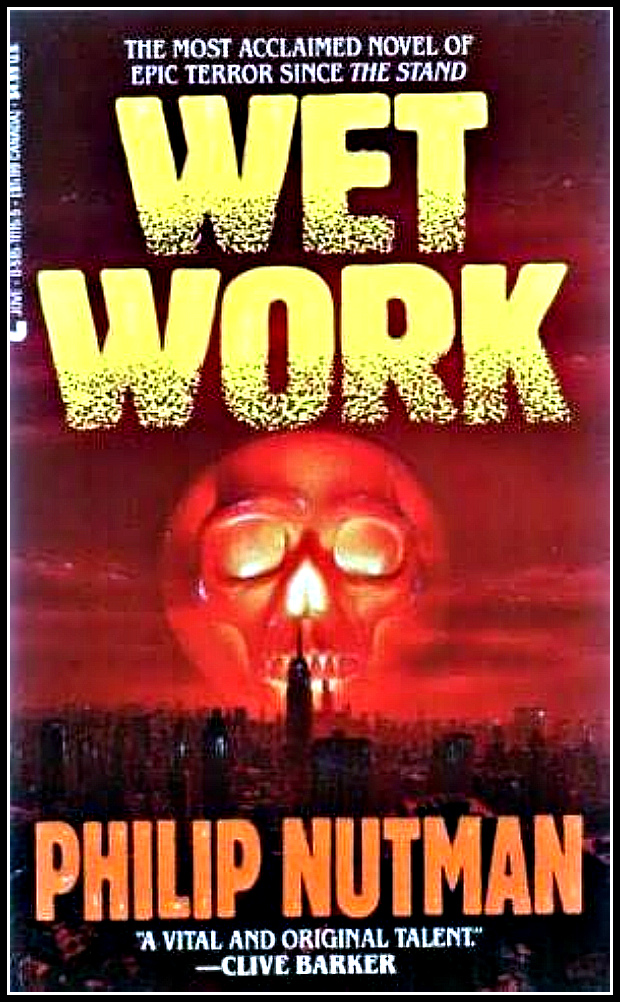
Philip Nutman isn’t a name most readers recognize outside of hardcore horror and zombie fiction circles, but within those communities, he’s remembered as an accomplished writer and journalist who carved out a unique space in the genre. For most of his career, Nutman worked as a freelance media journalist and film critic, contributing to magazines like Fangoria and Cinefantastique, where he covered the darker corners of cinema. As a fiction writer, he didn’t produce much in the way of novels, but the one he did publish—Wet Work (1993)—earned him lasting respect among fans who prefer their horror mixed with high-stakes action and cynical political undertones.

Wet Work began as a short story published in George A. Romero and John Skipp’s 1989 anthology Book of the Dead, a milestone collection that helped define zombie fiction as something literary rather than purely pulp. Even within that assembly of strong voices, Nutman’s story stood out for combining government espionage with apocalyptic horror. Expanding it into a full novel only amplified those elements, turning what had been a grim short tale into something closer to an action-horror epic with splatterpunk guts and a spy thriller’s pacing.

The novel opens with CIA operative Dominic Corvino, a member of an elite black-ops unit called Spiral, barely surviving a mission gone wrong in Panama City. From the start, Nutman gives the story a sense of distrust and paranoia—Corvino believes his team was deliberately sabotaged, their deaths engineered by someone inside the CIA. It’s an opening that reads more like a Cold War spy novel than a zombie tale, and that mix of tones is part of what makes Wet Work work so well. Nutman uses what he likely learned as a journalist—his knack for detail, the sense of how bureaucracies function (or fail to)—to give the early chapters an almost procedural authenticity. There’s a lived-in realism to the military and intelligence backdrop that keeps even the most outrageous elements of the story grounded.

Then comes the moment that shifts Wet Work from gritty reality into nightmarish surrealism. As the CIA plotline unfolds, a cosmic event takes place: the comet Saracen passes dangerously close to Earth and leaves behind some kind of invisible residue. It’s never fully explained whether it’s chemical, biological, or something beyond understanding, but its aftereffects begin to change life on the planet. Nutman uses the comet not just as a plot trigger but as a symbol of inevitability—a reminder that humankind’s end won’t always come from weapons or war, but sometimes from something as impersonal as celestial dust. It’s a bit of cosmic horror filtered through the lens of political and societal collapse, an end-of-days scenario that feels both mythic and strangely plausible.

Meanwhile, in Washington D.C., police officer Nick Packard becomes the reader’s main point of connection to the chaos on the ground. Packard starts the day leading a routine shift through the usual headaches of the city, but things unravel fast once Saracen’s effects take hold. Strange attacks start flooding police dispatch, cases of violence erupting in ways no one can explain, and what seem like random acts of brutality turn out to be part of something much larger. The city descends into panic as the dead begin returning to life. Nutman describes this breakdown with a sense of escalating dread that feels almost journalistic—each detail adds up, each scene observed as though through the eyes of someone trying to make sense of something senseless.

The zombies themselves are mostly what readers might expect from stories inspired by George A. Romero: slow-moving, decomposing, and relentless. But Nutman complicates things by hinting that not all of the reanimated are mindless. Some seem to retain fragments of human cunning or memory, enough to make them unpredictable and far more dangerous. This small twist gives the book a chilling edge, making it clear that intelligence doesn’t necessarily counteract monstrosity—it might even make it worse.

Corvino’s section of the novel runs parallel to Packard’s and serves as the darker, more psychological side of the story. He becomes consumed by his mission to find out who betrayed his team in Panama and make them pay. Physically, he’s battered and near his limits, operating in a world that no longer follows the rules of logic or hierarchy. Mentally, he’s trapped between loyalty, fury, and isolation—an operative trained for controlled violence now facing chaos that no training can manage. Nutman writes Corvino as a man unraveling in sync with the world around him. His search for answers feels less like a mission and more like an obsession, a desperate grasp at clarity in a world that’s literally stopped making sense.

Packard’s story, by contrast, brings everything down to a more personal survival narrative. As the crisis worsens, his only goal becomes reaching his wife, stranded in their suburban home outside the city. His journey across a collapsing Washington D.C. is one of the novel’s strongest threads, combining small moments of human connection with scenes of escalating horror. Through him, the reader gets a street-level view of societal breakdown—communications dying, infrastructure collapsing, and people reacting in unpredictable, often violent ways. What makes Packard’s arc compelling is its simplicity; amid government conspiracies and cosmic cataclysms, his is just a story about trying to save someone he loves.

Eventually, Corvino’s and Packard’s paths intersect, and both men come face to face with what’s left of the government. By this stage, authority itself has become just another form of predation. The people who once held power have adapted frighteningly well to the new world, shedding morality and decency like dead skin. Nutman doesn’t paint them as comic-book villains but as survivors whose ethics erode one decision at a time. In typical splatterpunk fashion, the line between humanity and monstrosity blurs completely.

Nutman’s writing in Wet Work is graphic, fast-moving, and unflinching. His descriptions of violence and gore are vivid without slipping into parody, and even when the pacing turns frenetic, it matches the story’s collapse into total madness. Where he stumbles is in a few awkward moments of dialogue and some stilted attempts at sexuality—scenes that read more forced than provocative. But those missteps never fully pull the story off course. If anything, they serve as reminders that Nutman, for all his journalistic precision, was still finding his rhythm in long-format storytelling.

The novel embodies everything bold about early 1990s horror fiction: big ideas, unrestrained violence, and a willingness to splice genres that didn’t normally coexist. Wet Work could just as easily sit beside Dawn of the Dead as it could a paranoid spy novel from the 1980s. Nutman understood that the systems people depend on—government, military, media—are fragile constructs that crumble the second survival becomes personal. That realism, drawn from his background in journalism, grounds the chaos he unleashes. Even at its most supernatural, Wet Work feels uncomfortably plausible because its human failures ring true.

After Wet Work, Nutman shifted back toward shorter forms, writing comics, novellas, and media journalism rather than more novels. In hindsight, that makes his one major book feel all the more significant. It’s the place where all his skills—his eye for detail, his fascination with moral gray areas, and his love of horror excess—come together.

For zombie fiction fans, Wet Work remains a hidden gem worth revisiting. It’s not just a gore-fest or survival tale but a demonstration of how horror doesn’t need to stay confined within its own walls. Nutman showed that the genre can bleed into others—melding espionage, political thriller, and cosmic dread into something distinct and alive. In a field that sometimes plays it safe, Wet Work reminds readers that horror thrives on experimentation, that it’s strongest when it’s hybridized and unpredictable. With Nutman’s death in 2013, any chance of seeing another full-length novel from him is gone, but what remains is proof that horror, when unafraid to evolve, can be far more than blood and fear—it can be reinvention itself.