14 Days of Paranoia #3: The Lincoln Conspiracy (dir by James L. Conway)


When it comes to conspiracy theories involving presidential assassinations, the theories surrounding JFK may get all the attention but it’s the theories surrounding the death of Abraham Lincoln are usually far more plausible.

Unless, of course, it’s the theories that are pushed in the 1977 docudrama, The Lincoln Conspiracy.

A mix of documentary-style narration and really cheap-looking historical reenactments, The Lincoln Conspiracy essentially indicts almost everyone who was alive in 1865 as being a part of either the conspiracy or the subsequent cover-up.  Really, it’s remarkable how many historical figures are implicated in this film.

With the Civil War coming to a close, President Lincoln (John Anderson) hopes to pursue a generous reconstruction policy for the former Confederate States.  Secretary of War Edwin Stanton (Robert Middleton), Senator Ben Wade (Dick Callinan), and a host of other are all opposed to this plan, both because they want vengeance and they also want to make as much money as possible off of the Southern cotton fields.  They come up with a plan to impeach Lincoln but, in order to draw up the articles, they have to make sure that Lincoln is not seen for a few days.  When Col. Lafayette Baker (John Dehner) discovers that an actor named John Wilkes Booth (Bradford Dillman) is planning on kidnapping Lincoln, Stanton and his conspirators decide to give Booth their unofficial support.  However, when the plan changes at the last minute and Stanton decides that it would actually be a bad idea to kidnap Lincoln, an angry Booth decides to just kill Lincoln, Andrew Johnson, and William Seward.

Booth succeeds in shooting Lincoln and making his escape.  The other members of Booth’s group all fail in their assignments.  Andrew Johnson becomes president.  Though grievously wounded, William Seward survives.  Booth flees to Canada and …. oh, you thought Booth died?  No, that was just a look alike who was shot by a bizarre soldier named Boston Corbett.  By allowing everyone to believe that Booth was killed, Stanton is able to cover up any role he and his allies played in inspiring the assassination.  Unfortunately, Col. Baker keeps a diary and it seems like he might be planning on revealing the truth but he dies mysteriously before he can.

(And, to give the film some credit, Col. Baker’s sudden death at 41 was an odd one.  And, though it’s not really explored in the film, Boston Corbett, the man who shoot Booth, really was a weirdo who was described by contemporaries as being a religious fanatic who castrated himself and claimed to hear the voice of God.)

It’s a big conspiracy theory that is presented in The Lincoln Conspiracy.  In fact, it’s a bit too big to really be taken seriously.  The film pretty much accuses everyone in Washington of having a part in the assassination.  The film itself has the cheap look of a community theater production and the use of Dr. Samuel Mudd as a narrator only adds to the film’s silliness.  If you’re a fan of gigantic and thoroughly implausible conspiracy theories, as I am, the film is entertaining in its way.  If nothing else, Bradford Dillman certainly looks like how most people probably imagine John Wilkes Booth to have looked.  Otherwise, The Lincoln Conspiracy is far-fetched and not at all realistic, which is why I assume that a lot of people in 1977 probably believed every word of it.

Previous entries in 2025’s 14 Days Of Paranoia:
  1. The Fourth Wall (1969)
  2. Extreme Justice (1993)

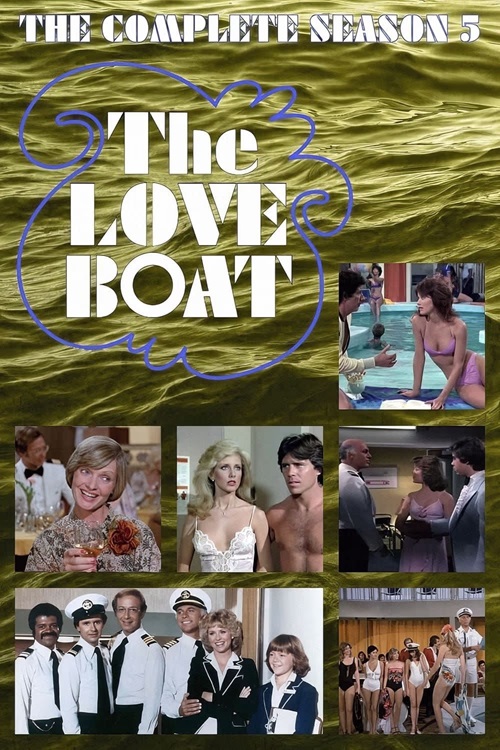
Retro Television Review: The Love Boat 5.14 “Good Neighbors/Captain’s Portrait/Familiar Faces”


Welcome to Retro Television Reviews, a feature where we review some of our favorite and least favorite shows of the past!  On Wednesdays, I will be reviewing the original Love Boat, which aired on ABC from 1977 to 1986!  The series can be streamed on Paramount Plus!

This week, Captain Stubing poses for a portrait.

Episode 5.14 “Good Neighbors/Captain’s Portrait/Familiar Faces”

(Dir by Jerome Courtland, originally aired on January 9th, 1982)

Don York (Sonny Shroyer) is an ad man who is so famous that even Gopher knows who he is.  Don gets really excited when he sees Doris Weldon (Arlene Golonka) boarding the boat.  Don rushes over and starts to hit on her.  He even notices that, according to the tag on her luggage, they live in the same building in Los Angeles!  They’re neighbors!  Too bad Doris refuses to date anyone who lives in the same building as her.  Don spends the entire cruise trying to get Doris to reconsider.  Personally, I suspected that Doris was just using the “neighbor” thing as an excuse to avoid telling Don that he’s very annoying and kind of pushy.  Stuff like that never happens on The Love Boat, though.  Instead, Doris is definitely attracted to Don but she doesn’t want him living next door.   Will things work out for Don and Doris?

Stan (Dean Butler) and Laura Barber (Mary Beth McDonough) are newlyweds.  Stan has the bar exam coming up so he’s brought his law books with him on his honeymoon.  (Boo!  Nerd!)  Stan’s future seems bright until he sees that Frank Jenson (Henry Jones) is also on the cruise.  Frank once owned the liquor store where Stan used to hang out when he was an alcoholic.  Stan apologizes for stealing from the store.  Frank accuses Stan of beating him up, something that Stan says didn’t happen.  Will things work for Stan, Laura, and Frank?

Of course, things will work out for them.  The is The Love Boat and things always work out on The Love Boat!  Both of the stories were okay but they were also kind of boring and predictable.  The more interesting story for this cruise featured Lee Meriwether as Barbara Baden, an artist who has been hired by the cruise line to paint a picture of Captain Stubing.  Apparently, any captain who sticks with the line for ten years gets their picture painted and hung in the corporate offices.

As you can probably already guess, the Captain and the artist end up falling for each other.  And if you didn’t already guess that Barbara’s portrait of the Captain would be a nude portrait that she ends up doing from memory after they become lovers, you’ve really never watched an episode of The Love Boat before.  Fortunately, it’s also an abstract painting and no one knows that they’re looking at a nude painting of the Captain.  In fact, the painting is so abstract that I get the feeling that the cruise line isn’t going to demand its money back.  This story was entertaining due to how uncomfortable Stubing was with being painted.  Gavin MacLeod did a good job portraying his nervousness and his panic when he discovered the painting was about to be unveiled made me chuckle a little.

Overall, this was kind of a bland episode.  But at least the scenery was pleasant.  It still provided a nice hour away from reality.

Film Review: Payday (dir by Daryl Duke)


First released way back in 1972, Payday tells the story of Maury Dann (played by the late, great Texas actor, Rip Torn).

Maury is a country singer.  He sings songs about wholesome values and good country girls.  His music isn’t exactly ground-breaking but his fans still love him and it’s easy to see why.  The movie opens with Maury performing in a small, country club and his charisma is undeniable.  He has a good singing voice and he easily dominates the stage.  Between songs, he flashes a friendly but slightly mischievous smile.  After his performance, he is perfectly charming when he meets his older fans.  And, when he meets a younger fan, he takes her outside and has sex with her in the backseat of his Cadillac.  He does this while her boyfriend is wandering around the parking lot looking for her.

Maury is a man who is in control when he’s on stage.  However, when he’s off-stage, the real Muary comes out.  When he’s not singing and basking in the applause of his fans, Maury is …. well, he’s a total mess.  Actually, mess doesn’t quite do justice to just how screwed up Maury Dann is.  He cheats on his girlfriend.  He pops pills constantly.  He treats the members of his band with a casual cruelty.  When Maury’s off-stage, that charming smile changes into a rather demented smirk.  Just when you think Maury’s done the worst possible thing that he could do, he does something even worse.

Payday follows Maury as he is driven through the South, singing songs and ruining lives.  Along the way, he gets into a fight with his mother and then a fight with his ex-wife and eventually, a fight with the boyfriend of that younger fan from the start of the movie.  We watch as Maury drinks, bribes DJs, and frames his employees for all sorts of crimes.  It’s an episodic film about a man who seems to understand that he’s destined to self-destruct no matter what he does.

Payday is very much a film of the early 70s.  Though the film may be about a self-destructive country star, it’s hard not to suspect that — as with most of the films from that era — Maury and his adventures were meant to be a metaphor for America itself.  Country Western is a uniquely American genre and by showcasing the damage that Maury does to everyone around him, the film seems to be suggesting that Maury’s sins are also America’s sins.  The people who idolize Maury and make him a star despite all of his flaws are the same people who reelected Richard Nixon and supported sending young men to die in Vietnam.

It’s all a bit much for one film to carry on its shoulders and spending two hours with Maury Dann is not exactly a pleasant experience but the film works because of the performance of Rip Torn.  When Torn died earlier this week, there was a lot of discussion about which performance was his best.  Quite a few people on twitter cited his roles in Defending Your Life and The Larry Sanders Show.  I personally mentioned The Man Who Fell To Earth and Maidstone.  But if you really want to see what made Rip Torn such a great actor, you simply must watch Payday.  Maury is a jerk with little in the way of redeeming qualities but Torn gives such a fearless and cheerfully demented performance that it’s impossible not to get caught up in his story.  As much as you want to look away, you can’t because Rip Torn keeps you so off-balance that you cannot stop watching.  Torn is smart enough to play Maury with just enough self-awareness that the character becomes fascinatingly corrupt as opposed to just being a self-centered jerk.

Finally, Payday simply feels authentic.  The film was made way before my time but I’m a Southern girl who has spent enough time in the country to know that the backroads of rural America haven’t changed that much over the past few decades.  At times, while watching Payday, I felt like I was back on my granduncle’s farm in Arkansas, walking through high grass and listening to the cicadas while watching the sun go down.

Payday is definitely a film that’s worth the trouble to track down.  Watch it and appreciate the fearless genius of the great Rip Torn.

A Movie A Day #10: The Longest Yard (1974, directed by Robert Aldrich)


longest-yard-burt-reynolds

Once, Paul “Wrecking” Crewe (Burt Reynolds) was a superstar NFL quarterback.  That was until he was caught up in a point-shaving scandal and kicked out of the league.  When a drunk Crewe steals his girlfriend’s car, gets into a high-speed police chase, and throws a punch at a cop, he ends up sentenced to 18 months at Citrus State Prison.

The warden of the prison, Rudolph Hazen (Eddie Albert), is a football fanatic who, at first, is excited to have Crewe as an inmate.  The prison guards have a semi-pro football game and Hazen wants Crewe to coach the team and help them win a national championship.  Though initially reluctant and just wanting to do his time, Crewe relents after witnessing and experiencing the cruelty of the prison system.  Crewe forms The Mean Machine, a team made up of prisoners, and agrees to play an exhibition game against the guards.

At first, the members of the Mean Machine are just looking for an excuse to hit the guards without being punished but soon, they realize that they have a chance to win both the game and their dignity.  But Hazen is not above blackmailing Crewe to throw the game.

When it comes to understanding the Tao of Burt, The Longest Yard is the place to start.  Starting with a car chase and ending with near martyrdom, The Longest Yard is the ultimate Burt Reynolds film.  Paul Crewe ranks alongside Deliverance’s Lewis Medlock and Boogie Night‘s Jack Horner as Reynolds’s best performance.  Before injuries ended his athletic career, Reynolds was a college football star and, on the prison’s playing field, he holds his own with the large group of former professional football players who were cast to play the guards and the prisoners.  The Longest Yard’s climatic football game takes up over an hour of screen time and reportedly, the action was largely improvised during shooting.  Unlike most movie football games, the one in The Longest Yard looks and feels like a real game.

The Longest Yard was directed by Robert Aldrich, who specialized in making movies about anti-authoritarians fighting the system.  The scenes of Crewe recruiting and training The Mean Machine are very reminiscent of Aldrich’s best-known movie, The Dirty Dozen.  With its combination of dark humor, graphic violence, rebellious spirit, and Southern-friend melodrama, The Longest Yard is a movie that could only have worked in the 1970s.  The Adam Sandler remake may have made a lot of money at the box office but it still comes nowhere close to matching the original.

For tomorrow’s movie a day, it’s the best film of 2016, which also happens to be about a football player in prison.

thelongestyard