Lisa Reviews An Oscar Winner: Gandhi (dir by Richard Attenborough)


Gandhi-poster

I just finished watching the 1982 best picture winner Gandhi on TCM.  This is going to be a tough movie to review.

Why?

Well, first off, there’s the subject matter.  Gandhi is an epic biopic of Mohandas Gandhi (played, very well, by Ben Kingsley).  It starts with Gandhi as a 23 year-old attorney in South Africa who, after getting tossed out of a first class train compartment because of the color of his skin, leads a non-violent protest for the rights of all Indians in South Africa.  He gets arrested several times and, at one point, is threatened by Daniel Day-Lewis, making his screen debut as a young racist.  However, eventually, Gandhi’s protest draws international attention and pressure.  South Africa finally changes the law to give Indians a few rights.

Gandhi then returns to his native India, where he leads a similar campaign of non-violence in support of the fight for India’s independence from the British Empire.  For every violent act on the part of the British, Gandhi responds with humility and nonviolence.  After World War II, India gains its independence and Gandhi becomes the leader of the nation.  When India threatens to collapse as a result of violence between Hindus and Muslims, Gandhi fasts and announces that he will allow himself to starve to death unless the violence ends.  Gandhi brings peace to his country and is admired the world over.  And then, like almost all great leaders, he’s assassinated.

Gandhi tells the story of a great leader but that doesn’t necessarily make it a great movie.  In order to really examine Gandhi as a film, you have to be willing to accept that criticizing the movie is not the same as criticizing what (or who) the movie is about.

As I watched Gandhi, my main impression was that it was an extremely long movie.  Reportedly, Gandhi was a passion project for director Richard Attenborough.  An admirer of Gandhi’s and a lifelong equality activist, Attenborough spent over 20 years trying to raise the money to bring Gandhi’s life to the big screen.  Once he finally did, it appears that Attenbrough didn’t want to leave out a single detail.  Gandhi runs three and a half hours and, because certain scenes drag, it feels ever longer.

My other thought, as I watched Gandhi, was that it had to be one of the least cinematic films that I’ve ever seen.  Bless Attenborough for the nobility of his intentions but there’s not a single interesting visual to be found in the entire film.  I imagine that, even in 1982, Gandhi felt like a very old-fashioned movie.  In the end, it feels more like something you would see on PBS than in a theater.

The film is full of familiar faces, which works in some cases and doesn’t in others.  For instance, Gandhi’s British opponents are played by a virtual army of familiar character actors.  Every few minutes, someone like John Gielgud, Edward Fox, Trevor Howard, John Mills, or Nigel Hawthorne will pop up and wonder why Gandhi always has to be so troublesome.  The British character actors all do a pretty good job and contribute to the film without allowing their familiar faces to become a distraction.

But then, a few American actors show up.  Martin Sheen plays a reporter who interview Gandhi.  Candice Bergen shows up as a famous photographer.  And, unlike their British equivalents, neither Sheen nor Bergen really seem to fit into the film.  Both of them end up overacting.  (Sheen, in particular, delivers every line as if he’s scared that we’re going to forget that we’re watching a movie about an important figure in history.)  They both become distractions.

I guess the best thing that you can say about Gandhi, as a film, is that it features Ben Kingsley in the leading role.  He gives a wonderfully subtle performance as Gandhi, making him human even when the film insists on portraying him as a saint.  He won an Oscar for his performance in Gandhi and he deserved one.

As for Gandhi‘s award for best picture … well, let’s consider the films that it beat: E.T., Tootsie, The Verdict, and Missing.  And then, consider some of the films from 1982 that weren’t even nominated: Blade Runner, Burden of Dreams, Class of 1984, Fast Times At Ridgemont High, My Favorite Year, Poltergeist, Tenebrae, Vice Squad, Fanny and Alexander…

When you look at the competition, it’s clear that the Academy’s main motive in honoring Gandhi the film was to honor Gandhi the man.  In the end, Gandhi is a good example of a film that, good intentions aside, did not deserve its Oscar.
http://www.youtube.com/watch?v=6oWqlb_TlLQ

Shattered Politics #37: Rosebud (dir by Otto Preminger)


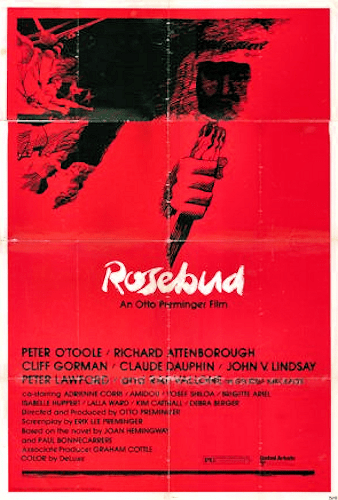
Rosebud_-_1975_-_Film_Poster

Before I review the 1975 film Rosebud, allow me to tell you about how I first discovered the existence of this particular film.

The greatest used bookstore in the world is located in Denton, Texas.  It’s called Recycled Books and it is three stories of pure literary goodness!  (Plus, there are apartments on the top floor where I attended some pretty interesting parties but that’s another story….)  When I was attending the University of North Texas, I used to stop by Recycled Books nearly every day.  One day, I happened to be searching the Film and TV section when I came across a beat-up paperback called Soon To Be A Major Motion Picture.

This book, which was written by Theodore Gershuny, told the story of how the previously acclaimed director Otto Preminger attempted to make a film about terrorism.  Starting with the attempts of Preminger’s son, Erik Lee Preminger, to come up with a workable script and then going on to detail how Peter O’Toole came to replace Robert Mitchum as the star of the film and ending with the film’s disastrous release, Soon To Be A Major Motion Picture proved to be a fascinating read.

After finishing the book, I simply had to see Rosebud for myself.  Unfortunately, at that time, Rosebud had not yet been released on Blu-ray or DVD.  So, I actually ended up ordering an old VHS copy of it.  The tape that I got was not in the best condition but it played well enough and I can now say that, unlike the majority of people in the world, I’ve actually seen Rosebud!

Which is not to say that Rosebud is any good.  It’s not the disaster that I had been led to expect.  In fact, it probably would have been more fun if it had been a disaster, as opposed to being just a forgettable film from a director who was probably capable of better.  Preminger started his career in the 30s and was considered, at one point, to be quite innovative.  He directed Laura and Anatomy of a Murder, two great films.  Unfortunately, there’s really nothing innovative about his direction of Rosebud.  In Gershuny’s book, Preminger comes across like an intelligent and thoughtful man who was too set in his ways to realize that what was shocking in 1959 was no longer that big of a deal in 1975.  (And, needless to say, it’s even less of a big deal in 2015.)

As for what Rosebud‘s about, it’s about a man named Sloat (Richard Attenborough), a former journalist who now lives in a cave in Israel and dreams of establishing a worldwide terrorist network.  Under Sloat’s direction, terrorists storm a yacht named the Rosebud and take the girls on board hostage.  The girls are wealthy and privileged.  Their fathers are judges, senators, and businessmen.  CIA agent Larry Martin (Peter O’Toole) is tasked with tracking down and rescuing the girls.  If it sounds like an action film — well, it’s not.  This is not a prequel to Taken.  Instead, it’s a very talky film that has a few isolated good moments and performances but otherwise, is fairly forgettable.

That said, the film does have an interesting cast.  Peter O’Toole seems bored by his role (and who can blame him?) but Attenborough briefly livens things up in the role of Sloat.  As for the girls being held hostage, they’re not given much to do.  One of them is played by a young Isabelle Huppert.  Long before she would play Samantha on Sex and the City, Kim Cattrall plays a hostage here.  The English hostage is played by Lalla Ward, who is now married to Richard Dawkins.

And then there’s the girl’s parents, who are played by an odd assortment of character actors.  Raf Vallone, an Italian, plays a Greek.  (His daughter, meanwhile, is played by the French Isabelle Huppert.)  Peter Lawford, looking somewhat dazed, shows up as Lalla Ward’s father.  (One of the sadder scenes in Gershuny’s book deals with Lawford’s attempts to remember his lines.)  And than, in the role of Cattrall’s father, we have a very distinguished looking man named John Lindsay.

John Lindsay was the former mayor of New York City, a man who ran for President in 1972 and, three years later, attempted to launch a new career as an actor.  Rosebud was his both his first and final film.  (Rumor has it that Martin Scorsese attempted to convince Lindsay to play Senator Palatine in Taxi Driver but Lindsay turned the role down.)  Lindsay is not particularly memorable in Rosebud.  It’s not so much that Lindsay gives a bad performance as much as it’s just the fact that he has a very bland screen presence.  That blandness probably served him well as a politician but, as an actor — well, let’s just say that John Lindsay was apparently no Fred Thompson.

And so that’s Rosebud.  It’s a film that, much like Maidstone, you can only appreciate if you know what went on behind the scenes.  I can’t really recommend Rosebud but, if you ever come across a battered old copy of Soon To Be A Major Motion Picture in a used bookstore, be sure to buy it!

Seriously, you will not be sorry.

Song of the Day: A Bridge Too Far Overture (by John Addison)


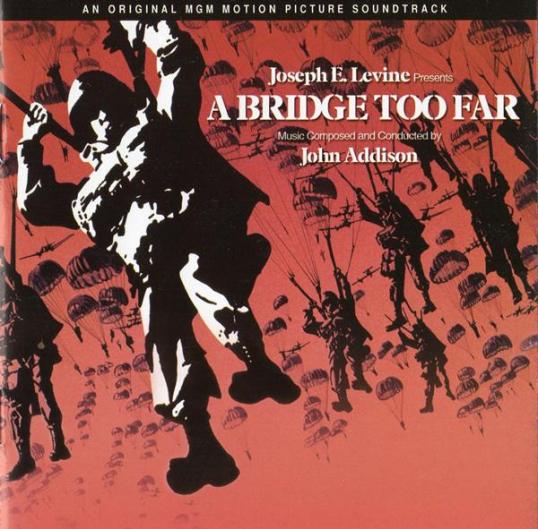
ABridgeTooFar-Front_zps46c29dfd

John Addison’s film score for Sir Richard Attenborough’s military epic, A Bridge Too Far, has become as recognizable and as iconic as the film itself. One particular piece of music from the film that anyone who has watched in full and/or passing this great film is today’s “Song of the Day”.

The title track is “A Bridge Too Far Overture” and it’s ever present melody becomes the leitmotif for the entire film. It starts off quite celebratory in the beginning then gradually becomes melancholy and defeating as it helps set the tone and gives a sense of the tragedy to come from a very victorious beginning.

As someone who has enjoyed and studied films which depict important military events in history this song remains as one of my favorite and I can catch myself humming or whistling the tune whenever I hear it play as the film plays on the TV.

Review: A Bridge Too Far (dir. by Sir Richard Attenborough)


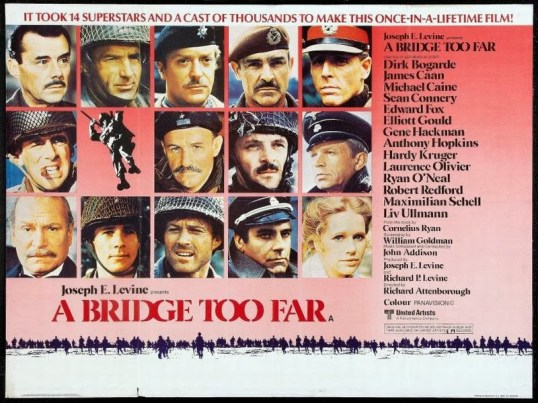
1977 a bridge too far

“Well, as you know, I always felt we tried to go a bridge too far” — Lt. Gen. Frederick Browning

With the recent passing of Sir Richard Attenborough I decided to bring up one of the films which first brought his name to my attention. I was quite the young lad when I first saw Attenborough’s epic war film A Bridge Too Far. I would say that it was one of my earlier memories of watching a film with my father who was a major fan of war films. One could say that I got my appreciation and love for the genre from him.

A Bridge Too Far was adapted from the Cornelius Ryan book of the same name which depicted from start to finish the disastrous World War II battle known as Operation Market Garden. The film states that the Allied landings at Normandy, France in the summer of 1944 had the German forces reeling and on the verge of collapse. With Eisenhower having to choose between competing plans to chase Hitler’s forces right into Berlin from his two best generals in George S. Patton and Bernard Montgomery, the film already lays down something that’s become synonymous with military disasters throughout history. Political expediency and pressure on Eisenhower led to an operation that was never attempted in military history and one which required every aspect of the operation to go according to plan for it to work. As the film would show this was not meant to be.

The film begins with the operation’s early days as Allied commanders rush to put Montgomery’s plan to drop 35,000 paratroopers behind German lines in occupied-Netherlands in order to capture and hold key bridges until Allied armored forces arrived to reinforce them. It’s a daring plan that the Attenborough films with a obvious confidence and enthusiasm, but also one that already showed some nagging doubts from field commanders who would be in the thick of the fighting if intelligence reports were inaccurate. One could almost say that Attenborough was making the film a sort of anti-war message which was a rarity when it came to Hollywood and and film industry depicting the events of World War II at the time.

While the film does explore that very anti-war theme throughout it’s really a by-product of how the battle itself unfolds and shown to the viewers that might give one such an idea. Yet, in the end A Bridge Too Far was a much more complicated film to just be labeled as an anti-war film. Yes, the battle itself was a disaster for the Allied forces of American, British and Polish soldiers involved, but despite the political bumbling and military arrogance of those who command from behind a desk, the film actually does a great job of showing that bond soldiers earn when confronted with the horrors of battle.

Attenborough and producer Joseph E. Levine pulls together an all-star cast for the film with names such as Sean Connery, Edward Fox, Robert Redford, Michael Caine and Laurence Olivier just to name a few. Films such as A Bridge Too Far rarely get made anymore in this day and age. The cast itself is part of the reason why the film still holds up to scrutiny decades after it’s release. While all-star casts such as this seemed to have been common place before the 1980’s it still looked like a daunting task for Attenborough to manage so many Hollywood stars and veteran British actors. Every character from Hopkin’s Col. Frost, Connery’s Gen. Urquhart and Redford’s Maj. Cook get to shine in their sections of the film as their individual stories about the battle all tie-in together to show just how complicated the events that they were filming truly turned out to be.

At times, one almost could feel overwhelmed by the amount of recognizable names and faces that come across the screen, yet Attenborough and producer Levine were able to juggle not just the logistics of the film’s screenplay, but the egos and reputation of the very stars who would become the backbone of the film.I think in a lesser filmmaker A Bridge Too Far could easily have turned into the very Operation Market Garden it was trying to depict.

It’s a film that never celebrates the concept of war itself, but actually shows that war remains a bloody and chaotic affair that relies not just on planning and execution but on the whims of lady luck. While Attenborough’s film never reached the sort of iconic status that another Cornelius Ryan adapted film has attained in The Longest Day, it does remain the more powerful of the two as it doesn’t just explore the historical event as a sort of academic exercise, but as an exploration of that old military adage of “No plan survives contact with the enemy”.

So, in the end I recommend that those looking to watch and experience the earlier directorial works of Sir Richard Attenborough should check out A Bridge Too Far. It remains to this day one of his more underappreciated films especially when compared to his later more acclaimed films like Gandhi, Chaplin and Shadowlands.