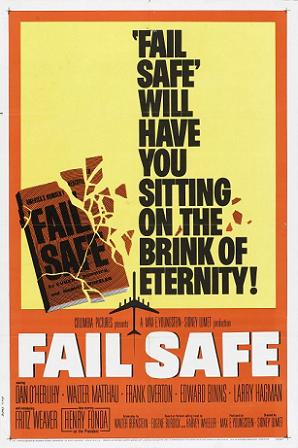
After watching Dr. Strangelove, you may find yourself asking what that film would have been like if it had treated its doomsday scenario seriously. Well, you can find out by watching yet another film from 1964, Sidney Lumet’s Fail-Safe.
What’s Fail-Safe about? Well, basically, it tells the exact same story as Dr. Strangelove, except without the humor. Once again, an American bomber is accidentally ordered to launch a nuclear attack against Russia. Again, the President (played, somewhat inevitably, by Henry Fonda) has to have an awkward conversation with the leader of Russia. Again, a sinister defense advisor (this time played by Walter Matthau) argues that the world can survive a nuclear war.
Admittedly, there is no equivalent to George C. Scott’s Buck Turgidson in Fail-Safe. However, there is a General Black (Dan O’Herilihy) who has a recurring nightmare about watching a bullfight while the sky around him glows with radiation.
Fail-Safe has the same plot as Dr. Strangelove but none of the humor. In fact, Fail-Safe has absolutely no humor at all. It’s one of the most somber films that I’ve ever seen. It has a good opening with General Black’s nightmare and an effective ending that makes excellent use of freeze frames but the middle of the film is basically just a collection of endless debates.
And I’m sure that approach made sense at the time because, after all, Fail-Safe was dealing with a serious theme, it was directed by a serious filmmaker, and it featured a bunch of serious actors. And maybe if I had never seen Dr. Strangelove, Fail-Safe would not seem like such a slow and boring movie. But I have seen Dr. Strangelove and, as a result, it’s impossible to watch Fail-Safe without wanting to hear Henry Fonda say, “You can’t fight here! This is the war room!”
Everyone already knows that the 1957 Best Picture nominee 12 Angry Men is a classic. We all know the film’s story — a teenage boy is on trial for murdering his family. 11 jurors want to convict. 1 juror doesn’t. Over the next few hours, that one juror tries to change 11 minds. Some of the jurors are prejudiced, some of them are bored, and some of them just want to go home. And, as the film reminds us, all 12 of them have a huge responsibility. You don’t need me to tell you that this is a great movie. Therefore, consider this to be less of a review and more of an appreciation of one of the best movies ever made.
1) The film is the feature debut of director Sidney Lumet. As any student of American film can tell you, Sidney Lumet was one of the most important directors in the history of cinema. After beginning his career in television, Lumet made his film directing debut with 12 Angry Men and he was rewarded with a much deserved Oscar nomination for best director.
2) The film’s story is actually a lot more complex than you might think. 12 Angry Men is such an influential film and its story has been imitated so many times that it’s easy to forget that the film’s plot is a lot more nuanced than you might think. Despite what many people seem to think, Juror Number 8 never argues that the defendant is innocent. Instead, he argues that the state has not proven its case beyond a reasonable doubt and, as a result, the defendant cannot be convicted. That’s an important lesson that is too often forgotten.
3) The movie celebrates the power of one person determined to do the right thing. Again, that’s a lesson that remains very relevant today.
4) As Juror Number Eight, Henry Fonda makes human decency believable.
5) As the angry and bullying Juror Number Three, Lee J. Cobb is the perfect antagonist.
6) As Juror Number Ten, Ed Begley makes Cobb seem almost reasonable. To be honest, the scene where Begley’s racist ranting causes all of the other jurors to stand up and turn their back on him feels a bit too theatrical. But it’s still undeniably effective. Alone among the jurors, Juror Number Ten is the only one without any hope of redemption. It’s a bit of a thankless role but Begley does what he has to do to make the character believable.
7) E.G. Marshall makes the wealthy Juror Number Four into a worthy opponent of Fonda without crossing the line into prejudice like Cobb and Begley. In many ways, Marshall’s role is almost as important as Fonda’s because Marshall’s performance reminds us that not all disagreements are the product of ignorance or anger.
8) As the Jury Foreman, Martin Balsam is the epitome of every ineffectual authority figure.
9) As Juror Number Seven, Jack Warden is hilariously sleazy.
10) As Juror Number Nine, Joseph Sweeney grows on you. The first time I saw the film I thought that Sweeney went a bit overboard but, on more recent viewings, I’ve come to appreciate Sweeney’s performance.
11) As Juror Number Twelve, Robert Webber is hilariously shallow. Juror Number Twelve is in advertising and Webber seems like he was right at home on Mad Men.
12) Though they don’t get as much of a chance to make an impression, John Fiedler, Jack Klugman, Edward Binns, and George Voskovec all do good work as the other jurors. If there’s ever been a film that proves the value of a great ensemble, it’s 12 Angry Men.
With the recent passing of director, Sidney Lumet, I decided to watch one of Lumet’s best-known films, the 1976 best picture nomineeNetwork.
Network tells the story of Howard Beale (played by Peter Finch). Howard is a veteran news anchor at a fictional television network. Because his ratings are in decline, Howard is fired. Howard reacts to this by announcing that he will commit suicide at the end of the next broadcast. Ironically, so many people tune in to see Howard kill himself that his ratings improve and Howard gets to keep his job under the watchful eyes of news director Max Shumacher (William Holden) and network executive Dianne Christiensen (Fay Dunaway).
At the same time, Max and Dianne are adulterous lovers. The course of the film’s narrative finds Max abandoning his wife (Beatrice Straight) and Dianne, who is described as a “child of the tube,” enthusiastically trying to produce an early reality television show starring a group of Marxist revolutionaries. They do this under the paranoid eyes of network president Frank Hackett (Robert Duvall) and Frank’s boss, the corrupt Arthur Jenson (Ned Beatty).
However, Howard Beale isn’t just an over-the-hill news anchor. He’s actually a seriously mentally ill man who hears voices and who starts to see himself as some sort of messiah. Eventually, this leads to a disheveled Howard giving a crazed speech in which he encourages viewers to yell, “I’m as mad as Hell and I’m not going to take it anymore!” Yes, this is the famous scene that is always used whenever some pompous media jackass wants to criticize the current state of television. Even though I think it’s one of the most overrated scenes in history, here it is:
Anyway, after this scene, Dianne starts to promote Howard as the “Mad Prophet of the Airwaves” and Max gets all outraged over how the news no longer has any integrity (bleh, Max is kinda full of himself) and eventually, Howard’s mad rantings get the attention of Arthur Jenson who has plans of his own for Howard. The whole thing eventually ends on one of those rather dark notes that’s impressive the first time you watch it but just seems more heavy-handed and clumsy with subsequent viewings.
As you might be able to tell from my review, I almost felt as if I was watching two different movies when I watched Network. For the first hour, the movie is a sharp and clever satire on the media. The characters are sharply drawn, the performance are full of nuance, and even the villainous Dianne is allowed a bit of humanity. And then, Howard gives his famous “mad as Hell” speech and the entire freaking film pretty much just falls apart as suddenly, all the characters start to act like cartoons. The film’s satire becomes so heavy-handed that you actually find yourself wanting to watch something mindless and brainless just because you know it would piss off self-righteous old Max. The actors stop acting and instead concentrate on shouting. Whatever humanity Dianne had been allowed suddenly vanishes and she just becomes yet another stereotypical “castrating bitch.” Max gets to spend a lot of time telling her why she’s worthless and it pretty much all comes down to the fact that 1) she’s under 40 and 2) she has a vagina. (Never mind the fact that Max has abandoned his wife, apparently men are allowed to be assholes.) By the time the 2nd half of the film ends, you don’t care about whatever the film’s message may have been. You’re just happy that everyone has finally shut up.
As I sat through the second half of this film, it soon became apparent to me why Aaron Sorkin has continually cited Network‘s screenwriter Paddy Chayefsky as a major influence. Chayefsky won an Oscar for writing Network and he’s constantly cited as one of the greatest screenwriters of all time but, quite frankly, his script isn’t that good. Much like Sorkin’s work, you’re aware of the screenplay not because of what the characters say but because they say so much. This is the type of film that is often wrongly called prophetic by bitter old men. This is largely because the script itself was written by a bitter old man. The only true insight one gets from this movie is the insight that the old will always view the young and the new as a threat.
And yet, even as the second half of the film collapses around us, Network still holds our attention. We’re still willing to stick around to see how all of this ends (and keep an eye out for a 17 year-old Tim Robbins who made his uncredited film debut at the end of Network). This has nothing to do with anything written by Paddy Chayefsky and everything to do with the direction of Sidney Lumet. I once read somewhere that you can’t make a good film out of a bad script. I’m not sure who said that though it has a definite William Goldman sound to it. Well, if nothing else, Network proves that this is not always the case.
To me, there is no more fitting tribute to Sidney Lumet than to say that he somehow managed to create something worthwhile out of Network.
With the recent passing of filmmaker Sidney Lumet I’ve gone through some of the films of his I’ve come to see as favorites of mine. One film which always came to the forefront whenever I spoke about Lumet as a filmmaker is his directorial film debut in 1957 with his adaptation of 12 Angry Men. Of all his films this is the one which I always go back to time and time again. Part of me is somewhat biased in regards to this film since I was part of a class reading of the original teleplay and played the role of Juror #3.
The scene in the film which I love the most has to be when Juror #8 (played with calm assurance by Henry Fonda) and Juror #3 (played with seething rage by Lee J. Cobb) finally get into it after a very long deliberation in trying to find a consensus on the guilt or innocence of the defendant in their case. I love how in this scene everything that’s right about the American jury system was being upheld by Juror #8. How the guilt or innocence of the defendant should come down to just the facts of the case and combing through all the testimony. How emotions and personal feelings and bias should never enter the equation. It is a person’s life in their hands and it is a responsibility too great to leave it to emotions to find the verdict.
This scene also shows the darker side of the American jury system in that there will be, at times, people chosen to preside as a juror in a case will come in with emotional baggage and a hidden agenda which clouds their decision making. They don’t look at the facts and testimony at hand but at what they believe to be true no matter what the facts may say otherwise. this is how the jury system becomes twisted and becomes part and parcel to the notion that justice is never truly blind but always colored by human frailties and prejudices.
Even 54 years since the films first premiered it still holds a powerful effect on me and those who sees it for the first time. It helps that you have a master filmmaker in Sidney Lumet guiding an exceptional cast of actors. One could come to the conclusion that the audience has the angel on one shoulder with Juror #8 and the devil on the other with Juror #3. All in all, a great scene that always stays with me long after the film has ended.
Sad news came across the news wire this morning as it was confirmed that one of the most esteemed filmmaker in America has passed away at the age of 86. Sidney Lumet was considered by many as one of the best filmmakers of all-time. He definitely is one of the best, if not the best, American filmmaker of all-time.
Lumet was quite prolific as a filmmaker since he began to work behind the camera starting in 1957 with the classic drama 12 Angry Men and ending with his most recent work in 2007 with Before the Devil Knows Your Dead. In between these two films he would direct another 43 films with all of them received positively by critics and audiences everywhere. He was the consummate professional and never waited for the perfect project to come along. He always went into a film project because he either liked the script or, barring being in one which didn’t have a script he liked, it had actors he wanted to work with or he wanted to test his abilities as a filmmaker with new techniques.
Sidney Lumet began his career directing Off-Broadway plays and summer stock productions. He would soon move into directing tv shows in 1950. It would be his time as a tv director where turn-arounds between episodes were so short that a director had to work quite fast that he would earn the reputation as a filmmaker who didn’t spend too much time shooting too many takes of a scene. Lumet became known as a filmmaker who would shoot one to two takes of a scene and move onto the next. Another tool he learned as a tv director that served him well once he moved into film was to rehearse for several weeks with his actors the script before starting up actual production behind the camera.
It was in 1957 when he finally moved into filmmaking with 12 Angry Men (itself previously a teleplay for a TV drama) which would catapult him into prominence in the film community. The film was well-received and still considered by many as one of the most influential films of its kind as it highlighted social injustice in a time when such themes were not considered profitable by studios and the people who ran them. This was the film which would help build the foundation of Lumet’s filmmaking-style as he would continue to use filmmaking as a way to tell the audience about social injustices not just in his preferred film location of New York, but in America and the world, in general. Some of the best films in American history were done by him during the 1970’s when he would take the chaos and public distrust of long-standing public institutions in the US and crafted three of the finest films of the 70’s and America as it was during that decade with Serpico, Dog Day Afternoon and Network.
Sidney Lumet’s legacy as a filmmaker will continue to inspire young filmmakers long after his passing. He was a man who looked at filmmaking as an artform and not just a way to entertain the audience. His films never talked down or pandered to the very general public who watched them unlike some of the filmmakers working in the industry today. His legacy as being the consummate “actor’s director” meant that one didn’t need to be dictatorial with his cast and crew to create a great piece of filmmaking. That there were other ways to make a film and do it in such a way that everyone were still able to give their best without being alienated to do so.
My very first experience when it came to Sidney Lumet had to have been watching his Cold War classic, Fail-Safe, in high school history and it was one of those films which got me looking at film as something more than a form of entertainment. Here was a film that was entertaining but also one so well-made and acted that it’s ideas and themes were not lost. It opened up my eyes to the possibility of film as a medium that could be used to teach, raise issues to debate in society and highlight both the good and the bad of the human experience.
Sidney Lumet has made such an impact not just on those who were fans of films and grow up to become players in the industry, but also those people who would work in other fields of life whether they were lawyers, judges, police officers or politicians (professionals he would use over and over in his films throughout his career). Even Supreme Court Justice SOnia Sotomayor would look at Lumet as an inspiring figure in convincing her that she made the correct choice in choosing law as the path for her professional life.
I find it one of the most fitting tribute for Sidney Lumet that his time as a filmmaker and doing what he enjoyed doing the most became inspirational for people of all color, stripe and creed. This was a man who didn’t just take from the public but gave back just as much in the end. America has truly lost one of its best artists.
Last night, as part of my continuing mission to see every film ever nominated for best picture, I watched Sidney Lumet’s Dog Day Afternoon. Dog Day Afternoon was released in 1975. Though nominated for best picture, it lost to One Flew Over the Cuckoo’s Nest.
In Dog Day Afternoon, Al Pacino plays Sonny, a nervous Viet Nam vet who, along with the dim-witted and possibly crazy Sal (John Cazale), attempts to rob a bank. Unfortunately for him, Sonny doesn’t really know what he’s doing and literally within minutes of him first drawing his gun, the bank is surrounded by cops. The robbery quickly descends into a hostage situation. As Pacino negotiates with a NYC police detective (Charles Durning), a crowd of onlookers gathers around the bank and starts to cheer with every defiant word that comes out of Sonny’s mouth. Sonny discovers he likes his new-found fame. In the film’s most famous scene, he stands outside the bank and leads the crowd in a chant of “Attica! Attica!” Eventually, Durning learns that Pacino’s motive for robbing the bank was to steal enough money for his suicidal lover (Chris Sarandon) to get a sex change operation. However, now that the robbery has failed, Pacino has a new plan. He demands a flight out of the country. Meanwhile, the hostages inside the bank start to form their own odd kinship with the two bank robbers and Durning finds himself being challenged by the F.B.I., who have a much more drastic plan for how to end the situation.
Dog Day Afternoon is a remarkable film, a dark comedy of desperation and human nature that, by the final scene, reaches a certain tragic grandeur. Sidney Lumet (who made his directorial debut in 1957 with 12 Angry Men and whose most recent film, Before the Devil Knows Your Dead, was released 51 years later) was one of the most important (if underrated) filmmakers of the 1970s and he proves it here. From the opening montage of New York City looking so wonderfully sordid at the height of the grindhouse era to Pacino’s bumbling initial attempt to rob the bank to the film’s violent and abrupt conclusion, Lumet captures your attention and, much like Al Pacino in this movie, he holds it hostage until the movie ends.
Dog Day Afternoon is probably one of the best acted films that I’ve ever seen. This is one of those films where every role — regardless of how large or how small — fills like an actual human being. By the end of the film, you feel as if you know the bank managers and the tellers almost as well as you know Pacino, Durning, Sarandon, and Cazale. Pacino is simply amazing here, giving a nervous, jittery performance as a character who manages to be both selfish and selfless at the same time. Durning, meanwhile, is hilarious as the frazzled detective who finds himself steadily overwhelmed by the circus around him. Much as you can’t help but root for Pacino no matter how self-absorbed he might act, you can’t help but sympathize with During, even if he is a member of the establishment. As Pacino’s transsexual lover, Sarandon plays his role with a fragile dignity that prevents the role from becoming a stereotype. However, for me, the film truly belongs to John Cazale who is both scary and oddly child-like as Sal. As seen below, Cazale improvised one of the best lines in the movie when he replies to Pacino’s question regarding to which country Cazale wants to make his escape.
Now, this is going to be difficult for me to admit but, as thrilling as it was to watch Pacino shout, “Attica! Attica!,” I honestly had no idea why that phrase was the one he chose to use to work up the crowd. In fact, if I had written this review right after seeing (or while watching) the film last night, I probably would have doubled embarrassed myself by claiming that Pacino was shouting “Ateka.” However, for once, I decided to be a responsible reviewer and I actually did some research as opposed to just going with my first conclusion. So, as a result of this film, I can now say that I know about the Attica Prison Riots of 1971.
But what’s truly significant about that “Attica” chant is that it’s the only part of this film (beyond a few fashion choices) that feels dated. As I watched the movie, it was easy for me to imagine myself jumping on twitter and seeing “#Attica” as a trending topic. We’ve all seen the famous “Attica!” scene in countless compilations but what’s often forgotten is how that sequence ends. When Pacino, obviously a bit star struck by all the attention, goes outside and start chanting a second time, he is suddenly tackled from behind by one of the bystanders who has decided to play hero. And as Pacino goes down to the ground, the same crowd that was previously cheering him now cheers for the new object of their affection. If nothing else, Dog Day Afternoon showed why sometimes we all need to escape to Wyoming.
Despite only appearing in 5 films and dying 8 years before I was born, John Cazale is one of my favorite actors. You might not recognize his name but, if you love the films of the 70s, you know who John Cazale is because he appeared in some of the most iconic films of the decade. Though he’s probably best known for playing poor Fredo in first two Godfather films, Cazale also appeared in The Conversation, Dog Day Afternoon, and The Deer Hunter. All five of his films were Oscar-nominated for best picture and three of them won. All five are, in their own individual ways, classics of modern cinema and, though he was never more than a supporting player, Cazale gave performances of such unexpected emotional depth that he elevated each of these films just by his very presence. Tragically, Cazale died at the age of 42 of lung cancer. At the time, he had just finished filming The Deer Hunter and he was engaged to marry an up-and-coming actress named Meryl Streep.
I Knew It Was You is a documentary that both attempts to tell the story of Cazale’s life as well as pay tribute to him an actor. While it fails somewhat to do the former, it succeeds flawlessly as a tribute. The film is filled with footage of Cazale’s legendary performances and watching these clips, you’re struck by not only Cazale’s talent but his courage as well. As more than one person comments during the documentary, it takes a lot of guts to so completely inhabit a role like The Godfather’s Fredo Corleone. While other actors might be tempted to overplay a character like Fredo (essentially winking at the audience as if to say, “I’m not a weakling like this guy,”) Cazale was willing to completely inhabit his characters, brining to life both the good and the bad of their personalities. Watching the clips, you realize that Cazale, as an actor, really was becoming stronger and stronger with each performance. On a sadder note, this documentary make it painfully obvious just how sick Cazale was in The Deer Hunter. The contrast between the nervous, lumbering Cazale of Dog Day Hunter and his gaunt, unbearably sad appearance in The Deer Hunter is simply heart breaking.
The documentary is full of interviews with actors and directors who either worked with or were inspired by John Cazale and you’re immediately struck by the affection that they all still obviously feel for him even 30 years after his death. Among those interviewed are Steve Buscemi, Al Pacino, Meryl Streep, Robert De Niro, Francis Ford Coppola, Sidney Lumet, Sam Rockwell, and Richard Dreyfuss. (I thought I knew every bit of Godfather trivia but I learned something new from this film when I found out that Richard Dreyfuss came close to being Fredo before Coppola saw Cazale in a play.) Perhaps most interesting are the interviews where actors like Pacino, De Niro, and Gene Hackman talk about how acting opposite John Cazale caused them to give better performances than they might have otherwise. If nothing else, it’s a good reminder that a classic film is, more often than not, a collaborative effort.
Where this documentary drops the ball is in detailing who Cazale was as a person. Though everyone’s affection for him is obvious, we learn little about what drove the man who was so sad and tragic as Fredo Corleone. Cazale’s upbringing is covered in about 2 minutes of flashy graphics and his untimely death (and his struggle to complete his Deer Hunter role) is also covered a bit too quickly. There’s a fascinating and inspiring story there but this documentary only hints at it. For reasons I still can’t figure out, this thing only lasts 40 minutes. Even just an extra 15 minutes would have been helpful.
Hollywood director Brett Ratner is also interviewed and I imagine this probably has something to do with the fact that Ratner co-produced this documentary. So, I guess Ratner is a Cazale fan and good for him but it’s still kinda jarring to see him there with directors like Lumet and actors like Pacino and De Niro. Ratner, to be honest, is the only one of the people interviewed who actually comes across as having nothing of value to say. Which isn’t all that surprising when you consider that Ratner is pretty much the golden child of bland, mainstream filmmaking right now.
Still, even if it never reaches the heights of Werner’s Herzog’s My Best Fiend, I still have to recommend I Knew It Was You as a touching tribute to a truly great actor. As a bonus, the DVD contains two short films featuring a very young and intense John Cazale. Watching him, you can’t help but mourn that he wasn’t in more movies but you’re so thankful for the legendary performances that he was able to give us.

 Through the Shattered Lens