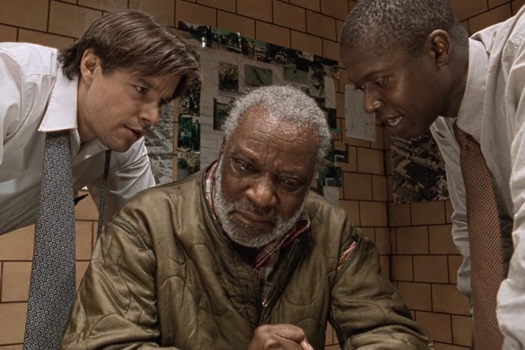
Retro Television Review: Homicide: Life On The Street 3.3 “Extreme Unction”


Welcome to Retro Television Reviews, a feature where we review some of our favorite and least favorite shows of the past!  On Sundays, I will be reviewing Homicide: Life On The Street, which aired from 1993 to 1999, on NBC!  It  can be viewed on Peacock.
This week, the White Glove Killer is discovered.

Episode 3.3 “Extreme Unction”

(Dir by Keith Gordon, originally aired on October 28th, 1994)

For all the hours that Pembleton and the other detectives put in and for all the motives that were considered and the suspects were interviewed, the murderer of Katherine Goodrich and two other women is captured not through deductive brilliance but because she herself enters the police station.

When Pamela Wilgis (Lucinda Jenney) first enters the station, she claims to have just witnessed two men dumping the third victim.  Pembleton is dismissive of her until she mentions the white gloves, a detail that has not been released to the public.  While Pembleton talks to her, the other detectives check out Pamela’s apartment and discover 12 sets of white cotton gloves hanging in her bathroom.  Pamela is the murderer.

When Pembleton asks Pamela about the gloves, Pamela suddenly starts speaking in an Irish accent.  Later, she starts speaking like an angry and rebellious child.  Later still, she reverts to being a wide-eyed innocent who says she had no idea how she ended up in the interrogation room.  Pembleton is convinced that she’s faking her alternate personalities but, despite his best efforts, he can never get her to actually confess that she committed the murders.

From the start, Homicide has emphasizes the role of luck in solving murders.  The majority of the show’s murders are solved precisely because someone thought they could outsmart the police or because they made a very obvious error.  For all of Pembleton’s strengths in the Box, his interrogation technique works best when he’s dealing with someone who doesn’t understand how the system works.  Pamela, on the other hand, obviously understands what he’s trying to do.  She knows the system and she knows how to game it.  Pamela does eventually confess but not Pembleton.  Instead, she does an interview with the obnoxious reported played by Tony Todd, blaming her crimes on the abuse she suffered as a child and her dissociative disorder.  Pembleton’s pride is hurt but he also finds himself struggling with his faith.  How can Pamela, after killing three saintly women, now avoid paying for her crimes?  Even with the thrilling interrogation scene between Pembleton and Pamela and the excellent performances of Andre Braugher and Lucinda Jenney, it’s all feels a bit anticlimactic.  But it also feels appropriate for the world in which Homicide takes place.

This episode also wrapped up a few other plotlines.  Munch, Bayliss, and Lewis finally own their bar.  Good for them.  I’m not really a bar person or a drinker but I probably would have enjoyed visiting the Waterfront whenever Munch was working the bar.  Even more importantly, Felton returned to his mentally unstable wife.  And again, that’s a good thing if just because I was getting sick of listening to Felton whine about his marriage.  So was Kay.

This episode was effective enough.  The scenes between Andre Braugher and Lucinda Jenney alone made the episode memorable.  At the same time, as I watched, it occurred to me that, if this episode had aired during the first season, the White Glove Murders probably never would have been solved.  If Adena Watson had died during the third season, one can be sure Bayliss would have gotten a confession out Risley Tucker.

Next week, we find out why Detective Crosetti has yet to return from Atlantic City.

Retro Television Review: Homicide: Life on the Street 3.2 “Fits Like A Glove”


Welcome to Retro Television Reviews, a feature where we review some of our favorite and least favorite shows of the past!  On Sundays, I will be reviewing Homicide: Life On The Street, which aired from 1993 to 1999, on NBC!  It  can be viewed on Peacock.

This week, the investigation into the Catherine Goodrich murder continues.

Episode 3.2 “Fits Like A Glove”

(Dir by Ted Demme, originally aired on October 21st, 1994)

Last week’s episode ended with Bayliss and Pembleton discovering that a supply shed had been broken into near the Goodrich scene.  This episode opens with Bayliss and Pembleton talking to the groundskeeper, who explains that he came across the shed earlier.  He reported that the shed had been broken into to the primary on the case, Detective Gaffney.  Gaffney never bothered to follow-up and the shed has since been cleaned up.

That’s it for Gaffney!  Lt. Russert calls him into the office and tells him he’s no longer heading up the investigation.  She tells him to take a few days off and then to transfer to another department.  She promises him a “fair recommendation.”  Gaffney replies that Russert only get her job because of her sex.  He goes as far as to compare her to a statue of a woman on a boat, except she’s not a mermaid.  “You’ve got legs,” he says.  It’s an odd bit of dialogue and I kind of wish that Gaffney had delivered it Al Pacino style.  “You’ve …. GOT …. LEGGGGGS!”

Pembleton is now the primary and not a moment too soon because another murdered woman has been found, again left in a dumpster outside a Catholic church and only wearing long white gloves.  Pembleton theorizes that the killer hates Catholics.  (So …. Matin Luther, maybe?)  Pembleton continues the investigation but clues are hard to come by and smarmy reporter Matt Rhoades (Tony Todd) keeps threatening to reveal that the killer puts gloves on the victims.  At one point, a murder memorabilia collector (Hugh Hodgin) shows up and claims that the murders are connected to a nationwide crime spree.  The collector turns out to be a flake, exactly the type of person who Russert believes would be driven to give false evidence if the news about the gloves got out.

Meanwhile, Kay finds herself being used as a messenger service by both Beau and his estranged wife.  Beau’s wife, Beth (Mary B. Ward), wants to surprise Beau with a romantic dinner so she asks Kay to tell Beau that Beth wants him to come by and see the kids.  Beau tells Kay to tell Beth that their son needs to tighten the laces on his baseball glove.  (Poor Kay!) Beau goes to the house to see the kids, just to discover that Beth lied and sent them away so she could make Beau dinner.  Beau gets mad and leaves.  Mary feeds Beau’s dinner to the dog.

Bayliss, Munch, and Lewis put in for a liquor license for the bar.  Lewis interrogates Munch as to whether or not he was ever arrested in the 60s but — surprise! — Bayliss is the one with the criminal record, an arrest and conviction for misdemeanor gambling while Bayliss was in college.  Bayliss, you never cease to surprise me!

This episode was a bit frustrating because Pembleton doesn’t seem to be any closer to solving the murders.  As well, Felton’s domestic drama would be a bit more compelling if Felton himself was a more likable character.  But, I still liked this episode.  The season 3 ensemble is amazing and just the pleasure of watching actors like Andre Braugher, Melissa Leo, Yaphet Kotto, Ned Beatty, Clark Johnson, Kyle Secor, and yes, even Daniel Baldwin all on the same show is more than enough of a reason to watch.  Everyone was at the top of their game in this episode.

Will Pembleton catch the killer next week?  I have faith and, judging by the way Pembleton crossed himself when looking at the second victim, so does he.

Retro Television Review: Homicide: Life On The Street 1.9 “Smoke Gets In Your Eyes”


Welcome to Retro Television Reviews, a feature where we review some of our favorite and least favorite shows of the past!  On Sundays, I will be reviewing Homicide: Life On The Street, which aired from 1993 to 1999, on NBC!  It  can be viewed on Peacock.

This week, season one comes to a close.

Episode 1.9 “Smoke Gets In Your Eyes”

(Dir by Wayne Ewing, originally aired on March 24th, 1993)

It’s another day in Baltimore.

While the rain falls and the cold wind blows, Detectives Howard and Felton investigate another murder and, for once, it’s Detective Howard who is getting distracted and irritable.  Felton lights a cigarette.  The witnesses all light cigarettes.  The uniformed cops light cigarettes.  The medical examiner looks over a body and lights a cigarette.  Howard bites into a celery stick.  To his horror, Felton realizes that Howard is trying to quite smoking and, therefore, she is going to be Hell to work with until she eventually gives up.  Howard swears that she’s not going to give up,  She’s dating State’s Attorney Ed Danvers and he’s not a huge fan of smoking.  Howard later assures Pembleton that sex with Danvers is so mind-blowing that it’s worth giving up cigarettes.

Bayliss is trying to give up cigarettes as well.  He’s doing it for his health.  (Sorry, Danvers!)  His attempt to go smoke-free lasts for a day or two.  He gives in while on a stake-out with Howard, Pembleton, and Felton.  Bayliss is so desperate to bum a cigarette that detectives nearly miss capturing their suspect.

Meanwhile, Lt. Giardello is shocked to discover that the upper flood of the building, the floor right above his department, has been closed for asbestos removal.  No one bothered to tell the detectives that they were working in a toxic environment.  Actually, with all the cigarette smoke, I doubt they would have noticed.  As always, Yaphet Kotto’s performance was one of the highlights of this episode.  Both his outrage over the asbestos and his joy about having found something to hold over the head of Captain Barnfather were wonderful to watch.

Finally, Munch and Bolander investigate the death of a 14 year-old boy who was beaten to death as a part of a gang initiation.  Fortunately, the members of the gang are not very smart.  One suspect confesses all that he knows after Munch and Bolander hook him up to what they claim is an atomic-powered lie detector that causes sterility.  (It’s actually the xerox machine.)  The head of the gang turns out to be a snot-nosed, middle class kid who says that the murder was an act of kindness.  A disgusted Bolander ends the episode, sitting in a bar and talking about how American society destroyed Elvis.  The bartender is played by a bemused John Waters.

This episode was originally meant to be the final episode of season one.  NBC, not wanting to end the first season on such a downbeat note, instead decided that Night of the Dead Living should be the finale, despite the fact that moving the episodes around caused all sorts of continuity problems.  For the purpose of the site, I’m reviewing the episodes in the order that they were meant to be shown.  So, for us, this is indeed the season finale.

And what a dark way to end the season!  But it also feels like the right way to end season one.  In its first season, Homicide was not an optimistic series.  The murder of Adena Watson went unsolved.  Bolander is alone and still pining for his ex-wife.  No matter how many murders are solved, there’s always another one right around the corner.  The first season of Homicide would have been downright depressing if not for the sense of humor of the detectives.  It was gallows humor, of course.  But it was very much needed.

Season one featured some great episodes (Three Men and Adena, the pilot, Night of the Dead Living) but it faltered towards the end.  Bolander’s relationship with Carol was never as interesting as the show’s writers seemed to think and the whole plotline with Chris Thormann getting shot went for an at least one episode more than necessary.  But still, the first season was challenging and frequently compelling.  It was also very low-rated.  Homicide came close to being canceled after the first 9 episodes.  When it did return for a second season, it was only given four episodes in which to prove itself.

We’ll start looking at those four episodes next week.

Retro Television Review: Homicide: Life On The Street 1.6 “Three Men And Adena”


Welcome to Retro Television Reviews, a feature where we review some of our favorite and least favorite shows of the past!  On Sundays, I will be reviewing Homicide: Life On The Street, which aired from 1993 to 1999, on NBC!  It  can be viewed on Peacock.

This week, we finally meet the arraber.

Episode 1.6 “Three Men and Adena”

(Dir by Martin Campbell, originally aired on March 3rd, 1995)

This week’s episode opens with Tim Bayliss and Frank Pembleton preparing to interrogate Risley Tucker (Moses Gunn).  Tucker is the arraber who Bayliss believes is responsible for murdering Adena Watson.  Adena used to work for Tucker, helping him take care of his horse before her mother told Adena that she didn’t want her spending so much time with Tucker.  As Tucker himself puts it, people tend to view arrabers (men who sell fruits and vegetables from a horse-drawn carriage) as being nomads.  As Tucker himself is a recovering alcoholic who was previously charged with (but not convicted of) statutory rape, it’s understandable why Adena’s mother didn’t want her spending time alone with him.  It’s also easy to understand why Bayliss is convinced that Tucker is guilty.  Pembleton, meanwhile,  is not as convinced.

Bayliss and Pembleton have already brought Tucker down to the station three times and interrogated him.  Giardello also points out that Tucker has been interviewed a total of 10 times about the case and, if he’s not charged after his latest interrogation, he’ll have grounds for a harassment suit.  Bayliss and Pembleton have fourteen hours to interrogate Tucker one final time and try to get a confession out of him.  After fourteen hours, they have to either arrest Tucker or send him home.  Giardello says that regardless of what happens, Bayliss has to go back into the regular rotation after this interrogation.  Bayliss’s time of exclusively investigating the Watson case is coming to an end.

Tucker arrives at the station and Bayliss and Pembleton get to work, trying to manipulate him into slipping up and confessing.

Considering how much they initially disliked each other, it’s interesting to watch how smoothly Bayliss and Pembleton work together in this episode.  Bayliss takes on the role of the “bad cop,” flat out accusing Tucker of killing Adena and shoving what little evidence they have in Tucker’s face.  At first, Pembleton plays the “good cop,” asking Tucker about what it’s like to be an arraber before moving on to discussing Tucker’s alcoholism.  Tucker says that he hasn’t had a drink in sixteen months.  Even when Pembleton asks if it’s possible that he slipped up and had a drink and blacked out on the night that Adena died, Tucker insists that he hasn’t touched a drop in sixteen months.

Bayliss and Pembleton work well together but Tucker remains adamant that he did not kill Adena.  Even when Bayliss threatens to press Tucker’s face against a hot pipe, Tucker swears he didn’t kill Adena.  Even when Pembleton gets Tucker to admit that he had feelings for Adena, Tucker says he didn’t kill Adena.  Tucker defiantly demands to take a polygraph and he passes it.  Bayliss, knowing that polygraphs are inadmissible in court and are hardly reliable arbiters of the truth, tells him that he failed.  At one point, the emotionally exhausted Tucker says that he’s not even sure if he’s innocent or not anymore.  That’s as close as Tucker comes to confessing.

As the interrogation wears on, Tucker starts to fight back and it’s somewhat jolting to realize that he’s been aware of how Bayliss and Pembleton have been manipulating him from the start.  He accuses Pembleton of thinking that he’s better than other black people.  He accuses Bayliss of having a dark side, pointing out that Bayliss was prepared to torture him to get a confession to a crime that Tucker insists he didn’t do.  It’s obvious that, in both cases, Tucker has correctly read both men.  Pembleton and Bayliss react by ganging up on Tucker, bombarding him with questions.  Tucker breaks down and starts to cry but, as time runs out, he continues to insist that he didn’t kill Adena Watson.

In the end, Tucker ends up sitting in the break room, watching television and waiting for someone to take him home.  Bayliss packs up all of the evidence in the Watson case, knowing that he failed to get the confession that he needed.  Despite not getting the confession, Bayliss has finally won Pembleton’s respect.  Pembleton tells Bayliss that he now believes Tucker is guilty.  Bayliss admits that he’s no longer as sure as he once was.

It says something about the strength of this episode that I’m not fully convinced of Tucker’s guilt as well.  When the episode started, I was sure that the arraber was guilty.  By the time it ended, my feelings were a bit more mixed.  For all of the emotional turmoil that Tucker went through over the course of the interrogation, he remained adamant that he didn’t kill Adena Watson.  Tucker confessed to being an alcoholic.  He confessed to having gotten into fights in the past.  He confessed to having pedophiliac feelings towards Adena.  But the only time he even slightley wavered in his claim that he didn’t kill Adena was when he was so exhausted that he barely knew what he was saying.  As well, the evidence against him was almost entirely circumstantial.  Evidence was found that Adena had been in Tucker’s barn but there was no way to prove that she was there the night she died.  Tucker’s barn did mysteriously burn down after Adena’s murder but there was no way to prove that Tucker burned it down to hide evidence.  I suspect Risley Tucker probably was guilty.  But if I was on a jury, I’d probably have to say that, without a confession, there was too much reasonable doubt.

By the end of the interrogation, all three men are exhausted.  The viewer is exhausted too!  This is an intense episode, one that plays out like a particularly kinetic, three-person play.  Kyle Secor and Andre Braugher continue to prove themselves to be a brilliant team but, in this episode, they’re equally matched by Moses Gunn, who keeps you guessing as far as Risley Tucker’s guilt or innocence is concerned.  Gunn, who died a few months after this episode aired, gives a performance that leaves you feeling as conflicted about Tucker as the two detectives.  If Tucker is guilty, then he’s a soulless monster who has gotten away with murder.  If Tucker is innocent, then we’ve just spent 50 minutes watching an elderly, recovering alcoholic go through a truly Hellish experience.  As the episode ends, the viewer is aware that all three of the men will be changed forever as a result of the 14 hours they spent in the box.

This was an outstanding episode, one that ended on a note of sadness.  Adena Watson’s killer will never be caught.  If Tucker did it, he got away with it.  If Tucker didn’t do it, Bayliss and Pembleton’s obsessive pursuit of him means that the real killer is probably already far away from Baltimore.  Not every case gets solved and not everyone gets justice.  To quote Casino’s Ace Rothstein, “And that’s that.”


Retro Television Review: Homicide: Life On The Street 1.5 “A Shot In The Dark”


Welcome to Retro Television Reviews, a feature where we review some of our favorite and least favorite shows of the past!  On Sundays, I will be reviewing Homicide: Life On The Street, which aired from 1993 to 1999, on NBC!  It  can be viewed on Peacock.

This week, the murders continue and two detectives continue to obsess.

Episode 1.5 “A Shot In The Dark”

(Dir by Bruce Paltrow, originally aired on February 24th, 1993)

As I watched this week’s episode of Homicide, it occurred to me that I really don’t care about Stanley Bolander’s relationship with Dr. Carol Blythe.

Seriously, I really did try to give this storyline a chance.  Bolander is played by the great character actor Ned Beatty.  Dr.  Blythe is played by Wendy Hughes.  Both Beatty and Hughes are no longer with us but they were both very good actors and I’m always in favor of giving good actors a plotline.  But, my God — Bolander is so whiny!  I mean, I get it.  He’s newly divorced and he’s unsure of himself and he’s a lot more comfortable investigating death than actually living life.  However, Dr. Blythe obviously likes him and Bolander had a fairly good date with her during the previous episode so why did he spend this episode afraid to talk to her on the phone?  During this episode, Bolander and Munch were investigating the murder of a drug dealer.  The only witness was a high-class prostitute who ended up hitting on Bolander, largely because she wanted him to buy her some food.  It was an interesting-enough case but instead of focusing on that, the whole thing was Munch telling Bolander to call Blythe and Bolander getting mad as a result.  It got old.

While Bolander whined about his relationship issues, Lewis and Crosetti continued to investigate the shooting of Officer Thormann.  Crosetti was convinced that Thormann had been shot by Alfred Smith (Mojo Gentry), largely because a man named Charles Flavin (Larry Hull) fingered Smith as being the shooter.  Lewis thought that Flavin was a more likely suspect, especially after Flavin failed a lie detector.  In the end, it was not superior police work that led to the arrest of Charles Flavin but instead his girlfriend telling Crosetti and Lewis that Flavin shot Thormann because he had a headache.  When confronted, Flavin immediately confessed and then started complaining about his migraine.

(As for Officer Thormann, he survives being shot in the head but he is now blind.)

Everyone is happy that Thormann’s shooter has been arrested but Crosetti finds himself wracked with guilt and self-doubt over the fact that he nearly arrested the wrong man.  In a wonderfully-acted moment, Crosetti tells Lewis that Giardello was right.  Crosetti was too close to Thormann to work the case.

Speaking of getting too involved in a case, Bayliss continues to obsess over the Adena Watson case.  After the incompetent Captain Barnfather (Clayton LeBouef) goes to a community meeting and reveals that a pipe was used to kill Adeena (and, in the process, ruins Bayliss’s plan to interrogate the man who he suspects is the murderer), Bayliss calls Barnfather and calls him a — cover your ears, if you’re young — “butthead.”  Barnfather is so offended that he comes to the station to demand that Bayliss be taken off the case.  Giardello tells Bayliss that he can either apologize or he can find another job.  Giardello also acknowledges that Barnfather’s an idiot and Bayliss has every reason to be upset.  Bayliss, who has a cold and is running a fever, apologizes and then tells Giardello that he’s willing to step down as primary and let Pembleton have the case.  Giardello, who really is the perfect boss, tells Bayliss to go home and get some sleep.

While Bayliss is losing his temper, Felton and Pembleton are investigating a man who lived in the neighborhood where Adeena’s body was found.  Felton’s theory is that the man killed Adeena and then kept her body in the trunk of his car before dumping her in the back yard where she was found.  The man’s car has subsequently been repossessed and Pembleton and Felton spend a night searching for the car on various impound lots.  When they finally find the car, they also find no evidence linking it to the Watson murder.  The focus of these scenes was less on the search for the car and more on listening to Pembleton and Felton bicker.  The two men sincerely dislike each other and Homicide deserves a lot of credit for acknowledging that working with someone is not the same thing as respecting them.  Pembleton views Felton as being a racist.  Felton views Pembleton as being a snob.  As they look for the car, they argue about everything, from the renaming of a street after Martin Luther King to Felton’s belief that Pembleton takes everything too personally.  Their argument is fascinating to listen to, largely because of the obvious disdain that each man has for the other.  Neither man is portrayed as having a monopoly on the truth.  Pembleton may be right about Felton’s prejudices but Felton is equally correct when he suggests that Pembleon is more concerned with showing up Bayliss than with investigating the case.  It’s the type of thing that you would never hear on television today.

In the end, the neighbor and his car prove to be a dead end.  But lab results come in that suggest that Bayliss’s suspicion that Adeena was killed by the local arabber may be correct.  While the rest of the squad celebrates the arrest of Charles Flavin, Pembleton and Bayliss prepare to bring in the arabber.

(According to Wikipedia, an arabber is a street vendor who sells fruits and vegetables from a horse-drawn cart.  Apparently, they’re a Northeastern thing and specifically a Baltimore thing.  Having grown up in the Southwest, I have to admit that I had never even heard the term before watching Homicide.)

All of the Bolander nonsense aside, this was a good episode that took a look at the mental strain involved in being a homicide detective.  Crosetti allowed himself to become so obsessed that he nearly arrested the wrong guy.  Bayliss allowed himself to become so obsessed that he nearly lost his job as a result.  Interestingly enough, Thormann’s shooter is captured because his girlfriend turned him in and not because of any superior policework.  Meanwhile, it’s easy to laugh at Pembleton and Felton spending an entire day chasing down a false lead but, in doing so, they eliminate the neighbor as a viable suspect and help to make the case against the arabber even stronger.  In the end, it’s a thankless job but this episode makes the viewer glad that someone’s doing it.

Next week, we finally meet the arabber!

Retro Television Review: Homicide: Life on Street 1.3 “Night of the Dead Living”


Welcome to Retro Television Reviews, a feature where we review some of our favorite and least favorite shows of the past!  On Sundays, I will be reviewing Homicide: Life On The Street, which aired from 1993 to 1999, on NBC!  It  can be viewed on Peacock.

This week, the Homicide Squad works the night shift on the hottest night of the year.

Episode 1.3 “Night of the Dead Living”

(Dir by Michael Lehmann, originally aired on March 31st, 1993)

On the hottest night of the year, Giardello’s homicide squad works the night shift.  Everyone comes in grumpy.  Munch has just broken up with his girlfriend.  Bolander is trying to work up the courage to call Dr. Blythe.  Bayliss is still obsessing on the Adeena Watson case and he and Pembleton are still trying to figure out how to work together.  Kay’s sister is having trouble at home.  Felton’s wife hates him.  Crosetti worries about his teenage daughter and her boyfriend.  Giardello tries to figure out why the air conditioner is only blowing out hot air on what Lewis claims is the hottest night in history.

Despite the heat and the statistics that show that most homicide occur at night, no calls come in.  Bayliss is convinced he’s cracked the Watson case when he discovers that the fingerprints on Adeena’s library book belongs to someone named James.   He sends Thorson out to arrest James.  James turns out to be a seventh grader who thinks he’s being arrested by not paying a library fine.  (James did check out the book, when he was in the fifth grade.)

A drunk man dressed as Santa Claus is brought in and later falls through the ceiling when he attempts to escape custody.  A baby is found in the station’s basement but it turns out to the cleaning lady’s baby.  She brings him to work with her to protect him from the rats that live in their apartment building.  Eventually, Bolander works up the courage to call Blythe and Bayliss and Pembleton figure out that Adeena’s body was found where it was because her killer brought the body down a fire escape.  At the end of the shift, Giardello assembles his detectives on the roof and joyfully sprays them with the water hose.

It’s an episode that feels like a play, taking place in one location and featuring a lot of monologuing.  Each member of the squad gets a their chance in the spotlight, with the episode revealing that every one of them is a bit more complex than they initially seem.  Even Munch, the misanthrope, is shown to light a candle in memory of “all those who have been killed.”  It’s one of those episodes that makes you understand why Homicide is considered to be classic while also showing you why it struggled in the ratings.  In this episode, Homicide revealed itself to be not a cop show but instead a show about people who happened to be cops.  Most shows about detectives end with an arrest.  This episode ends with Giardello showing his love for the people who work for him.  After spending an hour with everyone sweating and complaining, it’s nice to see them happy on the roof of the station house.  Yaphet Kotto’s joy in the final scene is a wonder to behold.  And yet, it’s easy to imagine how confused audiences, whose expectations had been set by more traditional crime show, would have been.

This episode was meant to be the third episode of the series.  NBC decided that it worked better as the finale of the first season and instead made it the ninth episode.  Peacock has this episode placed where it originally belonged and, with this review, that’s what I’m going with as well.


Retro Television Review: Homicide: Life on the Street 1.1 “Gone For Goode”


Welcome to Retro Television Reviews, a feature where we review some of our favorite and least favorite shows of the past!  On Sundays, I will be reviewing Homicide: Life On The Street, which aired from 1993 to 1999, on NBC!  It  can be viewed on Peacock.

Today, I take a look at the pilot for a show that has been called one of the best of all time.

Episode 1.1 “Gone For Goode”

(Directed by Barry Levinson, originally aired on January 31st, 1993)

The opening credits for the first episode of Homicide: Life on the Street immediately announce that the show is not going to be a typical network cop show.  The music starts out as moody and low-key before eventually being dominated by a pulsating beat.  The images of dirty streets and crumbling rowhouses and of a dog running around behind a fence are all in black-and-white.  The faces of the cast appear, the majority of them in harsh close-up.  When viewed today, most of the faces are familiar.  Daniel Baldwin, Ned Beatty, Andre Braugher, Clark Johnson, Yaphet Kotto, Melissa Leo, Jon Polito, and Kyle Secor all flash by and the thing that the viewer will immediately notice is that it’s almost as if they’ve been filmed to remove any hint of glamour or attractiveness.  (Out of that impressive cast, only Baldwin, Johnson, Leo, and Secor are still with us.)

Gone for Goode tells several stories, introducing the detectives as they investigate various murders in Baltimore.  Meldrick Lewis (Clark Johnson) and Steve Crosetti (Jon Polito) are first seen searching for a bullet in a dark alleyway and arguing in only the way that two people who have worked with each other for a long time can argue.  Lewis continually refers to Crosetti as a “salami-head,” and Crosetti, who claims that he’s being kept up at night by his doubts about whether or not John Wilkes Booth was actually Lincoln’s assassin, repeatedly says that Lewis will regret that.  Later, Crosetti writes a complaint about the ethnic insults that he’s been forced to listen to but apparently, he never actually sends it.

When not arguing with each other, Crosetti and Lewis investigate “Aunt Calpurnia,” who has buried five husbands and whose niece has nearly been murdered three times.  Aunt Calpurnia has life insurance policies out on everyone.  While digging up Calpurnia’s former husband, Lewis comments that the body in the grave doesn’t look as large as the man in the picture that he’s been given.  The cemetery’s caretaker replies, “Nobody stays fat down there.”  Technically, that’s true but it also turns out that the wrong man was buried in the grave and the caretaker has no idea where anyone is actually buried.

Detective Felton (Daniel Baldwin) and Detective Howard (Melissa Leo) investigate the murder of a man who was found decaying in a basement.  Howard is the primary detective on the case because Felton, being a screw-up, has too many unsolved cases under his name on the dry-erase board that dominates the squad room.  Howard currently has a streak of solved homicides and that continues for her when the murderer just happens to call the crime scene and then agrees to come in for a talk.

Detective Stanley Bolander (Ned Beatty) guilts Detective John Munch (Richard Belzer, who would play the same character years later on Law & Order: SVU) into investigating a hit-and-run that happened months ago.  Munch, who earlier tells a suspect that he is not Montel Williams (“So don’t like to me like I’m Montel Williams”) and leaves both Bolander and the suspect confused as to who Montel Williams is, eventually discovers that the murder was committed by a brain-dread idiot who can only repeat, “I was drinking,” when he’s confronted with his guilt.

Finally, Lt. Al Giardello (Yaphet Kotto) assigns Felton to work with Frank Pembleton (Andre Braugher), a brilliant but arrogant detective who insists on working alone.  Pembleton and Felton’s partnership begins with Pembleton spending an hour in the station’s garage, searching for his squad car because Pembleton forgot to write down the parking space on the back of his keys.  (Of course the garage is full of identical white cars.)  When Felton says suggests just going upstairs and getting a new set of keys, Pembleton shouts that the next car he tries to unlock could be the right car.

Needless to say, the Pembleton/Felton partnership does not last and Pembleton instead ends up working with an eager newcomer to the squad, Tim Bayliss (Kyle Secor).  They two of them work surprisingly well together until Bayliss objects to Pembleton “fooling” a suspect into waving his right to an attorney.

As the episode comes to a close, Bayliss answers his first call in the squad room.  At the crime scene, in the middle of a torrential storm, he discovers the body of a small girl.

I have to say that the idea of trying to review Homicide: Life on The Street is a bit intimidating, just because the show has got an almost legendary reputation.  It’s often described as being the best cop show of the 90s, as well as being held up as a perfect example of a show that was too good to last.  It was never a hit in the ratings and came close to being canceled several times.  Because it was filmed in Baltimore, it was viewed as being an outsider amongst the New York and Hollywood-produced shows that dominated the airwaves.  Executive produced by Barry Levinson (who also directed Gone for Goode) and based on a non-fiction book by David Simon, Homicide is the show that is often cited as the precursor for The Wire, another show that was loved by the critics but not by its network or the Emmy voters.

The pilot is intriguing, largely because it seems determined to scare off its audience.  Unlike other television  detectives, who are inevitably portrayed as being crusaders who are obsessed with justice, the detectives in Homicide are a blue collar bunch who, for the most part, are just doing their job.  Sure, someone like Frank Pembleton might be brilliant.  And Stanley Bolander might truly mean it when he tells Munch that “we speak for the dead.”  And Bayliss does seem to be very enthusiastic about being a “thinking” policeman.  But the show suggests that most detectives are like Felton, Lewis, and Much.  They’re not particularly brilliant and their approach to the job can sometimes seem callous.  But occasionally, they get lucky and a murder is solved.  Indeed, if there is any real message to the pilot, it’s that criminals are stupid.  They get caught not because of brilliant police work but because they do stupid things, like calling the crime scene or failing to ditch the car that they sole.

That said, the pilot also does what a pilot is supposed to do.  It introduces the characters and gives them just enough space to make an impression, along with also leaving enough room for them to grow.  The characters may not all be instantly likeable but, fortunately, the strong cast holds your interest.  The pilot is very much a product of the 90s, with Munch ranting about Montel Williams and Crosetti mentioning Madonna at one point.  But, at the same time, it still feels relevant today.  Pop culture might change but murder remains the same.