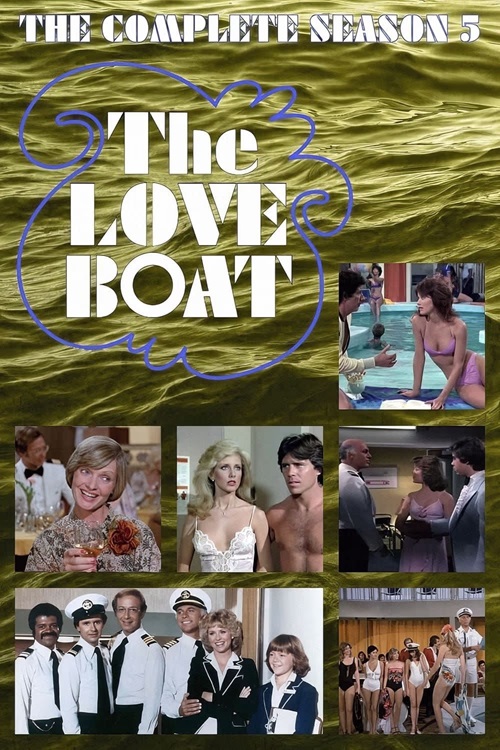
Retro Television Review: The Love Boat 5.19 “New York, A.C./Live It Up/All’s Fair in Love and War”


Welcome to Retro Television Reviews, a feature where we review some of our favorite and least favorite shows of the past!  On Wednesdays, I will be reviewing the original Love Boat, which aired on ABC from 1977 to 1986!  The series can be streamed on Paramount Plus!
Come aboard, we’re expecting you!

Episode 5.19 “New York, A.C./Live It Up/All’s Fair in Love and War”

(Dir by Richard Kinon, originally aired on February 20th, 1982)

Poor Captain Stubing!  He’s just returned from burying an old friend named George and now, he’s thinking about his own mortality.  When he starts to feel unwell, Stubing goes to Dr. Bricker who tells Stubing that his problems are not physical.  The problem is that …. STUBING’S DEPRESSED!  Stubing decides to live each day to the fullest and good for him.  This was a simple storyline but I liked it.  I always appreciate the episodes that allow Stubing to be vulnerable without turning him into a hard-luck doofus.  In this episode, Stubing was dealing with something that almost everyone has either had to or will deal with at some point in their life.  It was also nice to see Doc Bricker giving good advice for once.  Bernie Kopell is so likable in the role that I always appreciate it when he gets to play Doc as being something other than a lech.

As for the other two stories …. agck!

Three New York friends (played by former teen idols Eddie Byrnes, Fabian, and Bobby Sherman) have boarded the cruise.  They are members of the Alimony Club.  They’re all divorced and they’ve all sworn that they’ll keep each other from marrying again.  They are a club that believes all marriages are doomed to failure.  But when Sherman’s ex-wife, Annette Funicello, boards the boat, it looks like the Alimony Club might lose a member.  And listen, I know that guys have their little rituals and their little clubs and that’s okay.  But the Alimony Club just feels weird.  It should be called the Misery Club because they seem to be more interested in keeping Bobby Sherman depressed than anything else.  I always find it odd when previously divorced couples get back together on The Love Boat.  I mean, did they forget why they got divorced in the first place?

Meanwhile, Jill St. John and Ron Ely have been having an affair for four years.  Every 12 months, they get together for a romantic getaway.  Ron says he can’t marry Jill because he’s married and has children back home.  (*cough* jerk *cough*)  Jill, who really could do better, insists that Ron leave his wife.  She even has her brother board the cruise and flirt with her (*cough*  Oh my Gosh, creepy! *cough*) to make Ron jealous.  Ron gets jealous, alright.  He beats up Jill’s brother and then reveals that he was lying about having a wife.  He’s not married …. he’s scared of commitment!  And now he’s ready to get married!  Uhmmm …. like seriously, WHAT THE HECK IS THAT!?  (I gave up cursing for Lent.)  Jill — you were a BOND GIRL!  You were TIFFANY FREAKING CASE!  YOU CAN DO BETTER!

Oy vey, this episode.
A Blast From The Past: Dragnet 1970 4.22 “D.H.Q.: Night School” (dir by Jack Webb)


Dragnet began as a radio program in 1949 before making it’s way over to television in 1951. Each episode starred (and the majority were directed by) Jack Webb, who played a no-nonsense cop named Joe Friday. Friday narrated every episode, dropping trivia about the history of Los Angeles while also showing viewers how the cops went about catching criminals. Despite what is commonly believed, Joe Friday never said, “Just the facts, ma’m,” but he did investigate each case with the cool determination of a professional who kept his emotions under control. The majority of Dragnet’s episodes were based on actual cases that were worked by the LAPD, hence the opening declaration of, “The story you are about to see is true.”

On television, Dragnet originally ran from 1951 to 1959, during which time Dragnet also became the first television series to be adapted into a feature film. Jack Webb decided to relaunch Dragnet in 1966 and he produced a made-for-television movie that followed Friday and his latest partner, the far more talkative Bill Gannon (Harry Morgan), as they worked multiple cases over the course of one long weekend.  That made-for-television movie led to a series that ran from 1967 to 1970.

The second television series is the best-remembered version of Dragnet, beloved for its scenes of Friday and Gannon debating the issues with a motely collection of hippies, campus radicals, and pipe-smoking academics.  Jack Webb viewed Friday as being the voice of the common American, who supported the troops, supported the president, and who wanted to spend the weekend grilling in peace.  Friday was the middle-aged suburbanite who wanted to the kids to stay off the grass, whether it was on his front lawn or being sold on a college campus.  These episodes were often campy.  It’s hard not to smile while listening to Friday and Gannon deadpan their way through conversations with flakey long-haired hippies.  It was often obvious that the writers of Dragnet had never actually had any experiences with the hippies, beyond what they saw on the evening news.  And yet, as silly as things often were, the show is an interesting time capsule of the era in which it was made.  If nothing else, it’s a chance to see the turbulent 60s through the eyes of the other side.

Last year, I shared my favorite episode of Dragnet.  For the new year, I’m sharing my second favorite, an episode that originally aired on March 19th, 1970.  In Night School, Joe Friday is attending a night class where he and his classmates sit in a circle and just “rap” about the issues of the day.  No one knows that Joe is a cop but Joe feels that he is still on duty and when he sees that the guy sitting across from him has a baggie of weed in his notebook, Friday makes an arrest.  The professor, who says “There’s nothing wrong with marijuana, I smoke it myself!,” attempts to kick Sgt. Friday out of his class.  “Would you rather be known as good ol’ friendly Joe, the class narc?” the professor asks.  Joe fights for his right to get an education and a man with an eyepatch emerges as an unlikely voice of reason.

Why do I like this episode?  There’s something undeniably entertaining about seeing straight-laced, deadpan Joe Friday attending a class with at least three hippies.  It always amuses me that, on this show, Joe Friday loosening up just means that Joe trades his suit for a sweater.  Also entertaining is Leonard Stone’s over-the-top performance as the villainous professor.  And how can you not smile at Bill Gannon’s weary claim of “I just knew there was no way you could get a B sitting around talking?”  Or Jack Webb’s delivery of the line, “That’s my thing, keeping the faith, baby?”  Or Jack Curtiss’s hyperactive performance as campus drug pusher Jerry Morgan?  “Hey, that’s just oregano!”  Whatever you say, Jerry.

Today’s blast from the past certainly does feel like a trip in a time machine.  Step on in and take a look at California in 1970!

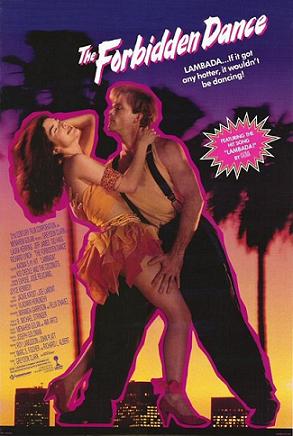
Embracing the Melodrama Part II #84: The Forbidden Dance (dir by Greydon Clark)


Forbidden_danceDANCE!

I love to dance, I loved to teach others how to dance, and I love watching other people dance.  If you’ve been reading my reviews for a while, then you know that I can not resist a film that features a lot of dancing.  It doesn’t matter if the director is inept.  It doesn’t matter if the script makes no sense.  It doesn’t matter if the actors don’t have a bit of acting talent to use to their advantage.  As long as the film features a lot of dancing, I’m happy.

Seriously, people, when in doubt … DANCE!

Let’s take the 1990 film The Forbidden Dance, for instance.  Now, if I wanted to be nit-picky, I could probably find a lot to criticize about this film.  I mean, this film even has a pro-environmental message and you know how annoyed I can get with message films.  And you know what?  You can do a google search and you can find all sorts of insanely negative reviews of this film.

But you know what?

I don’t really care about any of that.  This is, at heart, a dance film.  It features almost non-stop dancing, so I really can’t be too critical of it.  Add to that, it also features memorable performances from Sid Haig and the late Richard Lynch.  Unfortunately, neither Haig nor Lynch get out on the dance floor because, if they had, The Forbidden Dance would have been legendary.

The Forbidden Dance begins in the Brazilian rain forest.  A tribe of Native Brazilians is happily dancing and basically not bothering anyone.  As we learn later on in the film, the dance that they are doing is called the Lambada and apparently, the Brazilian government tried to ban it “because it was too sexy.”

(Amazingly enough and according to Wikipedia, the Lambada apparently was an actual dance craze back in 1990.  The Forbidden Dance came out on the exact same weekend as a competing film about the Lambada.  That film was called, appropriately enough, Lambada.  Strangely enough, two years ago, I randomly reviewed that film for this very site.)

Anyway, all the dancing and the fun is interrupted by the arrival of Benjamin Maxwell (Richard Lynch), a mercenary who works for a Big Evil Corporation.  Maxwell tells the tribe that they might want to stop dancing and leave because the rain forest is going to be destroyed.

Naturally enough, the tribe’s king responds to this by sending his daughter, Nisa (Laura Harring), to America.  Accompanying Nisa is Joa (Sid Haig), a witch doctor.  However, Nisa and Joa’s attempts to invade the headquarters of Big Evil Corporation results in Joa being arrested.

(Incidentally, you might recognize Laura Harring from David Lynch’s Mulholland Drive, where she played a similarly mysterious character who was lost and hunted in Los Angeles.)

Left to fend for herself, Nisa gets a job working as a maid for a wealthy family.  And while neither Mr. nor Mrs. Anderson has much interest in the backstory of the help, their son Jason (Jeff James) is a different story.  As Jason’s mother complains, Jason doesn’t have much interest in anything other than dancing.  And, when Jason spots Nisa dancing in her bedroom, he becomes intrigued with her.  Ignoring the snobbish reactions of his wealthy friends, Jason asks Nisa to teach him the Lambada!

And hey!  Guess what!  There’s going to be a dance contest and it’s going to be televised!  What better way to get a platform to protest the destruction of the Brazilian Rain Forest then by winning the contest?  Standing in the way of this plan: Benjamin Maxwell (who, in one icky scene, demands that Nisa dance for him), Jason’s parents and friends, and the fact that, through a complicated series of events, Nisa ends up being forced to dance in the sleaziest club in Los Angeles.

So, look — there’s all sorts of things that I could say about The Forbidden Dance but it features a lot of dancing so I’m inclined to be generous towards the film, especially since Laura Harring and Jeff James both know how to move and look really good dancing together.  I mean, the word Dance is right there in the title. The film promises dancing and it delivers.  Plus, it also delivers Sid Haig and Richard Lynch at their demented best.

So, why complain when you can … DANCE!?