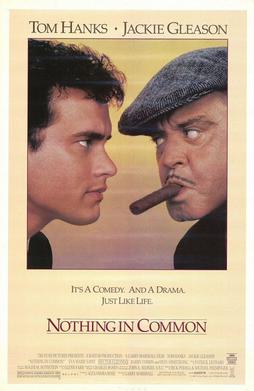
Nothing In Common (1986, directed by Garry Marshall)


Tom Hanks plays David Basner (Tom Hanks), an advertising executive whose immature lifestyle gives him insight into what sells but has also left him totally unprepared to deal with the fallout when his mother (Eva Marie Saint) leaves his father, Max (Jackie Gleason).  David, who is struggling to come up with the perfect commercial for a demanding client (Hector Elizondo), has to come to terms with both his father’s bad health and his history of infidelity.

This isn’t my favorite Tom Hanks movie.  It comes from that awkward period when Hanks was trying to make the transition from comedy to drama and its attempt to mix the two genres is not always successful.  The scenes of Hanks at the ad agency are often so cartoonish that they don’t seem like they belong in a movie where Jackie Gleason loses a foot to diabetes and realizes that he spent his entire marriage emotionally abusing his wife.  The movie, though, is worth watching for the teaming of Hanks and Gleason, two comedic actors who eventually proved themselves to equally as skilled at playing it serious.  Gleason, especially, gives a strong performance.  This was his final film and Garry Marshall convinced him to take it by asking, “Do you really want to go out on Smokey and the Bandit 3?”  Gleason would die a little over a year after the release of Nothing In Common and this film, even if it wasn’t perfect, gave the world a chance to see what a good actor he really was.

This film is often cited as the the movie that started Hanks on the way to becoming a dramatic actor.  Like Punchline, Nothing In Common played a role in Hanks becoming more than just a comedian but  I think Big was ultimately the better showcase for Hanks’s ability to mix pathos with laughs.  Nothing In Common was directed by Garry Marshall and, as was usually the case with Marshall, he often doesn’t trust the audience to figure things out for themselves.  He goes overboard trying to force an emotional response instead of just trusting the material.  Tom Hanks still does a good enough job in Nothing In Common.  Hanks is as likable as always and you can see the dramatic actor emerging in Hanks’s performance even if Hanks still wasn’t totally comfortable with it.

Nothing In Common is flawed but it was definitely a better swan song for Jackie Gleason than Smokey and the Bandit 3.
The TSL’s Grindhouse: Steele Justice (dir by Robert Boris)


“You don’t recruit him!  You unleash him!”

That’s what they say about John Steele, the man who Martin Kove plays in 1987’s Steele Justice.  John Steele served in Vietnam and he was one of the best and most fearless members of the special forces.  On the final day of the war, he was on the verge of arresting the corrupt General Kwan (Soon-Tek Oh) until Kwan suddenly announced that the war was over and the Americans were leaving.  Steele laughed, shrugged, and turned his back on Kwan and started to walk away.  Was Steele planning on just walking back to America?  Well, regardless, Kwan shot Steele and his friend in the back.  Fortunately, Steele survived.  Steele may be stupid but he’s strong.

Years later, both Steele and Kwan are now living in California.  Kwan is a prominent businessman who is also the secret leader of the Vietnamese mafia.  Naturally, his main henchman is played by Al Leong.  If Al Leong’s not working for you, are you even evil?  John Steele has not been quite as successful.  He was a cop until he got kicked off the force.  Then he got a job transporting horses across California.  Despite his cool guy name, John Steele doesn’t seem to be that good at anything that doesn’t involve killing people.

But then Kwan murders Steele’s best friend and former partner, Lee (Robert Kim).  In fact, Kawn not only murders Lee but he also kills Lee’s entire family.  The only survivor is Lee’s daughter, Cami (Jan Gan Boyd), a piano prodigy who is supposed to be 14 years old even though she’s being played by someone who is in her 20s.  Steele and Lee’s former boss, Bennett (Ronny Cox), gives Steele permission to track down the people responsible for Lee’s death.

John Steele sets out to destroy Kwan.  The film gives us a lot of reasons to be on Steele’s side but it’s hard not to notice that a lot of innocent people end up getting killed as a result of Steele’s vendetta.  Any time that Steele goes anywhere, Kwan’s people attack and a bunch of innocent bystanders get caught in the crossfire.  For example, Steele’s ex, Tracy (Sela Ward), agrees to look after Cami.  It turns out that Tracy is a music video director and, of course, she takes Cami to work with her.  The video shoot turns into a bloodbath, with even the members of the band getting gunned down.  And yet, not even Tracy seems to be particularly disturbed by that.  One might think that Tracy would at least sarcastically say something like, “Hey, John, thanks for getting the band killed before I got paid,” but no.  Tracy just kind of laughs it all off.  At no point does Steele or Bennett or really anyone seem to feel bad about all of the people who get killed as a result of the decision to unleash John Steele.  Those people had hopes and dreams too, you know.

I really like Martin Kove on Cobra Kai.  I love how his portrayal of the over-the-hill and burned-out John Kreese manages to be both intimidating and pathetic at the same time.  I’ve also seen a number of interviews with Kove, in which he’s discussed his career as an exploitation mainstay and he always comes across as being well-spoken and intelligent.  That said, Martin Kove appears to be totally lost in Steele Justice, unsure if he should be playing John Steele as a grim-faced avenger or as a quick-with-a-quip action hero.  Whenever Steele is angry, Kove looks like he’s on the verge of tears.  Whenever Steele makes a joke, Kove smiles like an overage frat boy who, while cleaning out his old storage unit, has just discovered his long lost copy of Bumfights.  It’s a confused performance but, to be honest, no one really comes out of Steele Justice looking good.  This is a film that features a lot of talented actors looking completely and totally clueless as to why they’re there.

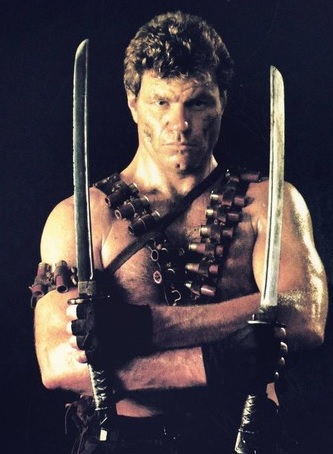
On the plus side, Steele Justice did give this world this totally intimidating shot of Martin Kove, preparing to be get and give justice.  Recruit him?  No, just unleash him!

The King of Love (1987, directed by Anthony Wilkinson)


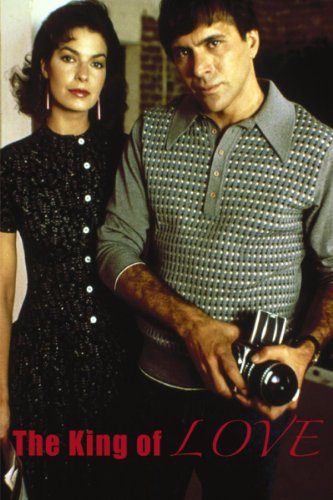
From the depths of the 80s comes this soapy film about a publisher played by Nick Mancuso whose father issues fuel not only his rise but also his fall.  When the movie starts, Mancuso is dying because he’s been shot by an unknown assassin but he still needs someone to give him some answers before he can give up the mortal coil.  Much like Dutch Schultz deliriously babbling about his dog Biscuit after getting fatally wounded, Mancuso spends his last minutes flashing back to how he became America’s most controversial magazine publisher.

In a ruthless and methodical fashion, Mancuso rose up the ranks from being just a lowly photographer to being the publisher of Love, a magazine that may remind you of Playboy and Penthouse but which is definitely not either one because it’s called Love.  Because sex and nudity sells, Love grows to be a billion dollar empire but, along the way, Mancuso uses and alienates everyone who gets close to him.  With his outspoken views on politics and his advocacy for free love and personal freedom, he also become the number one enemy of anti-pornography crusaders everywhere.  Only his partners, Nat (Michael Lerner) and Annie (Sela Ward), are willing to stay with him, mostly because they’re both in love with him.

Mancuso is obsessed with running a rival publisher out of business.  Jack Kraft (Rip Torn) is just a ruthless as Mancuso and he also might be his father.  In fact, everything that Mancuso does is because he wants to get revenge on Jack for not being there for him as he was growing up, even though he doesn’t have any definite proof that Jack is actually his father and Jack refuses to say whether he is or isn’t.  As Mancuso lies on his death bed, Jack stops in for one last visit.  Mancuso finally asks Jack flat-out if he’s his father.  “I don’t know,” Jack answers, as the film draws to a close.  I know that’s a big spoiler but it probably does not matter because this film has never been released on video and it probably never will be.  My mom has a copy on VHS tape, which she recorded when it originally aired in 1987.  It even has the original commercials.  It’s possible my mom may have the only copy of this film in existence, I don’t know.

The King of Love‘s attempt to be daring and racy is sabotaged by its origin as a made-for-TV movie from the 80s.  There may be a lot of talk about sex but you’re not going to see or hear anything that could have gotten ABC fined by the FCC.  What’s most interesting about The King of Love is the way that the film combines the personas of the three most famous adult magazine publishes.  Mancuso dresses like Bob Guccione, spouts Hugh Hefner’s philosophy, and ultimately suffers Larry Flynt’s fate.  Otherwise, the movie’s not very interesting at all but it is also ways enjoyable to watch Rip Torn play an arrogant bad guy and Michael Lerner manages to overcome a bad script and give an effective performance as Mancuso’s conflicted second-in-command.

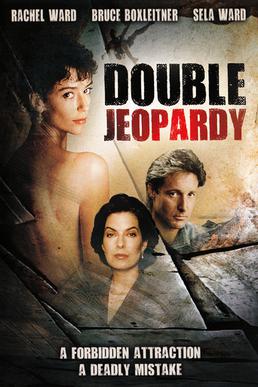
Double Jeopardy (1992, directed by Lawrence Schiller)


Salt Lake City is riveted by the sensational murder trial of mountain climber Lisa Burns Donnelly (Rachel Ward).  Lisa killed her ex-boyfriend, Eddie.  She says that she did it in self-defense after Eddie raped her.  The prosecution claims that she murdered Eddie after he caught her cheating on him with another man.  Lisa’s lawyer, Karen Hart (Sela Ward), is up for a judgeship.  Her husband, Jack (Bruce Boxleitner) is Lisa’s ex-boyfriend.  What Karen doesn’t know is that, other than Lisa, Jack is the only person who witnessed what happened the night of the murder because, just moments before, he and Lisa had been committing PG-13-rated adultery in her shower.

One of the interesting things — in fact, maybe the only interesting thing — about Double Jeopardy is that several online sellers claim that the film stars Aaron Eckhart.  It is true that Eckhart is in the movie.  It was shot in Salt Lake City while he was a student at BYU and it was his film debut.  However, Eckhart has about a minute of screen time and about five lines.  He plays a Marine named Dwayne who someone meets in an airport.  His big line is, “Semper Fi, babe!”

As for the film, since it’s set in Salt Lake City, there’s a lot of talk about how Lisa is being unfairly judged for her unconventional (read: non-Mormon) life style and there’s a heavy-handed subplot about Jack trying to put on a production of The Crucible but it doesn’t add up too much.  It would probably have been easier for the movie to make a point about religious and moral persecution if Lisa wasn’t actually guilty of murdering Eddie.  Instead, the movie leaves you thinking, “Maybe those Mormons have a point.”

Double Jeopardy tries hard to be something more than your standard legal thriller but it’s pretty forgettable.  Rachel Ward was always a great femme fatale and Sally Kirkland gives a good performance as the cop who sees through both Lisa and Jack.  The film was produced for Showtime at a time when cable was still trying to prove that it could provide original content worth paying for so there’s some cursing and sideboob tossed in, as if to say, “See?  You don’t get this on NBC!”  Otherwise, this is a by-the-numbers made-for-TV movie.

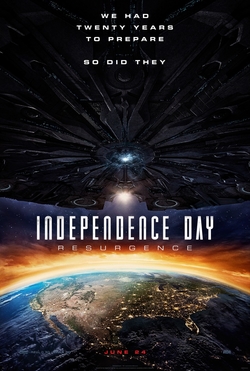
A Quickie With Lisa Marie: Independence Day: Resurgence (dir by Roland Emmerich)


Independence-Day-2-poster

Oh, who cares?

Sorry, I know that’s like an ultra unprofessional way to open a review but Independence Day: Resurgence is one of the least inspiring films that I’ve ever seen.  Jeff and I saw it the day that it opened and, at the time, I was planning on reviewing it the next day.  But when I sat down to actually write about the movie … well, I discovered that I could hardly care less.  This is one of those films that I could have easily waited until December to review.  However, seeing as today is Independence Day, this seemed to be the right time to say something about it.

Memorable movies inspire.  Good movies inspire love.  Bad movies inspire hate.  A movie like Independence Day: Resurgence inspires apathy.

Actually, what’s really frustrating about Independence Day: Resurgence is that it starts out with such promise.  The first few scenes suggest that maybe the film is trying to be something more than just another “let’s blow shit up while stars get quippy” action film.  Independence Day: Resurgence imagines an alternative history for post-alien invasion Earth and it’s actually pretty clever.  Earthlings have taken advantage of the alien technology but society has also become heavily militaristic.  The main characters of the first film are all revered as heroes but, when we first meet former President Whitmore (Bill Pullman, with a wise old man beard), he’s having nightmares about the invasion.

And seriously, for the first 30 minutes or so, I really thought that Independence Day: Resurgence might turn out to be surprisingly clever, that maybe it would satirize the excesses of the original while subtly critiquing everything that’s fucked up about our real world.

Well, that was a mistake on my part.  There is no satire.  There is no critique.  Instead, it’s just another alien invasion film and it’s all terribly predictable.  It may be a sequel to the first Independence Day but it feels more like a rip-off of Battle: Los Angeles.  Considering what the film could have been, it’s impossible not to be disappointed by how familiar and uninspired it all is.

What I failed to take into account is that this film was directed by Roland Emmerich.  Emmerich is a director who is best distinguished by his total lack of self-awareness.  After all, this is the director who, in Anonymous, seriously suggested that William Shakespeare personally murdered Christopher Marlowe.  Watching Independence Day: Resurgence and listening to the generic dialogue and witnessing the generic mayhem, I started to get the sinking feeling that the film was a joke and that  Emmerich was the only person on the planet who was not in on it.  He doesn’t realize how predictable his movies are or that his characters are cardboard cut-outs or that the film’s inspiring moments are so overdone that they instead become groan-inducing.  One of the stars of the first film sacrifices himself in Resurgence and you know who it’s going to be from the minute he shows up onscreen.  Emmerich is not a good enough director to make his sacrifice touching.  The fact that the film ends with the promise of a sequel is not surprising and yet, it still somehow manages to be annoyingly presumptive.  The film’s ending seems to be taunting us.  “Of course, you’re going to want to sit through this shit for a third time…what other choice do you have?”

In the film’s defense, the cast is big and it includes a lot of good actors.  Unfortunately, the characters are so undeveloped that you again find yourself regretting what a waste it all is.  Jeff Goldblum and Judd Hirsch are both likable but Bill Pullman seems to be incredibly bored with the whole thing.  Liam Hemsworth, Jessie Usher, and Maika Monroe are all stuck playing typical Emmerich ciphers.

I should mention that, despite how negative this review may sound, I did not hate Independence Day: Resurgence, at least not in the way that I’ve hated other films, like Anonymous or the remake of Straw Dogs.  My problem with Resurgence isn’t that I hated it or even that I disliked it.  It’s that I didn’t feel much about it, one way or the other.  It’s one of those film that is best described as “just kinda being there.”  Apathy is the worst thing that a film can inspire.

Perhaps the best thing about Independence Day: Resurgence is that Roland Emmerich has protected the holiday from being co-opted by Garry Marshall.

Here’s the Trailer for Robotec…I mean Independence Day: Resurgence


Independence Day Resurgence

For decades fans of Robotech (Macross everywhere else in the world) have been hoping for a live-action film adaptation of this very iconic anime series from Japan. Many Westerners had their first introduction to anime after watching the localized version of the original Japanese series Macross. There have been some traction to get the live-action film up and running but rarely past pre-production stage.

With special effects advancing to the point that we can almost recreate dead people back to life via digital trickery, entire worlds astronomers could only dream of and fantastical lands and creatures it’s high time we got a live-action Robotech film. We fans deserve such a gift.

For now, let’s settle for Independence Day: Resurgence which seems to lift certain elements from the anime series spoken of above to make up the plot of the sequel to 1996’s blockbuster hit, Independence Day.

Independence Day: Resurgence is set for a June 24, 2016 release date.

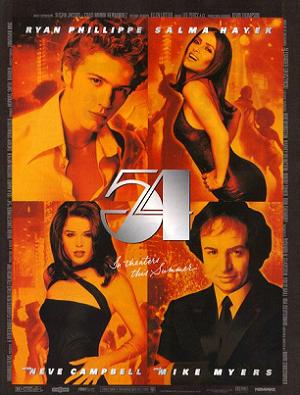
Embracing the Melodrama Part II #95: 54 (dir by Mark Christopher)


54_poster

“A guy named Steve Rubell had a dream: To throw the best damned party the world had ever seen and to make it last forever. He built a world where fantasy was put up as reality and where an 80-year-old disco queen could dance till dawn. Where models mingled with mechanics, plumbers danced with princes. It was a place where all labels were left behind. A place where there were no rules.”

— Shane O’Shea (Ryan Phillippe) in 54 (1998)

So, did you actually read that quote at the beginning of the review?  I don’t blame if you didn’t because not only is it ludicrous overwritten but it just goes on and on.  It’s one of those quotes that you read in a script and you think to yourself, “They better get absolutely the best actor in the world to deliver these lines,” and then you realize Ryan Phillippe has been cast in the role.

Except, of course, I doubt that any of those lines were found in the original script for 54.  54 is one of those films where, as you watch it, you can literally imagine the chaos that must have been going on during the editing process.  Subplots are raised and then dropped and the mysteriously pop up again.  Characters change both their personalities and their motives in between scenes.  Huge dramatic moment happen almost at random but don’t seem to actually have anything to do with anything else happening in the film.

In short, 54 is a mess but it’s a mess that’s held together by incredibly clunky narration.  Shane O’Shea, who spent the waning days of the 1970s working at Studio 54, narrates the film.  And, despite the fact that Shane is presented as being kinda dumb (think of Saturday Night Fever‘s Tony Manero, without the sexy dance moves), his narration is extremely verbose and reflective. It’s almost as if the narration was written at the last-minute by someone desperately trying to save a collapsing film.

I watched 54 on cable because I saw that it was about the 70s and I figured it would feature a lot of outrageous costumes, danceable music, and cocaine-fueled melodrama.  And it turns out that I was right about the cocaine-fueled melodrama but still, 54 is no Boogie Nights.  It’s not even Bright Lights, Big City.

54 does have an interesting cast, which makes it all the more unfortunate that nobody really gets to do anything interesting.  Poor Ryan Phillippe looks totally lost and, in the film’s worst scene, he actually has to stand in the middle of a dance floor and, after the death of elderly Disco Dottie (that’s the character’s name!), yell at all the decadent club goers.  Breckin Meyer is cute as Phillippe’s co-worker and Salma Hayek gets to sing.  Neve Campbell plays a soap opera actress who Phillippe has a crush on and…oh, who cares?  Seriously, writing about this film is almost as annoying as watching it.

Mike Myers — yes, that Mike Myers — plays the owner of the club, Steve Rubell.  The role means that Myers gets to snort cocaine, hit on Breckin Meyer, and vomit on the silk sheets of his bed.  I think that Myers gives a good performance but I’m not really sure.  It could have just been the shock of seeing Mike Myers snorting cocaine, hitting on Breckin Meyer, and vomiting on the silk sheets of his bed.

If you want to enjoy some 70s decadence, avoid 54 and rewatch either Boogie Nights or American Hustle.

Gone Girl – The 2nd Trailer


The 2nd trailer for Gone Girl was released recently. David Fincher’s and Gillian Flynn’s film adaptation of Flynn’s popular novel focuses on a writer dealing with the disappearance of his wife. While the trailer expands things a bit compared to the teaser (as any trailer would), there’s the strangest set of casting choices for this film. What I’m most excited about is Flynn handling her own screenplay. Movies are always different from books, but I’m hoping it works out. One fills in the blanks as they go through the story, and I read this before finding out anything concrete about the film. Additionally, I’m also curious about what Trent Reznor  and Atticus Ross are doing for the soundtrack, which also comes out around the same time.

Gone Girl premieres in cinemas on October 3rd.

http://www.youtube.com/watch?v=iLPdwyJLWJE