On Monday night, Dancing With The Stars did a horror night, in which “the stars” did dances that were inspired by horror films. One of the first to perform was a professional wrestler who is apparently known as The Miz. When the Miz performed, he was dressed in black and he had several fake pins attached to his face.
After he danced, host Trya Banks asked The Miz what scared him. Obviously seeing a chance to suck up to the judges and the audience, the Miz grandly announced, “This! Doing this every week terrifies me! Dressing up like Hellraiser and dancing terrifies me….”
Uhmmm, excuse me, Mr. Miz — the character’s name is Pinhead. The movie is called Hellraiser. You were dressed up as Pinhead.
Seriously, I felt that the Miz should have been eliminated from the competition at that exact moment but no. His sucking up worked. Everyone laughed. Everyone applauded. No one called him out on his error. It upset me a bit. I was like, “Who are you to do horror night when you don’t even know the difference between the movie and the character!?”
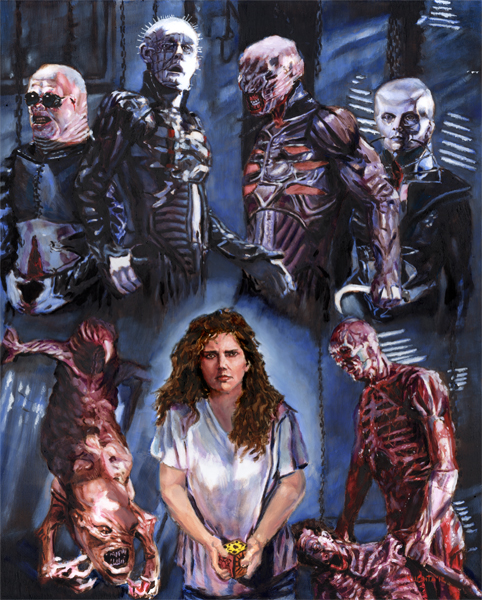
Really, they should all be forced to watch or rewatch Hellraiser. First released in 1987, the directorial debut of Clive Barker holds up pretty well as a blood-filled horror movie. It tells the story of Larry (Andrew Robinson), his daughter Kristy (Ashley Laurence), and his second wife, Julia (Clare Higgins). Larry’s ne’er-do-well brother, Frank (Sean Chapman), has died under mysterious circumstances so Larry moves into Frank’s old house and tries to renovate it. He hopes that this will somehow help his strained marriage to Julia, who was having an affair with Frank. Why Larry thinks this is a good idea is never quite clear. Larry seems to be a nice guy but it doesn’t take long for the audience to get the feeling that he might not be that smart.
Kristy, on the other hand, is much smarter than her father and she knows better than to trust Julia. In fact, Kristy refuses to even live in the same house as Julia. Still, Kristy does check in on her father occasionally and she quickly realizes that Julia is doing something strange. It turns out that Frank may be dead but his tortured, skinless spirit lives on. Julia has been picking men up in bars and bringing them back to the house so that Frank can steal their skin. On the one hand, you do have to feel kind of sorry for all of the people who die. On the other hand, Frank does look better with skin.
Frank ended up in his skinless state because he foolishly opened up a puzzle box. That’s where Pinhead (played by Doug Bradley) comes into the equation. Pinhead and the other Cenobites live in another demension and they’ve spent so much time “exploring” that they can no longer tell the difference between pain and pleasure. Pinhead’s face is covered in pins. (In fact, Pinhead started out as something of a fan nickname as Bradley is just credited with playing “the Lead Cenobite” in the film’s end credits.) The Cenobites are actually only in Hellraiser for a few minutes. The majority of the film is made up of Julia bringing strange men home and Frank attacking them. But it’s the Cenobites — and Pinhead in particular — who make the biggest impression. Beyond his bizarre appearance, Doug Bradley plays the character with such haughty arrogance that it’s hard not to be intrigued. He knows things.
Hellraiser holds up well. Andrew Robinson does his best but Larry is a bit of a moron. However, Clare Higgins has fun with her femme fatale role while Ashley Laurence is likable and sympathetic as Kristy. For the most part, the special effects hold up well and even the film’s slightly more cartoonish moments add to the feeling that the film takes place in a universe that is becoming increasingly unstable. The puzzle box is wonderful creation. It’s easy to say that you would never mess with something like that but most people would. The temptation would just be too great.
Watch Hellraiser and never get Pinhead’s name wrong again!
 While at a boxing match, an aging gangster (Malcolm McDowell) learns that his former mentor and eventual rival, Freddy Mays (David Thewlis), is about to be released from prison. The gangster flashes back to wh
 Through the Shattered Lens