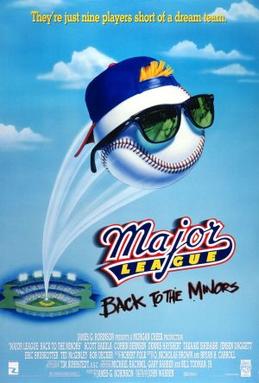
Roger Dorn (Corbin Bernsen), the former third baseman for the Cleveland Indians, is the new owner of the Minnesota Twins. There’s a hotshot hitter playing for the Buzz, the Twins’s Minor League affiliate. Downtown Anderson (Walton Goggin) can hit the ball over the fences but he still needs to learn about teamwork before he’ll be ready to move up to the majors. Roger recruits an old friend, an aging pitcher named Gus Cantrell (Scott Bakula), to manage the Buzz and mentor Downtown. Under Gus’s leadership, the Buzz starts winning games. Even some former Indians, like Pedro Cerrano (Dennis Haysbert) and Taka Tanaka (Takaaki Ishibashi), are recruited to play for the Buzz. When the manager of the Twins, Leonard Huff (Ted McGinley), insults Gus and the Buzz over dinner, Gus challenges the Twins to an exhibition game, the minors against the majors. Huff accepts the challenge.
I had always heard that Major League: Back To The Minors was the worst of three Major League films but I liked it. It wasn’t as good as the first one but it wasn’t as boring as the second one. A lot of it has to do with the cast, who give it their all. Walton Goggins is great as the cocky Downtown Anderson but really, all of the actors playing entire team did a good job. They’re all misfits, of course. I especially liked Doc (Peter Mackenzie), a medical student-turned-pitcher who has the slowest fastball in the game. This movie had a little of the warmth and insider humor that made the first Major League film so special. It’s an underdog story, with the minor league players proving that they’re just as good as the spoiled players in the big leagues.
I didn’t find the idea of an exhibition game between the Twins and the Buzz to be believable. In the movie, they actually play two games against each other and they both take place during the regular season. When did they find the time to play each other? I guess they gave up one of their travel days but it still doesn’t seem like something that would happen.
I enjoyed this movie more than I thought I would. It helped that I love baseball. And I love the minor leagues, even if they don’t get the same respect as the majors. Some of the best baseball I’ve ever seen has been in minor league games. They may not have the huge contracts but they’ve got the talent, they’ve got something to prove, and they’ve got the love of the game.
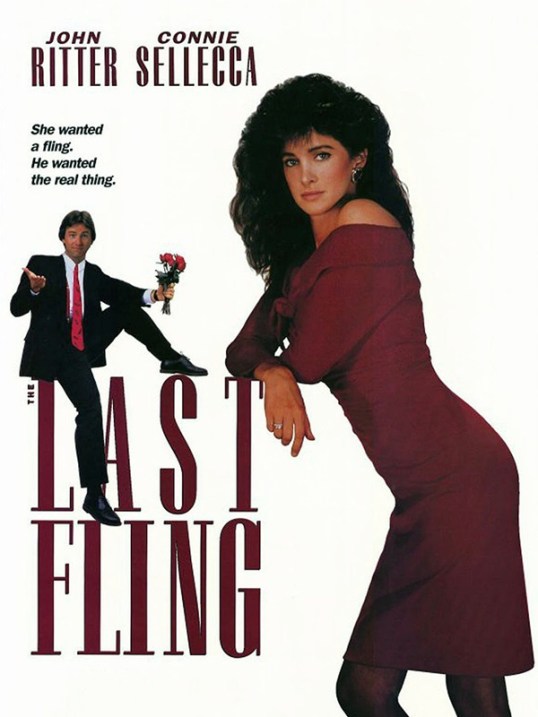
Welcome to Retro Television Reviews, a feature where we review some of our favorite and least favorite shows of the past! On Sundays, I will be reviewing the made-for-television movies that used to be a primetime mainstay. Today’s film is 1987’s The Last Fling! It can be viewed on YouTube and Tubi.
Phillip Reed (John Ritter) is an attorney who has never gotten married, despite all of his friends trying to set him up with single women. Even his law partner (Scott Bakula) worries about how Phillip’s love life is going. Phillip’s married best friends (Paul Sand and Kate Zentall) think that Phillip is scared of commitment. Phillip’s mother (Paddi Edwards) thinks he’s gay. Joanne Preston (Shannon Tweed) enjoys sleeping with him but she owns a lot of cats that make him sneeze. And since he’s played by John Ritter, you better believe that every sneeze is more dramatic than the last.
Gloria Franklin (Connie Selleca) is engaged to marry Jason Elliot (John Bennett Perry) but she worries that her rigidly controlled lifestyle has caused her to miss out on enjoying her time as a single person. When she finds out that Jason is going to go to Las Vegas for a wild bachelor party, she decides to have one last fling of her own.
Phillip and Gloria meet each other at the zoo. (Again, because Phillip is played by John Ritter, there are multiple shots of him making monkey noises while looking at the gorillas.) Gloria tells Phillip that her name is Marsha Lyons. Their meeting leads to Phillip and Gloria/Marsha spending the weekend in Mexico together. (A very young, pre-Saved By The Bell Mario Lopez shows up as the kid who gives them their renal car.) Despite an unseen mishap that causes their car to catch on fire, Phillip and Gloria spend a romantic night at a villa. When Phillip wakes up the next morning, he’s convinced that he’s finally found the woman with whom he wants to spend the rest of his life. However, Gloria is already gone. She leaves behind a video confession, in which she tells Phillip that she’s going to be getting married.
Phillip returns to Los Angeles, determined to track down the mysterious Gloria and stop that wedding.
The Last Fling is an uneven romantic comedy. It starts out as an amiable and sweetly funny film, with both Connie Sellecca and John Ritter giving likable performances. But once Phillip returns from Mexico and starts searching for Gloria, it gets a bit too manic for its own good. Instead of being a funny movie about two human beings looking for love, it instead becomes a live-action cartoon with John Ritter running from one location to another while being chased by Gloria’s husband-to-be. The movie ends up getting so frantic that it actually becomes a bit annoying, which is a shame considering how things started. By the end of the movie, Phillip is so obsessive that it’s hard not to feel that Gloria would be better off just staying single and maybe spending the next weekend in Mexico with Scott Bakula.
The director of The Last Fling played Buzz in Rebel Without A Cause. Fortunately, no one plays chicken in this movie.
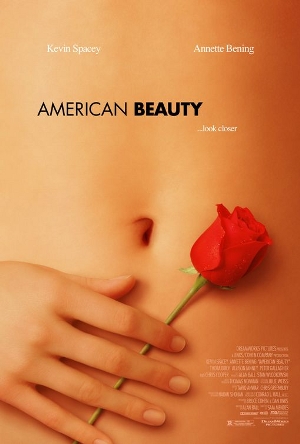
I know, I know. “American Beauty is an incisive satire that looks at the stifling conformity of American suburbia with Kevin Spacey giving the definitive portrait of the male midlife crisis and blah blah blah blah blah blah.” Listen, American Beauty is a terrible film. I don’t care if it won a lot of Oscars, including the 1999 award for best picture. American Beauty is a shallow film that, at its worst, is deeply misogynistic.
American Beauty tells the story of two people. They’re married. They live in the suburbs. They have a teenage daughter who is a cheerleader. They pretend to have the perfect life but actually, everyone’s extremely unhappy.
WOW! OH MY GOD! PEOPLE ARE SECRETLY UNHAPPY IN THE SUBURBS!? MY MIND IS BLOWN! WOW, NO ONE’S EVER HAD THAT THOUGHT BEFORE! OH. MY. GOD!
Anyway, the husband is named Lester (Kevin Spacey). Lester’s a loser. He narrates the film and he’s played by Kevin Spacey so you’re supposed to think that he’s really this great guy who deserves better but honestly, Lester’s a whiny little jerk. He’s upset because, now that he’s an adult, he misses being a teenager. Life hasn’t turned out the way that he wanted it to. Boo hoo. As I said, Lester is kind of whiny but the film treats him like he’s an enlightened truth seeker. In order to keep the audience from realizing that Lester is a loser, the film surrounds him with one-dimensional stereotypes.
And really, Lester is the ultimate male fantasy. Everything that he says and thinks is wise. His every thought and feeling matters. To its discredit, the world has failed to recognize that Lester’s vapid thoughts are worthwhile. Lester quits his job and finds employment working in fast food. Lester fantasizes about fucking his daughter’s best friend (Mena Suvari). Lester starts to smoke weed with his teenage neighbor (Wes Bentley). In real life, Lester would just be another pathetic guy having a midlife crisis but, in the world of American Beauty, he’s a seeker of truth,
Anyway, eventually, Lester gets shot in the back of the head and dies but that doesn’t keep him from still narrating the film. You just can’t shut him up.
Meanwhile, Lester’s wife is Carolyn (Annette Bening) and wow, is she evil! Get this — she actually tries to keep the house clean, is obsessive about her job, and wants her family to eat dinner together. Oh my God, so evil! She ends up having an affair with Buddy Kane (Peter Gallagher) and, when they have sex, we’re supposed to laugh at them because they’re so cartoonishly loud. And when Lester catches them, the audience is expected to applaud and say, “Way to go, Lester!” The film ridicules Carolyn’s affair but it idealizes Lester’s sexual fantasies. Lester’s determination to be independent and do what he wants is presented as being heroic. Carolyn’s determination to have a life that does not revolve around her pathetic husband is presented as being villainous.
And why is that?
Basically, it comes down to the fact that Lester has a penis whereas Carolyn has a vagina.
American Beauty is probably one of the most misogynistic films that I have ever seen, one in which men are exclusively victims of all those unreasonable and untrustworthy women. Whiny loser Lester is presented as being a hero. Ricky, the next door neighbor played by Wes Bentley, spends his time going on and on about the beauty of an empty bag and we’re supposed to see some sort of higher truth in his pretentious blathering. Meanwhile, Carolyn is portrayed as being a shrew. Lester’s teenager daughter (Thora Birch) is a spoiled brat. Lester’s sexual obsession, the cheerleader played by Mena Suvari, is presented as being a suburban seductress but, in the film’s eyes, she’s partially redeemed when she suddenly admits to being a virgin.
(The film seems to think that the revelation that teenagers lie about sex is truly shocking. This is one of those films that makes you wonder if the filmmakers have ever hung out with anyone outside of their own small circle of friends.)
One huge subplot deals with Ricky’s father, a military guy played by Chris Cooper, mistakenly believing that Lester is gay. And, honestly, American Beauty would have been a better film if Lester had been a gay man and if, instead of buying a new car and getting a crappy job, Lester had dealt with his identity crisis by coming out of the closet. Certainly, a lot of Lester’s anger would have made a lot more sense if he was a man struggling to come to terms with his sexuality as opposed to being a man who just doesn’t like his job and is upset that his wife no longer has the body of a 17 year-old.
(We are, of course, supposed to be shocked when Cooper suddenly reveals that he himself is gay. But, honestly, the film’s plans for Cooper are obvious from the minute he first appears on-screen and dramatically squints his eyes in disgust at the sight of two men jogging together. Cooper is a good actor but he’s terrible in American Beauty.)
It would have taken guts to make Lester gay and, at heart, American Beauty is a very cowardly film. It attacks easy targets and it resolutely refuses to play fair. So desperate is it to make Lester into a conventional hero that it refuses to let anyone around him be human. As a result, a talented cast is stuck playing a collection of one-note stereotypes. No wonder a lot of people love this film — it makes you feel smart without requiring that you actually think.
American Beauty was written by Alan Ball and directed by Sam Mendes. Both Ball and Mendes have subsequently done far better work, which is good because American Beauty is a terrible movie. The script is a pretentious mess and Mendes never seems to be quite sure what exactly he’s trying to say from scene-to-scene.
American Beauty did win best picture but who cares?
 Through the Shattered Lens