Today’s horror scene is a classic moment from today’s horror on the lens, 1959’s The House on Haunted Hill!
One of the joys of this film is definitely watching Vincent Price having a lot of fun with that skeleton.
Today’s horror scene is a classic moment from today’s horror on the lens, 1959’s The House on Haunted Hill!
One of the joys of this film is definitely watching Vincent Price having a lot of fun with that skeleton.
Today’s horror scene that I love comes from 1975’s Trilogy of Terror, directed by Dan Curtis and starring Karen Black.
In this scene, Karen Black discovers that the doll she recently purchased as a birthday gift has a mind of its own.
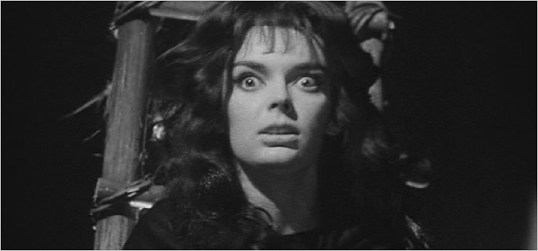
The British-born actress, Barbara Steele, became a star in Italy in the 60s, working with directors from Riccardo Freda to Mario Bava to Federico Fellini. One of Steele’s defining roles was in Bava’s 1960 film, Black Sunday.
In this scene, Steele’s witch is sentenced to be executed and, since this is a Bava film, it won’t be a quick execution. What makes this scene stand-out is Steele’s defiance. It’s hard not to admire her refusal to give those judging her what they want. You watch this scene and you have no doubt that if you get cursed by Barbara Steele, it’s going to be a curse for life.

A true scene stealer, the character actor Dick Miller was a Navy veteran who earned a Phd in psychology, even while he was already appearing on stage. His 1952 move from New York to California was originally so that he could pursue a career as a writer. Instead, he ended up becoming one of the most beloved members of Roger Corman’s stock company. (Famously, in 1952’s Apache Woman, he played both a Native American and the townsperson who shot him.) Many of the directors who started their careers under Roger Corman continued to cast Dick Miller in their own films, keeping Miller busy as a character actor. Miller worked with everyone from Martin Scorsese to Joe Dante to James Cameron to Steven Spielberg to Jim Wynorski. Miller often played characters named Walter Paisley, a reference to his first starring role in Corman’s A Bucket of Blood.
In this scene from 1981’s The Howling, Dick Miller lets two reporters know what’s truly going on with the werewolves.
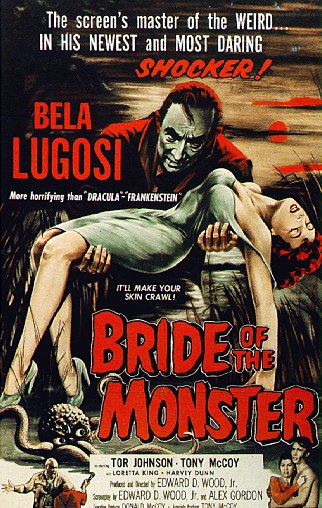
“Home? I have no home.”
So begins the monologue that serves as the centerpiece of the 1955 Ed Wood film, Bride of the Monster. The monologue is delivered by Bela Lugosi, appearing in one of his final roles.
Far too often, people tend to be snarky about the work that Lugosi did under the direction of Ed Wood. But you know what?
He actually delivers a pretty good performance in Bride of the Monster.
Ignore all of the stuff about atomic supermen and instead, just pay attention to the way Lugosi delivers the lines. Pay attention to the pain in his voice as he says that he has no home. Pay attention and you’ll discover that Lugosi actually gave a good performance in Bride of the Monster. He delivers the lines with such wounded pride that you can’t help but think that maybe we should let him create a race of atomic supermen.
Among the old horror icons, Lugosi has always been the most underrated actor. He got typecast early and he appeared in some unfortunate films but Bela Lugosi had real talent and you can see it in this scene.
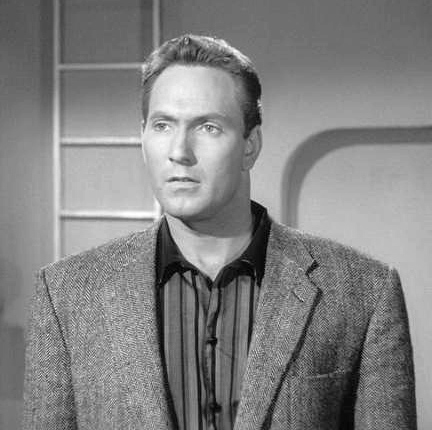
Gregory Walcott appeared in a lot of good films over the course of his long career. He had supporting roles in major blockbusters. He was a friend and frequent collaborator of Clint Eastwood’s. In 1979, he played the sheriff in the Oscar-nominated Norma Rae.
That said, he will probably always be most remembered for playing Jeff, the patriotic pilot, in Ed Wood’s 1957 masterpiece, Plan Nine From Outer Space. Walcott gave probably as good a performance as anyone could in Plan 9, though that didn’t prevent the film from wrong being declared one of the worst ever made. Walcott, for most of his career, was not a fan of Plan 9 but, in the years before he passed away in 2015, Walcott’s attitude towards the film mellowed considerably. He even appeared in Tim Burton’s Ed Wood.
In this scene from Plan 9, Walcott shows how to deal with a smug alien.
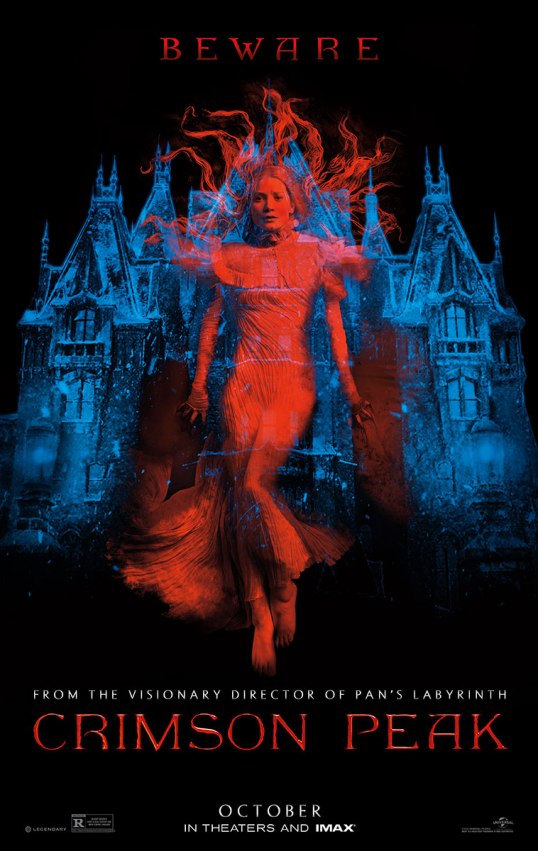
Since it’s Guillermo Del Toro’s birthday, it just seems appropriate that today’s horror scene that I love should be one of my favorite scenes from one of my favorite Del Toro movies.
Here’s the opening of 2015’s haunting (and, in my opinion, underrated) Crimson Peak!
Since today is Sigourney Weaver’s birthday, I think it’s probably a given that today’s scene of the day would feature her defeating an alien. In this scene from 1979’s Alien, Ripley shows why she is the last human survivor of the Nostromo.
(As cool as Ripley is, she’s still nowhere close to being as much of a badass as Jonesy the Cat. Jonesy just had to hiss and the alien knew better than to mess with the ship’s cat.)
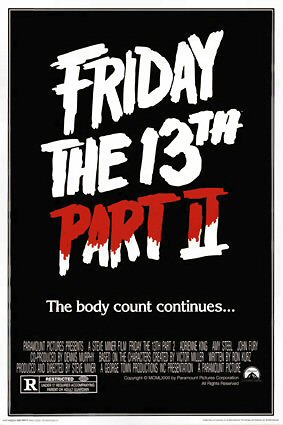
Today is a significant day for fans of Friday the 13th Part II. Today is the birthday of both Warrington Gillette and Tom McBride. Gillette was one of two actors to play Jason Voorhees in that film (he plays Jason without the mask while stuntman Steve Daskewisz played Jason whenever he was wearing a mask) and he is 65 years old today. Tom McBride, who passed away in 1995, played Mark, whose death was one of the films most shocking moments. Today, he would have been 72 years old.
Today’s scene that I love comes from Friday the 13th Part II, which I think is a genuinely underrated horror film. Whenever I see this scene, I roll my eyes at Vicki (Lauren-Marie Taylor) running outside in her underwear just to look for something in her car but then I remember all of the times that I’ve done the exact same thing and I realize that I probably wouldn’t survive a horror film.

I’ve always loved the interview with the chief of police in the original Night of the Living Dead. I love the delivery of that classic line. “….they’re all messed up.” Yes, they are. The chief doesn’t seem to be particularly perturbed by the fact that the dead are coming back to life. Instead, his attitude is very straight-forward. To quote Tommy Lee Jones in Rolling Thunder, “Let’s go clean ’em up.”
When we first see this interview, it’s easy to laugh at the sight of the chief’s posse and everyone’s odd confidence that the dead will somehow just go away. (Death, after all, is the one thing that is guaranteed to happen to everyone eventually.) Once you know how the story’s going to end, though, this scene becomes much more ominous.
 Through the Shattered Lens